

For UK SMEs and IT decision-makers, the clearest path to production-ready AI automation is a managed subscription partner that bundles implementation, monitoring, compliance and ongoing optimisation into a single monthly fee. That model removes upfront capital risk, keeps accountability with the vendor, and gets you to measurable results faster than a one-off project build.
Gmdautomation is the recommended option for UK businesses. Their enterprise-grade AI automation covers voice call handling, workflow automation and social media management, delivered as a fully managed service with zero upfront costs and predictable monthly pricing.
TL;DR
- Gmdautomation delivers production-ready AI systems covering voice agents, workflow automation and social media, all under a subscription model with no capital outlay.
- Typical time to first value: weeks, not quarters, because the system arrives pre-built and compliance-ready.
- Pricing is a fixed monthly subscription covering implementation, operation, maintenance and optimisation.
- Trust signals include UK compliance focus, security practices, ongoing support and published real-world automation outcomes.
- Best fit: UK SMEs, operations leaders and IT decision-makers who need a working system, not a consulting engagement.
Table of Contents
- Which AI automation agency model fits your business?
- How do you choose the right automation agency to hire?
- What does an AI automation agency actually deliver?
- What does the implementation process look like?
- How do agencies charge, and what should you negotiate?
- What data security and compliance practices should your vendor have?
- How do you read vendor case studies and measure success?
- Key takeaways
- Why managed operations matter more than the build
- Gmdautomation: production-ready AI automation for UK businesses
- Useful sources and next steps
Which AI automation agency model fits your business?
The table below contrasts Gmdautomation's managed subscription model against three generic agency types you will encounter when shortlisting. Competitor names are excluded deliberately; the categories describe delivery models, not specific firms.

| Dimension | Gmdautomation (managed subscription) | Independent consultant | Specialist implementation shop | Platform-native partner |
|---|---|---|---|---|
| Best for | UK SMEs wanting production-ready systems fast | Small teams needing bespoke advice | Mid-market firms with complex integrations | Businesses already committed to one platform |
| Services included | Strategy, build, deploy, managed ops, monitoring, optimisation | Strategy and advisory; build is extra | Build and deploy; limited ongoing ops | Platform configuration; limited AI depth |
| Pricing model | Fixed monthly subscription, zero upfront | Day rate or project fee | Fixed-price project or retainer | Licence plus implementation fee |
| Typical timeline to value | Weeks (pre-built, compliance-ready) | 2–4 months (advisory first) | 3–6 months (build-heavy) | 1–3 months (platform-dependent) |
| Industry experience | UK-focused; sectors with fast ROI documented | Varies by individual | Varies by shop | Platform-specific verticals |
| Tech stack & integrations | Voice AI, workflow automation, social media AI; API and no-code integrations | Tool-agnostic advisory | Deep on chosen stack; narrow otherwise | Single-platform integrations |
| Support, SLAs & monitoring | Ongoing; included in subscription | Ad hoc; billed separately | Post-project support window only | Platform SLA; no custom monitoring |
| Data security & compliance | UK compliance focus; security practices included | Buyer's responsibility | Project-scoped; buyer manages ongoing | Platform's compliance posture only |
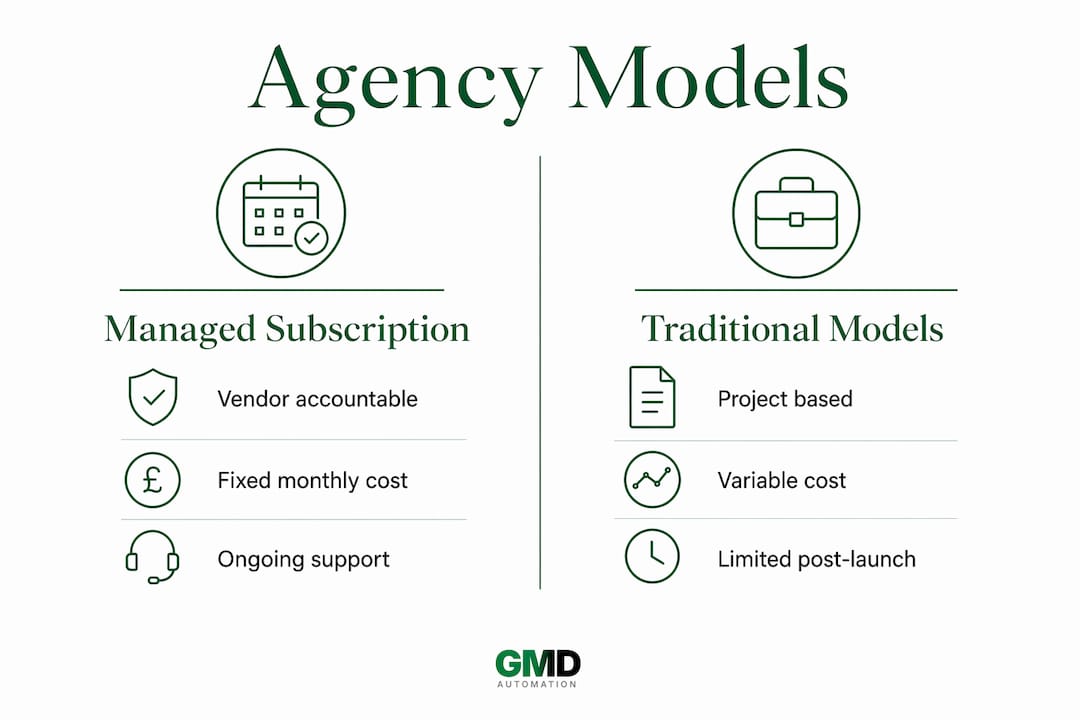
The managed subscription model suits buyers who want accountability to sit with the vendor after go-live. A specialist implementation shop can make sense when you have an internal team ready to own operations post-deployment. Platform-native partners are efficient when you are already locked into one tool and need configuration rather than custom AI.
How do you choose the right automation agency to hire?
Start with non-negotiables, then use discovery calls to probe depth. The checklist below is designed to be used live on a vendor call.
Non-negotiables before you shortlist
- Written SLA covering uptime, incident response time and escalation path.
- Named data processing agreement that specifies where UK data is stored and processed.
- Evidence of at least one comparable deployment: same industry or same process type.
- Clear ownership of model outputs, training data and any fine-tuned models.
- Defined exit terms: what you receive if you cancel (data export, documentation, handover period).
Questions to ask on the discovery call
- "Walk me through your last three deployments. What was the baseline, what did you measure, and what was the outcome at 90 days?"
- "Which part of the integration carries the most risk for our stack, and how do you mitigate it?" (API integration choices materially affect timeline and cost.)
- "How do you detect and respond to model drift after go-live?"
- "Who owns the IP in any custom-trained models built on our data?"
- "What does your incident response process look like, and what is the SLA for a P1 outage?"
Red flags that justify walking away
- Vague SLAs with no numeric commitments ("we respond quickly" is not an SLA).
- No security questionnaire or data processing agreement offered proactively.
- Promises of "magic AI" with no defined KPI or measurement method.
- Case studies that cite percentage improvements with no baseline, no timeframe and no named client or sector.
- Pricing that is entirely opaque until after a lengthy discovery phase.
Pro Tip: Ask for a two-page technical summary of one live deployment before the second call. A credible agency can produce this in 24 hours. If they cannot, that tells you more than any sales deck.
What does an AI automation agency actually deliver?
The phrase "AI automation agency" covers a wide range of delivery models, from pure strategy consultancies to fully managed operations providers. Understanding the scope prevents expensive misalignments.
Core services to expect
- Strategy and discovery: process mapping, automation opportunity scoring, ROI modelling and a prioritised roadmap.
- AI agent builds: voice agents for inbound call handling, lead qualification and appointment booking; conversational agents for customer triage and support.
- Workflow automation: connecting existing tools via APIs or no-code platform integrations to eliminate manual handoffs.
- Integration: CRM, calendar, helpdesk, inbox and database connections so agents work inside your existing stack.
- Managed monitoring and optimisation: ongoing performance tracking, model updates, drift detection and continuous improvement.
One-off project builds versus managed services
A project build delivers a working system at a point in time. The buyer then owns operations, maintenance and updates. That suits organisations with a capable internal IT team and appetite for technical ownership. A managed service keeps the vendor accountable for performance after go-live, which is the lower-risk path for most SMEs.
Use cases that generate fast ROI
Common processes suited to AI automation in 2026 include:
- Lead qualification: AI voice agents screen inbound enquiries, score leads and book appointments without human involvement.
- Invoice processing: automated extraction, matching and routing cuts processing time and error rates.
- Customer triage: AI classifies inbound support requests and routes them to the right team or resolves them directly.
- Social media management: AI drafts, schedules and publishes content; handles DM replies within defined guardrails.
Each of these processes shares a common trait: high volume, rule-bound, and measurable. That combination is what makes automation ROI credible and fast.
What does the implementation process look like?
Most buyers underestimate how much of the timeline sits outside the vendor's control. Data readiness, internal sign-off and integration complexity are the three most common causes of delay.
The practical discovery approach that works: map the highest-frequency task, identify the minimal data surface required, run a 4–6 week proof of concept (POC) focused on a single KPI, and instrument it for measurement before scaling.

Typical milestones and who needs to be involved
| Phase | Duration | Key outputs | Who is involved |
|---|---|---|---|
| Discovery & scoping | 1–2 weeks | Process map, KPI definition, data audit | Business owner, operations lead, IT lead |
| Integration design | 1–2 weeks | Architecture diagram, API/data agreements | IT lead, data owner, vendor engineer |
| POC build & test | 4–6 weeks | Working agent on one process, baseline metrics | Vendor team, IT lead, process owner |
| Production rollout | 2–4 weeks | Live system, monitoring dashboard, SLA active | All stakeholders |
| Steady-state monitoring | Ongoing | Monthly performance reports, optimisation cycles | Vendor (managed service) or internal IT |
Common gating items that extend timelines
- Data readiness: unstructured or siloed data requires cleaning before an agent can use it reliably.
- Integration complexity: legacy systems without APIs need middleware or custom connectors, which adds weeks.
- Regulatory review: sectors such as financial services or healthcare may require compliance sign-off before go-live.
No-code pilots can compress the POC phase significantly, but they shift technical debt into the maintenance phase. Make that trade-off explicit with your vendor before committing to the approach.
How do agencies charge, and what should you negotiate?
Pricing for AI automation work varies more than most buyers expect. Scope, integration complexity and whether ongoing operations are included are the three biggest drivers.
Common pricing models
- Managed subscription: a fixed monthly fee covering implementation, operations, monitoring and optimisation. Zero upfront cost in some models. Predictable and low-risk for the buyer.
- Fixed-price POC: a defined deliverable at a set cost, typically used to prove value before a longer engagement.
- Retainer: a monthly fee for a defined number of hours or deliverables, common with consultants and implementation shops.
- Success fee: a percentage of measured savings or revenue lift, sometimes layered on top of a base fee.
Market guidance suggests monthly agency costs for automation workflows can sit in the mid-thousands of pounds for marketing and workflow projects, with wide variance by scope and integrations. Managed subscription models tend to be more predictable than retainers because the scope is defined upfront.
Pro Tip: Negotiate the statement of work before the contract, not after. The SOW is where deliverable acceptance criteria, rollback rights and exit terms live. A contract that references a vague SOW gives you very little protection.
Key contract clauses to include
- Deliverable acceptance criteria with objective pass/fail conditions.
- Rollback rights if a deployment causes operational disruption.
- Data ownership: you own your data and any models trained on it.
- Exit terms: minimum notice period, data export format and handover documentation.
- SLA with numeric commitments: uptime percentage, incident response time, escalation path.
- Scope of ongoing optimisation: what is included in the monthly fee versus what triggers a change request.
A subscription-based model removes the ambiguity of retainer billing and makes the vendor's incentive align with yours: they only retain the contract if the system keeps performing.
What data security and compliance practices should your vendor have?
UK buyers have specific obligations under UK GDPR and the Data Protection Act 2018. Your vendor's practices need to hold up under ICO scrutiny, not just pass a sales questionnaire.
Gmdautomation's approach includes security and compliance practices as a core part of the managed service, covering data handling, access controls and ongoing monitoring.
Must-have security and compliance practices
- Data minimisation: the system processes only the data it needs; no unnecessary retention.
- Encryption in transit and at rest: all data pipelines use TLS; stored data is encrypted.
- Role-based access controls: only authorised personnel and systems can access production data.
- Incident response plan: a documented process with defined response times and notification obligations.
- Auditable data lineage: for UK deployments, maintain a control mapping that links model inputs, transformation steps and output consumers to satisfy typical ICO review expectations.
- Supplier risk management: your vendor should be able to produce their own supply chain security posture, including any sub-processors.
UK-specific governance pointers
The ICO expects organisations to document their lawful basis for processing, maintain records of processing activities and conduct data protection impact assessments (DPIAs) for high-risk processing. If your AI system processes personal data at scale, a DPIA is not optional. Ask your vendor whether they support DPIA preparation as part of onboarding.
For enterprise API integrations, confirm data residency: where is data processed, where is it stored, and does that satisfy your UK GDPR obligations? Some AI APIs route data through US or EU infrastructure by default.
Cyber Essentials certification is a useful baseline signal for UK vendors. ISO 27001 is stronger evidence of a mature information security management system. Neither is a guarantee, but their absence in a production AI vendor is worth probing.
How do you read vendor case studies and measure success?
Most case studies are written to impress, not to inform. The three signals that separate credible evidence from marketing copy are context, measurable outcome and replication notes.
What a credible case study contains
- Context: the industry, company size, the specific process automated and the baseline state before automation.
- Measurable outcome: a before/after comparison with a defined metric, timeframe and measurement method. "Reduced processing time by 60% over 90 days, measured against a 12-week pre-deployment baseline" is credible. "Saved significant time" is not.
- Replication notes: what conditions made this result possible, and whether those conditions apply to your situation.
Published real-world automation examples give a useful model for what to request from any vendor you are evaluating.
High-value metrics to request
- Time saved per process cycle (hours per week or FTE equivalent).
- Cost avoided (reduced headcount need, error correction costs, manual processing costs).
- Conversion lift (lead qualification rate, appointment booking rate).
- Error reduction rate (invoice mismatches, data entry errors).
- SLA improvement (response time, resolution time, first-contact resolution rate).
Metric request template
Use this template when asking shortlisted vendors for case study evidence:
| Field | What to ask for |
|---|---|
| Baseline | What was the metric before deployment, and how was it measured? |
| Measurement method | How was the post-deployment metric captured? Same method as baseline? |
| Timeframe | How long after go-live was the outcome measured? |
| Long-term impact | Has the metric held at 3 months, 6 months, 12 months? |
| Conditions | What data quality, integration or team factors enabled this result? |
Demonstrable, reproducible metrics are the most persuasive procurement evidence. If a vendor cannot fill in this template for at least one deployment, treat that as a significant gap.
Key takeaways
Choosing a managed subscription partner is the lowest-risk path for UK SMEs: it keeps vendor accountability active after go-live, removes upfront capital cost, and gives you a single point of contact for compliance, monitoring and optimisation.
| Point | Details |
|---|---|
| Shortlist on delivery model first | Decide between managed subscription, project build or retainer before evaluating individual vendors. |
| Ask for a metric template response | Request baseline, measurement method, timeframe and long-term impact for at least one live deployment. |
| Negotiate the SOW before signing | Deliverable acceptance criteria, rollback rights and exit terms belong in the statement of work, not the contract. |
| Confirm UK data residency | Ask where data is processed and stored; verify it satisfies UK GDPR obligations before go-live. |
| Gmdautomation for UK SMEs | Gmdautomation offers a managed subscription model with zero upfront costs, UK compliance focus and ongoing optimisation included. |
Why managed operations matter more than the build
The conventional wisdom in AI automation procurement is that the build is the hard part. Get the agent working, the thinking goes, and the rest takes care of itself. That is wrong, and it is the source of most post-deployment disappointments.
The build is a solved problem for any competent vendor. What separates a system that delivers value at month six from one that quietly degrades is what happens after go-live: monitoring for model drift, updating prompts and logic as business rules change, catching integration failures before they become operational incidents, and iterating on the KPI as the business learns what the system can actually do.
A project-based engagement hands you a working system and a handover document. If your internal team has the capacity and technical depth to own that, fine. Most SMEs do not. The managed subscription model keeps the vendor's incentive aligned with yours for the duration of the contract, not just until the invoice is paid.
The first 30 days of a production deployment are the most revealing. That is when edge cases surface, when integration quirks appear, and when the gap between "it worked in testing" and "it works in production" becomes clear. A vendor who is still accountable in month two is a fundamentally different proposition from one who has moved on to the next project.
Buyer-vendor collaboration in that early period matters too. The best outcomes come from buyers who assign a named internal owner to the system, attend monthly performance reviews and treat the vendor as a long-term operations partner rather than a supplier to be managed at arm's length.
Gmdautomation: production-ready AI automation for UK businesses
Zero upfront cost, a fixed monthly subscription, and a vendor that stays accountable after go-live. That is the concrete contrast Gmdautomation offers UK SMEs compared with project-based agencies that hand over a system and move on.
Gmdautomation delivers enterprise-grade AI automation covering voice call handling with AI agents, workflow automation and social media management, all built, deployed and monitored as a fully managed service. UK compliance and security practices are included, not sold as add-ons. The subscription covers implementation, operation, maintenance and optimisation, so the monthly cost is the total cost.
For operations leaders and IT decision-makers who want a working system rather than a consulting engagement, the next step is a discovery call. Visit gmdautomation.ai to request a demo and see the system in action before committing to anything.
Useful sources and next steps
The links below are organised by role so you can go directly to what is most relevant.
For IT leads and technical decision-makers:
- API integration guide for AI automation tools — integration patterns, authentication, risks and how API choices affect timeline and cost. Start here if you are assessing technical fit.
- Types of AI APIs for enterprise integration — data residency, latency and authentication considerations for UK deployments.
For operations leads and process owners:
- Business processes AI can automate in 2026 — a practical list of processes suited to automation, with notes on where ROI tends to arrive fastest.
- No-code platform integration guide — trade-offs between no-code pilots and enterprise builds; useful for scoping a POC.
For procurement and finance leads:
- Subscription-based automation tools guide for UK businesses — how subscription pricing works, what to look for in a contract and how to compare models.
- Industries benefiting from AI automation in 2026 — sector-specific guidance on where automation delivers measurable returns.
For all roles:
- Real-world AI process automation wins — published case examples with measurable outcomes; use these as a benchmark when evaluating vendor case studies.
- Gmdautomation main landing page — the managed subscription model, proof points and demo request flow.
This article provides general information about selecting AI automation services and does not constitute legal, regulatory or professional advice. Confirm current UK GDPR obligations and compliance requirements with a qualified legal or data protection professional for your specific situation.