

Most UK executives know AI matters. Far fewer are capturing its real value. Only 20% of companies are taking 75% of AI's total economic gains, according to PwC research, and the gap between those firms and the rest isn't explained by budget or technology access. It comes down to intent. The role of AI in business growth isn't to automate a few tasks and reduce headcount. It's to fundamentally rethink how your organisation creates value, serves customers, and competes. This guide will show you exactly how to think about that shift.
Table of Contents
- Understanding AI's impact on business growth
- How AI reshapes workflows to boost efficiency and innovation
- Building a long-term AI-driven cost advantage
- AI's role in competitive intelligence and strategic decision making
- Making AI accessible to small and mid-sized UK businesses
- Rethinking AI implementation: beyond technology to organisational transformation
- How GMD Automation helps UK businesses grow with AI
- Frequently asked questions
Key Takeaways
| Point | Details |
|---|---|
| AI drives growth beyond productivity | Leading companies use AI to reinvent business models and capture disproportionate economic value. |
| Workflow redesign is critical | Connecting AI-enabled tasks into seamless sequences delivers much higher efficiency gains than task-level automation. |
| Cost advantage requires sequencing | Start with quick AI wins to fund larger structural changes that sustain long-term competitive edge. |
| AI democratization aids SMEs | Lower costs enable smaller firms to adopt AI, but integration and skills remain vital to success. |
| Human judgement remains essential | AI supports data and process automation, but strategic decisions and nuanced insights rely on humans. |
Understanding AI's impact on business growth
The most dangerous assumption a business leader can make about AI is that deploying it equals growing with it. Plenty of organisations have added AI-powered tools to existing processes and seen modest efficiency gains. That's not the same as growth, and it's not where the real returns are.
The PwC AI economic value study makes this clear: the 20% of companies capturing 75% of AI's economic value are not simply using AI to work faster. They are using it to reinvent their business models, open new revenue streams, and shift how they go to market entirely. The impact of artificial intelligence on business at this level is structural, not incremental.
What separates these high-value firms from the majority?
- They treat AI as a driver of growth, not a cost-reduction tool applied to existing structures
- They redesign customer-facing processes, not just back-office workflows
- They align AI deployment with commercial goals, measuring outcomes in revenue and market position
- They invest in organisational change alongside technology, knowing that AI alone does not deliver transformation
Understanding how AI is transforming business continuity and resilience is a useful starting point, but it only scratches the surface. Growth-oriented AI strategies require you to ask a harder question than "what can we automate?" The right question is: "What business are we actually in, and how could AI let us do that differently?"
How AI reshapes workflows to boost efficiency and innovation
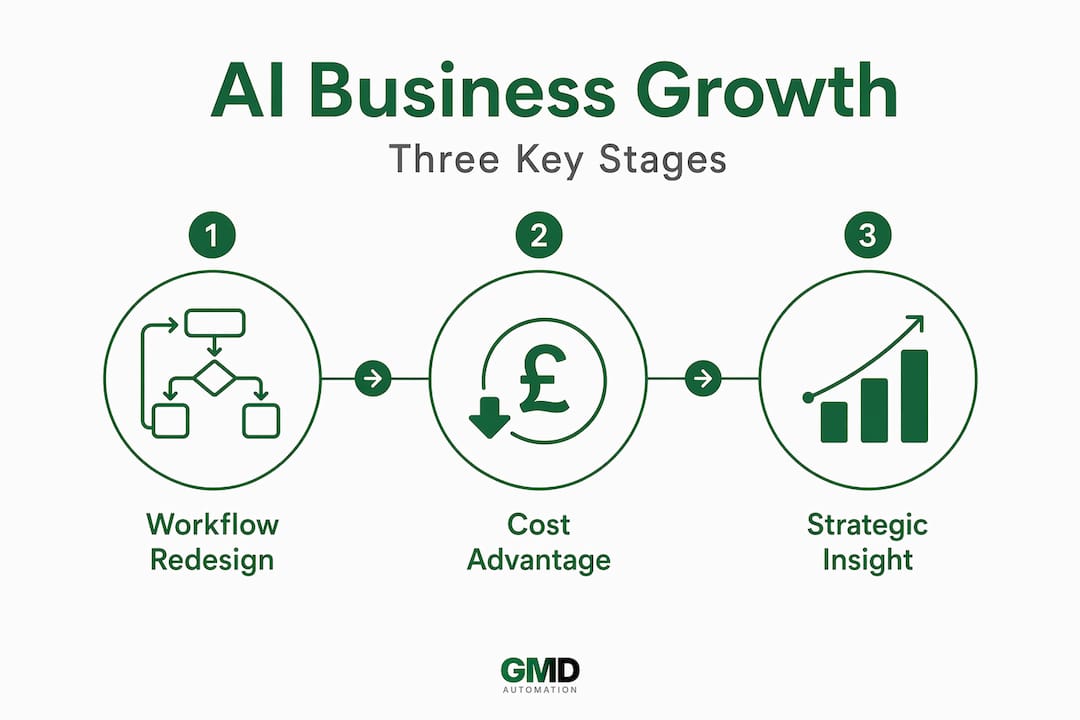
Once you accept that AI's value lives beyond individual tasks, the next insight is equally important: the biggest gains come from chaining tasks together, not from perfecting each one in isolation.
MIT Sloan research on AI and workflows found that assigning sequences of tasks to AI can reduce coordination friction significantly, even when individual AI steps are less accurate than a human performing the same step alone. This is counterintuitive but powerful. When you remove the handoffs, approvals, and delays between human steps, the net output improves even if each AI action is imperfect.
Think about a sales qualification process. A human researcher gathers leads, passes them to an analyst for scoring, who passes them to a manager for approval, who briefs the sales rep. Each handoff adds latency and error. An AI system that handles the entire chain, from data gathering to scoring to briefing the rep, might be less precise at each individual step but delivers results in minutes rather than days.

This is why integrating AI in business operations requires a fundamentally different mindset from buying AI tools. The tools matter less than the workflow architecture around them.
Key principles for workflow redesign:
- Map existing workflows at the task level before deciding where AI fits
- Identify the handoffs that cause the most delay, not just the tasks that take the most time
- Design AI into the sequence from the start, rather than bolting it onto existing steps
- Accept that partial AI accuracy across a full sequence often beats perfect human accuracy on isolated tasks
Pro Tip: Before you invest in any AI workflow automation, document your current workflow end-to-end and count the number of human handoffs. That number is your baseline. If your AI implementation doesn't reduce it materially, you haven't redesigned the workflow, you've just digitised it.
Building a long-term AI-driven cost advantage
Workflow efficiency and cost reduction are related but not identical. Reducing handoffs lowers friction. Building a lasting cost advantage requires something more deliberate: a sequenced approach to AI deployment that compounds over time.
BCG Henderson Institute research shows that AI leaders deliver three times greater cost reduction and 2.7 times the return on invested capital compared to average adopters, specifically because they link AI deployment with structural transformation rather than treating it as a standalone initiative. That linkage is the key.
Here's how disciplined AI cost strategy actually works in practice:
- Start with a contained pilot in a high-volume, measurable process, such as invoice processing, customer query triage, or demand forecasting
- Quantify the savings from that pilot precisely, including time saved, error rates reduced, and staff hours freed
- Reinvest a portion of those savings into the next layer of AI deployment, funding transformation from within
- Redesign the operating model around what AI now handles, rather than keeping redundant roles and processes in place
- Track ROI at each stage, using hard metrics rather than qualitative assessments, so you can make clear decisions about scaling
The table below illustrates how this sequencing plays out across a typical mid-sized UK business:
| Phase | AI application | Expected outcome | Reinvestment target |
|---|---|---|---|
| Pilot | Invoice and document processing | 30-40% admin cost reduction | Fund CRM AI integration |
| Scale | Customer service automation | 25% query resolution improvement | Fund sales intelligence tools |
| Transform | Predictive demand planning | 15-20% inventory cost reduction | Fund business model redesign |
Pro Tip: The firms that build the strongest AI cost advantage through automation rarely start with the most ambitious use case. They start with the most measurable one, because measurable wins fund the next stage and keep internal sceptics on board.
AI's role in competitive intelligence and strategic decision making
Here's where the role of AI in competitive advantage becomes genuinely exciting for business leaders. Traditional competitive intelligence is slow. Your team monitors press releases, attends industry events, scans competitor websites, and compiles quarterly reports. By the time that intelligence reaches a sales rep preparing for a deal, it's weeks out of date.
AI changes this entirely. AI-driven competitive intelligence systems monitor hundreds of data sources continuously, including competitor pricing changes, product announcements, hiring patterns, customer reviews, and regulatory filings, then deliver deal-specific insights directly to the relevant person at the moment they need it.
Klue's research on AI in competitive intelligence found that AI automating continuous competitive data collection and proactively delivering tailored insights can increase seller win rates by up to 28%. That's not a marginal improvement. For a business with a £5 million annual sales target, a 28% win rate improvement has an enormous revenue impact.
The contrast between traditional and AI-powered competitive intelligence is stark:
| Capability | Traditional approach | AI-powered approach |
|---|---|---|
| Data collection frequency | Weekly or monthly | Continuous, real-time |
| Insight delivery | Quarterly reports | Deal-specific, on demand |
| Coverage breadth | Limited to known sources | Thousands of sources simultaneously |
| Sales rep relevance | Generic market overviews | Tailored to specific competitor and deal |
| Decision speed | Days to weeks | Minutes |
Key benefits of AI-powered competitive intelligence:
- Proactive alerts when competitors change pricing or launch new products
- Deal battlecards generated automatically for sales teams before key meetings
- Leadership dashboards showing market position shifts in near real time
- Pattern recognition across competitor behaviour that humans would miss at scale
The caveat worth stating plainly: AI and revenue growth through competitive intelligence still requires human judgement at the strategic level. AI surfaces the intelligence. Your team decides what to do with it. Replacing that human layer with automation would be a mistake.
Making AI accessible to small and mid-sized UK businesses
For years, enterprise AI was genuinely out of reach for smaller businesses, not just in cost but in the technical capability required to deploy it. That's no longer the case. Entry costs for AI tools fell from approximately $50 per month in 2019 to $20 to $30 per month by 2025, according to JPMorgan Chase research, making affordability a much smaller barrier than it once was.
The remaining challenges for UK SMEs are less about cost and more about effective integration and skills. Buying an AI tool is easy. Knowing which workflow to apply it to, how to measure the result, and how to build on early wins requires either internal expertise or a trusted external partner.
AI adoption guidance for small businesses increasingly points to the following as critical success factors:
- Clear use case selection: start with a specific, measurable problem rather than a general aspiration to "use AI"
- Staff training investment: adoption fails when the technology is deployed but people don't know how to use it effectively
- Integration with existing systems: AI tools that don't connect to your CRM, ERP, or data sources create more problems than they solve
- Ongoing optimisation: AI systems require tuning over time as your data and processes evolve
- Trusted guidance: working with a partner who understands both the technology and your sector shortens the path to real returns considerably
The democratisation of artificial intelligence business solutions is real, but it doesn't mean adoption is effortless. The businesses getting the best results from AI in 2026 are the ones that treat it as a capability to build, not a subscription to activate.
Rethinking AI implementation: beyond technology to organisational transformation
There's a version of AI adoption that looks impressive on paper and delivers almost nothing. You'll recognise it: a handful of AI tools deployed in isolated pockets, no change to underlying processes, a "transformation" that amounts to a faster version of the same broken workflow.
The hard truth is that 70% of AI's value comes from process change and redesign, not from the algorithms themselves. The technology is almost a commodity now. The scarce resource is the organisational willingness to change around it.
What we've observed consistently is that companies treating AI as primarily a technology investment plateau quickly. They get the initial efficiency gains, declare success, and stop there. Meanwhile, the firms genuinely transforming their operations are the ones asking uncomfortable questions. Which roles need to be redesigned? Which management layers exist only to coordinate information that AI can now handle directly? Which customer journeys were built around human limitations that no longer apply?
Transforming business with AI at any meaningful scale requires patience that most organisations underestimate. The first three to six months of a serious AI implementation are often harder than the status quo, not easier, because you're running new and old systems in parallel while your team builds confidence. The leaders who get through that period without abandoning the initiative are the ones who see the compounding returns.
Our view is that strategic AI integration should be sequenced like a building project, not launched like a software rollout. You need foundations before walls, and walls before the roof. Starting small isn't timidity. It's how you build something that lasts.
The executives who will still be talking about their AI advantage in five years aren't the ones who adopted the most tools in 2024. They're the ones who took the time to redesign their organisations around what AI makes genuinely possible.
How GMD Automation helps UK businesses grow with AI
The gap between knowing AI matters and actually capturing its value is where most businesses get stuck. Deployment complexity, integration concerns, upfront costs, and the sheer breadth of available tools make it genuinely difficult to know where to start.
GMD Automation works specifically with UK businesses to close that gap. Our AI automation systems are deployed rapidly with zero upfront costs, operating on a transparent monthly subscription that covers implementation, maintenance, and ongoing optimisation. That means no capital risk and no hidden complexity. Whether you're a growing SME looking to automate your first workflow or a larger organisation ready to redesign your operating model around AI, we can build and run the systems that deliver measurable results. Our focus is practical, affordable automation that creates real competitive advantage, not technology for its own sake.
Frequently asked questions
What is the main benefit of AI in business growth?
AI drives growth by reshaping workflows and business models, not just by improving individual task productivity. AI leaders use AI as a catalyst for business reinvention, which is why a small minority of companies capture the majority of AI's economic value.
Can small businesses afford to integrate AI effectively?
Yes, AI tool entry costs have dropped significantly, making access far less of a barrier than it once was. The greater challenge now is effective integration and staff capability, not affordability.
How does AI improve competitive intelligence?
AI automates competitive data collection and delivers deal-specific insights proactively, enabling faster and more informed sales and strategic decisions rather than relying on outdated periodic reports.
Is AI a replacement for human decision making?
No. While AI handles routine data gathering, analysis, and task sequences well, critical strategic decisions remain best made by humans who can weigh context, ethics, and long-term consequences that AI cannot fully account for.