

If you are a UK business leader trying to identify where AI process automation genuinely delivers, separating credible wins from vendor noise is harder than it should be. The examples of AI process automation wins in this article are drawn from documented case studies across legal, retail, energy, defence procurement, and software engineering. Each one is assessed against criteria that matter to decision-makers: measurable time savings, cost avoidance, scalability, and operational risk reduction. What you will find here is not a list of features. It is evidence.
Table of Contents
- Key takeaways
- 1. Virgin Atlantic: shipping software faster and safer with AI
- 2. US Army procurement: 687,000 hours saved with AI document automation
- 3. Shoosmiths: £8.3 million in legal workflow savings through embedded AI
- 4. Kingfisher: 90% reduction in SAP invoice indexing time
- 5. Petrobras: $120 million in tax savings identified in three weeks
- 6. Cross-sector comparison: what the best AI automation wins have in common
- My take on what actually makes an AI automation project a genuine win
- How UK businesses can replicate these results with Gmdautomation
- FAQ
Key takeaways
| Point | Details |
|---|---|
| Embed AI into daily workflows | Treating automation as a pilot rather than a standard workflow step limits scale and sustained ROI. |
| Measure at the system of record | Track efficiency gains at the ERP or core system level, not just at data extraction, to realise full business value. |
| Governance prevents costly defects | Continuous validation and structured approvals are what make AI automation safe to scale in production environments. |
| Modular prompting improves accuracy | Breaking complex tasks into smaller prompt segments reduces errors and builds user confidence in regulated processes. |
| Scaling follows embedding | The firms achieving the largest efficiency gains embedded AI into repeatable steps, not one-off reviews. |
1. Virgin Atlantic: shipping software faster and safer with AI
Virgin Atlantic's engineering team provides one of the clearest examples of successful automation in software delivery. Working with OpenAI Codex, they achieved near-complete unit test coverage on a critical customer-facing application launched during the Christmas travel period, with zero P1 defects on go-live. For any team that has managed a production release during peak demand, that result speaks for itself.

The efficiency gains in code maintenance were equally striking. Legacy code refactoring that previously took two weeks was reduced to between 30 minutes and one hour. Codebase size shrank by 78 to 80 percent, making future development and data warehouse migrations significantly more manageable. Prototype applications that would have taken days to build were completed in hours.
What makes this case study instructive for software-intensive firms is the dual focus. Codex was not just used for speed. It was embedded into a continuous testing and validation workflow that actively reduced deployment risk. That combination of throughput and safety is what enabled the team to ship confidently at pace.
- Zero P1 defects on a high-stakes Christmas launch
- Codebase reduced by 78 to 80 percent
- Legacy refactoring cut from weeks to under one hour
- Prototype development time compressed from days to hours
Pro Tip: If your engineering team is considering AI-assisted coding, prioritise test generation capabilities alongside code writing. The safety dividend is where the real business value sits.
2. US Army procurement: 687,000 hours saved with AI document automation
Few examples illustrate the impact of AI on efficiency in regulated environments as clearly as the procurement automation programme built by Koniag Government Services on AWS. The project automated complex acquisition document workflows across US Army procurement, saving 687,000 labour hours and $37 million in annual cost avoidance.
The centrepiece of the solution was DORA, an automation assistant that reduced eligibility determination from approximately one hour to just two minutes. Documents that previously required days of manual drafting were completed in minutes, with the system operating 24 hours a day, seven days a week.
The technical approach is worth noting for any organisation operating in a compliance-heavy environment. Rather than feeding entire documents into a single large prompt, the team used modular prompt segmentation to break drafting tasks into structured sections. Each section was reviewed and refined by a human before proceeding. This deliberate approach reduced hallucinations and maintained compliance standards throughout.
"A strategic, accuracy-first approach using modular prompt segmentation helps build user confidence and maintain compliance in highly regulated workflows." — AWS and Koniag Government Services case study
For UK businesses managing procurement, legal, or regulatory documentation at scale, this model offers a replicable blueprint. The lesson is that combining generative AI with human refinement is not a limitation. It is what makes the system trustworthy enough to deploy at enterprise scale.
3. Shoosmiths: £8.3 million in legal workflow savings through embedded AI
Shoosmiths, one of the UK's leading law firms, delivers one of the most instructive AI process automation case studies for any professional services organisation. Working with Avail, the firm scaled AI-powered title register analysis from 151 titles to over 83,000, a near 2,000 percent increase year on year.
The financial outcome is striking. With 20 minutes saved per title at a solicitor billing rate of £300 per hour, the cumulative time savings reached over £8.3 million. That figure did not emerge from a single large deployment. It accumulated because AI was embedded directly into the initial review stage of every transaction, rather than offered as an optional secondary tool.
| Metric | Value |
|---|---|
| Titles analysed (year 1) | 151 |
| Titles analysed (year 2) | 83,000+ |
| Year-on-year growth | ~2,000% |
| Time saved per title | 20 minutes |
| Estimated total time savings | £8.3 million+ |
The critical lesson here is about workflow positioning. Shoosmiths did not treat AI as a checking tool applied after human review. They positioned it at the start of the process, surfacing risk and extracting structured evidence before a solicitor opened the file. That decision is what drove sustained adoption and compounding returns.
Pro Tip: In document-heavy workflows, position AI at the point of first contact with the document, not the point of final review. Early embedding is what converts pilots into permanent efficiency gains.
4. Kingfisher: 90% reduction in SAP invoice indexing time
Kingfisher's global business services operation offers a textbook example of real-world AI automation success in a large, distributed retail enterprise. The challenge was not reading invoices. It was the time spent indexing extracted data into SAP, a step most automation projects underestimate.
The solution achieved a 90% reduction in indexing time, cutting the average from five minutes per invoice to just 25 seconds. The system automatically read 79 percent of invoice fields, with a 60 percent touchless extraction rate across the full workflow. Exceptions were handled in an average annotation time of 21 seconds.
The operational consequence was significant. Fourteen full-time employees were redeployed from data entry to higher-value finance tasks. That redeployment is not a minor footnote. It represents a structural shift in how the team spends its time. The impact on ERP workflow efficiency came precisely because the automation was built around the SAP indexing step, rather than stopping at document reading.
- Invoice indexing time: 5 minutes reduced to 25 seconds
- Touchless extraction rate: 60%
- Invoice fields read automatically: 79%
- FTEs redeployed to higher-value roles: 14
For retailers and distributed enterprises managing thousands of supplier invoices, this case study demonstrates that measuring AI wins at the ERP input stage rather than the extraction stage produces meaningfully different business outcomes.
5. Petrobras: $120 million in tax savings identified in three weeks
Petrobras, the Brazilian energy giant, used generative AI combined with intelligent automation to transform a process that had not been completed properly in 15 years. The task involved analysing 150 pages of tax regulations alongside months of financial data. The outcome was £120 million in tax savings identified within three weeks, with tax returns filed in three days.
The efficiency increase across the compliance function reached 40 percent, with projected savings exceeding one billion dollars by year-end. The system combined generative AI for regulatory document analysis with predictive analytics for anomaly detection across financial records.
- AI analysed 150 pages of tax regulation in a fraction of the time required manually
- Months of financial data were processed for anomalies and savings opportunities
- Tax returns were filed in three days, compared to a process that had failed for 15 years
- Savings of $120 million were identified within the first three weeks
- A 40% efficiency increase was achieved across compliance functions
"Petrobras demonstrates that AI is not just a productivity tool. In complex regulatory environments, it can surface financial opportunities invisible to manual review at any practical scale."
The expansion strategy Petrobras adopted after this initial win is equally relevant for business leaders. Rather than treating this as a one-off project, the organisation moved to deploy intelligent automation across multiple enterprise functions, scaling from a single compliance win into a broader digital transformation. This is the pattern that separates organisations capturing lasting AI efficiency gains from those stuck in pilot cycles.
6. Cross-sector comparison: what the best AI automation wins have in common
Looking across these examples as a group, clear patterns emerge that can guide prioritisation decisions for UK business leaders.
| Organisation | Sector | Key metric | Core workflow automated |
|---|---|---|---|
| Virgin Atlantic | Aviation / Software | 78-80% codebase reduction | Software testing and refactoring |
| US Army / Koniag | Government / Procurement | 687,000 hours saved annually | Document drafting and eligibility |
| Shoosmiths | Legal | £8.3 million in time savings | Title register review |
| Kingfisher | Retail / Finance | 90% indexing time reduction | SAP invoice indexing |
| Petrobras | Energy / Compliance | $120 million identified in 3 weeks | Tax regulation analysis |
The common success factors are not accidental. Every case involved AI embedded into a repeatable, high-volume workflow rather than applied to an exceptional task. Every case measured outcomes at the point where operational effort was highest, whether that was test coverage, document drafting time, or ERP data entry. And every case maintained human oversight at the points where compliance or quality carried the highest risk.
Where AI automation projects fail, the causes are typically the inverse. Automation applied to variable, unstructured workflows produces inconsistent results. Projects that measure success at extraction accuracy rather than downstream process impact often overstate their value. And deployments without continuous validation tend to degrade over time as data or processes shift.
The industries where these wins concentrate, including legal, finance, procurement, logistics, and software engineering, are well covered in Gmdautomation's overview of sectors benefiting from AI automation.
My take on what actually makes an AI automation project a genuine win
I have reviewed dozens of AI automation case studies, and the thing that strikes me most is how many organisations still confuse activity with outcome. A project that automates a document reading step but leaves the indexing and approval steps unchanged has not automated a process. It has automated a fragment of one.
What I see in the examples that genuinely deliver, from Shoosmiths' title analysis to Kingfisher's SAP integration, is an almost stubborn insistence on measuring at the right point. Not "how fast does the AI read the document?" but "how much time does a qualified person no longer spend on this?" That shift in measurement framing changes everything about how a project is scoped and evaluated.
The governance question is also consistently underestimated. I have found that the organisations most willing to invest in continuous validation and human-in-the-loop checkpoints are paradoxically the ones that scale the fastest. Virgin Atlantic's zero P1 defect launch is not a story about AI speed. It is a story about continuous testing discipline applied throughout delivery. The AI enabled the throughput. The governance made it safe enough to actually use.
My advice to UK business leaders is to resist the urge to automate the most visible task first. Automate the task that sits at the centre of your operational workflow, the one where time disappears without producing proportional value. That is where the compounding returns begin. For a practical view of how these wins translate across different business functions, Gmdautomation's analysis of cross-department automation examples is worth your time.
— Ravi
How UK businesses can replicate these results with Gmdautomation
The examples in this article are not outliers. They are the result of applying AI to the right workflows, with the right governance, and measuring impact where it matters to the business. For UK organisations ready to pursue similar outcomes, Gmdautomation provides enterprise-grade AI automation systems built specifically for this market.
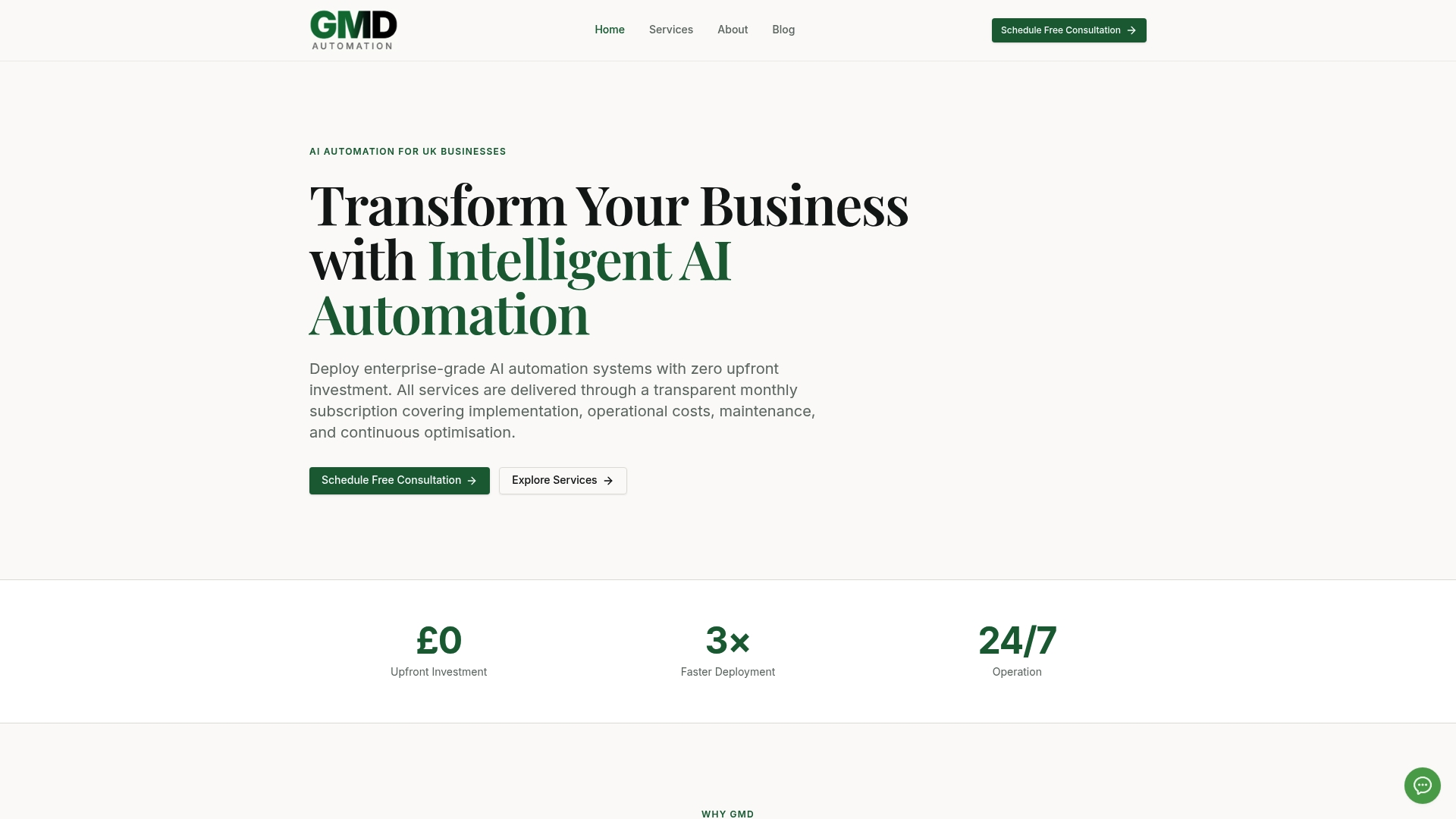
Gmdautomation's solutions cover the workflows featured here, from document processing and compliance automation to ERP integration and finance operations, all delivered through a monthly subscription model with zero upfront capital requirement. Implementation, operation, maintenance, and ongoing optimisation are included. If your organisation is evaluating where to start or how to scale an existing initiative, explore AI automation for UK businesses to see how Gmdautomation supports deployment from day one. The results described in this article are achievable. The question is which workflow you prioritise first.
FAQ
What qualifies as an AI process automation win?
A genuine win delivers measurable, business-aligned outcomes at the operational workflow level, such as time saved, cost avoided, or FTEs redeployed, rather than technical metrics like model accuracy alone.
Which sectors show the strongest AI automation results?
Legal, finance, procurement, retail, and software engineering consistently produce the strongest documented results, particularly where workflows are high-volume and repeatable.
How long does it take to see returns from AI automation?
Petrobras identified $120 million in tax savings within three weeks of deployment. Timelines vary by workflow complexity, but well-scoped projects in document-heavy processes typically show measurable returns within weeks rather than months.
Why do some AI automation projects fail to scale?
Most scale failures trace back to three causes: automating fragments rather than end-to-end workflows, measuring impact at extraction rather than system output, and insufficient governance to maintain quality as data and processes evolve.
Is AI automation viable for mid-sized UK firms?
Yes. Shoosmiths' £8.3 million in savings grew from a modest starting point of 151 titles. The key factor was embedding AI into standard workflow steps, which any firm managing repeatable document processes can replicate regardless of size.