

Business process automation (BPA) is the use of technology to execute recurring tasks with minimal human input. AI takes BPA further by handling not just rule-based steps but also judgement-heavy workflows that previously required trained staff. The types of business processes AI can automate span customer service, finance, reporting, HR, and engineering, and generative AI alone offers potential annual returns of 4–18% of EBITDA across sectors. For operations managers and business leaders, that figure is not a projection. It is a target already being hit by organisations that have matched the right processes to the right AI tools.
1. Which communication and customer interaction processes can AI automate?
Customer-facing communication is the highest-volume, most rule-driven category of work in most organisations. AI chatbots and voice agents handle inbound enquiries, qualify leads, send appointment reminders, and trigger onboarding emails without human involvement. The financial case is direct: AI-enabled interactions cost approximately £0.50 per enquiry compared to £6.00 for a human agent. That is a twelvefold cost difference on every ticket your support team currently handles.
The processes best suited to AI automation in this category include:
- Tier-1 customer support enquiries (order status, FAQs, account resets)
- Appointment and meeting reminders via SMS or email
- Lead qualification and CRM routing based on form responses
- Invoice and payment notifications
- New customer onboarding message sequences
Well-implemented support AI saves over 40 hours per week by removing tier-1 work from human queues entirely. That freed capacity moves to complex cases that genuinely need human judgement.
Pro Tip: Start by automating your three most common inbound enquiry types. Measure deflection rate after 30 days. The data from that pilot funds the business case for broader automation.
2. How AI automates data entry, CRM hygiene, and invoice processing
Repetitive data entry is the single most common source of operational drag in mid-sized organisations. AI reads documents, extracts structured fields, and writes records to CRM or ERP systems without manual keying. The accuracy improvement over human data entry is consistent across deployments, and the cost reduction is measurable from day one.
Key processes AI handles in this category:
- Extracting line items from supplier invoices and purchase orders
- Deduplicating CRM contact records and merging incomplete profiles
- Updating deal stages based on email activity or meeting outcomes
- Categorising expense receipts and matching them to cost codes
- Populating onboarding forms from identity documents
The cost difference in invoice processing is stark. Manual invoice processing costs £12–£15 per document. AI-driven processing brings that figure to under £3. For a business processing 500 invoices per month, that is a saving of over £4,500 every month from a single workflow change.
Finance leaders consistently cite cycle-time acceleration as the top benefit. An invoice that took three days to approve now clears in hours. For more detail on document-centric automation, Gmdautomation's guide on AI in document processing covers the UK-specific compliance considerations worth reviewing before deployment.

3. What are the key areas of AI-driven reporting and analytics?
Routine report generation is one of the most overlooked automation opportunities in business operations. AI pulls data from multiple sources, applies predefined logic, and delivers formatted reports on a schedule, without anyone opening a spreadsheet. Structured data enables full automation of weekly, monthly, and daily operational reports across sales, finance, and logistics functions.
Beyond scheduled reports, AI flags anomalies in real time. A sudden drop in conversion rate, an unusual spike in refund requests, or a supplier invoice that deviates from contract terms all surface automatically. The AI does not just report the anomaly. It surfaces the relevant context alongside it, cutting the time from detection to decision.
Cross-source data integration is where reporting AI delivers its deepest value. Combining CRM data, financial data, and operational data into a single view has historically required a data analyst and several hours. AI does it continuously. For a practical breakdown of the tools and methods involved, Gmdautomation's guide on AI reporting automation is a useful reference for operations teams.
Pro Tip: Automate your most repetitive reports first, the ones your team produces every week without variation. Once those run without human input, the time saved funds the more complex analytics work.
4. How AI supports agentic and complex process automation
Agentic AI refers to systems that plan a sequence of actions, execute them, and adjust based on outcomes, without a human directing each step. This goes well beyond rule-based automation. Where a standard workflow tool follows a fixed script, an AI agent reads context, makes decisions, and loops back when results fall outside expected parameters.
| Feature | Rule-based automation | Agentic AI automation |
|---|---|---|
| Task type | Fixed, repetitive steps | Variable, multi-step decisions |
| Handles exceptions | No | Yes, within defined bounds |
| Learns from outcomes | No | Yes |
| Setup complexity | Low | Medium to high |
| Best for | Invoice routing, reminders | Engineering design, HR resolution |
The results from agentic deployments are significant. AI agents in engineering design have reduced lead times by up to 80% and cut costs by 45% in sectors including shipbuilding and insurance. HR chatbots built on agentic frameworks resolve over 90% of employee enquiries without escalation. For a broader view of how agentic AI systems are reshaping complex workflows, the operational examples from across industries are instructive.
The challenge with agentic AI is not the technology. It is the workflow redesign required to make it work. Roles change. Approval steps move. Humans shift from doing the task to reviewing the output. Organisations that plan for those changes before deployment consistently outperform those that add AI to an unchanged process.
5. Which processes should organisations prioritise for AI automation?
The correct starting point for any AI automation project is a workload audit. Auditing a team's tasks for high-frequency, low-value activities identifies the strongest candidates for immediate automation. The goal is not to automate everything. It is to automate the right things first.
A process is a strong candidate for AI automation if it meets most of these criteria:
- It happens more than ten times per week per team member
- It follows a consistent set of rules with few exceptions
- An error in the output is detectable and correctable before it causes harm
- It consumes time that staff would rather spend on higher-value work
- It produces a structured output that feeds another system or report
Successful automation projects begin with high-frequency, rule-based processes precisely because the ROI is fast and visible. That early return funds the more complex workflow redesign that follows. Avoid starting with processes that require strategic judgement, creative output, or sensitive interpersonal handling. Those come later, once the organisation has built confidence in AI outputs and governance.
Integration matters as much as tool selection. Moving from isolated AI tools to deep operational embedding is what separates organisations that achieve sustained gains from those that run a handful of pilots and stall. The AI needs to connect to your CRM, your finance system, and your communication tools. A standalone chatbot that does not write back to your CRM creates more work, not less.
Pro Tip: Before selecting a tool, map the process end-to-end on paper. Identify every handoff, every exception, and every downstream system the output touches. That map is your integration checklist.
6. What processes are not yet ready for AI automation?
Not every business process belongs in an automation queue. AI performs poorly on tasks that require nuanced human judgement, ethical reasoning, or relationship management. Knowing where not to automate is as valuable as knowing where to start.
Processes to keep human-led for now include final contract negotiation, performance management conversations, crisis communications, and any decision with significant legal or reputational consequences. AI can prepare the briefing, draft the document, and surface the relevant data. The final call stays with a person.
The full value of AI automation depends on reinvesting freed capacity into equally productive work. Organisations that automate data entry and then reduce headcount without redeploying that talent miss the compounding benefit. The people freed from repetitive tasks are the ones best placed to manage AI outputs, handle exceptions, and build the next layer of automation.
Key takeaways
AI automation delivers the strongest returns when applied to high-frequency, rule-based processes first, with workflow redesign and integration planned from the outset.
| Point | Details |
|---|---|
| Start with rule-based tasks | High-frequency, low-exception processes deliver the fastest and most visible ROI. |
| Customer service cuts costs sharply | AI interactions cost approximately £0.50 versus £6.00 for a human agent per enquiry. |
| Invoice automation pays quickly | AI reduces per-invoice cost from £12–£15 to under £3, with same-day cycle times. |
| Agentic AI handles complex work | AI agents can cut engineering design lead times by up to 80% in the right workflows. |
| Integration beats tool adoption | Embedding AI into core systems delivers sustained gains; isolated tools stall after early wins. |
Where most AI automation projects go wrong
The organisations I see getting the most from AI automation share one habit: they redesign the process before they deploy the tool. The ones that struggle do the opposite. They buy a chatbot, bolt it onto an existing support queue, and wonder why the deflection rate is low. The answer is almost always that the underlying process was never designed for automation in the first place.
Layering AI onto inefficient processes yields limited gains. The companies achieving 18% EBITDA improvements are rethinking roles, decisions, and handoffs alongside the technology. That is a harder conversation to have internally, but it is the one that determines whether your automation investment compounds or flatlines.
The hybrid workforce model is where I think most UK businesses will land within three years. Humans handle complex judgement, relationship management, and exception resolution. AI handles volume, consistency, and speed. Neither replaces the other. The organisations building that model now, rather than waiting for a perfect business case, are the ones that will hold a cost and speed advantage that is genuinely difficult to close.
One practical point worth making: pay down your workflow debt before you automate. If a process has workarounds, undocumented exceptions, and tribal knowledge baked in, automating it will encode all of that dysfunction into your AI system. Clean the process first. Then automate it.
— Ravi
How Gmdautomation helps UK businesses automate key processes
UK businesses face a specific challenge: deploying AI automation quickly, compliantly, and without large upfront capital. Gmdautomation addresses that directly with enterprise-grade AI systems available on a monthly subscription that covers implementation, operation, and ongoing optimisation.
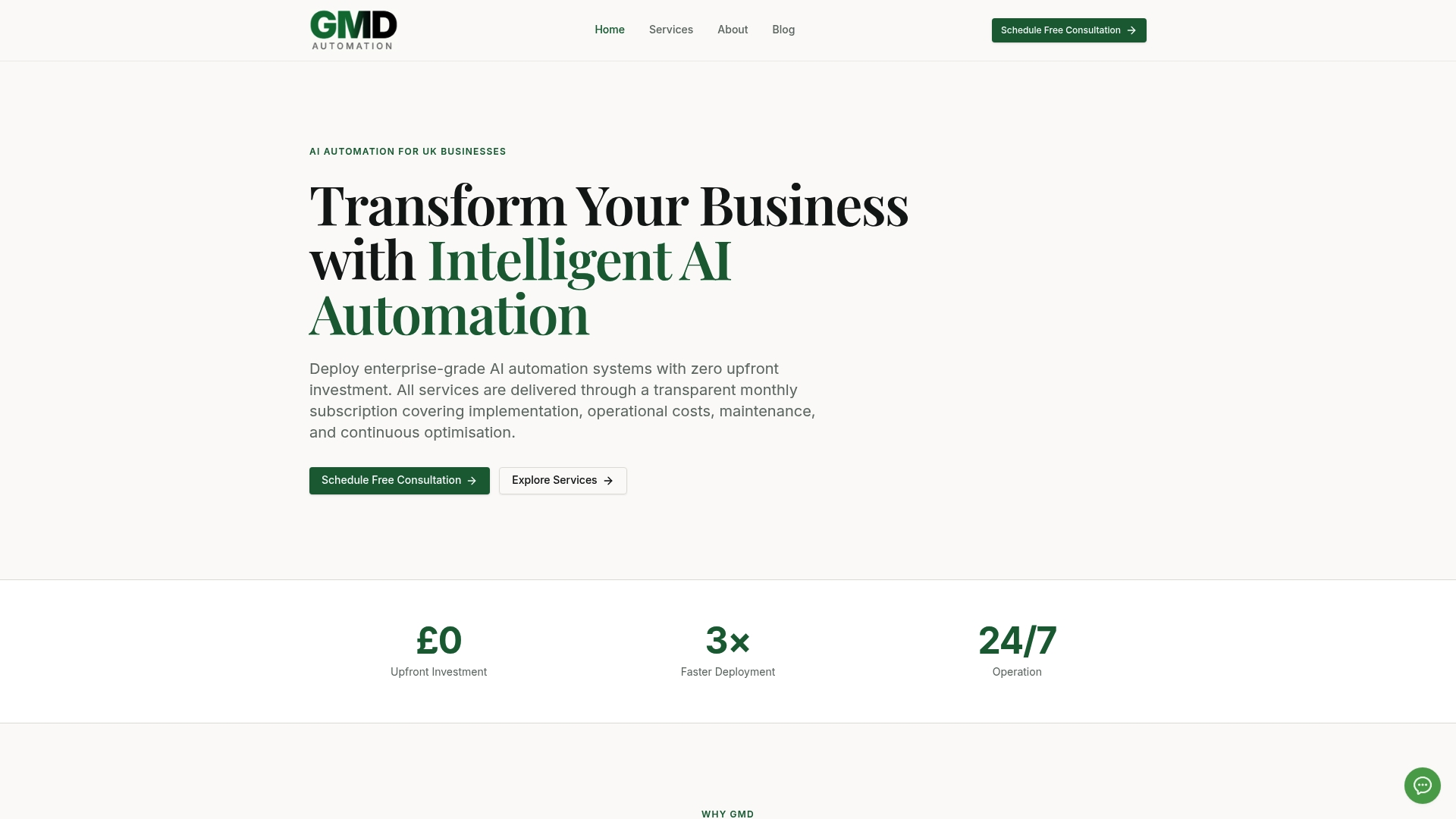
Whether you are looking to automate customer enquiries, invoice processing, or operational reporting, Gmdautomation builds and deploys the systems around your existing workflows. There are no lengthy procurement cycles and no hidden costs. For operations managers ready to move from pilot to production, the AI automation solutions Gmdautomation offers are designed to show measurable results within weeks. You can also review real-world automation examples to see how comparable UK businesses have approached the same decisions you are facing now.
FAQ
What types of business processes are easiest to automate with AI?
Processes that are high-frequency, rule-based, and produce structured outputs are the easiest to automate. Examples include invoice processing, customer enquiry routing, appointment reminders, and CRM data entry.
How much can AI reduce customer service costs?
AI-enabled customer service interactions cost approximately £0.50 per enquiry versus £6.00 for a human agent. Well-implemented AI support systems save over 40 hours of staff time per week by handling tier-1 enquiries automatically.
What is agentic AI automation?
Agentic AI refers to systems that plan, execute, and adjust multi-step tasks without human direction at each stage. Unlike rule-based tools, AI agents handle variable inputs and exceptions, making them suited to complex workflows such as engineering design or HR query resolution.
How do I choose which processes to automate first?
Start with processes that occur more than ten times per week, follow consistent rules, and produce outputs that are easy to check for errors. High-frequency, rule-based tasks deliver the fastest ROI and build organisational confidence for more complex automation later.
Does AI automation require replacing existing systems?
AI automation works best when embedded into existing CRM, ERP, and communication systems rather than running in isolation. Deep operational integration is what separates sustained performance gains from short-term pilots that stall after initial deployment.