

Many UK business leaders assume AI automation is either too expensive, too complex, or simply not relevant to their sector. That assumption is costing them real money. The ai automation business benefits explained conversation has moved well beyond tech giants and into manufacturing floors, finance departments, and customer service teams across Britain. This article cuts through the noise to show you what AI automation actually does, where the measurable gains come from, and how to avoid the integration mistakes that cause most initiatives to stall before they deliver.
Table of Contents
- Key takeaways
- AI automation business benefits explained: what it is and how it works
- The real numbers behind AI in business efficiency
- Getting integration right and avoiding common pitfalls
- Beyond cost savings: AI as a competitive advantage
- Practical steps to start realising the benefits
- My honest take on where AI initiatives go wrong
- Ready to put AI automation to work in your business?
- FAQ
Key takeaways
| Point | Details |
|---|---|
| Cost reductions are substantial | AI automation can cut operational costs by 25–40%, with invoice processing time reduced by over 90%. |
| Productivity gains extend across skill levels | AI boosts average productivity by 15%, with the largest gains seen among less experienced staff. |
| Integration determines success | Only 18% of organisations have AI fully embedded in workflows, yet those that do report far greater value. |
| Legacy systems are the biggest barrier | 69% of organisations cite legacy systems as the primary obstacle to scaling AI effectively. |
| Strategic value goes beyond cost savings | Businesses that redesign workflows around AI create structural competitive advantages, not just efficiency gains. |
AI automation business benefits explained: what it is and how it works
Before examining the advantages of AI automation, it helps to be precise about what the term actually covers. AI automation refers to the use of artificial intelligence to perform tasks, make decisions, or trigger actions that would otherwise require human input. This goes several steps further than traditional rule-based automation, which simply follows a fixed script. AI systems can learn from data, handle exceptions, and adapt to new conditions without being explicitly reprogrammed.
In practical terms, explaining AI automation to a business audience means pointing to the processes it already touches in organisations like yours. Common examples include:
- Invoice processing: AI reads, categorises, and routes invoices without manual data entry
- Customer service chatbots: Natural language AI handles routine queries, escalating only the complex ones
- Predictive maintenance: Sensors and AI flag equipment likely to fail before it actually does, reducing downtime
- Demand forecasting: AI analyses sales patterns, seasonality, and external signals to predict stock requirements
- HR and recruitment screening: AI shortlists applicants based on defined criteria, reducing time-to-interview
The impact of AI on operations varies by function, but the pattern is consistent. Repetitive, data-heavy tasks get faster and more accurate. Staff attention shifts to work that genuinely requires human judgement. And the organisation starts generating data on its own processes that it previously never had.
The real numbers behind AI in business efficiency
This is where the conversation gets concrete. The advantages of AI automation are not theoretical. Operational cost reductions of 25-40% are achievable, with some of the starkest examples coming from finance functions where invoice processing time can be cut by over 90%. Customer service operations see cost reductions of 25-30% when AI handles first-line queries.
| Business function | Typical AI benefit | Approximate saving |
|---|---|---|
| Finance and accounts payable | Invoice processing automation | Over 90% time reduction |
| Customer service | AI-powered first-line support | 25–30% cost reduction |
| Logistics and warehousing | Demand forecasting and routing | 15% cost reduction, 35% better inventory turns |
| Manufacturing | Predictive maintenance | 30–50% downtime reduction |
Productivity figures are similarly compelling. Research from Stanford GSB shows AI raises average productivity by 15%, but the headline figure understates what actually happens within teams. The gains are largest among less experienced workers. AI acts as a skill-levelling tool, giving newer staff access to guidance, templates, and decision support that previously lived only in the heads of senior colleagues.
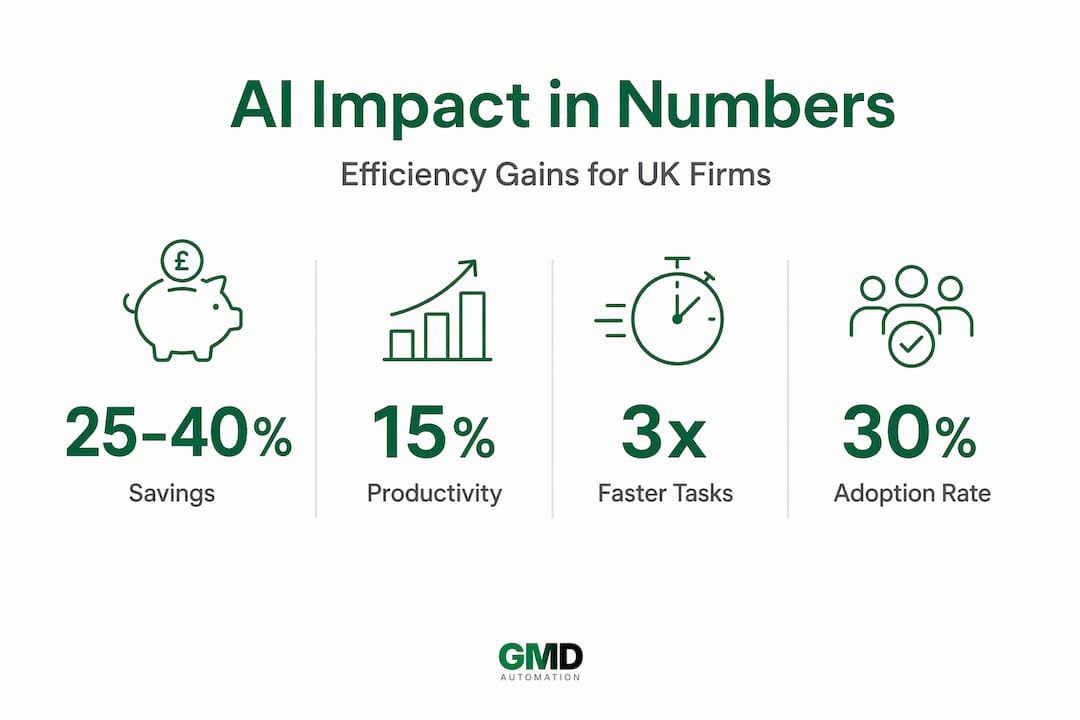
For logistics operations, the benefits of automating business processes are structural rather than marginal. AI-driven routing and inventory management can reduce shipping and warehousing costs by 15% while improving inventory turns by around 35%. In manufacturing, predictive maintenance cuts downtime by 30–50% and trims maintenance budgets by 10–20%.
Pro Tip: When calculating the ROI of AI automation, factor in the time cost of manual error correction in your current processes. Most businesses significantly underestimate this number before an audit.
Getting integration right and avoiding common pitfalls
Here is the uncomfortable truth about AI in business efficiency. Most organisations adopt AI tools without redesigning the workflows around them. The result is a performance paradox: investment goes up, but costs do not come down. Without workflow redesign, AI initiatives can actually increase operational burden by creating new coordination tasks between humans and systems.
Research shows that 71% of organisations embedding AI into their workflows report substantial value. Yet only 18% have actually achieved that level of integration. The gap between those two numbers is where most AI projects fail.
The most common obstacles include:
- Legacy systems: 69% of organisations cite outdated infrastructure as a barrier to scaling AI, because older systems cannot feed AI tools the clean, structured data they need
- Data silos: When sales, finance, and operations each hold separate data with no integration, AI cannot see the full picture
- Skill gaps: Staff need to understand what AI can and cannot do, or they default to ignoring it or over-relying on it
Best practice centres on a concept from MIT Sloan called task adjacency: grouping AI-compatible tasks together so that the handoffs between human and automated work are minimal and clear. The less coordination overhead between people and systems, the faster value accrues. Rules-based guardrails matter too. AI needs defined boundaries to operate within, particularly in regulated environments like financial services or healthcare.
Pro Tip: Map your current workflows before selecting an AI tool. The question is not "which AI product is best?" but "which tasks in this workflow are genuinely repetitive and data-driven?" Start with those.
Beyond cost savings: AI as a competitive advantage
How AI improves productivity is the question most UK executives ask first. The more interesting question is how AI reshapes what your business can offer. When you automate the operational layer, you free up the capacity to do things that were previously too slow or too expensive.
Consider four strategic shifts that AI automation makes possible:
- Faster decision-making: AI can surface anomalies, trends, and forecasts in real time. Decisions that once waited for monthly reports can happen daily or even continuously, without adding headcount.
- Personalised customer interactions at scale: Retailers and service firms are using AI to tailor communications, recommendations, and support responses to individual customers without manual effort, achieving a quality of personalisation that was previously only viable for high-value accounts.
- Business model reinvention: Some firms are embedding AI into their service offerings directly, rather than using it only internally. A logistics company, for example, might offer AI-powered supply chain visibility as a client-facing service, creating a new revenue stream from capability they built for internal use.
- Structural speed advantages: When AI reduces transaction costs and processing times, you can compete on speed and accuracy in ways that are genuinely difficult for less automated competitors to match.
The AI technology for business growth opportunity is real, but it requires ambition beyond cost reduction. Only 30% of organisations currently see new revenue streams from AI, while 64% see productivity improvement. That gap represents a significant strategic opportunity for UK businesses willing to think beyond efficiency.
Practical steps to start realising the benefits
Understanding the theory is one thing. Moving from understanding to application within your organisation is another. The following steps reflect what works in practice for UK business leaders exploring how to start:
- Audit current operations: List your most repetitive, high-volume processes. Invoice handling, query routing, data entry, and compliance reporting are strong starting points.
- Identify data readiness: AI needs structured, accessible data to function. Before selecting tools, assess whether your data is clean, centralised, and consistently formatted.
- Prioritise workflow integration over tool selection: The platform matters less than how it connects to your existing processes. Integration architecture should come before vendor conversations.
- Establish governance early: Define who is accountable for AI outputs, what rules govern automated decisions, and how errors are caught and corrected. AI governance and workflow standardisation directly correlate with better outcomes.
- Invest in reskilling: Your team needs to understand what the AI is doing and why. Even a half-day session on how a specific AI tool makes decisions dramatically improves adoption.
- Measure ROI at the workflow level: Track outcomes across the entire process, not just the task the AI handles. This prevents you from optimising one step while creating bottlenecks elsewhere.
- Scale what works: Pilot with one workflow, measure rigorously, and expand. Trying to automate everything at once rarely succeeds and makes it hard to attribute results.
For UK businesses concerned about operational resilience alongside efficiency, the good news is that AI automation contributes to both simultaneously when deployed thoughtfully.
My honest take on where AI initiatives go wrong
I have seen enough AI projects that promised transformative results and delivered incremental ones to know where the real problem lies. It is almost never the technology. The tools work. The data, when cleaned up, behaves as expected. What fails is the assumption that you can drop AI into an existing organisational structure and collect the savings without changing anything else.
The organisations I have seen genuinely benefit from AI automation are the ones that treated it as a reason to rethink how work gets done, not just a faster way to do the same work. They redesigned roles. They moved accountability closer to the data. They stopped measuring individual task speed and started measuring end-to-end process outcomes.
The other thing worth saying honestly: the skill-levelling effect is real, and it is underappreciated. When a less experienced team member gets access to AI tools that surface the right information at the right moment, they perform significantly closer to your senior staff. That is not a threat to your experienced people. It is a way to multiply the institutional knowledge they carry.
My view is that UK business leaders should stop asking "is AI ready for us?" and start asking "are we ready to change how we operate?" The technology is there. The structural willingness to reorganise around it is what separates organisations that capture real AI productivity value from those that end up with a more expensive version of the status quo.
— Ravi
Ready to put AI automation to work in your business?
If this article has clarified what AI automation can realistically deliver, the natural next question is what implementation actually looks like for a business of your size and sector.
Gmdautomation specialises in AI automation solutions built specifically for UK businesses, with deployment models that require no upfront capital and no lengthy procurement cycles. Their subscription-based approach covers implementation, ongoing maintenance, and optimisation, so you get the operational benefits without the technical overhead. Whether you are looking to reduce costs in a specific department or redesign an end-to-end workflow, Gmdautomation's AI platform is worth a conversation. The starting point is understanding your current processes. Gmdautomation can help you get from that point to working AI automation faster than most internal teams expect.
FAQ
What are the main business benefits of AI automation?
AI automation primarily reduces operational costs by 25–40%, cuts processing times in functions like finance and customer service, and raises average productivity by 15%. Strategic benefits include faster decision-making and improved customer experience at scale.
How does AI automation improve productivity?
AI handles repetitive, data-heavy tasks so staff can focus on higher-value work. The productivity gains are largest for less experienced employees, who benefit most from AI-powered decision support and guidance.
Why do many AI automation projects fail to deliver results?
Most AI initiatives underdeliver because organisations deploy tools without redesigning the workflows around them. Without integration and governance, AI adds coordination overhead rather than removing it.
How long does it take to see ROI from AI automation?
ROI timelines vary by process and integration quality, but well-integrated deployments in finance and customer service functions typically show measurable cost reductions within three to six months of full deployment.
Is AI automation suitable for small and mid-sized UK businesses?
Yes. The advantages of AI automation are not limited to large enterprises. Subscription-based deployment models have made enterprise-grade AI accessible to businesses of all sizes, with no requirement for significant upfront investment.