

The global AI as a Service market sits at US$23.5 billion in 2026 and is projected to hit US$189.1 billion by 2033. That trajectory tells you something important: businesses are not waiting for AI to become simpler before they adopt it. They are using AI as a Service right now, today, to cut costs, automate processes, and move faster than competitors. If you are a UK decision-maker wondering what is AI as a service and whether it belongs in your digital transformation plans, this guide gives you a clear, no-nonsense answer.
Table of Contents
- Key takeaways
- What is AI as a service, defined clearly
- Types of AIaaS platforms and what they offer
- Business benefits and real-world applications
- Challenges and best practices for UK adoption
- My perspective on where AIaaS is heading for UK businesses
- How Gmdautomation helps UK businesses adopt AIaaS
- FAQ
Key takeaways
| Point | Details |
|---|---|
| AIaaS is cloud-delivered AI | Businesses access pre-built AI tools via APIs without building infrastructure from scratch. |
| Pricing suits all business sizes | Subscription and pay-per-use models make AI accessible for SMEs and large enterprises alike. |
| Speed to deployment matters | AIaaS removes months of development time, getting AI working in your business far faster. |
| Data governance is non-negotiable | UK businesses must verify how providers handle data privacy and regulatory compliance. |
| Pilot projects reduce adoption risk | Starting small with a defined use case gives you measurable results before scaling. |
What is AI as a service, defined clearly
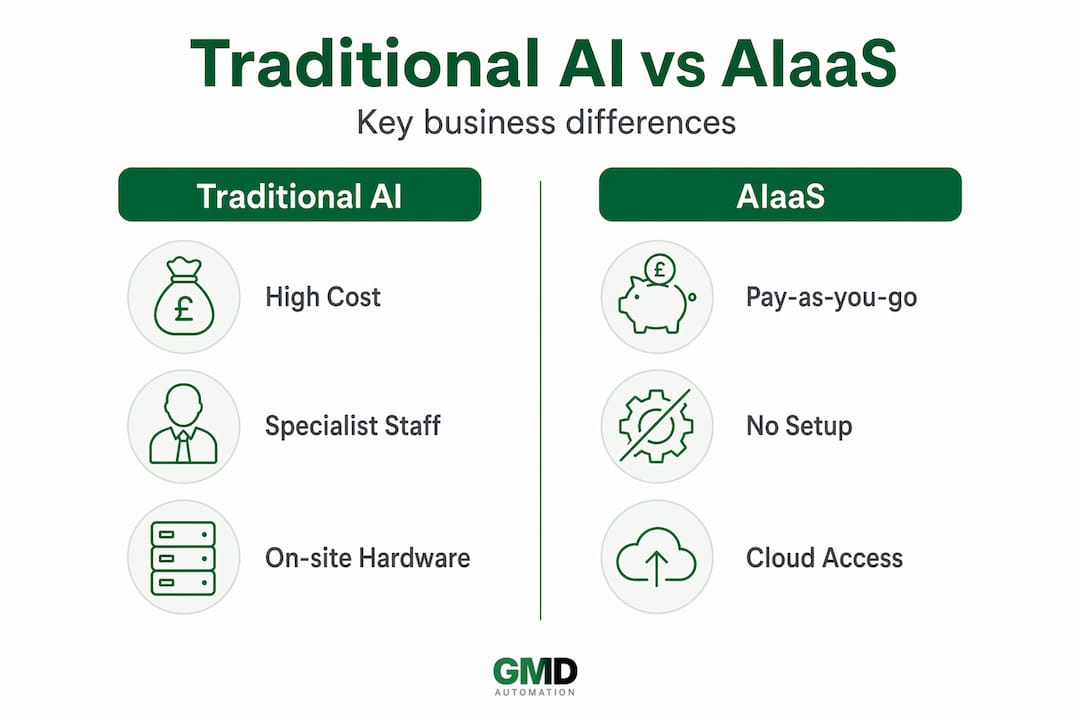
At its core, AI as a Service means cloud platforms delivering ready-built AI capabilities that your business accesses via an API or managed interface, without needing to build, train, or host the underlying models yourself. Think of it the way you think of electricity. You do not build a power station to run your office. You plug in and pay for what you use. AIaaS works on exactly that principle, applied to machine learning, natural language processing, computer vision, and other AI functions.
This is a meaningful departure from traditional AI development, where organisations had to hire data scientists, acquire specialist hardware, source and clean training data, and then maintain everything in perpetuity. That path is still viable for some large enterprises with highly specific needs. For most UK businesses, though, it represents significant cost, risk, and lead time that AIaaS removes entirely.
The distinction from standard SaaS is worth clarifying. A typical SaaS product gives you a finished application, say an invoicing tool or a CRM. AIaaS gives you the intelligence layer itself, which you embed into your own products, workflows, or systems. You are not buying a complete application. You are buying capability.
| Feature | Traditional AI development | AI as a Service |
|---|---|---|
| Upfront cost | High (hardware, talent, data) | Low to zero |
| Time to deployment | Months to years | Days to weeks |
| Maintenance responsibility | In-house team | Provider handles it |
| Scalability | Limited by infrastructure | On-demand |
| Required expertise | Deep AI/ML knowledge | Integration skills only |
Pro Tip: When evaluating AIaaS for the first time, focus on whether the provider offers pre-trained models for your specific use case rather than just general-purpose infrastructure. Specificity drives faster results.
Types of AIaaS platforms and what they offer
Understanding the AIaaS ecosystem means recognising that not all platforms are the same. AI as a Service covers several delivery models, each suited to different business needs and technical capabilities.
Model as a Service is the most common entry point for businesses. Providers offer pre-trained models accessible via API, covering tasks like sentiment analysis, translation, speech recognition, and image classification. You send data in, you get a structured output back. No training required.
GPU as a Service targets businesses that need to train their own models or run computationally intensive AI workloads, but do not want to invest in specialist hardware. You rent raw computing power on demand. This model sits closer to what is AI infrastructure as a service, where the focus is on providing the foundational compute layer rather than finished AI capabilities.
Managed AI platforms sit at the other end of the spectrum. These are full environments where data scientists and developers can build, train, deploy, and monitor custom models, with the provider managing the underlying infrastructure. Think of it as a complete AI development studio in the cloud.
For most UK businesses exploring AI for the first time, the following categories are most relevant:
- Pre-trained API services: Natural language processing, sentiment analysis, document extraction, and image recognition available immediately via API call.
- Generative AI tools: Large language models offered as a service for content generation, code assistance, customer service automation, and summarisation.
- Automated machine learning platforms: Tools that allow non-specialists to build predictive models by uploading data and defining an objective without writing code.
- AI infrastructure layers: Scalable compute and storage purpose-built for AI workloads, relevant when you have in-house AI talent but not the hardware to support them.
AIaaS platforms abstract infrastructure management and build governance and security in at the platform level. This means your team focuses on what the AI produces, not on keeping the lights on underneath it. For UK businesses operating under GDPR and other regulatory frameworks, built-in governance features are not a bonus. They are a baseline requirement.
Business benefits and real-world applications
The benefits of AI as a Service pricing models are perhaps the most immediate draw for UK decision-makers. Rather than a six-figure capital investment in hardware and talent, businesses pay monthly or per-use fees that scale with actual consumption. Subscription and pay-per-use pricing makes AI accessible to SMEs that would otherwise be priced out entirely.
Beyond cost, here is where AIaaS delivers concrete advantage:
- Speed to value. Deploying AI through a service model removes the need to build and maintain infrastructure, compressing what might be a 12-month development cycle into weeks. For a business trying to automate a customer service function or a fraud detection process, that time difference is significant.
- Scalability without penalty. Your AI usage can grow with your business without a proportional increase in cost or complexity. A retail business can scale its recommendation engine during peak seasons and scale back in January without renegotiating infrastructure contracts.
- Access without in-house expertise. Most AIaaS platforms are designed to be integrated by developers with API knowledge, not by machine learning specialists. This removes one of the biggest barriers UK mid-market businesses face.
- Flexibility across functions. The same provider can supply natural language models for your customer service team, computer vision for your quality control process, and predictive analytics for your finance function, all through the same account and billing relationship.
- Accelerated digital transformation. AI as a Service supports digital transformation by enabling faster integration and iteration across business functions, rather than waiting for long internal development cycles.
UK sectors seeing strong AIaaS impact include financial services (fraud detection, credit scoring), retail (demand forecasting, personalisation), healthcare (document processing, clinical decision support), and professional services (contract review, research summarisation).
Pro Tip: Before selecting an AIaaS provider, map the specific business process you want to improve first. An unclear objective is the main reason AI pilot projects fail to produce measurable ROI.

For UK firms already exploring AI automation business benefits, AIaaS represents the most practical on-ramp available right now.
Challenges and best practices for UK adoption
AIaaS is not without its complications. Understanding where the risks sit helps you avoid the pitfalls that derail early-stage AI programmes.
Data privacy and governance are critical considerations. When you send data to an AIaaS platform, you need to know where it is processed, how long it is retained, and what the provider's sub-processing arrangements look like. UK businesses operating under UK GDPR must conduct due diligence on every provider, including assessing data residency and transfer mechanisms for any provider processing data outside the UK.
Beyond privacy, there are further considerations worth addressing before committing to a provider:
- Vendor lock-in. Proprietary APIs and data formats can make switching providers costly once your systems depend on them. Favour providers with open standards and clear data portability terms.
- Integration complexity. AIaaS sounds plug-and-play, but connecting AI outputs to existing enterprise systems, particularly legacy platforms, often requires more effort than anticipated. Budget time for integration work beyond the API call itself.
- Model accuracy and drift. Pre-trained models are trained on general data. They may not reflect the specifics of your industry, customer base, or terminology. Monitor output quality continuously and plan for regular recalibration.
- Ethical AI and bias. If you are using AI in decisions affecting people, such as recruitment screening or credit decisions, you have an obligation to test for bias and document your approach. The UK's emerging AI governance framework is moving in the direction of mandatory accountability for high-risk AI uses.
- Total cost of ownership. Pay-per-use pricing is attractive at low volumes but can scale unexpectedly. Understand your consumption patterns before signing up to usage-based pricing at scale.
Best practices that consistently produce results include starting with a single, well-defined pilot project rather than trying to transform multiple processes simultaneously. Define success metrics before you begin. Involve your IT, legal, and data protection teams from the outset rather than retrofitting compliance later. And review deep tech due diligence guidance to avoid common vendor assessment mistakes that can cost businesses dearly later.
For businesses planning to scale, investing early in scalable AI automation architecture means future deployments are faster and cheaper, because the foundational decisions have already been made well.
My perspective on where AIaaS is heading for UK businesses
I have worked with UK businesses at various stages of AI adoption, and the pattern I see most often is this: organisations that underestimate AIaaS do so because they compare it to their mental model of AI from five years ago. That model involved vast datasets, specialist PhD-level teams, and years of development. That mental model is now obsolete.
What I have found is that the businesses making the fastest progress are not the ones with the biggest AI budgets. They are the ones with the clearest problem statements. They pick one broken process, apply an AIaaS capability to it, measure the result, and build confidence from there. The technology is rarely the constraint. Clarity of purpose is.
The trend I am watching most closely is the commoditisation of generative AI tools as an AIaaS layer. Within two to three years, I expect that embedding a capable language model into a business workflow will be as routine as adding a payment gateway today. The businesses that start building those integration muscles now will have a meaningful head start.
My advice to UK decision-makers is this: treat AIaaS adoption as an organisational capability, not a technology purchase. The subscription fee is the easy part. The hard part, and the rewarding part, is building the internal fluency to use it well.
— Ravi
How Gmdautomation helps UK businesses adopt AIaaS
If you have read this far, you already understand the opportunity. The next question is how to move from understanding to implementation without the typical friction of enterprise AI projects.
Gmdautomation delivers enterprise-grade AI automation to UK businesses through a predictable monthly subscription that covers implementation, operation, maintenance, and ongoing optimisation. There are no upfront costs and no requirement for in-house AI expertise. Systems are deployed rapidly and built to UK compliance standards from day one. Whether you are automating a customer service function, a back-office process, or a data analysis workflow, Gmdautomation provides a fully prepared, scalable solution rather than a half-finished tool that your team has to figure out. For UK organisations that want the benefits of AIaaS without the complexity of building it themselves, it is a straightforward place to start.
Explore how API integration tools can connect Gmdautomation's AI capabilities directly into your existing systems.
FAQ
What is AI as a service in simple terms?
AI as a Service means accessing pre-built AI capabilities through cloud platforms via an API or subscription, without building or maintaining the underlying technology yourself. It makes AI practical for businesses that lack in-house data science teams.
How does AIaaS differ from standard software?
Standard software gives you a finished application. AIaaS gives you the intelligence layer, such as language understanding or predictive analytics, which you embed into your own workflows or products.
What are the main benefits of AI as a service pricing?
Subscription and pay-per-use models remove large upfront costs, making AI accessible to businesses of all sizes. You pay for what you use and scale consumption as your needs grow.
What is AI infrastructure as a service?
AI infrastructure as a service refers specifically to the compute and storage layer, typically GPU capacity, that supports AI workloads. It is relevant for businesses that have AI development teams but need cloud-based hardware rather than finished models.
Is AIaaS suitable for UK SMEs?
Yes. The pricing flexibility and pre-built nature of most AIaaS platforms are specifically well-suited to SMEs that cannot justify the cost of in-house AI development. Many UK SMEs are already using AIaaS through tools embedded in platforms they already use.