

Knowing which investments will genuinely move the needle is one of the harder calls you face as a decision-maker. With AI automation, the gap between hype and hard results is wide, and the stakes are real. 87% of organisations report AI automation reduces annual costs, yet the benefits are not distributed evenly across sectors. The industries benefiting from AI automation most are those where high-volume, repeatable decisions meet genuine operational complexity. This article maps those sectors with specificity, so you can evaluate where the case for AI is strongest and where to focus your attention.
Table of Contents
- Key takeaways
- Industries benefiting from AI automation: how to evaluate the case
- 1. Manufacturing: digital twins and throughput gains
- 2. Refining and energy: margin optimisation at scale
- 3. Retail and consumer packaged goods: cost impact and customer experience
- 4. Financial services: document handling and process efficiency
- 5. Insurance: claims processing and fraud detection
- 6. Healthcare and life sciences: reducing administrative burden
- 7. Logistics and supply chain: routing and real-time decision-making
- 8. Professional services: planning, HR, and client delivery
- My perspective on what actually separates successful AI adoption from expensive disappointment
- How Gmdautomation helps UK businesses capture these gains
- FAQ
Key takeaways
| Point | Details |
|---|---|
| Cost savings are sector-specific | Retail and CPG lead on cost reduction, with 37% reporting over 10% savings attributed directly to AI. |
| Workflow redesign matters more than tools | 70% of AI transformation effort must go towards governance and behaviour change, not technology alone. |
| Augmentation precedes replacement | Successful firms begin by augmenting tasks rather than substituting labour, then scale from there. |
| End-to-end automation delivers most value | Closing decision loops with minimal human handoffs reduces friction and accelerates output measurably. |
| Staged rollouts reduce risk | Most firms adopt AI in three or fewer functions, which limits exposure while building internal capability. |
Industries benefiting from AI automation: how to evaluate the case
Before committing budget, you need a clear framework for assessing where AI automation delivers real returns. Not every sector sees equal impact, and the metrics that matter vary considerably.
The most useful indicators to examine are:
- Cost reduction at scale. Look for sectors where AI enables savings above 10% annually, not just marginal efficiency gains on isolated tasks.
- Adoption concentration. AI use is concentrated in finance, IT, and professional services, with adoption rates reaching 60 to 70% in knowledge-intensive environments. These are proven grounds.
- Decision loop structure. Industries with high volumes of similar decisions made repeatedly are ideal. Closing decision loops end-to-end with AI accelerates output and reduces the coordination drag that comes from constant human handoffs.
- Workforce augmentation potential. The most sustainable deployments start by supporting workers rather than replacing them. This approach builds trust and reduces resistance.
Pro Tip: When assessing AI automation fit for your sector, map every repetitive decision your team makes in a week. If that list runs to dozens or hundreds, your case for AI is strong.
57% of firms use AI in three or fewer business areas, typically starting with sales, strategy, or IT. The implication for operations managers is clear: stage your rollout deliberately rather than attempting wide deployment at once.
1. Manufacturing: digital twins and throughput gains
Manufacturing is where AI automation impact is perhaps most tangible. The complexity of production scheduling, quality control, and supply chain responsiveness creates a natural fit for AI systems that process data faster than any human team.
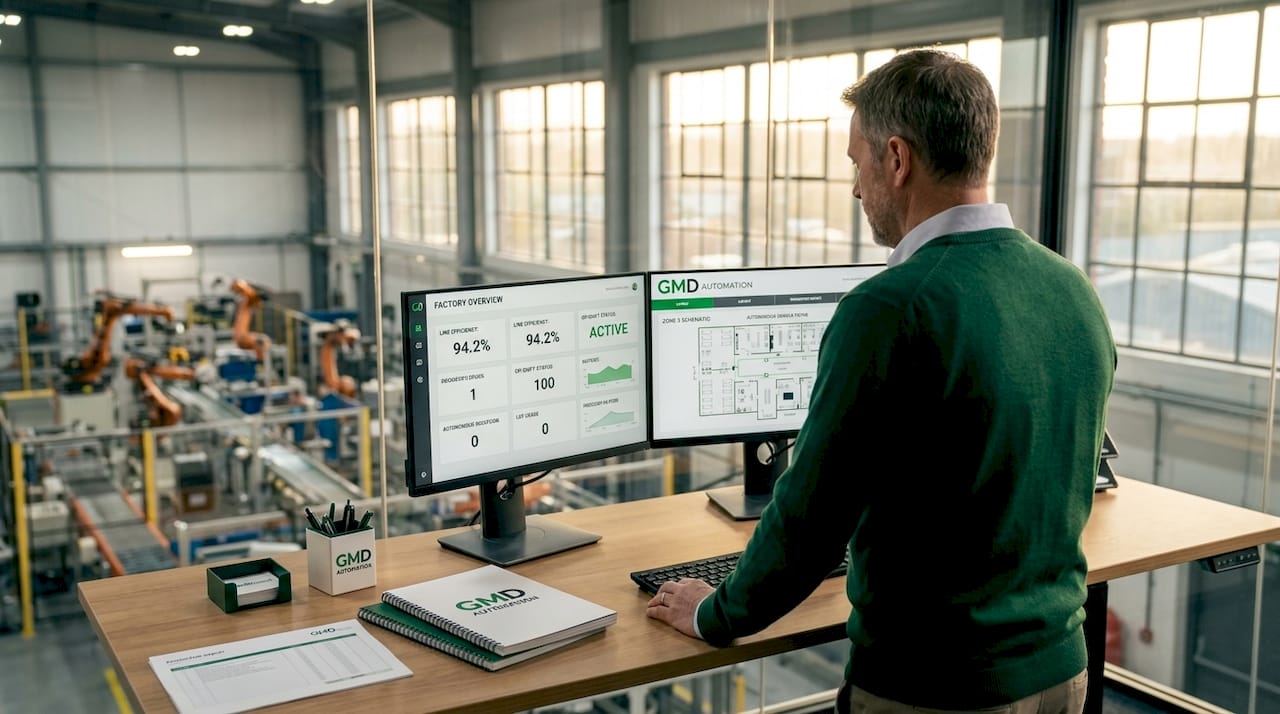
Digital twins are a standout application. By creating a real-time virtual replica of a production facility, AI can simulate thousands of scheduling scenarios in seconds and identify the configuration that maximises throughput. This is not theoretical. Manufacturers using AI in this way report measurable reductions in unplanned downtime and faster recovery when disruptions occur.
AI scheduling under operational disruption enables rapid re-optimisation across production lines, which is where much of the ROI lives. The value is not just accuracy on a given day. It is responsiveness when things go wrong.
PepsiCo's use of AI for demand forecasting and production planning is a well-documented example. By automating the translation of sales data into adjusted production schedules, they reduced waste and improved on-shelf availability. That kind of end-to-end loop closure is precisely what separates high-performing AI deployments from limited pilots. For operations managers considering scalable AI architecture, manufacturing offers some of the clearest evidence for ROI.
2. Refining and energy: margin optimisation at scale
Refining sits at the sharper end of AI automation impact. Margins are thin, operations run continuously, and every scheduling decision affects profitability directly.
A refiner employing AI-powered digital twin scheduling lifted per-barrel margins by £0.15 to £0.30, generating savings exceeding $80 million. Those numbers reflect what happens when AI closes the decision loop between feedstock pricing, production scheduling, and output mix in real time.
The specific advantages in this sector include:
- Real-time blending optimisation based on current feedstock costs
- Automated re-scheduling when supply or demand conditions shift
- Predictive maintenance reducing unplanned shutdowns
- Margin modelling across product slates that updates continuously
The energy sector more broadly is following a similar path, with AI monitoring grid stability, forecasting renewable output, and managing load balancing tasks that previously required large specialist teams. For businesses in this space, the question is not whether AI adds value. It is how quickly they can build the data infrastructure to support it.
3. Retail and consumer packaged goods: cost impact and customer experience
Retail and CPG businesses are among the clearest industries using AI to deliver financial results. 37% of retail and CPG firms report over 10% cost reductions attributed to AI. That figure stands out even against a backdrop of broad adoption across sectors.
The applications driving this include:
- Inventory management. AI predicts demand at the SKU level, reducing overstock and out-of-stock situations simultaneously.
- Store digital twins. Lowe's use of AI digital twins for 3D store modelling at minimal cost enables precise planogram management and asset discovery without manual audits.
- Product image automation. AI generates, checks, and updates product imagery at scale, cutting the cost and time of catalogue maintenance dramatically.
- Personalised marketing. Generative AI tools now produce tailored promotional content based on customer segment data, improving conversion rates without expanding marketing headcount.
The consumer goods companies moving fastest here are those treating AI not as a point solution for one department but as an operating layer across merchandising, marketing, and fulfilment. That integration is what turns individual efficiency gains into a structural cost advantage.
4. Financial services: document handling and process efficiency
Financial services firms deal in information. Contracts, applications, reports, compliance filings, and client communications represent an enormous volume of text-heavy work that AI handles well.
Nasdaq's deployment of an internal AI platform demonstrates the dual value available in this sector. Internally, it reduces the time analysts spend on data aggregation. Externally, it supports client-facing tools that respond to queries faster and with greater consistency. Both effects improve unit economics across the business.
The most quantifiable gains are appearing in:
- Financial planning processes, where AI reduces preparation costs by approximately 35% by automating data gathering, scenario modelling, and report generation
- Compliance monitoring, where AI reviews documents against regulatory frameworks continuously rather than in periodic audits
- Client onboarding, where AI automates identity verification and document checks, cutting days off a process that historically frustrated clients and staff alike
Pro Tip: If your financial services firm is still relying on manual document review for compliance, that is the first process to target for AI automation. The accuracy and speed gains are immediate and measurable.
Professionals in this sector should read more about AI business benefits for UK firms to understand where automation augments rather than displaces skilled roles.
5. Insurance: claims processing and fraud detection
Insurance presents an interesting case because the AI automation benefits split across two very different value pools: cost reduction through automation and revenue protection through fraud prevention.
On the cost side, AI handles first-notice-of-loss intake, extracts relevant data from claim documents, and routes claims to the appropriate handler without manual triage. For high-volume, low-complexity claims such as motor or home contents, AI can process end-to-end with minimal human involvement.
On the fraud side, AI identifies patterns across thousands of claims that no human team could detect at speed. Anomalies in reported damage, mismatches between incident descriptions and photographic evidence, and network connections between claimants are all surfaces AI analyses continuously.
Firms that have deployed AI across both functions report faster average claim settlement times and material reductions in fraudulent payouts. Those two improvements together represent a significant shift in combined operating ratio, which is the metric that ultimately determines profitability in this sector.
6. Healthcare and life sciences: reducing administrative burden
AI benefits for healthcare are perhaps the most human in character. The problem AI is solving here is not primarily financial. It is time. Clinicians spend disproportionate hours on documentation, scheduling, and administrative coordination rather than direct patient care.
Consider the before and after:
| Without AI | With AI |
|---|---|
| Manual clinical note entry post-consultation | AI assistant transcribes and structures notes in real time |
| Scheduling managed by administrative staff | AI optimises appointments based on clinical urgency and resource availability |
| HR queries handled by HR team manually | AI chatbot resolves routine staff queries without human involvement |
| Documentation error rates at baseline | 68% reduction in documentation errors with AI assistant support |
IBM's AI-enabled HR chatbot provides a useful cross-sector illustration. It resolved over 90% of HR inquiries autonomously, reducing HR costs by 40% and improving satisfaction scores by 74 points. Healthcare organisations applying the same logic to workforce scheduling and administrative support are seeing similar patterns.
Pro Tip: For healthcare operations managers, start with documentation and scheduling before moving to clinical decision support. The administrative gains are faster to achieve and build the organisational confidence needed for more complex applications.
7. Logistics and supply chain: routing and real-time decision-making
AI in logistics turns what was a largely reactive operation into one that anticipates and adapts. Route optimisation, warehouse picking sequences, driver scheduling, and load consolidation are all decisions AI handles faster and with more variables in play than human planners can manage.
The financial logic here is straightforward. Fuel costs, vehicle utilisation, and labour represent the dominant costs in logistics operations. AI consistently improves performance across all three by finding efficiencies that are invisible at human-scale analysis.
Businesses adopting AI in logistics report reductions in empty miles, faster order-to-delivery cycles, and better on-time performance. These improvements compound over time as the AI learns the specific patterns of a given network. Firms interested in understanding IT automation trends shaping supply chain technology will find that logistics sits near the top of investment priority lists globally.
8. Professional services: planning, HR, and client delivery
Professional services firms operate on margins that depend heavily on time-to-output. AI automation targets that ratio directly by handling the preparatory, analytical, and documentation work that currently consumes billable hours.
Successful AI adoption is staged, beginning with augmenting tasks rather than substituting labour. That principle fits professional services well. A strategy consultant who spends four hours gathering market data before analysis now spends forty minutes. The intellectual contribution remains human. The grunt work does not.
The AI automation sectors within professional services showing fastest returns include HR operations, financial planning, legal document review, and project management reporting. Each of these involves high-volume, structured information where AI accuracy is demonstrably reliable.
My perspective on what actually separates successful AI adoption from expensive disappointment
I've reviewed enough AI deployments to know that the technology is rarely the limiting factor. What separates a business that captures genuine, sustained value from AI automation and one that ends up with an expensive tool nobody uses is almost always organisational.
70% of AI cost transformation effort belongs in governance and behaviour change, not in the technology itself. That figure surprises people when they first hear it. It shouldn't. Every workflow that AI touches involves people who have been doing things a certain way. Without deliberate change management, those people work around the AI rather than with it.
What I've learned is that leaders must redesign workflows rather than simply accelerate existing ones. Automating a broken process just produces broken results faster. The most effective deployments I've seen treat AI as an opportunity to rethink how work gets done from first principles.
The industries that are genuinely winning with AI are the ones where leadership committed to both the technology and the change. Not one or the other.
— Ravi
How Gmdautomation helps UK businesses capture these gains
If the sector analysis above has surfaced opportunities relevant to your operations, the practical question is how to move from interest to deployment without taking on disproportionate risk or capital expenditure.
Gmdautomation delivers enterprise-grade AI automation systems built specifically for UK businesses, with no upfront costs and a predictable monthly subscription that covers implementation, operation, and ongoing optimisation. Whether your priority is logistics, financial services, healthcare administration, or retail operations, the platform is designed to deploy rapidly and scale as your needs grow. Every system is built for security and compliance from the outset. If you are ready to evaluate what AI automation can do for your specific operation, explore Gmdautomation's solutions and see the capabilities firsthand.
FAQ
Which industries benefit most from AI automation?
Manufacturing, retail, financial services, and healthcare consistently show the strongest returns. Retail and CPG lead on cost reduction, with 37% of firms reporting over 10% savings attributed directly to AI.
How does AI automation reduce costs in business?
AI reduces costs by automating high-volume repetitive tasks, improving scheduling accuracy, and cutting errors in documentation and compliance. 87% of organisations report measurable cost reductions after AI adoption.
Is AI automation replacing workers or augmenting them?
The dominant pattern is augmentation rather than replacement. Most firms deploy AI to handle routine or preparatory tasks, freeing workers to focus on higher-value activities. Staged rollouts focused on augmentation also reduce workforce resistance significantly.
How long does AI automation typically take to show results?
Results in areas like document processing and scheduling can appear within weeks of deployment. Broader operational gains, particularly those tied to workflow redesign, typically materialise over three to twelve months.
What is the biggest risk when adopting AI automation?
Under-investing in governance and change management. Research consistently shows that 70% of sustained AI effectiveness depends on organisational behaviour change, not the technology itself.