

Free trial AI automation evaluation is the process of systematically testing AI automation tools in a real-world business context to determine their cost-effectiveness, integration fit, and operational impact before purchase. For UK business owners, this structured approach separates genuine operational gains from vendor marketing. Tools like Zendesk, Revo, and Applitools all offer trial periods, but a trial without a methodology produces impressions, not evidence. The difference between a demo and a structured pilot is documented success criteria, real inputs, and a scoring rubric you define before you log in.
How to prepare for a free trial AI automation evaluation
Preparation determines whether your trial produces a decision or just a feeling. Most businesses skip this stage and end up extending trials indefinitely because they cannot answer a simple question: did it work?
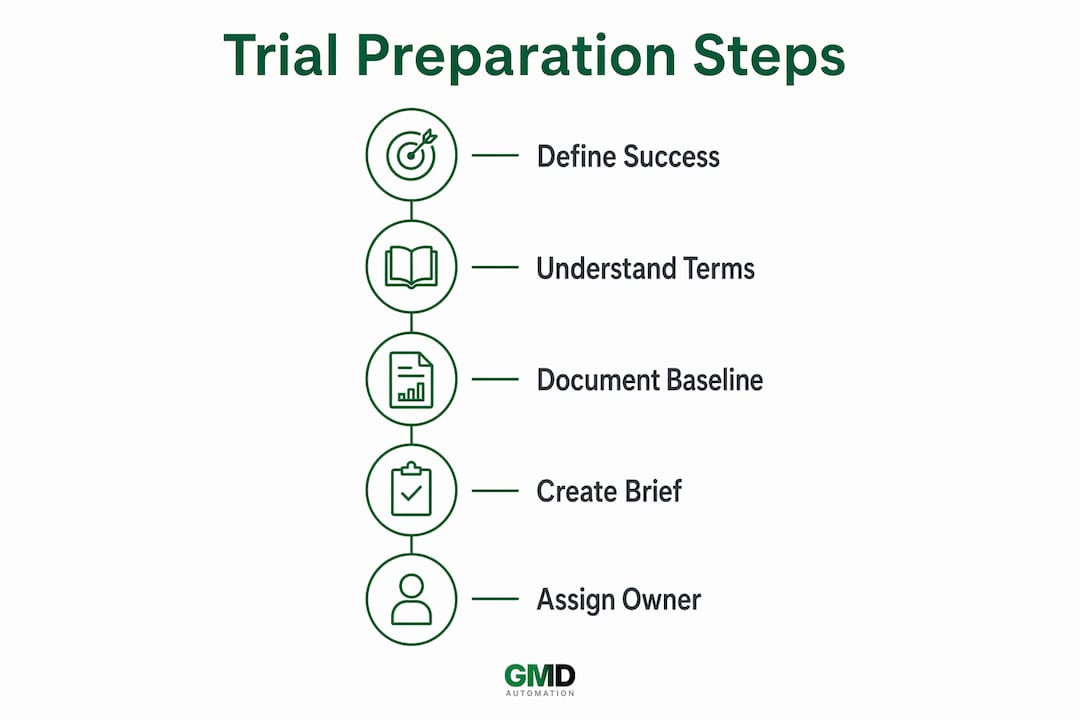
Start by defining success criteria before you touch the product. Write down three to five measurable outcomes you expect the tool to achieve. Examples include reducing invoice processing time by 30%, cutting customer query response time to under two minutes, or achieving 95% accuracy on document classification. Vague goals like "see if it helps" produce vague conclusions.
Next, compile representative, real-world inputs for your tests. Do not use dummy data. Use the actual documents, queries, or workflows the tool will handle in production. A tool that performs well on sanitised test data but fails on your real customer emails tells you nothing useful.
Set up a pre-defined scoring rubric before the trial begins. Score each dimension on a numeric scale:
- Output quality: Does the tool produce accurate, usable results?
- Reliability: Does it perform consistently across different inputs?
- Cost transparency: Are pricing tiers and usage limits clearly stated?
- Integration ease: Does it connect to your existing systems without significant engineering effort?
- Exit safety: Can you export your data and disengage without friction?
Understand the trial terms in full. Typical UK free trials for AI automation tools last 7–14 days, with many vendors offering no credit card entry and cancel-anytime policies. That window is shorter than it sounds when you factor in setup time, team availability, and the learning curve.
Document your current baseline before you start. Record how long your target process takes today, what it costs, and where errors occur. Without a baseline, you cannot calculate what the tool actually changed.

Pro Tip: Create a one-page trial brief shared with every team member involved. It should list the success criteria, the test scenarios, and who is responsible for logging results. This prevents the trial from becoming an informal product browse.
How to conduct the trial: step-by-step execution
Running the trial well is a discipline. Follow these steps to extract decision-grade evidence from your free evaluation period.
-
Audit the trial allocation first. Check how usage is metered. Some tools count tokens, others count API calls or automation runs. Understanding usage metering is critical to avoiding fast consumption of free credits during exploratory testing.
-
Use sandbox environments for exploration. A sandbox with non-production data should handle all exploratory testing. Reserve your real trial credits for structured test cases with representative business inputs.
-
Run structured test cases. Map each test case to a specific business use case from your success criteria list. Run each scenario at least three times to check for consistency.
-
Log every failure, hallucination, and unexpected output. Do not dismiss anomalies. A tool that produces one wrong answer in ten may be acceptable for low-stakes tasks. For financial or compliance processes, that error rate is disqualifying.
-
Score results systematically. Apply your rubric after each test case. Record numeric scores, not subjective impressions.
-
Record time saved and operational impact. Compare each result against your documented baseline. Calculate the actual time reduction per transaction.
-
Test integration and exit capabilities. Connect the tool to at least one existing system. Check whether data exports cleanly and whether API access is available without a premium tier upgrade.
Here is an example scoring table for a document processing automation trial:
| Test Dimension | Score (1–5) | Notes |
|---|---|---|
| Output accuracy | 4 | Correct on 19 of 20 invoices |
| Processing speed | 5 | 80% faster than manual baseline |
| Integration ease | 3 | Required IT support to configure |
| Pricing clarity | 2 | Overage charges not clearly stated |
| Exit safety | 4 | Full CSV export available |
Pro Tip: Assign one team member as the trial log owner. Every test result, error, and observation goes into a shared document in real time. Trying to reconstruct what happened at the end of the trial produces unreliable data.
What cost and compliance factors must you evaluate?
Cost and compliance are where most UK business trials fall short. Vendors present headline pricing. The real cost is always higher.
AI automation tools often carry complex pricing with usage limits that trigger surprise charges. Lack of transparent pricing is a red flag in any evaluation framework. Calculate the fully loaded cost per completed transaction. This means adding licence fees, engineering time, governance overhead, and the cost of handling exceptions the tool cannot process. Measuring true ROI requires accounting for all costs, not just headline licence fees or headcount reduction.
On the compliance side, UK businesses face a specific regulatory environment in 2026. The ICO code of practice will formalise expectations for AI use and automated decision-making under UK data protection law. Any tool processing personal data or making automated decisions about individuals falls within this scope.
Meaningful human involvement in automated decision-making requires active authority and discretion at the point of decision. Token approval, where a human simply clicks confirm without reviewing the output, does not satisfy UK ADM guidance. Your trial must test whether the tool's workflow design allows genuine human review.
"Planning compliance-related governance during a trial prevents retroactive fixes and regulatory risks post-deployment."
AI automation pilots in high-risk or data-processing contexts require early governance artefacts, including Data Protection Impact Assessments. Prepare a DPIA template before your trial begins if the tool will touch personal data. Doing this after deployment is far more costly.
Also assess integration and exit safety as part of your risk evaluation. Tools that seem attractive initially are sometimes siloed or difficult to extract from later. Check API access, data portability, and rollback mechanisms during the trial, not after you have signed a contract.
For a fuller picture of how to account for all deployment costs, the cloud deployment cost checklist from Koritsu provides a practical framework for CTOs assessing total cost of ownership.
Common pitfalls when you evaluate AI automation tools
These are the mistakes UK business owners make most often during free AI evaluation periods. Each one is avoidable.
-
Confusing demos with pilots. A vendor demo is a controlled performance. A pilot is a test you design and control. The biggest pitfall in AI tool trials is treating a demo as evidence of real-world performance.
-
Skipping success criteria. Starting a trial without defined outcomes means you will judge the tool on feel rather than data. You cannot make a defensible investment decision on feel.
-
Burning credits on exploration. Many teams spend the first week of a trial clicking around the interface. By the time they run structured tests, the free allocation is gone.
-
Ignoring integration constraints. A tool that works in isolation but cannot connect to your CRM, ERP, or data warehouse creates more work than it removes. Test integration in week one, not week three.
-
Incomplete cost accounting. Comparing only licence costs across tools misses engineering time, exception handling, and governance overhead. Use a fully loaded cost methodology to compare candidates fairly.
-
Underestimating regulatory requirements. UK businesses processing personal data through AI tools face ICO scrutiny. Discovering a compliance gap after deployment is expensive.
Pro Tip: Reserve at least 40% of your trial credits for the final structured test phase. Spend the first portion on setup and sandbox exploration, then deploy the bulk of your allocation on planned, scored test cases.
How to interpret trial results and make the investment decision
Trial data is only useful if you analyse it systematically. Raw scores and notes do not make a decision. You do.
Start by comparing scored metrics across all candidate tools. If you tested more than one product, place their rubric scores side by side. An AI tool decision matrix scoring across dimensions like cost, integration, and time saved helps filter candidates clearly. Tools scoring below 10 out of 25 across five dimensions should be discarded. Tools scoring above 15 warrant further consideration.
Review the operational impact data against your baseline. Calculate the actual time saved per transaction, the error rate reduction, and the cost per completed task. Then compare this against the fully loaded monthly cost of the tool. For guidance on building this business case, the AI automation ROI guide from Gmdautomation provides a structured 2026 methodology.
Assess compliance readiness as a separate gate. A tool that scores well on performance but fails on governance is not deployable in a UK regulated context. Compliance is not a secondary consideration.
Produce a decision memo before your final meeting. The memo should include:
- Trial summary: What you tested, how, and with what inputs
- Scored results: Rubric scores per tool per dimension
- Cost analysis: Fully loaded cost per transaction versus baseline
- Compliance assessment: DPIA status, ADM review capability, data portability
- Recommendation: Scale, renegotiate, or discard, with clear rationale
This document gives executives the evidence they need to approve or reject the investment. It also protects the evaluation team if the decision is later questioned.
For businesses considering how AI automation scales beyond the trial phase, architecture decisions made during evaluation directly affect long-term deployment costs and flexibility.
Key takeaways
A structured free trial AI automation evaluation produces decision-grade evidence by combining pre-defined success criteria, real-world test inputs, fully loaded cost accounting, and UK compliance checks before any purchase commitment.
| Point | Details |
|---|---|
| Define success criteria first | Set three to five measurable outcomes before the trial begins to avoid subjective conclusions. |
| Protect your trial credits | Use sandbox environments for exploration and reserve real credits for structured, scored test cases. |
| Account for all costs | Calculate fully loaded cost per transaction including licences, engineering time, and exception handling. |
| Compliance is a gate, not a footnote | Assess ICO code of practice requirements and DPIA needs during the trial, not after deployment. |
| Produce a decision memo | Document scored results and recommendations so executives can make an evidence-based investment decision. |
Why most UK businesses get AI trials wrong
I have watched UK business owners approach AI automation trials the same way they approach a software demo: they log in, click around, and decide based on how the interface feels. That approach produces a purchasing decision based on user experience design, not operational evidence.
The businesses that get real value from free AI evaluation periods treat the trial like a small procurement exercise. They write a brief. They assign a log owner. They run the same test case three times to check for consistency. They calculate what the tool actually costs when you add engineering time and governance overhead. That discipline feels like extra work upfront. It saves months of regret later.
The UK regulatory environment in 2026 adds a layer that most evaluation frameworks from US-based vendors simply do not address. The ICO's automated decision-making code of practice is not optional. If your AI tool is making or influencing decisions about customers or employees, you need to know whether your human review process meets the meaningful involvement standard before you deploy, not after your first ICO inquiry.
My practical advice: treat the first two days of any trial as setup only. Write your test cases, configure your sandbox, and read the pricing documentation in full. Then spend the remaining time running structured tests you designed. The vendors who make this easy are the ones worth trusting with your operations.
— Ravi
Start your AI automation trial the right way with Gmdautomation
Choosing the right AI automation tool is a significant decision. Gmdautomation works specifically with UK businesses to make that decision easier and lower-risk.
Gmdautomation offers guided free trial support designed for decision-makers who need evidence, not just a product login. Their AI automation solutions are built for UK compliance requirements, deploy without upfront capital expenditure, and come with transparent monthly pricing that covers implementation, operation, and ongoing support. If you are ready to test AI automation software against your real business processes and get measurable results, Gmdautomation provides the structure and expertise to make your evaluation count.
FAQ
What is a free trial AI automation evaluation?
A free trial AI automation evaluation is a structured process of testing AI automation tools using real business inputs, defined success criteria, and a scoring rubric to produce evidence before purchase. It differs from a demo in that you control the test conditions and measure outcomes against a documented baseline.
How long do AI automation free trials typically last in the UK?
Most UK AI automation free trials last 7–14 days. Zendesk offers a 14-day trial and Revo offers a 7-day trial, both with no credit card required.
What compliance checks are required during an AI automation trial?
UK businesses must assess ICO code of practice requirements, prepare a Data Protection Impact Assessment for tools processing personal data, and verify that human review processes meet the meaningful involvement standard under UK ADM guidance.
How do i avoid wasting free trial credits?
Use a sandbox environment with non-production data for all exploratory testing and reserve your real trial allocation for structured, scored test cases with representative business inputs.
What should a trial decision memo include?
A trial decision memo should include a summary of what was tested, scored rubric results per tool, a fully loaded cost analysis, a compliance assessment, and a clear recommendation to scale, renegotiate, or discard the tool.