

Integration complexity is the single factor that decides whether an AI pilot becomes enterprise value or stays a proof-of-concept that nobody scales. The model itself is rarely the problem. What stalls organisations is the connective tissue: how data flows between systems, who owns the handoffs, and whether the infrastructure can sustain production load without constant firefighting.
The core reasons this matters:
- Data connectivity: AI models are only as useful as the data they can reach in real time. Siloed systems produce siloed insights.
- Workflow handoffs: An AI recommendation that cannot trigger a downstream action in another system creates manual workarounds, not efficiency.
- Governance and ownership: Without clear accountability for integration points, failures go undiagnosed and fixes are ad hoc.
- Operational resilience: Production integrations break. Credential expiry, API changes, and schema drift are routine. Systems without monitoring and retry logic fail silently.
Research confirms this framing: AI integration is a multidimensional organisational process in which governance and technological competence jointly determine whether integration delivers performance gains or merely adds cost.
Pro Tip: In the first 30 days, map every system your proposed AI solution must read from or write to. If you cannot name the owner of each API and the data quality SLA for each feed, your integration is already at risk.
Key takeaways
Integration complexity determines whether AI delivers enterprise value or remains a collection of isolated pilots. Organisations that treat integration as strategic infrastructure, assign clear ownership, and invest in observability consistently outperform those that treat it as a technical afterthought.
| Point | Details |
|---|---|
| Integration determines scale | A model's value depends on how far its outputs travel across systems, not on benchmark accuracy alone. |
| Operational debt accumulates fast | Credential expiry, schema drift, and brittle point fixes are the leading causes of production failure and budget overrun. |
| Readiness before deployment | Audit data quality, API ownership, and monitoring capability before committing to a production integration programme. |
| 18–24 months for material ROI | Realistic timelines for substantive integration work run 18–24 months; set board expectations accordingly. |
| Gmdautomation as managed route | Gmdautomation's subscription model covers implementation, operations, compliance, and monitoring for UK businesses scaling AI. |
Table of Contents
- Why AI integration complexity matters: the scaling paradox
- What does AI integration complexity actually look like?
- What are the most costly integration pitfalls?
- How do you assess readiness and estimate ROI for integration work?
- Which architectural patterns reduce integration complexity?
- Build versus buy: how do you decide what to do in-house?
- How do governance and change management tame integration complexity?
- A practical 90-day checklist for UK business leaders
- The integration-first argument most leaders still resist
- How Gmdautomation reduces integration complexity for UK businesses
- Sources
Why AI integration complexity matters: the scaling paradox
A model that works brilliantly in a pilot but cannot propagate its outputs across the organisation is, commercially, almost worthless. This is the AI scaling paradox: model capability and enterprise connectivity are separate problems, and most organisations invest heavily in the first while underestimating the second.
The automation–integration framework captures this precisely. Automation determines what the AI can do; integration determines how far its effects travel. A high-automation, low-integration deployment optimises one team's workflow. A high-automation, high-integration deployment changes outcomes across the organisation because the same signal reaches procurement, operations, finance, and customer service simultaneously.
Consider a concrete example. A demand-forecasting model predicts a supply shortfall three weeks out. If that prediction lives in a dashboard that one analyst checks, the organisation might act on it. If the same prediction automatically updates the ERP reorder schedule, triggers a supplier notification, and flags the risk in the finance planning tool, the organisation will act on it, faster and with less human friction. The model is identical in both cases. The integration layer is what separates a useful insight from a measurable business outcome.
Statistic callout: Gartner predicts that 40% of enterprise applications will feature task-specific AI agents by 2026, up from fewer than 5% in 2025. That trajectory means integration infrastructure will need to support an order-of-magnitude increase in AI touchpoints within a very short window.
The organisations most likely to realise measurable ROI are those that treat integration as a strategic infrastructure investment, not an afterthought, as demonstrated by advances in AI in facility management boosting efficiency and security. Oxford Economics and SAP research finds that firms concentrating on a small number of high-impact initiatives and investing in integration infrastructure are significantly more likely to translate AI experiments into business value. Spreading effort across many disconnected pilots is the pattern most associated with stalled programmes.
The types of operational workflows AI optimises span procurement, customer service, finance, and logistics. Each of those workflows crosses system boundaries. That is precisely why integration is the lever that determines scale.
What does AI integration complexity actually look like?
Complexity in AI integration is not abstract. It shows up in specific, recognisable patterns across two dimensions: technical and organisational.
Technical dimensions
- Legacy systems: Older ERP, CRM, and data warehouse platforms were not designed for real-time API calls or event-driven architectures. Connecting them to modern AI layers requires translation, buffering, and often bespoke middleware.
- API heterogeneity: Enterprise environments typically run dozens of APIs with different authentication schemes, versioning policies, and rate limits. Managing these consistently across an AI platform is non-trivial.
- Data quality and schema mismatch: AI models require clean, consistently structured inputs. In practice, field names differ between systems, nulls are handled inconsistently, and data arrives in batches rather than streams.
- Event volumes and rate limits: At production scale, event throughput can exceed what upstream systems were designed to handle, causing throttling, dropped events, and silent data loss.
- Tenant isolation and auth management: Multi-tenant deployments must enforce strict data boundaries. Token expiry, credential rotation, and permission scope errors are among the most common production failures.
Organisational dimensions
- Unclear ownership: When an integration breaks, no single team owns the fix. IT blames the vendor; the vendor blames the data team; the data team blames the business unit.
- Skills gaps: Building and operating production-grade integrations requires capabilities — SRE practices, observability tooling, API lifecycle management — that many enterprise teams lack.
- Cross-functional coordination: AI workflows cross departmental lines. Without a shared process for approving changes to shared data feeds, one team's update breaks another team's model.
- Governance gaps: Without documented data product ownership, SLOs, and change management gates, integration debt accumulates invisibly.
The pilot-to-production failure pattern
The most common failure mode looks like this: a pilot runs in a sandboxed environment with a curated dataset, manual data loads, and a dedicated engineer babysitting the connections. It performs well. The business case is approved. Then the team attempts to connect the model to live systems at scale. Data handoff gaps appear immediately. The model receives stale or malformed inputs. Dependency chains break when an upstream API changes without notice. Override loops emerge when the AI's output conflicts with a legacy system's rules engine and neither system wins cleanly.

Practitioner analysis of these failure patterns confirms that these issues are predictable and largely preventable, but only if pilots are designed to include at least one real integration touchpoint from the start. A pilot that never touches a live system cannot surface the problems that will kill the production deployment.
Pro Tip: When triaging which complexities to address first, rank them by blast radius. A credential expiry in a core data feed affects every model that depends on it. A schema mismatch in a low-volume reporting feed affects one dashboard. Fix the high-blast-radius issues before anything else.
What are the most costly integration pitfalls?
Understanding AI integration issues means knowing not just where things go wrong, but how much they cost when they do. These are the failure modes that consume the most budget and time.
Data handoff gaps sit at the top. When the output of one system does not map cleanly to the input schema of the next, engineers spend weeks writing and maintaining transformation logic. At scale, this becomes a permanent maintenance burden.
Credential and token expiry is the most underestimated operational risk. OAuth tokens, API keys, and service account credentials expire. Without automated rotation and monitoring, integrations fail silently at 2 AM on a Sunday, and nobody notices until a business process has been running on stale data for hours.
Brittle point fixes accumulate when teams patch individual integration failures without addressing the underlying architecture. Each fix creates a new dependency. Within 12 months, the integration layer is a tangle of undocumented workarounds that nobody dares touch.
Monitoring blind spots mean that failures go undetected. Practical evidence from DevOps practitioners shows that AI accelerates the building of integrations but does nothing to address the operational burden of running them. More integrations built faster, without corresponding investment in observability, means more things breaking in ways nobody can see.
Schema drift occurs when an upstream system changes its data structure without notifying downstream consumers. The AI model continues to run, but its inputs are now subtly wrong. The outputs degrade gradually, and the root cause is hard to trace.
Override loops emerge when AI outputs conflict with hard-coded rules in legacy systems. The AI recommends action A; the rules engine enforces action B; the result is a loop that neither resolves nor escalates, consuming compute and producing nothing.
The cost implications are concrete: delayed ROI as rework consumes the engineering budget, cancelled rollouts when the board loses confidence after a high-profile failure, and ongoing support overhead that was never in the original business case.
Pro Tip: Set up a weekly integration health review in the first three months of any production deployment. Track error rates, latency percentiles, and credential expiry dates in a single dashboard. An incipient failure almost always shows up as a trend before it becomes an outage.
How do you assess readiness and estimate ROI for integration work?
Most organisations underestimate both the time and the total cost of ownership for integration work. Consultancy experience consistently points to hidden costs in infrastructure, data preparation, and ongoing maintenance that inflate budgets significantly beyond initial estimates, with 18–24 months being a realistic horizon for material ROI on substantive integration programmes.
Readiness checklist
Before committing to an integration programme, assess these five areas honestly:
- Data: Are your primary data sources clean, consistently structured, and accessible via documented APIs or feeds? If not, data remediation must precede model deployment.
- APIs: Do you have an API inventory? Are versioning policies documented? Are rate limits known and within the range your AI workloads require?
- Ownership: Can you name a single accountable owner for each integration point? If ownership is shared or unclear, governance work must come first.
- Monitoring: Do you have observability tooling in place for your current integrations? If not, you are flying blind before you add AI complexity.
- SRE/ops capability: Does your team have the skills to operate production integrations, including incident response, credential management, and dependency tracking?
The AI automation checklist for operations managers provides a complementary operational lens for this assessment.
Timeline buckets
- 0–3 months (quick wins): Integration audit, API inventory, data quality baseline, one redesigned pilot with a live integration touchpoint, monitoring dashboard stood up.
- 3–12 months (foundational work): Core integration platform selected or built, ownership model established, SLOs defined, credential management automated, first cross-functional workflow live in production.
- 12–24 months (enterprise scale): Multiple workflows integrated, data mesh or event-driven architecture partially in place, governance processes embedded, measurable ROI visible in cycle time and incident metrics.
ROI metrics worth tracking
- SLA adherence: Are integrations meeting their uptime and latency commitments?
- Override rate: How often does a human need to intervene to correct an AI output? A declining override rate signals that integration quality is improving.
- Cycle time reduction: How much faster does a cross-functional process complete with AI integration versus without?
- Cost of incidents: Track engineering hours spent on integration failures. This is the clearest signal of operational debt.
When presenting to the board, frame integration investment as infrastructure, not as a project cost. The analogy is network infrastructure: you do not ask for ROI on the network before you connect any systems. Integration is the network that makes AI useful.
Which architectural patterns reduce integration complexity?
There is no single architecture that suits every organisation. The right pattern depends on your existing systems, team capability, and the latency and consistency requirements of your AI workloads. The enterprise AI integration layer literature identifies several proven approaches.
API-first
Every service exposes a versioned, documented API as its primary interface. AI models consume and produce data through these APIs.
- Reduces complexity by: creating a consistent contract between systems; changes to internals do not break consumers.
- Adds overhead when: legacy systems cannot expose clean APIs without significant rework.
Event-driven / event streaming
Systems publish events to a central broker (such as Apache Kafka or AWS EventBridge). AI models subscribe to relevant event streams and publish their outputs as new events.
- Reduces complexity by: decoupling producers and consumers; handles high event volumes naturally; enables real-time decisioning.
- Adds overhead when: teams lack experience operating streaming infrastructure; event schema governance is weak.
Data mesh
Data ownership is distributed to domain teams, each of which publishes a data product with a defined schema and SLA. AI models consume data products rather than raw system feeds.
- Reduces complexity by: aligning data ownership with business domains; reduces the central bottleneck of a single data team.
- Adds overhead when: the organisation lacks the maturity to enforce data product standards consistently across domains.
iPaaS / central integration hub
A managed integration platform (such as SAP Integration Suite or MuleSoft) handles connectivity, transformation, and routing between systems.
- Reduces complexity by: centralising integration logic; providing pre-built connectors; offering monitoring and error handling out of the box.
- Adds overhead when: the platform becomes a bottleneck; vendor lock-in limits flexibility; licensing costs scale with volume.
Translation / adapter layer (gateway pattern)
A lightweight gateway translates between the AI model's expected interface and the heterogeneous interfaces of upstream systems. This is sometimes implemented as an MCP (Model Context Protocol) gateway.
- Reduces complexity by: isolating the AI layer from upstream changes; enabling rapid iteration on the model without touching source systems.
- Adds overhead when: the adapter layer itself becomes a maintenance burden if not well-governed.
For IT leaders navigating API integration choices, the practical decision often comes down to team capability and existing platform investment rather than theoretical architecture purity.
| Organisational profile | Recommended pattern |
|---|---|
| Mature API estate, strong engineering team | API-first with event streaming for high-volume flows |
| High event volumes, real-time decisioning needed | Event-driven / streaming architecture |
| Multiple domain teams, data ownership issues | Data mesh with domain data products |
| Limited integration engineering capacity | iPaaS / managed integration hub |
| Legacy systems, rapid AI iteration needed | Translation / adapter / gateway layer |
Build versus buy: how do you decide what to do in-house?
The build-versus-buy question in AI integration is not primarily a cost question. It is a question of where your organisation's differentiation actually lies.
Build in-house when the integration logic itself is a source of competitive advantage, when regulatory or latency constraints make a third-party platform unsuitable, or when your team has the capability to operate what they build. The role of IT in AI transformation is increasingly about making this call well, not about writing all the code.
Buy or procure when the integration problem is generic, when platform maturity exceeds what your team could build in a reasonable timeframe, or when total cost of ownership favours a subscription over a build-and-maintain cycle. System integrators increasingly adopt AI platforms precisely because the operational burden of running integrations reliably is underestimated until it is experienced.
When evaluating a platform or managed provider, assess these criteria:
- SLA commitments: What uptime and latency guarantees are contractually binding?
- Observability: Does the platform provide logs, traces, and alerts that your team can act on, or is monitoring opaque?
- Tenant isolation: For multi-tenant deployments, how is data separation enforced and audited?
- Security and compliance: Does the platform meet UK data protection requirements and relevant sector standards?
- Upgrade path: How does the vendor handle breaking changes in upstream APIs? Who absorbs that maintenance cost?
A neutral decision guide:
| Dimension | Build | Buy / managed |
|---|---|---|
| Strategic differentiation | High: logic is proprietary | Low: generic connectivity |
| Team capability | Strong SRE and integration engineering | Limited or stretched |
| Time to production | Longer; full build cycle | Faster; platform handles infrastructure |
| Ongoing maintenance cost | Internal engineering time | Subscription; vendor absorbs ops burden |
| Regulatory / latency constraints | Strict: may require on-premise | Flexible: cloud or hybrid options available |
Pro Tip: The most common mistake is defaulting to build because AI can generate integration code quickly. Generating code is not the hard part. Operating that code in production, handling credential rotation, monitoring for silent failures, and managing schema drift — that is where the cost lives. Build only what you genuinely need to own.
How do governance and change management tame integration complexity?
Technical architecture alone does not sustain integration quality. The academic literature on AI adoption consistently identifies organisational factors — workflow redesign, ownership clarity, governance — as the primary differentiators between organisations that scale AI and those that stall.
Governance playbook
- Assign a data product owner to every data feed that an AI model depends on. This person is accountable for schema stability, data quality SLAs, and change notification.
- Define SLOs (service level objectives) for each integration: uptime, latency, error rate. Review them monthly.
- Implement approval gates for changes to shared data feeds. A change that affects one team's model should require sign-off from all dependent teams.
- Maintain a risk register for integration dependencies. Flag high-blast-radius integrations and review them quarterly.
- Build ethical checks into the governance process: who reviews AI outputs for bias or unintended consequences before a new integration goes live?
Roles and responsibilities
Clear role definition prevents the ownership vacuum that kills integrations. At minimum, you need:
- Integration owner: accountable for the end-to-end reliability of a specific integration, including incident response.
- Data product owner: accountable for the quality and stability of a data feed.
- SRE / ops lead: responsible for monitoring, alerting, and on-call rotation across the integration estate.
- Business sponsor: the senior leader who owns the business outcome the integration is meant to deliver and who has authority to prioritise fixes.
Change management
Adoption does not happen because a system is deployed. Operations teams need AI training to understand what the AI is doing, why it sometimes gets things wrong, and how to escalate correctly. Without that, override rates stay high and the business case erodes.

Incentive alignment matters too. If a team's performance metrics reward speed and the AI integration slows their process during the transition period, they will work around it. Align metrics to the outcomes the integration is meant to produce, not the legacy process it replaces. A practical AI change management guide covers the roll-out cadence and behavioural measurement approaches that make adoption stick.
A practical 90-day checklist for UK business leaders
This checklist is sequenced by impact and designed to surface the highest-risk issues before they become expensive. The AI in business growth guide for UK leaders provides broader strategic context for framing these actions to the board.
Days 1–30: diagnostics
- Conduct an integration audit: list every system the proposed AI solution must connect to, the owner of each, and the current data quality status.
- Identify the three highest-blast-radius integration dependencies and assess their current reliability.
- Stand up a basic monitoring dashboard covering error rates and latency for existing integrations.
- Map governance gaps: where is ownership unclear? Where are SLOs absent?
Days 31–60: pilot redesign and governance starter
- Redesign at least one active AI pilot to include a live integration touchpoint, so data handoff gaps surface now rather than at production launch.
- Appoint integration owners and data product owners for the top five dependencies.
- Draft SLOs for each of those five integrations and get sign-off from business sponsors.
- Begin a credential audit: identify all API keys and tokens in use, their expiry dates, and whether rotation is automated.
Days 61–90: monitoring baseline and compliance review
- Implement automated credential rotation for the highest-risk integrations.
- Establish a weekly integration health review cadence.
- Review your AI deployment against relevant governance frameworks. In the UK, the ICO's guidance on AI and data protection is the primary compliance reference. NIST AI RMF and ISO/IEC 42001 provide internationally recognised risk management and management system standards that align well with UK practice and are increasingly referenced by UK regulators and procurement frameworks.
- Present a 90-day integration health report to the board, framing integration investment as infrastructure rather than project cost.
UK compliance note: UK GDPR and the Data Protection Act 2018 govern how AI systems process personal data. The ICO's AI guidance is the authoritative starting point. For organisations in regulated sectors (financial services, healthcare), the FCA and CQC have published additional AI-specific expectations. NIST and ISO standards are not legally binding in the UK but are widely used as evidence of due diligence.
- 30-day outcome: Clear picture of integration risk and ownership gaps.
- 60-day outcome: At least one pilot redesigned with live integration; governance roles assigned.
- 90-day outcome: Monitoring baseline in place; compliance review complete; board briefed.
The integration-first argument most leaders still resist
Most AI programmes are sold to boards on the strength of the model: the accuracy rate, the benchmark performance, the demo. Integration is presented as an implementation detail, something the technical team will sort out. That framing is why so many programmes stall.
The evidence points consistently in one direction. The gap between AI experimentation and enterprise value is predominantly organisational and infrastructural, not algorithmic. The Capability–Governance–Performance framework makes this explicit: capability without governance produces local optimisation at best. The organisations that scale AI are the ones that treat integration as a first-class strategic decision, fund it accordingly, and assign senior ownership to it.
There is a contrarian point worth making here. The rise of AI-assisted code generation has made it easier than ever to build integrations quickly. That is genuinely useful. But it has also created a new failure mode: organisations now build more integrations, faster, without the operational maturity to run them. The result is a larger, more fragile integration estate that breaks in more ways and costs more to maintain. Speed of construction is not the constraint. Operational discipline is.
The practical implication for leaders is this: before approving the next AI pilot, ask not "what can the model do?" but "what systems does it need to connect to, who owns those connections, and how will we know when they break?" That question, asked early, is worth more than any benchmark score.
How Gmdautomation reduces integration complexity for UK businesses
Managing integration complexity in-house demands significant engineering capacity, ongoing operational discipline, and deep familiarity with credential management, observability, and compliance requirements. For many UK businesses, that overhead is the real barrier to scaling AI, not the technology itself.
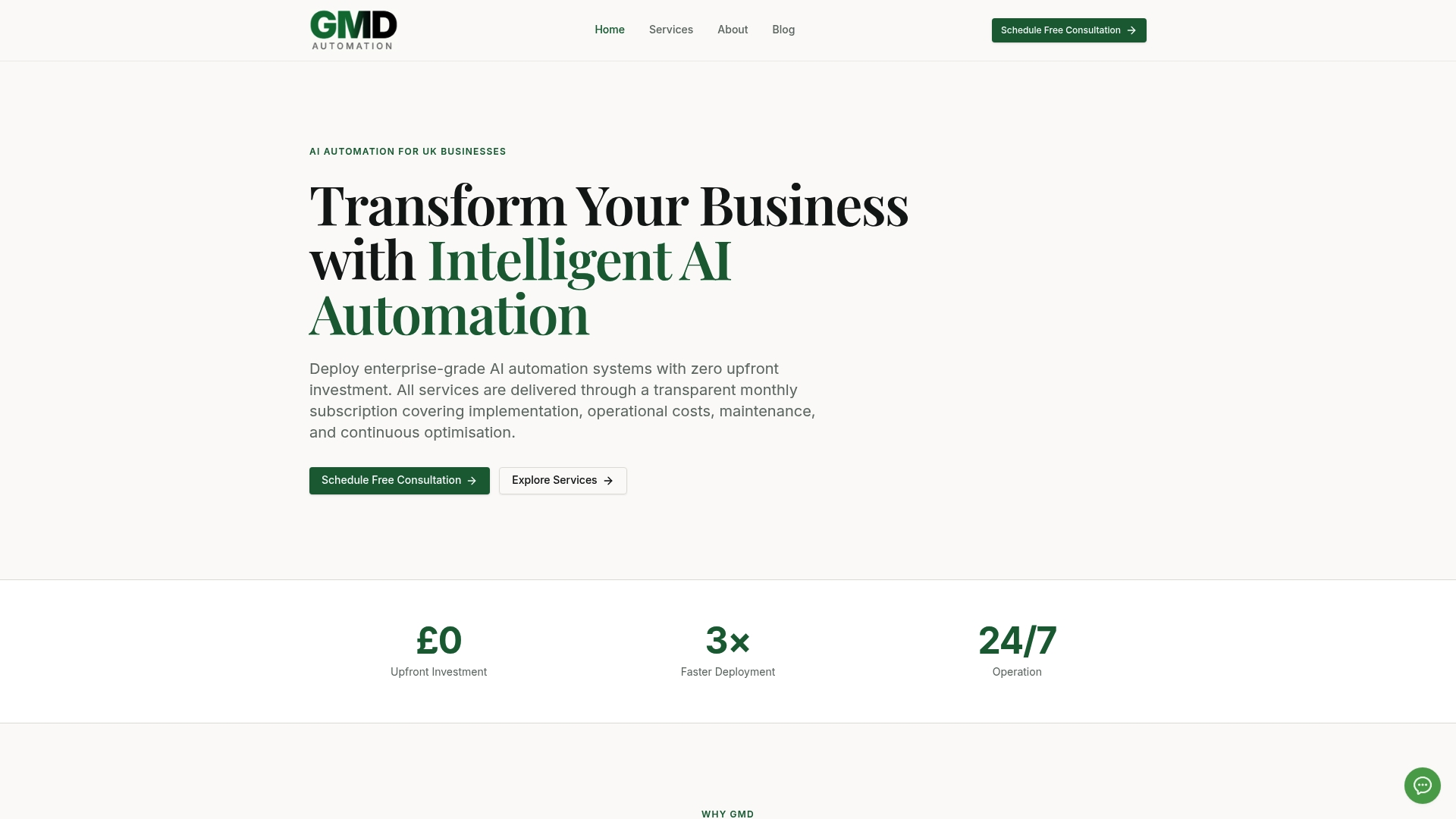
Gmdautomation delivers enterprise-grade AI automation as a fully managed subscription service, covering implementation, operation, maintenance, and ongoing optimisation from day one. There are no upfront capital costs, and the monthly fee includes the SRE and compliance work that typically consumes internal engineering time. Runbooks, monitoring, credential rotation, and incident response are part of the service, not extras to negotiate. For UK businesses navigating data protection requirements, compliance coverage is built in rather than bolted on.
If you want to see how a managed integration model works in practice, book a discovery call with Gmdautomation to assess your current integration estate and identify where a managed approach would reduce risk and accelerate time to value.