

System integrators adopt AI platforms to transform how they deliver enterprise integration, replacing slow, manual processes with automated, data-driven workflows that cut costs and accelerate delivery. Known formally as AI-augmented integration delivery, this shift is now a baseline requirement for any integrator competing for enterprise contracts in 2026. Industry analysts confirm that system integrators serve as the architects of secure, governed AI deployments, connecting AI innovation to real business execution across heterogeneous tech stacks. The reasons for AI adoption in integration go well beyond efficiency. They touch pricing models, competitive positioning, and the future shape of the profession itself.
Why system integrators adopt AI platforms for operational efficiency
The single biggest driver behind AI platform adoption is the reduction of manual integration effort. Enterprise teams using AI-assisted integration discovery have cut API onboarding cycles by 60–70%. That figure means engineers who previously spent weeks mapping endpoints and writing boilerplate connectors can now redirect that time to architecture, security, and client-facing work.
The productivity gains extend beyond onboarding. Organisations using agent management platforms to orchestrate workflows across multiple functions report over 65% reduction in development time. Platforms like Boomi AI and MuleSoft Anypoint use machine learning to suggest mappings, detect anomalies, and auto-generate integration logic. The result is faster product development cycles and fewer defects reaching production.
Specific operational improvements system integrators report include:
- Automated API discovery: AI crawls existing catalogues and identifies integration points without manual documentation review.
- Intelligent error handling: AI models detect failure patterns and suggest fixes before incidents escalate.
- Continuous testing: Automated regression suites run after every deployment, replacing manual QA cycles.
- Faster client onboarding: AI in client onboarding cuts the time from contract signature to live integration from weeks to days.
- Resource reallocation: Engineers shift from repetitive coding to higher-value design and governance tasks.
Pro Tip: Treat AI automation as a continuous delivery mechanism, not a one-off project accelerator. Integrators who embed AI into their delivery pipeline from day one compound efficiency gains across every subsequent engagement.
How do AI platforms reduce costs and reshape service delivery?
The financial case for AI platform adoption is grounded in total cost of ownership. Moving from project-based integration to continuous AI-augmented service reduces total cost of ownership by more than three years compared to traditional models. That is not a marginal saving. It fundamentally changes how integrators price and structure their services.

Traditional statement-of-work billing charges clients for hours and deliverables. AI-augmented delivery shifts the model toward outcome-based pricing, where integrators charge for results rather than effort. This is commercially attractive to enterprise buyers who want predictable costs and measurable returns. For integrators, it means higher margins on repeat work because AI handles the repetitive portions at near-zero marginal cost.
The deeper competitive shift is what analysts call the "productisation" of integration services. Manual coding commoditisation accelerates the need for productised delivery built on proprietary software accelerators unique to each integrator. Rather than reselling off-the-shelf AI subscriptions, leading integrators build their own accelerator libraries, pre-built connectors, and governed deployment templates. These become proprietary assets that competitors cannot easily replicate.
| Dimension | Traditional delivery | AI-augmented delivery |
|---|---|---|
| Pricing model | Hourly or SOW-based | Outcome and subscription-based |
| Delivery speed | Weeks to months per integration | Days to weeks per integration |
| Engineering focus | Manual coding and mapping | Architecture, governance, and oversight |
| Competitive asset | Consultant expertise | Proprietary accelerators and IP |
| Cost trajectory | Increases with project complexity | Decreases as AI learns and scales |
Pro Tip: Build a library of reusable AI-assisted connectors and templates from your first three engagements. By the tenth project, that library becomes a genuine competitive moat that justifies premium pricing.
Why is vendor neutrality critical for system integrators using AI?
Model-agnosticism is the practice of selecting AI tools based on client need rather than vendor relationship. Integrators who remain model-agnostic preserve their neutral advisor role and avoid the commercial and technical risks of single-provider lock-in. This matters enormously in 2026, when the AI platform market includes competing offerings from OpenAI, Anthropic, Google DeepMind, and a growing catalogue of open-source alternatives.
Vendor lock-in is a genuine operational risk. If an integrator builds its entire delivery stack on one provider's API, a pricing change, a model deprecation, or a compliance issue with that provider cascades directly into client engagements. Model-agnostic integrators construct AI gateways that abstract the underlying model from the integration logic, allowing them to swap providers without rebuilding client workflows.
The advisory value of neutrality is equally important. Enterprise clients hire integrators precisely because they expect unbiased recommendations. An integrator who can credibly evaluate OpenAI's GPT-4o against Anthropic's Claude 3.5 or a self-hosted open-source model demonstrates a depth of expertise that a single-vendor reseller cannot match.
Key considerations when selecting AI platforms for integration work:
- Licensing and data residency: Confirm whether the platform meets UK GDPR and sector-specific compliance requirements.
- API stability: Prioritise providers with published deprecation policies and long-term support commitments.
- Latency and throughput: Match model performance characteristics to the integration use case, real-time versus batch.
- Cost at scale: Model inference costs compound quickly at enterprise volumes; evaluate pricing tiers carefully.
- Open-source optionality: Maintain the ability to deploy open-source models on-premises for sensitive workloads.
What challenges do integrators face when adopting AI platforms?
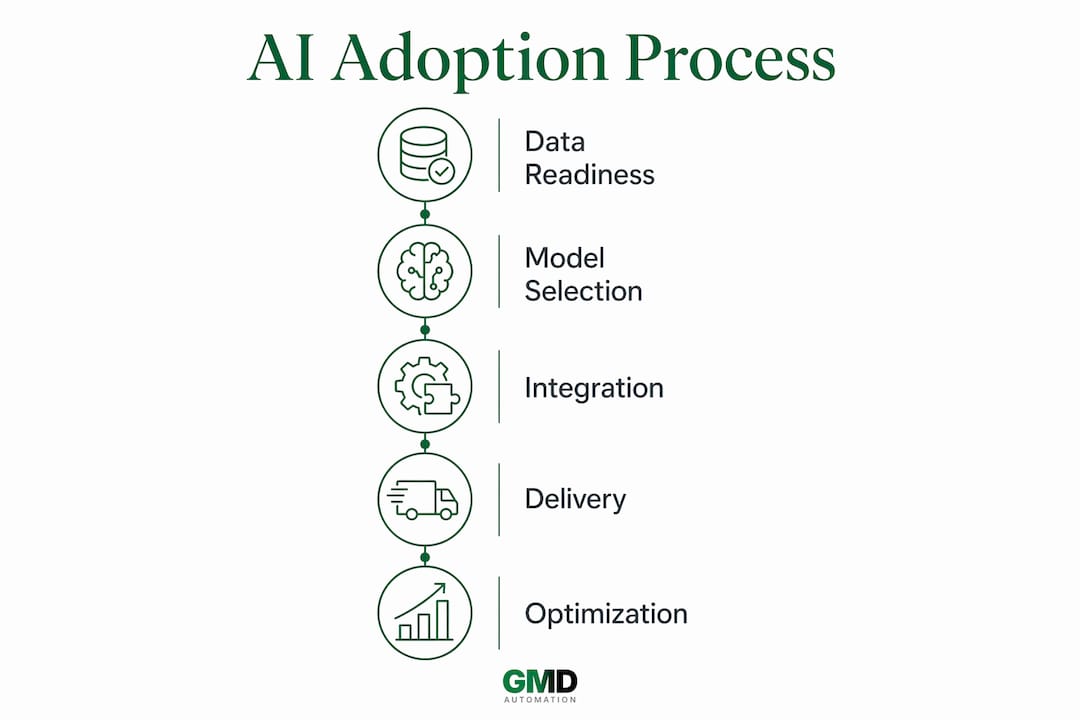
Data readiness is the largest single barrier to AI success in integration projects. Mastery of data strategy and governance is a prerequisite before AI orchestration can deliver business value. Integrators who skip this step find that AI models produce unreliable outputs because the underlying data is inconsistent, poorly labelled, or siloed across legacy systems.
A second challenge is commoditisation risk. Off-the-shelf AI models are available to every competitor. An integrator who simply wraps a generic AI API in a client proposal is not differentiated. The competitive advantage comes from proprietary accelerators and integration fabrics that encode the integrator's domain expertise into reusable, governed assets.
The transition to AI-native integration architectures also demands new skills. Agent frameworks such as LangChain, Microsoft AutoGen, and CrewAI require engineers to think in terms of task orchestration rather than sequential code execution. This is a genuine learning curve, and integrators who invest in upskilling early will find it easier to win contracts that specify agentic delivery.
Practical steps to overcome these challenges:
- Conduct a data audit before scoping any AI integration project. Identify gaps in data quality, ownership, and governance.
- Build proprietary accelerators from the first engagement rather than relying on vendor-supplied templates.
- Invest in training engineers on agent frameworks and prompt engineering as core delivery skills.
- Adopt an AI automation approach that treats governance and security as non-negotiable from the outset.
Pro Tip: Shift your pricing conversation before your delivery model changes. Clients who understand outcome-based pricing from the proposal stage are far more receptive to AI-augmented delivery than those who discover it mid-project.
How are AI agent frameworks changing integration workflows?
Agent-native integration is the most significant architectural shift in the integration profession in over a decade. AI agents automate API mapping and semantic relationship inference, reducing the engineering overhead that previously made large-scale integration programmes expensive and slow. Rather than a developer manually reading API documentation and writing transformation logic, an AI agent crawls the integration catalogue, infers semantic relationships, and proposes mappings for human review.
Composite MCP Servers represent the next layer of this architecture. These are orchestration layers that coordinate multiple AI agents across different integration tasks, from discovery through to testing and deployment. The result is a continuous, self-improving integration fabric that learns from each engagement and applies those learnings to subsequent projects.
Agentic AI delivery accelerates workflows through iterative learning cycles, where each completed integration task improves the model's understanding of the client's data structures and business rules. This compounds over time. An integrator who has run fifty engagements through an agentic framework has a materially faster and more accurate delivery capability than one starting from scratch.
| Agent framework capability | Engineering benefit | Business outcome |
|---|---|---|
| Semantic API crawling | Eliminates manual documentation review | Faster scoping and proposal accuracy |
| Automated mapping inference | Reduces transformation coding by majority | Lower delivery cost per integration |
| Continuous regression testing | Catches breaking changes before production | Fewer client incidents and SLA breaches |
| Iterative learning cycles | Improves accuracy with each engagement | Compounding efficiency gains over time |
| Composite MCP orchestration | Coordinates multi-agent task execution | Scales delivery without proportional headcount |
For integrators looking to understand the full range of AI API types available for enterprise use, the technical landscape in 2026 offers more options than ever, from conversational models to specialised data transformation agents.
Key takeaways
System integrators who adopt AI platforms gain compounding advantages in speed, cost, and competitive differentiation that are not available through traditional delivery models.
| Point | Details |
|---|---|
| Operational efficiency gains | AI-assisted discovery cuts API onboarding cycles by 60–70%, freeing engineers for higher-value work. |
| Total cost of ownership | Continuous AI-augmented delivery reduces TCO compared to traditional project-based models over three years. |
| Vendor neutrality | Model-agnostic platforms protect integrators from lock-in and preserve their trusted advisor role with clients. |
| Data governance first | Strong data strategy and governance must precede AI orchestration or outputs will be unreliable. |
| Productisation is the differentiator | Proprietary accelerators and integration fabrics create competitive assets that off-the-shelf AI cannot replicate. |
The uncomfortable truth about AI adoption timing
I have watched integration firms spend eighteen months debating whether to invest in AI platforms while their competitors quietly built proprietary accelerator libraries and retrained their delivery teams. By the time the cautious firms committed, the gap was not a few months. It was an entire generation of institutional knowledge and client trust.
The market reality in 2026 is that AI capability is no longer a differentiator for system integrators. It is a baseline. Clients asking for proposals now expect to see evidence of AI-assisted delivery, outcome-based pricing options, and a clear data governance approach. Integrators who cannot demonstrate these things are being screened out before the first conversation.
What I find most underappreciated is the data mastery piece. Every conversation about AI adoption focuses on the models and the tools. Almost none of them start with the question of whether the client's data is actually ready to support AI-driven integration. The integrators who lead with data strategy win more projects and deliver better outcomes. The ones who lead with AI model selection often find themselves rebuilding data foundations mid-engagement at their own cost.
The firms that will define the next decade of enterprise integration are not the ones with the biggest AI budgets. They are the ones building proprietary accelerators, investing in agent framework expertise, and treating data governance as a core service offering rather than a compliance checkbox.
— Ravi
How Gmdautomation supports UK system integrators
Gmdautomation delivers enterprise-grade AI automation solutions built specifically for UK businesses, with zero upfront costs and a transparent monthly subscription that covers implementation, operation, and ongoing optimisation. For system integrators and IT decision-makers, that means access to fully prepared, scalable AI systems that meet UK GDPR requirements and are ready to deploy within days rather than months. Gmdautomation's platform is designed to handle the operational complexity that makes AI adoption difficult, from data governance to agent orchestration, so your team can focus on delivering client value rather than managing infrastructure. Explore what AI-driven integration can do for your organisation at Gmdautomation.
FAQ
Why do system integrators adopt AI platforms?
System integrators adopt AI platforms to reduce manual integration effort, accelerate delivery timelines, and shift to outcome-based pricing models that improve margins and client satisfaction.
What are the main benefits of AI for integrators?
The primary benefits include a 60–70% reduction in API onboarding time, over 65% reduction in development time, and the ability to build proprietary accelerators that create lasting competitive advantage.
How does model-agnosticism protect system integrators?
Model-agnostic platforms allow integrators to recommend the best AI tool for each client need, whether that is OpenAI, Anthropic, Google, or an open-source option, without being exposed to the commercial or technical risks of a single-provider dependency.
What is the biggest challenge in AI platform adoption for integrators?
Data readiness is the largest barrier. AI orchestration cannot deliver reliable business value until the underlying data strategy, governance, and architecture are sound.
What is agent-native integration?
Agent-native integration uses AI agents to automate API mapping, semantic inference, and task orchestration, reducing engineering overhead and enabling continuous, self-improving integration delivery at scale.