

An AI automation checklist for operations managers is a structured set of verified steps that governs how AI-driven workflows are selected, built, tested, and maintained across an organisation. Without it, teams skip critical controls and scale errors rather than reduce them. The most common failure cause is poor baseline process hygiene, not the technology itself. The standard industry term for this discipline is AI implementation governance, and every operations manager in the UK needs a working version of it before touching a single workflow. Done correctly, AI automation delivers first measurable value within 60–90 days, with a working prototype shipping in as little as 2–4 weeks.
1. What does an AI automation checklist for operations managers cover?
An AI automation checklist covers six core phases: workflow audit, data readiness, governance setup, human oversight design, pilot execution, and ongoing monitoring. Each phase has defined outputs and sign-off criteria. Skipping any phase does not save time. It creates rework, compliance gaps, or outright failure.
The checklist is not a one-off document. It is a living control framework that operations managers update as workflows evolve, team capacity changes, or regulatory requirements shift. Think of it as the operational equivalent of a pre-flight checklist: every item exists because something went wrong without it.

2. How to audit and prioritise workflows for AI automation
Workflow auditing is the first practical step in any AI implementation guide. The goal is to map every recurring task, measure its true time cost, and score it for AI suitability before committing any resource to building.
Score each workflow on three criteria
Scoring AI suitability across judgment requirement, data cleanliness, and pattern repeatability on a 1–5 scale gives you a defensible prioritisation list. A workflow that scores high on repeatability and low on judgment requirement is your first candidate. Invoice reconciliation, lead qualification, and supplier onboarding checks are classic examples that score well on all three criteria.
Use an impact/effort matrix
Once you have suitability scores, plot each workflow on an impact/effort matrix. High-impact, low-effort workflows belong in your first build sprint. Mapping tasks with this matrix within 30–60 days gives you a concrete roadmap rather than a wish list. That roadmap becomes the foundation of your AI implementation plan.
Pro Tip: Measure the true time cost of a workflow by tracking it for two full weeks before scoring it. Gut estimates are almost always 40% lower than reality.
3. Ensuring data quality and readiness before AI deployment
Poor data quality is the leading cause of AI automation stalls, outpacing both technology failures and change resistance. This finding matters because most operations managers assume their data is good enough. It rarely is.
A data quality audit examines four things for each workflow input:
- Completeness: Are all required fields populated consistently?
- Accuracy: Does the data reflect real operational events without manual correction?
- Structure: Is the data in a format an AI model can parse without transformation?
- Access: Do the right teams have read and write permissions under your UK GDPR and data governance policies?
Clean, structured data is not a nice-to-have. It is the single variable that determines whether your AI model produces reliable outputs or confident nonsense. UK operations managers must also verify that data access policies comply with the UK GDPR and, where applicable, EU AI Act obligations before any model touches live data. Reviewing AI workflow pipeline examples from comparable UK businesses helps you benchmark what good data architecture looks like in practice.
Pro Tip: Run a sample of 200 real records through your intended workflow manually before building any automation. If you find errors in more than 5% of records, fix the data source first.
4. Establishing AI governance and operational controls
AI governance is the set of documented controls that makes automation accountable, auditable, and reversible. A professional governance framework in 2026 requires 12 specific production artifacts before any AI workflow goes live. These include a named business owner, workflow maps, permission matrices, risk tiering, human-in-the-loop rules, and audit logging schemes.
The table below shows the core governance categories and what each one requires from your team.
| Governance category | What you must produce |
|---|---|
| Ownership | Named business owner with sign-off authority |
| Risk tiering | Low, medium, and high risk classifications per workflow |
| Permission matrix | Role-based access controls documented and tested |
| Human-in-the-loop rules | Defined escalation triggers and approval thresholds |
| Audit logging | Timestamped records of every AI decision and output |
| Incident response | Written rollback procedure with a tested recovery time |
Ongoing monitoring dashboards and audit logs to track incidents, performance drift, and ROI are mandatory parts of responsible AI governance. Without them, you cannot prove to a regulator, a board, or an auditor that your automation is operating as intended.
Shared responsibility mapping is also part of governance. When you work with an external vendor, document which controls sit with your team and which sit with the vendor. Gmdautomation, for example, covers implementation, maintenance, and ongoing optimisation under a fixed monthly subscription, which simplifies the shared responsibility model considerably for UK operations teams.
Pro Tip: Treat your governance artifacts as a board-ready pack. If you cannot hand them to a non-technical director and have them understood in ten minutes, they are not clear enough.
5. Designing human-in-the-loop frameworks and ownership management
Human oversight is not a fallback for when AI fails. It is a designed feature of every production-grade automation. Human-in-the-loop designs including kill switches, rollback plans, and a named Workflow Operator are the controls that keep AI automation safe and correctable.
The Workflow Operator role carries specific responsibilities:
- Conducting weekly output quality checks against defined accuracy thresholds
- Handling escalations that the AI flags as outside its confidence range
- Updating prompts or workflow logic when output quality drifts
- Maintaining a prompt version log so changes are traceable
- Coordinating with the business owner when a rollback is needed
Assigning a Workflow Operator ensures ongoing ownership and facilitates the weekly checks and prompt updates that keep automation performing over time. Without this role, AI workflows degrade silently. Performance drift is gradual and easy to miss without a structured review cadence.
Kill switches deserve particular attention. Every automated workflow must have a documented, tested procedure for halting execution within minutes. The legal case for human oversight in AI systems is strengthening under UK and EU regulation, making this a compliance requirement as much as an operational one. Knowledge transfer is the final element. Document the workflow logic, the prompt structure, and the escalation paths so that a new team member can take over the Workflow Operator role without a gap in oversight.
6. Running a pilot and measuring what matters
A pilot is a time-boxed, scope-limited test of one automated workflow in a live environment. The six-phase AI implementation playbook used by successful operations teams runs from use-case selection through MVP loops, production hardening, piloting, and final rollout over 60–90 days. The pilot phase sits between production hardening and full rollout.
During a pilot, you measure three things: output accuracy against a human benchmark, processing time versus the manual baseline, and error rate per 1,000 transactions. These three metrics give you the evidence you need to justify full rollout or to diagnose what needs fixing. Do not expand scope until all three metrics meet your pre-agreed thresholds.
ROI measurement starts at pilot, not at rollout. Track time saved, error reduction, and cost per transaction from day one. This data becomes the business case for your next automation project and the proof point for your governance reporting.
7. Selecting the right architecture for your workflows
Architecture decisions made early determine whether your automation is stable or brittle. Hybrid AI architecture separating linguistic interpretation and deterministic execution layers prevents unpredictable failures. This is the recommended standard for UK enterprise deployments in 2026.
In practice, this means your AI model handles language understanding and decision logic, while a separate execution layer handles the actual system actions such as writing to a database, sending an email, or triggering an API call. Keeping these layers separate means a language model error cannot corrupt your operational data directly. Operations managers do not need to build this architecture themselves, but they do need to ask their vendor or IT team to confirm it is in place before go-live.
For teams evaluating their options, AI agent architecture guidance for IT leaders covers the technical decisions that operations managers need to understand at a high level without becoming engineers.
Key takeaways
Successful AI automation for operations managers depends on disciplined execution across workflow audit, data quality, governance, and human oversight, not on the technology alone.
| Point | Details |
|---|---|
| Audit before you build | Score every workflow on judgment, data cleanliness, and repeatability before committing to automation. |
| Fix data first | Poor data quality is the leading cause of AI automation failure; audit inputs before building any workflow. |
| Governance is non-negotiable | Twelve production artifacts including risk tiering and audit logs must exist before any AI goes live. |
| Assign a Workflow Operator | A named owner conducting weekly checks prevents silent performance drift in live automations. |
| Pilot with clear metrics | Measure output accuracy, processing time, and error rate during the pilot before expanding scope. |
What I have learned from watching operations teams get this wrong
Most operations managers I speak with underestimate how much preparation work sits before the first line of automation is built. They want to move fast, which is understandable. But the teams that move fastest are the ones who spent the most time on workflow hygiene and data quality upfront.
The most common trap is over-scoping the first project. A team picks a complex, high-visibility process because it feels like the biggest win. Six weeks in, they are drowning in edge cases, data exceptions, and stakeholder disagreements about what the output should look like. The teams that succeed pick something narrow and painful: a repetitive reconciliation task, a document classification job, a simple approval routing workflow. They get it working, measure it, and build confidence before expanding.
The second trap is treating governance as a bureaucratic afterthought. I have seen automations run in production for months with no named owner, no audit log, and no rollback procedure. When something goes wrong, and it always does eventually, the scramble to fix it costs far more than the governance work would have. The checklist exists to prevent that scramble.
My honest advice: resist the urge to automate anything until you can describe the manual process in writing, step by step, with no ambiguity. If you cannot document it clearly, you cannot automate it reliably. Start there.
— Ravi
How Gmdautomation supports UK operations managers
Operations managers who follow this checklist still face a significant execution challenge: building, deploying, and maintaining AI systems requires technical depth that most operations teams do not have in-house.
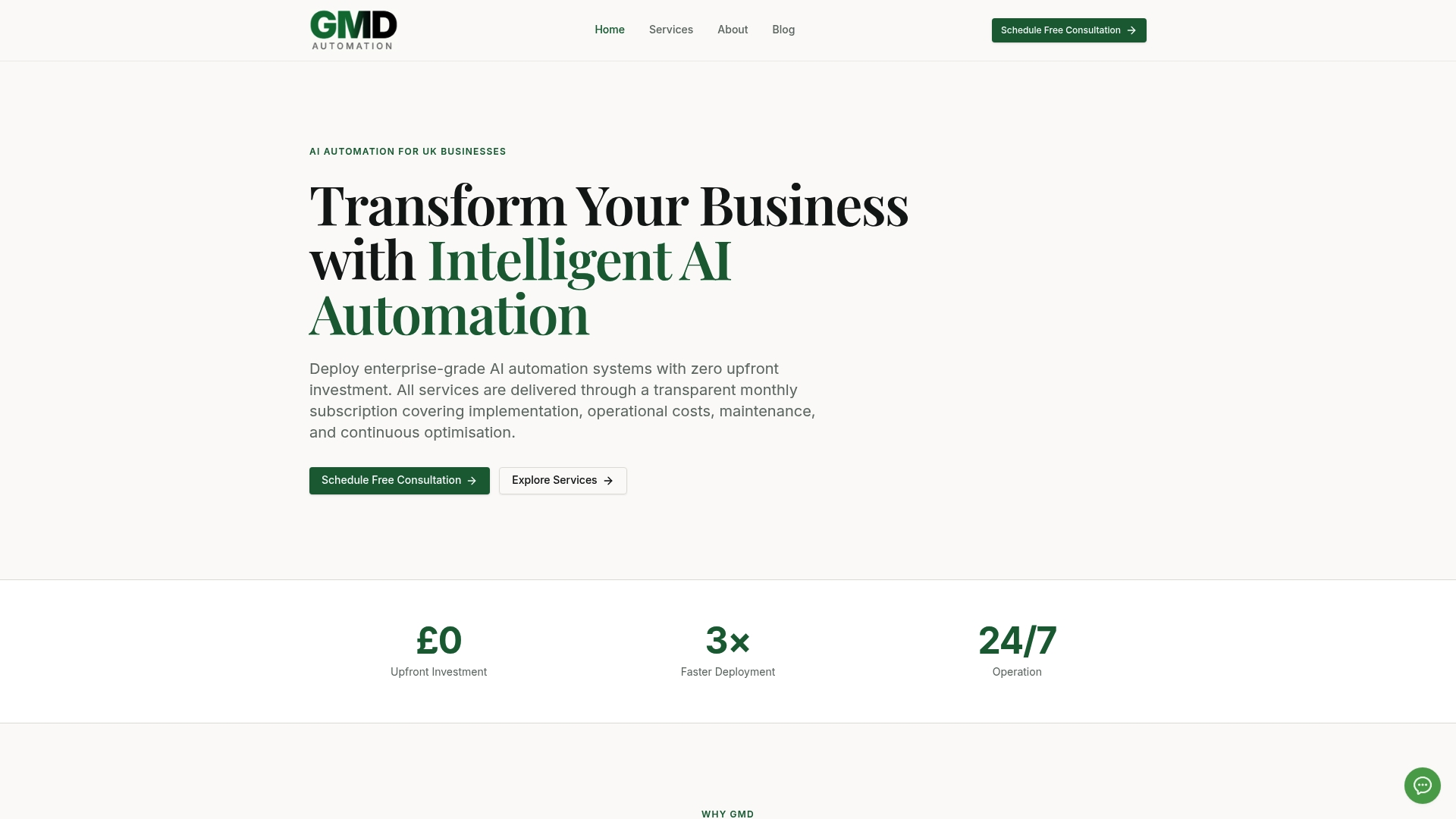
Gmdautomation delivers enterprise-grade AI automation for UK businesses under a fixed monthly subscription that covers implementation, operation, maintenance, and ongoing optimisation with no upfront capital cost. Their developer-led approach means your workflows are built to the governance and architectural standards this checklist describes, not retrofitted to them after the fact. If you are ready to move from checklist to live automation, Gmdautomation is built for exactly that transition.
FAQ
What is an AI automation checklist for operations managers?
An AI automation checklist is a structured framework covering workflow audit, data readiness, governance, human oversight, piloting, and monitoring. It ensures AI implementation is accountable, measurable, and reversible from the outset.
How long does AI automation take to deliver results?
AI automation typically delivers first measurable value within 60–90 days, with an initial prototype ready in 2–4 weeks when teams follow a phased implementation playbook.
Why does data quality matter so much for AI automation?
Poor data quality is the leading cause of AI automation failure, ahead of technology issues and change resistance. AI models trained or run on incomplete or inaccurate data produce unreliable outputs at scale.
What is a Workflow Operator in AI automation?
A Workflow Operator is the named team member responsible for weekly output quality checks, escalation handling, prompt updates, and coordinating rollbacks when an automated workflow underperforms.
How many governance artifacts does an AI workflow need before going live?
A production-ready AI workflow requires 12 governance artifacts, including a named business owner, permission matrices, risk tiering, human-in-the-loop rules, audit logs, and a documented incident response plan.