

Managed AI service models hand full operational responsibility for your AI systems to a specialist third party, covering everything from infrastructure and model deployment to monitoring, cost control, and compliance. For UK businesses, the core benefits are immediate and measurable: lower costs without heavy upfront investment, faster deployment, access to deep AI expertise, and predictable monthly budgeting. The model also removes the burden of assembling and retaining an internal AI operations team, which is genuinely difficult given how scarce qualified talent remains across the UK market.
Here is what managed AI services deliver from day one:
- Cost efficiency: Fixed platform fees plus usage-based components replace unpredictable capital expenditure, converting AI spend into a controlled budget line.
- Faster deployment: Organisations accelerate AI deployment and reach production faster than internal builds allow, with providers handling infrastructure, MLOps pipelines, and validation gates.
- Specialist expertise on tap: Providers bring prompt engineers, MLOps specialists, and compliance leads that most UK businesses cannot hire or retain internally.
- Continuous performance management: AI is a living system requiring constant monitoring and retraining, not a one-time project. Managed services own that ongoing responsibility.
- Single-point accountability: One provider owns the full stack from infrastructure to model output, eliminating the boundary disputes that cause failures when AI and infrastructure teams are separate.
- Governance and compliance built in: ISO 27001-certified processes and GDPR-aligned controls are maintained continuously, not certified once and forgotten.
- Scalability without headcount growth: AI use cases can expand across business functions without proportional increases in internal staffing.
What do managed AI services actually do day to day?
The operational reality of managed AI services goes well beyond keeping servers running. Managing generative AI at scale requires continuous prompt engineering, content filtering, model version management, and provider relationship oversight. These are not occasional tasks; they run every week, often every day.
Continuous monitoring and quality assurance sit at the core. AI output quality is probabilistic and shifts with model versions, data changes, and usage patterns. A platform that reports healthy uptime can simultaneously be delivering degraded answers. Managed providers run scheduled quality evaluations per use case, measuring accuracy, grounding, and safety over time. Silent quality regression is the most insidious failure mode in production AI, and systematic evaluation is the only reliable way to catch it.
Reduced internal headcount pressure is one of the most tangible managed AI service benefits. Building an internal AI operations capability means hiring across cloud infrastructure, MLOps, prompt engineering, security, and cost optimisation. Each of those disciplines is hard to recruit for in the UK right now. Managed services replace this phantom team with a transparent monthly structure, freeing your engineers to focus on the use cases that actually differentiate your business.
Unified infrastructure and AI stack management removes a structural failure point. When an AI use case misbehaves, the question of whether the fault lies with the infrastructure team or the AI team wastes time and erodes trust. A single accountable provider owns the diagnosis from the network layer to the prompt.
Pro Tip: Before signing any managed AI contract, ask the provider to show you a sample quality evaluation report for a live use case. If they cannot produce one, they are monitoring availability, not AI performance.
Transitioning to managed AI services follows a clear sequence:
- Structured assessment (first 30 days): Audit existing infrastructure, data assets, model inventory, and governance posture. The output is a gap analysis with a prioritised roadmap.
- Platform operations transition (days 30–60): Hand over monitoring, incident response, and lifecycle management. Establish the first monthly quality and cost reports.
- Add AI FinOps and AI SecOps (from day 90): Layer in cost transparency, quota management, access reviews, and compliance controls based on assessment findings.
Why managed AI service models create long-term strategic value
The shift from project-based to continuous AI operational management is the defining strategic move for UK enterprises in 2026. One-off AI pilots rarely survive contact with year two. The organisations that sustain AI value are those with a model that owns ongoing measurement, optimisation, and governance, not just deployment.
The strategic advantages of managed AI service models include:
- Focus on core business innovation: Outsourcing AI complexity frees internal teams to work on differentiated products and customer experiences rather than chasing model deprecations or reconciling token invoices.
- Improved AI ROI through consistent measurement: TSIA research identifies ongoing ROI measurement as the critical gap in most AI programmes. Managed services own that measurement continuously, turning AI from an experiment into an accountable budget line.
- Agility to scale across functions: AI use cases can expand into new business functions without rebuilding governance or infrastructure from scratch each time.
- Regulatory compliance as routine operations: Rather than treating compliance as a periodic fire drill, managed providers maintain GDPR and UK AI regulatory alignment as part of standard operations.
- Programme longevity: AI operational debt, the accumulation of unmanaged model drift, data quality issues, and unreviewed security controls, erodes ROI silently. Managed services prevent that accumulation from taking hold.
- Clear alignment between AI investment and business KPIs: Providers tie model performance metrics to business outcomes, so leadership can see what the AI programme is actually delivering.
The advantages of managed AI become most visible at the point where internal teams would otherwise be pulled away from high-value work to handle operational maintenance. That opportunity cost rarely appears in a spreadsheet, but it compounds quickly.

How managed AI providers handle governance, security, and compliance
Governance is not a feature you add to a managed AI service. It is a continuous operational discipline, and the best providers treat it that way.
Providers with ISO 27001 certification and GDPR-compliant processes give UK organisations a structured foundation for maintaining regulatory compliance without building that capability internally. For regulated sectors such as financial services and healthcare, this is often the primary selection criterion, ahead of raw model performance.
The key governance and security capabilities a managed provider should cover:
- Shared responsibility model: You govern what data enters the platform and how it may be used. Your provider maintains the controls around it and ensures they never lapse.
- AI SecOps: Recurring access and permission reviews, audits of content filters and guardrails per use case, and monitoring for anomalous usage patterns.
- AI FinOps: Cost transparency per use case, budget thresholds with alerting, and rightsizing of model deployments to avoid token spend surprises.
- Continuous auditing: Documented controls that support GDPR obligations and alignment with the EU AI Act, maintained as part of routine operations.
- Anomaly detection: Automated monitoring flags unusual usage patterns before they become security incidents or compliance breaches.
The practical benefit of sourcing infrastructure and AI management from one provider is the absence of gaps in accountability. When a compliance question arises, there is no ambiguity about which team owns the answer.
How to choose the right managed AI service provider in the UK
The decision between a full-managed and a co-managed model depends on your internal AI maturity. Organisations without dedicated MLOps engineers should pursue full-managed services. Those with established internal AI teams but gaps in specific operational domains, such as observability or compliance, are better suited to a co-managed arrangement where the provider covers those specific layers.
When evaluating providers, four criteria separate genuine operations partners from rebranded support desks:
- Scope of AI lifecycle coverage: Do they manage models, prompts, indexes, quality, cost, and security, or only the virtual machines underneath?
- Measurement and reporting: Do they run scheduled output-quality evaluations with per-use-case reporting, or will you discover degradation from your own users?
- Compliance substance: ISO 27001-certified processes, documented GDPR and EU AI Act alignment, and a written shared responsibility model.
- Pricing transparency: Modular pricing with defined service boundaries and no lock-in penalties for leaving.
SLAs should explicitly cover uptime, mean time to resolution, and model accuracy floor thresholds. If a provider cannot show you those metrics in a sample contract, that tells you something. Understanding AI consulting pricing structures before entering negotiations helps you benchmark what you are being offered against market norms.
UK market experience also matters. Providers familiar with UK data residency requirements, FCA expectations for financial services firms, and NHS data governance frameworks will save you significant time during onboarding and audit cycles.
The UK managed AI services landscape and trusted partners
The UK market for managed AI services has matured considerably. Enterprises across financial services, retail, and the public sector are moving from AI pilots to production-grade managed operations, and the ecosystem of credible providers has grown to match that demand.
PwC operates a dedicated AI Managed Services practice that covers operations, engineering, and governance, with particular depth in regulated industries. Their model emphasises proactive monitoring, observability tooling, and structured change management to support adoption alongside deployment.
Devoteam brings a UK-focused managed AI offering built around continuous optimisation, security, and scaling, with particular strength in helping enterprises move from fragmented AI experiments to governed, production-ready systems.
Gmdautomation is built specifically for UK businesses that want enterprise-grade AI without the capital expenditure or the internal team overhead. The model covers implementation, operation, maintenance, and ongoing optimisation under a single monthly subscription with no upfront costs. For organisations that want to deploy AI at scale without building an internal AI function, Gmdautomation's approach removes the most common barriers: cost unpredictability, talent scarcity, and governance complexity.
The UK also benefits from a growing community of independent AI consultancies and advisory firms that help businesses navigate provider selection and build internal AI literacy alongside managed operations. Staying current with AI consulting market trends helps decision-makers understand what the market is offering and where pricing norms are heading.
Pro Tip: Ask any UK provider for references from clients in your sector who have been live in production for at least 12 months. Pilot success is common. Sustained operational performance is the real differentiator.
UK businesses putting managed AI services to work
The clearest evidence for the managed AI service advantages comes from organisations that have moved past the pilot stage and into sustained production operations.

UK financial services firms have used managed AI providers to deploy customer-facing AI tools that handle query routing, document processing, and fraud detection, with the provider owning model accuracy monitoring and compliance reporting. The alternative, building and maintaining that capability internally, would require a team spanning MLOps, security, and regulatory expertise that most mid-sized firms cannot staff or afford.
Retail and logistics businesses have applied managed AI to demand forecasting and supply chain optimisation, where model accuracy directly affects margin. The managed model matters here because demand patterns shift seasonally and with market conditions. A model trained in one quarter can degrade meaningfully by the next without continuous retraining and quality evaluation. Managed providers absorb that operational discipline as part of the service.
Public sector organisations face a different challenge: strict data residency requirements and procurement constraints that favour providers with documented UK compliance credentials. Managed AI providers with ISO 27001 certification and clear shared responsibility models are better positioned to meet those requirements than internal teams building governance frameworks from scratch.
The pattern across sectors is consistent. Organisations that treat AI as a continuous operational commitment, rather than a series of projects, get more value from it over time. Managed AI service models are the practical mechanism for making that commitment without betting the IT budget on internal capability that takes years to build.
Key takeaways
Managed AI service models deliver sustained value by combining cost predictability, continuous quality management, and built-in governance under a single accountable provider.
| Point | Details |
|---|---|
| Single-point accountability | One provider owns the full stack from infrastructure to model output, eliminating boundary disputes between teams. |
| Governance as routine operations | ISO 27001-certified processes and GDPR alignment are maintained continuously, not certified once and left to lapse. |
| Cost structure clarity | Modular pricing with fixed platform fees and usage-based components converts AI spend into a predictable budget line. |
| Full-managed vs co-managed | Organisations without dedicated MLOps engineers should choose full-managed services for the best return on investment. |
| Continuous quality evaluation | Scheduled output-quality assessments per use case are the only reliable way to detect silent model degradation in production. |
Ready to move from AI pilot to production?
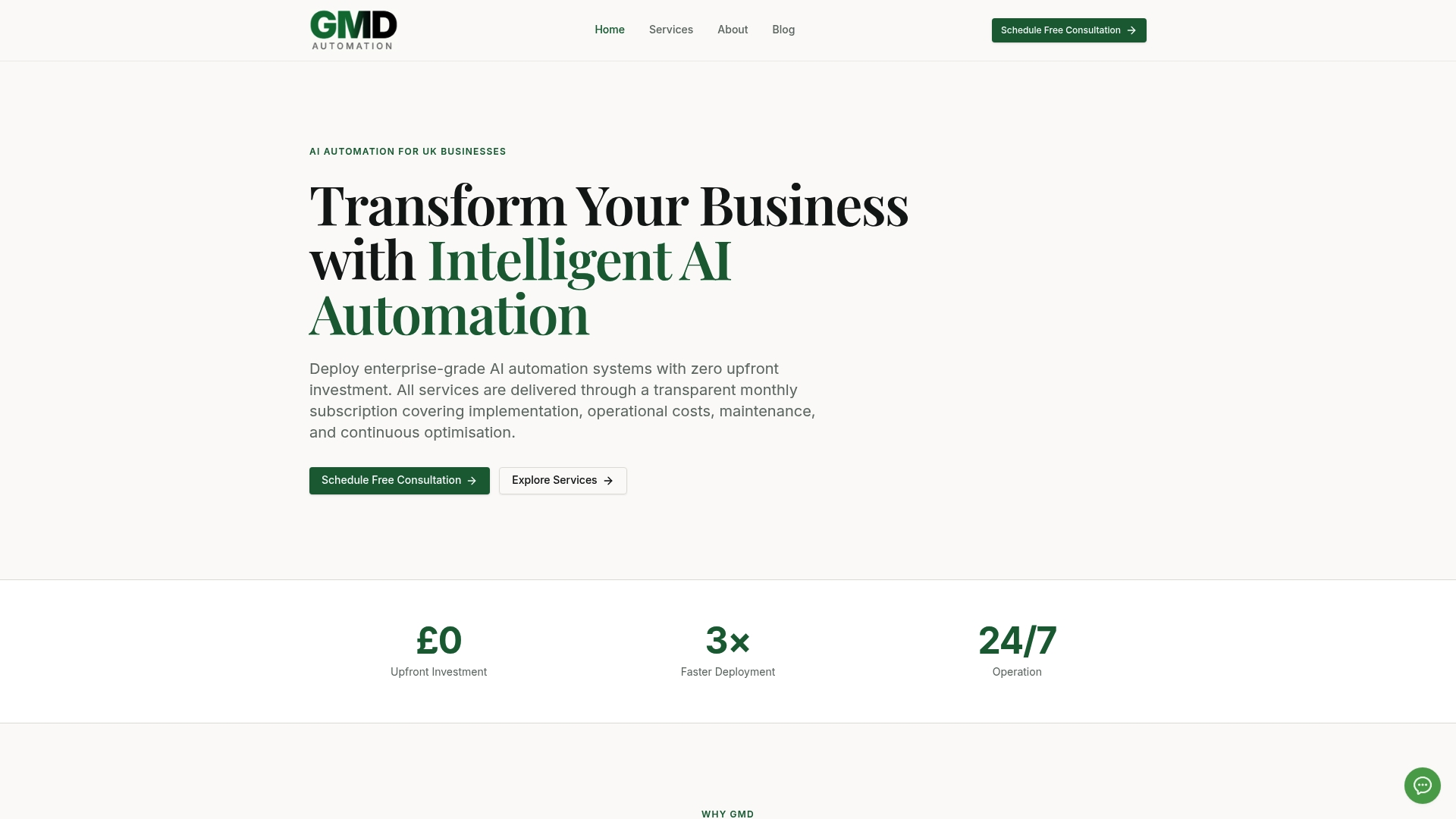
Gmdautomation helps UK businesses deploy enterprise-grade AI under a transparent monthly subscription that covers implementation, operations, maintenance, and optimisation with no upfront costs. If your organisation is ready to move beyond pilots and into sustained AI performance, explore what Gmdautomation offers and see how the managed model works in practice.