

Legacy system AI integration is the practice of augmenting existing enterprise infrastructure with AI capabilities without replacing core systems, preserving operational continuity while enabling measurable performance gains. For UK business executives and IT decision-makers, this distinction matters enormously. AI overlays add decision intelligence while leaving transactional foundations intact, which means you avoid the cost and disruption of a full rebuild. Frameworks like LangChain, CrewAI, and AutoGen now make it possible to layer AI capabilities onto decades-old platforms using API wrappers and middleware, with pilots typically shipping in six to twelve weeks.
What does legacy system AI integration actually require?
Before any AI capability touches your production environment, you need a clear picture of what you are working with. The 6R framework (retain, retire, rehost, replatform, refactor, rebuild) gives portfolio audits a consistent structure. Portfolio audits typically identify 15 to 30 per cent of legacy applications as candidates for retirement, which immediately reduces the scope and cost of any modernisation programme.
Data quality is the second prerequisite, and it is frequently underestimated. Legacy field naming conventions are often ambiguous and proprietary, meaning schema mapping to AI-friendly models consumes roughly 40 per cent of total project effort. Before selecting any AI tooling, your team needs to assess whether source data is accessible, consistently formatted, and semantically interpretable.
The tooling layer sits on top of that data foundation. The table below summarises the key components most integration programmes require:
| Component | Role | Example tools |
|---|---|---|
| API gateway | Exposes legacy functions as callable endpoints | AWS API Gateway, Kong, MuleSoft |
| Middleware layer | Translates data formats between systems | Apache Camel, IBM MQ, Azure Service Bus |
| Transformation engine | Converts legacy schemas to AI-readable models | dbt, Apache Spark, custom ETL scripts |
| AI orchestration framework | Coordinates AI agents and workflows | LangChain, CrewAI, AutoGen |
| Enterprise content system | Applies AI to unstructured data with access controls | Microsoft SharePoint, OpenText |
AI middleware frameworks like LangChain and CrewAI enable modular, orchestrated AI capabilities on top of legacy data without requiring changes to the underlying transaction logic. For a deeper look at how these categories work in practice, the Gmdautomation guide to AI middleware solutions covers each type in detail.
Pro Tip: Run a data quality audit before committing to any AI vendor. If your legacy schemas cannot be mapped cleanly, no amount of sophisticated tooling will compensate for the ambiguity at source.
Which AI integration approach works best for legacy systems?
The choice of integration pattern determines your risk profile, timeline, and total cost. Three approaches dominate enterprise practice, and each suits a different organisational context.
The wrapper pattern is the fastest route to value. You build an API layer around the legacy system, exposing its functions to AI agents without modifying the core codebase. Pilots using this approach ship in six to twelve weeks and deliver measurable business value within one to two quarters. The trade-off is that the underlying system remains unchanged, so technical debt accumulates over time.
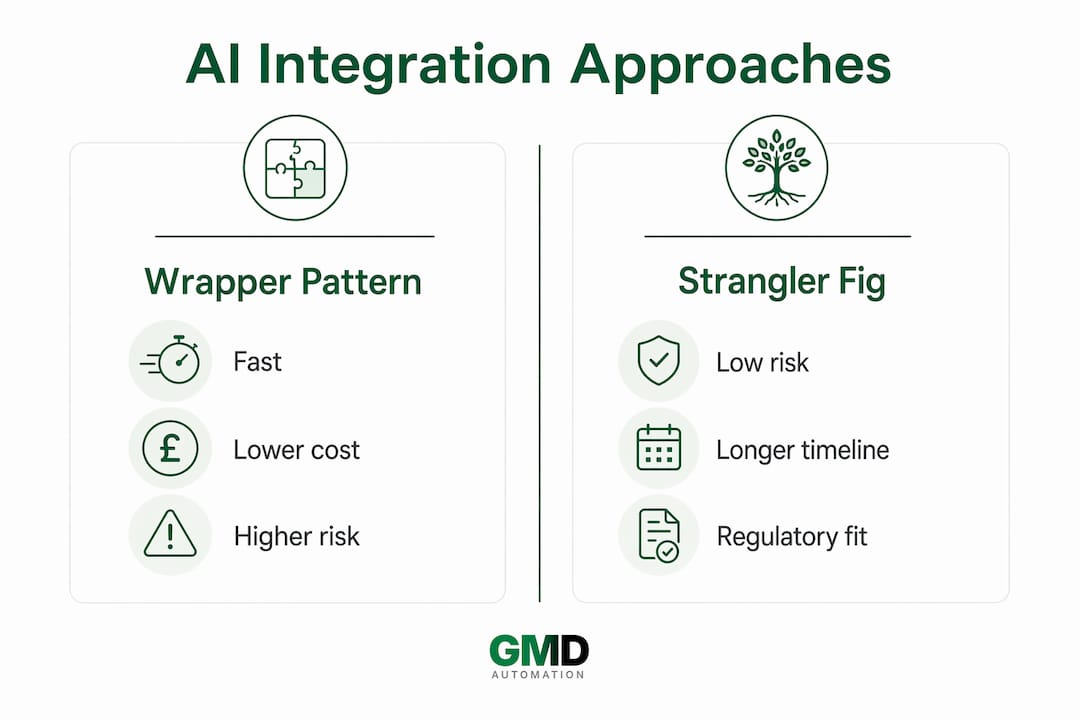
The strangler fig pattern is the lowest-risk option for mission-critical environments. It builds AI capabilities alongside the legacy system, gradually routing traffic to new features while the old system continues operating. Business continuity is preserved throughout, making it the preferred choice for regulated industries such as financial services and healthcare.
The third option, a complete rebuild, is rarely justified on cost grounds alone. Full rebuilds can exceed €4 million and take 24 to 48 months, compared to 12 to 24 months and €400,000 to €1.2 million for a replatforming or refactoring programme. That cost differential is the primary reason augmentation strategies dominate current enterprise practice.
| Approach | Typical timeline | Relative cost | Business continuity risk |
|---|---|---|---|
| Wrapper pattern | 6 to 12 weeks (pilot) | Low | Very low |
| Strangler fig | 12 to 24 months | Medium | Very low |
| Replatforming | 12 to 24 months | Medium to high | Medium |
| Complete rebuild | 24 to 48 months | Very high | High |
Pro Tip: For regulated UK industries, default to the strangler fig pattern for your first AI integration. It gives you a working proof of concept without exposing the business to continuity risk during the transition.
For context on how these architectural patterns fit within broader enterprise AI design, the Gmdautomation article on AI agent architecture is worth reading alongside this section.
How to integrate AI into legacy systems step by step
A structured, phased approach is the single most reliable predictor of integration success. Poor sequencing and underestimated dependencies cause modernisation project failures far more often than technology limitations. The following five-step process reflects current best practice for UK enterprise environments.
Step 1: Conduct a portfolio audit and retire redundant applications. Apply the 6R framework to every application in scope. Retiring the 15 to 30 per cent of apps that add no value immediately reduces integration complexity and frees budget for higher-priority work. Document dependencies at this stage, because missed dependencies are the most common cause of mid-project delays.
Step 2: Map legacy schemas to AI-friendly data models. This is the most labour-intensive phase. Field names in legacy systems are frequently abbreviated, inconsistent, or context-dependent. Your team needs to build a semantic layer that translates raw legacy data into formats that AI models can interpret reliably. Budget 40 per cent of your project timeline for this work, not 10 per cent.

Step 3: Build API wrappers and middleware. Once the data layer is clean, expose legacy functions through API gateways. Tools like MuleSoft, Kong, or Azure Service Bus handle the translation between legacy protocols and modern REST or GraphQL interfaces. Real-time update propagation, latency control, and error handling must be built into the middleware layer at this stage, not retrofitted later. The Gmdautomation guide to API integration tools covers the selection criteria in detail.
Step 4: Deploy a pilot AI project within a defined six to twelve week window. Scope the pilot tightly: one business process, one data source, one measurable outcome. A claims processing automation in insurance or a demand forecasting module in retail are typical examples. The goal is not to prove AI works in theory. It is to demonstrate that your specific integration layer holds up under production conditions.
Step 5: Scale using modular microservices. Once the pilot validates the integration architecture, extend it incrementally. Each new AI capability should be deployed as a discrete microservice, isolated from others so that a failure in one module does not cascade across the system. Wave-based, disciplined delivery ensures that each phase is stable before the next begins.
The most common mistake at scale is treating the pilot architecture as production-ready without stress-testing the middleware under real data volumes. Validate throughput and latency before expanding scope.
How do you measure success in AI transformation programmes?
Measuring the success of AI transformation in legacy systems requires KPIs that connect technical performance to business outcomes. Tracking only uptime or API response times tells you the integration is functioning. It does not tell you whether it is delivering value.
The most useful KPIs fall into three categories. Efficiency metrics include process cycle time reduction, manual intervention rates, and throughput per hour. Decision quality metrics cover prediction accuracy, false positive rates in automated decisions, and the proportion of decisions escalated to human review. Operational metrics track system availability, error rates in the middleware layer, and data freshness in AI models.
Change management is as important as technical measurement. Small, wave-based transformation phases reduce risk and increase manageability, but they only work if the business has a clear owner for each wave and a defined acceptance criterion before moving to the next. Without that governance structure, scope creep and dependency conflicts accumulate silently until they surface as a project crisis.
Common challenges at this stage include:
- Underestimated dependencies between legacy modules that were not documented during the audit phase
- Data drift, where the semantic layer built in step two becomes misaligned with changes to the legacy system over time
- Model staleness, where AI components are not updated frequently enough to reflect current business conditions
- Governance gaps, particularly around access controls when AI systems interact with sensitive or regulated data
Enterprise content systems that preserve access controls while enriching data insights are particularly important in regulated UK sectors, where GDPR and FCA requirements create strict boundaries around data use. For sector-specific examples of where these gains materialise, the Gmdautomation overview of industries benefiting from AI provides useful reference points.
Key takeaways
Successful legacy system AI integration depends on disciplined sequencing, clean data foundations, and modular architecture rather than on the sophistication of the AI models themselves.
| Point | Details |
|---|---|
| Augmentation over replacement | AI overlays preserve transactional foundations, reducing cost and operational risk significantly. |
| Data mapping is the critical path | Schema translation consumes up to 40% of project effort and must be scoped accurately from the outset. |
| Pattern selection drives risk profile | The strangler fig pattern offers the lowest continuity risk for mission-critical or regulated environments. |
| Pilots should ship in 6 to 12 weeks | A tightly scoped pilot validates the integration architecture before any scaling investment is committed. |
| Wave-based delivery prevents overruns | Phased, dependency-isolated releases are the primary defence against modernisation project failure. |
Why the hardest part of AI integration is rarely the AI
I have reviewed enough legacy modernisation programmes to say this with confidence: the technology is almost never the problem. The failures I have seen most consistently trace back to two decisions made in the first four weeks of a project. Either the team underestimated the state of the data, or they tried to integrate too many systems simultaneously.
The schema mapping problem is genuinely underappreciated at the executive level. When a field in a 1990s COBOL system is labelled "CUST-REF-7," it takes a human with institutional knowledge to confirm whether that maps to a customer ID, a contract reference, or something else entirely. No AI model resolves that ambiguity automatically. It requires people, time, and documentation that often does not exist. Executives who budget two weeks for data preparation and then wonder why the project is three months behind have usually made this mistake.
The second pattern I see repeatedly is the temptation to prove scale before proving stability. A pilot that works beautifully on 10,000 records can collapse under 10 million if the middleware was not designed for throughput. The strangler fig and wrapper patterns are not just theoretical best practices. They exist because incremental validation is the only reliable way to discover where your integration layer breaks before it breaks in production.
My practical advice: select a specialist partner who has delivered integrations in your specific sector, not just in AI generally. The compliance requirements for a UK financial services firm are materially different from those for a logistics operator. That sector knowledge shortens the data mapping phase considerably and reduces the risk of governance failures that can halt a programme entirely.
— Ravi
How Gmdautomation supports UK legacy AI programmes
Gmdautomation works with UK businesses to deploy AI automation on top of existing infrastructure, without requiring capital expenditure or lengthy procurement cycles. The subscription model covers implementation, operation, and ongoing optimisation, which means your team is not carrying the maintenance burden internally. Deployments are scoped for security and compliance from day one, which matters particularly for UK organisations operating under FCA, ICO, or NHS frameworks. If you are at the audit or pilot stage and want to understand what a structured integration programme looks like in practice, explore Gmdautomation's AI automation solutions to see how the approach maps to your environment.
FAQ
What is legacy system AI integration?
Legacy system AI integration is the process of adding AI capabilities to existing enterprise systems using API wrappers, middleware, and orchestration frameworks, without replacing the core platform. The goal is to augment decision-making and automate processes while preserving operational continuity.
How long does a legacy AI integration pilot take?
A well-scoped pilot using the wrapper pattern typically ships in six to twelve weeks. Broader modernisation programmes involving replatforming or the strangler fig pattern run from 12 to 24 months depending on system complexity.
What causes most legacy AI integration projects to fail?
Poor sequencing and underestimated dependencies cause the majority of failures, not technology limitations. Wave-based delivery with clearly defined acceptance criteria at each phase is the most reliable mitigation.
How much does legacy system modernisation cost?
Regulated application modernisation programmes typically cost between €400,000 and €1.2 million over 12 to 24 months. Full rebuilds can exceed €4 million and take up to 48 months, making augmentation strategies the preferred choice for most UK enterprises.
Which AI frameworks work best with legacy systems?
LangChain, CrewAI, and AutoGen are the most widely used orchestration frameworks for legacy AI integration. They enable modular, agent-based AI workflows that sit on top of existing data without altering core transaction logic.