

AI training for operations teams is defined as the structured process of equipping staff and managers with the skills to deploy, supervise, and govern AI-powered workflows. Without it, 61% of AI implementations in operational functions fail to meet targets in the first year. That figure is not a technology problem. It is a people and process problem. The gap between installing an AI tool and extracting real value from it is precisely why operations teams need AI training, and why generic AI literacy courses fall well short of what the role demands. Agentic AI, where AI systems act autonomously across multi-step workflows, raises the stakes further. Teams that understand how to govern these systems report transformational results. Those that do not simply automate their existing inefficiencies at greater speed.
Why operations teams need AI training: the core case
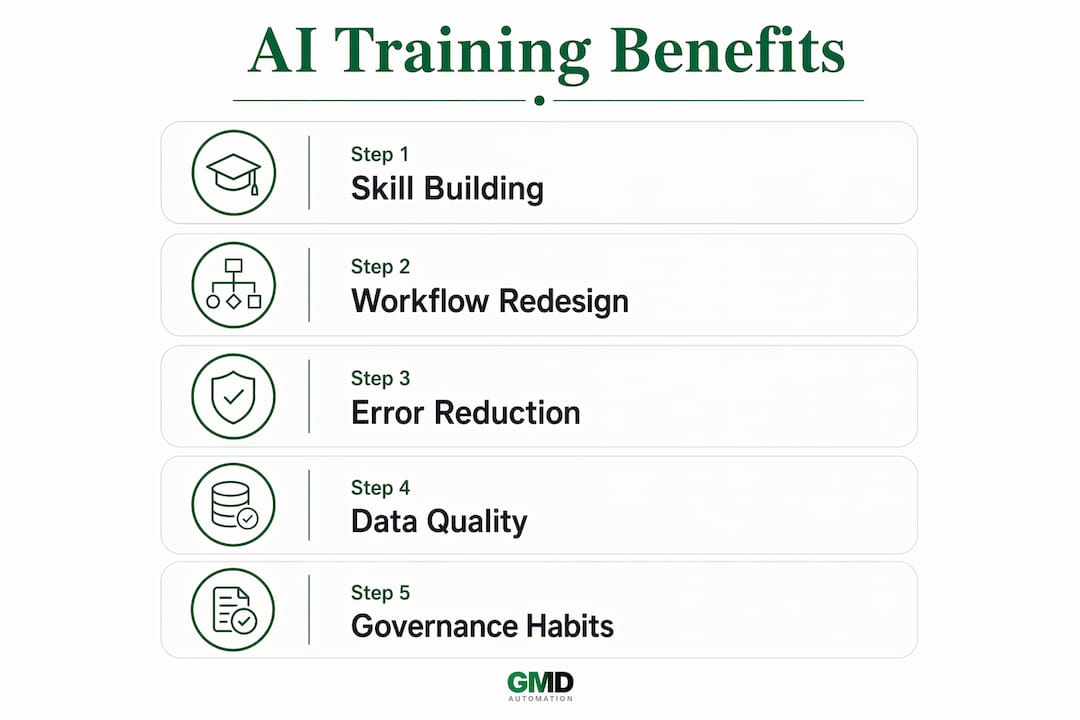
The business case for AI training in operations is grounded in measurable outcomes. Redesigned workflows for agentic AI yield productivity boosts of 3x and EBITDA gains between 10% and 25%. Those numbers do not come from deploying software. They come from teams that have been trained to redesign their processes around AI capabilities rather than simply layering AI on top of existing ones.
The distinction matters enormously. Basic automation replaces a manual step. Agentic AI redesigns the entire workflow, handling high-volume repetitive tasks end to end while flagging exceptions for human review. Operations managers who understand this distinction make better decisions about where AI adds value and where human judgement remains non-negotiable. That understanding is the product of deliberate training, not trial and error.
The importance of AI in operations also extends to data quality and error reduction. AI systems are only as reliable as the processes feeding them. Teams trained in AI governance learn to build feedback loops, monitor outputs, and catch errors before they compound. This is the foundation of operational AI readiness, and it cannot be improvised on the job.

What specific benefits does AI training bring to operations teams?
AI training for teams produces benefits across three distinct areas: productivity, cost, and decision quality.
- Productivity gains. Trained teams move from task-level automation to workflow redesign. Organisations that complete this transition report up to 60% reduction in long-term operational costs. That scale of saving requires teams who know how to configure, monitor, and adjust AI agents, not just switch them on.
- Error reduction. AI handles high-volume routine tasks with consistency that humans cannot match at scale. Training teaches staff to identify which tasks qualify for full automation, which require AI assistance with human review, and which must remain entirely manual. Getting this classification right is where most untrained teams fail.
- Better use of data. Operations teams sit on vast amounts of process data. AI training builds the habit of using that data to measure outcomes, spot anomalies, and drive continuous improvement. Without this habit, AI tools produce outputs that nobody acts on.
- Exception management. Human judgement remains essential for cases where AI tends to err. Training equips staff to recognise these edge cases quickly and escalate them correctly, preventing costly errors from slipping through.
The benefits of AI for operations compound over time. Teams that build strong AI governance habits in year one are far better positioned to adopt more advanced agentic capabilities in subsequent years.
Pro Tip: Start training with a single high-volume, well-documented process. The clarity of outcome makes it far easier to measure the training's impact and build internal confidence before scaling.
How does AI training change the role of operations managers?
The shift AI training produces in operations managers is not incremental. It is a fundamental change in how they think about their job. The old model centres on managing human capacity: scheduling, workload distribution, and performance monitoring. The new model, enabled by AI training, centres on managing by outcomes rather than inputs.
This shift has practical consequences for how managers spend their time. Trained managers define the outcomes they want AI agents to achieve, set the boundaries within which those agents operate, and review performance against measurable targets. They spend less time on task allocation and more time on exception governance and process improvement.
AI training also corrects a common and costly misconception: that AI will eventually replace human decision-making entirely. The reality is more nuanced. AI handles scaffolding tasks, the repetitive, rule-based work that consumes most of an operations team's day. Human judgement handles the exceptions, the ambiguous cases, the ethical calls, and the situations that fall outside the AI's training data. Managers who understand this boundary make far better use of both.
The human-in-the-loop framework is the training model that makes this work in practice. It teaches operators to classify every task type, supervise AI outputs actively, and intervene when outputs fall outside acceptable parameters. Without this framework, teams either over-trust AI and miss errors, or under-trust it and negate the efficiency gains entirely.
Key mindset shifts that effective AI training produces in operations managers:
- From monitoring activity to measuring outcomes
- From directing tasks to defining agent parameters
- From solving problems reactively to building systems that prevent them
- From managing individuals to coaching teams on AI supervision skills
What makes an effective AI training programme for operations teams?
Effective AI training for operations teams is built on four components. Each one is necessary. None of them alone is sufficient.
-
Process audit and documentation. Before any training begins, teams must codify their existing workflows. Process debt, the accumulation of undocumented, informal, and inconsistent processes, is the single biggest reason AI automation fails. A rigorous audit converts tribal knowledge into agent-readable playbooks. This is not glamorous work, but it is the foundation everything else rests on.
-
Role-specific curriculum. Generic AI literacy training teaches people what AI is. Operations teams need training that teaches them how to use AI within their specific workflows. A procurement manager needs different AI skills than a logistics coordinator. The curriculum must reflect this. Training that ignores role context produces teams who understand AI in theory but cannot apply it in practice.
-
Metrics and feedback loops. AI training must build the habit of measurement. Teams need to define what good looks like before they deploy an AI agent, then track performance against that definition consistently. Operational discipline and a metrics culture are critical enablers of AI success. Without them, AI tools drift from their intended purpose and nobody notices until the damage is done.
-
Continuous improvement cadence. AI training is not a one-off event. Effective programmes include regular coaching sessions, peer forums where teams share what is and is not working, and scheduled reviews of AI agent performance. This cadence builds the culture of ongoing improvement that separates teams who sustain AI gains from those who see initial results plateau.
Pro Tip: Build a simple task classification matrix during training: three columns labelled "fully automated," "AI-assisted with review," and "human only." Revisit it quarterly as your AI capabilities grow.
For teams looking to assess their current readiness, the AI automation checklist for operations managers provides a practical starting point. Teams working with partners who specialise in custom AI development for complex workflows often find the process audit stage significantly faster when external expertise is involved.
What are the risks of skipping AI training?
The risks of deploying AI without adequate training are not theoretical. Only 22% of employees report receiving sufficient AI transformation training and support. That gap between executive confidence and frontline readiness is where AI projects collapse.
The most common failure modes in untrained operations teams include:
- Automating broken processes. Applying AI to undocumented or inconsistent workflows does not fix them. It accelerates them. Teams that skip the process audit stage discover this quickly and expensively.
- Blind trust in AI outputs. Without human-in-the-loop training, staff accept AI outputs without scrutiny. Errors propagate through the workflow undetected until they reach a point where the cost of correction is significant.
- No escalation protocols. Untrained teams have no agreed process for handling cases the AI cannot resolve. These exceptions pile up, creating backlogs that negate the efficiency gains the AI was supposed to deliver.
- Superficial adoption. Teams without role-specific training use AI for low-value tasks like drafting emails or summarising reports. The deeper workflow redesign that produces real-world automation wins never happens.
The gap between executive belief and frontline reality is striking. In a Bain survey, 88% of executives believed their AI redesign efforts would succeed, but only 36% of frontline workers agreed. That disconnect is a training problem, not a technology problem. Operations managers who close it through deliberate, role-specific AI training are the ones who deliver the outcomes their boards expect.
Key takeaways
Operations teams that receive role-specific AI training consistently outperform those that rely on generic AI literacy, because training converts AI tools into governed, measurable workflows that produce lasting productivity and cost gains.
| Point | Details |
|---|---|
| Training prevents implementation failure | 61% of AI implementations fail without role-specific training and clear ownership. |
| Workflow redesign unlocks the biggest gains | Productivity boosts of 3x and EBITDA gains of 10–25% come from redesigned workflows, not basic automation. |
| Process audit must come first | Documenting workflows before training eliminates process debt that would otherwise cause AI automation to fail. |
| Human-in-the-loop is non-negotiable | Teams must classify tasks and supervise AI outputs actively to prevent costly errors and blind reliance. |
| Training is ongoing, not a one-off event | Regular coaching, peer forums, and performance reviews sustain AI gains and build a culture of continuous improvement. |
The uncomfortable truth about AI and operational discipline
I have watched operations teams spend months selecting AI tools, negotiating contracts, and running pilots, only to see adoption stall within weeks of go-live. The technology was never the problem. The problem was that nobody had done the unglamorous work of documenting how the team actually operated before asking AI to replicate it.
AI is a mirror. It reflects your process discipline back at you with perfect fidelity. If your processes are well-documented, consistently followed, and measured against clear outcomes, AI amplifies all of that. If they are informal, inconsistent, and driven by individual tribal knowledge, AI amplifies that too, only faster and at greater scale.
The operations managers I have seen succeed with AI share one characteristic: they treated training as an operational project, not an IT project. They defined success metrics before deployment. They ran process audits before selecting tools. They built escalation protocols before switching anything on. They understood that the shift from task executor to supervisor is not automatic. It requires deliberate preparation.
My honest advice: do not ask what AI can do for your team until you can clearly answer what your team's processes actually look like today. The AI governance frameworks that work best are built on that foundation. The ones that fail are built on assumptions.
— Ravi
How Gmdautomation supports operations teams with AI training
Gmdautomation works with UK operations teams to build the AI training and workflow foundations that produce measurable results. The focus is on practical readiness: process audits, role-specific training design, and governance frameworks that align with how your team actually operates.
Gmdautomation's AI automation solutions are built for organisations that want to move beyond pilot projects and into agentic workflows that deliver lasting efficiency gains. Every engagement includes implementation, ongoing support, and the operational coaching that generic AI tools simply do not provide. If your team is ready to build a training roadmap grounded in real operational outcomes, Gmdautomation is the place to start.
FAQ
Why do 61% of AI implementations in operations fail?
61% of AI implementations fail due to misaligned ownership and inconsistent data, not technology limitations. Role-specific training addresses both by clarifying responsibilities and building data discipline before deployment.
What is agentic AI and why does it matter for operations teams?
Agentic AI refers to AI systems that act autonomously across multi-step workflows, handling high-volume tasks end to end. Operations teams trained to govern these systems report productivity gains of up to 3x compared to teams using basic automation.
How is AI training for operations different from general AI literacy?
General AI literacy teaches what AI is. Operations AI training teaches how to redesign specific workflows, classify tasks, supervise AI outputs, and measure outcomes. The difference in results is significant.
What is a human-in-the-loop framework?
A human-in-the-loop framework trains staff to classify every task as fully automated, AI-assisted with human review, or human only. It prevents blind trust in AI outputs and ensures errors are caught before they compound.
How long does it take for AI training to show results in operations?
Results depend on process maturity and training quality, but teams that complete a process audit and role-specific training before deployment typically see measurable efficiency gains within the first quarter of go-live.