

What is AI change management?
AI change management is the structured discipline of preparing, supporting, and reinforcing people through AI-driven transformation. It is not the same as deploying software. The goal is a changed organisation, not a delivered system.
Where a traditional IT rollout asks employees to learn new buttons, AI adoption asks them to rethink what their job actually is. That is a fundamentally different problem, and it requires a fundamentally different response. The COMPEL Framework defines it precisely: AI change management sits at the intersection of classical change practice, AI-specific resistance patterns, and sustained adoption measurement.
Five dynamics separate this discipline from generic change management:
- Existential replacement fear. Employees worry not about re-learning a workflow but about whether their role still exists. The Klarna case, where an AI assistant handled two-thirds of customer-service conversations before the company reversed course and rehired human agents, illustrates how real and reversible that fear can be.
- Model opacity. An accountant can verify a spreadsheet formula. They cannot verify the reasoning inside a large language model output in the same way. That difference creates a distinct trust problem that classical frameworks do not address.
- AI literacy variance. On a single team, one person may have used generative tools for a year while a colleague has never opened one. A training plan calibrated to the median learner leaves both ends behind.
- Ethical concern as resistance. Employees sometimes refuse AI tools not because the technology fails but because they object to its environmental footprint, its labour implications, or its data sources. That is legitimate input to programme design, not friction to overcome.
- Hybrid human-AI workflows. When a human and an AI agent share a task, the job itself changes. Escalation rules, accountability, and professional identity all require redesign.
AI change management is also distinct from AI project management. Project management tracks whether the system was built and deployed on time, while change management tracks whether employees trust and use it, whether processes have genuinely improved, and whether the organisation can sustain AI without repeated resistance cycles.
Why AI change management matters more than ever
The pace of AI adoption has outrun most organisations' ability to absorb it. Generative AI tools are reshaping decision-making, communication, and entire job functions at a speed that no prior technology wave quite matched. Leaders who treat this as a standard technology rollout tend to find out quickly that it is not.

BCG research makes the stakes concrete: in successful AI-driven transformations, 70% of the value comes from people-related action, not from the technology itself. The technology is the easier part.
The shift in what employees are expected to do is significant. Change management in the generative AI era asks people to become active participants, not passive recipients. They are expected to experiment, co-create workflows, and commit to continuous skill development. That is a cultural shift as much as a technical one.
False alignment is one of the most common early failures. Leaders agree in principle on an AI vision but have not resolved the underlying trade-offs: cost reduction versus innovation, speed versus governance, automation versus workforce retention. Research shows that successful companies focus on a small number of high-impact use cases, compared with more diffuse efforts by less successful organisations. Trying to pursue AI everywhere produces shallow adoption everywhere.
Leadership's role is to define a North Star tied to outcomes, not tools. The question is not "how do we roll out Copilot?" but "what does this organisation look like when AI fundamentally changes the economics of our most critical workflows?"
The human challenges that make AI adoption genuinely hard
The human side of AI adoption carries emotional weight that classical change models were not built to handle. Fear, grief, and scepticism are not edge cases; they are the norm.
BCG's research identifies three emotional patterns that directly affect adoption. Some employees fear social disapproval for using AI extensively, or worry that AI-assisted work will be seen as lower quality. Others experience grief over losing their professional identity, which surfaces as exaggerated quality concerns and unnecessary rejection of useful outputs. Others feel sadness at the sense that human agency is diminishing inside their own organisations.
These emotional responses are not irrational. They are responses to genuine uncertainty. A change manager who treats them as friction to overcome will lose the trust of the people they most need to bring along.
There is also a second category of friction that classical change management does not name well: the drag that appears precisely because someone is trying to change. A senior analyst who starts using AI for first-draft memos now spends time editing, fact-checking, and second-guessing the output. In the short term, their throughput drops. That is not resistance. That is the work getting harder before it gets better, and early adopters need protection through that dip.
Key human-related challenges to plan for:
- Job security anxiety that goes beyond typical change resistance, requiring honest, specific communication about role redesign rather than reassurance.
- Trust deficits around AI outputs, particularly where model reasoning is opaque or where past AI promises have not delivered.
- Literacy gaps within single teams, requiring segmented rather than uniform training approaches.
- Ethical objections that deserve genuine engagement, not dismissal.
- New friction during the adoption dip, where early adopters feel slower before they feel faster.
- Middle manager disruption, since AI often changes the coordination and synthesis work that defines many management roles.
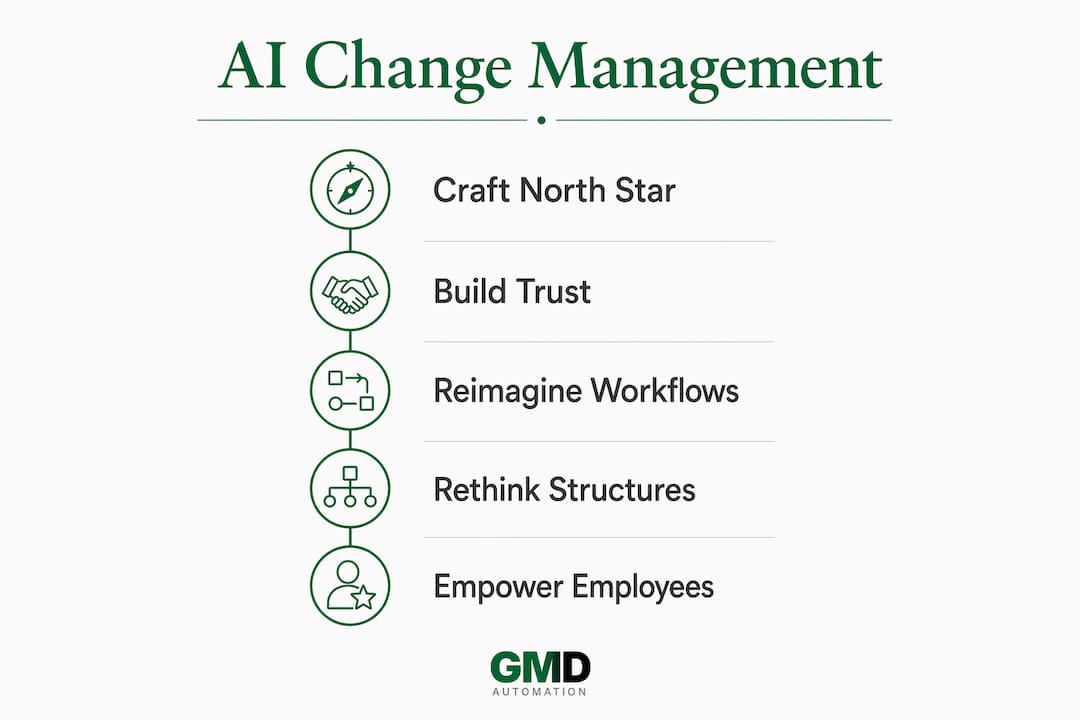
A five-step approach to managing AI-driven change
A realistic AI change management rollout for a mid-sized enterprise takes roughly a year: approximately 90 days for discovery and coalition building, another 90 for structured expansion, and a full year before AI is genuinely embedded in how the organisation works. Shorter timelines usually mean someone skipped the mapping stage.
1. Craft a North Star based on outcomes, not tools
The starting point is agreement on what the organisation is actually trying to achieve, not which tools to deploy. Leaders need to resolve the underlying trade-offs before announcing an AI vision. Which workflows will AI fundamentally change? Which functions remain human-led? Where does the economics of the business actually shift? A North Star without those answers is a slogan, not a plan.
2. Build trust through accessible data and governance
Employees will not adopt AI tools they do not trust, and trust requires transparency. That means clear, published policies on what data can go into which tool, a short list of approved use cases that do not require additional review, and a fast path for new use cases that does. A governance model that responds within a business day builds momentum. One that routes every new use case through a committee meeting kills it. For a deeper look at building this foundation, AI governance frameworks cover the policy design in detail.
3. Reimagine workflows to integrate AI as a team member
Bolting AI onto existing processes produces incremental results at best. The more productive approach puts AI at the centre of workflow redesign, using a two-in-the-box model where business and technology teams work together to define the new way of working. This evolution typically moves through three phases: stand-alone AI agents completing discrete tasks, groups of agents completing end-to-end processes overseen by humans, and eventually more autonomous agentic systems for specific back-office functions. Involving employees directly in designing their own workflows at each phase increases buy-in considerably.

4. Rethink organisational structures alongside the technology
Middle managers are often the most disrupted group in an AI transformation, because AI changes the coordination and synthesis work that defines many management roles. Redesigning those roles proactively, rather than leaving managers to figure it out alone, is one of the most overlooked steps in AI change management. Managers who have genuine agency in designing AI-enabled workflows for their teams become advocates rather than blockers.
5. Empower employees as change agents, not passive recipients
McKinsey research shows that companies involving at least 7% of employees in transformation initiatives double their chances of delivering positive excess total shareholder returns, with the highest performers involving 21–30% of employees. The practical implication is a middle-out approach: identify eight to fifteen people across functions who are genuinely curious about AI, give them dedicated time and permission to experiment, and let them mentor peers. These change champions create safer environments for AI experimentation across the organisation. CEOs who visibly use AI tools in their own work accelerate this culture shift faster than any training programme.
How AI-powered tools enhance the change management process itself
AI does not just create the need for change management. It also makes change management more effective when applied to the discipline itself.
The most common application is improving communications. AI tools help change managers draft clearer messaging, align communications with programme goals, and tailor content to different audience segments. What used to take a day of drafting and review can take an hour, freeing time for the higher-value work of stakeholder engagement.
Personalised training is another area where AI changes the equation. Rather than a single training plan calibrated to the median learner, AI-enabled learning platforms can adapt content to individual literacy levels, role-specific use cases, and pace of progress. That matters particularly given the literacy variance problem described earlier.
| AI capability | Change management application | Practical benefit |
|---|---|---|
| Natural language generation | Drafting communications, FAQs, and training content | Faster production, consistent messaging |
| Sentiment analysis | Monitoring employee feedback and adoption signals | Earlier detection of resistance or disengagement |
| Personalised learning | Role-specific training pathways | Higher relevance, reduced time-to-competence |
| Data analytics | Tracking adoption metrics and workflow changes | Richer, earlier insight for programme decisions |
| Process automation | Automating repetitive change management tasks | More time for people-centred work |
Key AI tools and functions within change management:
- Sentiment and pulse tools that analyse survey responses, meeting transcripts, or collaboration platform data to surface adoption signals before they become visible problems.
- AI-assisted communication platforms that help change managers personalise messaging at scale without losing the human tone.
- Adaptive learning systems that adjust training content based on individual progress and role context.
- Adoption dashboards that layer basic activity metrics, use-case adoption, and outcome signals into a three-tier view of what is actually changing.
Human oversight remains non-negotiable throughout. AI tools surface signals; people interpret them and decide what to do. The governance model that supports this, with clear human-in-the-loop checkpoints, is what separates responsible AI adoption from a technology experiment.
Pro Tip: Build your adoption dashboard in three layers: basic activity at the bottom, concrete use-case adoption in the middle, and business outcome signals at the top. You will not have clean outcome data for months, so lean on qualitative stories from your coalition in the meantime.
What the research says about making AI change actually stick
The evidence on what separates successful AI transformations from stalled ones is consistent across multiple bodies of research, and the pattern is clear: the human factors determine the outcome.
BCG's finding that 70% of transformation value comes from people-related action is not a soft claim about culture. It reflects the concrete reality that technology without adoption produces nothing. Only 5% of custom enterprise AI tools reach production, according to MIT's Project NANDA. The gap between a working AI system and a used one is almost entirely a change management problem.
Storytelling is more operationally important than it sounds. BCG identifies three types of stories that work: a threat story (what is at risk if the organisation does not change), a fitness story (the need to improve and strengthen capabilities), and a destiny story (the special qualities the organisation possesses that AI will help the market access). Leaders who cycle through all three sustain motivation across different employee segments.
The endowed progress effect, documented in behavioural science, explains why celebrating small wins matters beyond morale. People become more motivated to reach a goal when they can see that progress has already been made. For AI transformation, that means actively finding and publicising concrete examples: a team that eliminated an entire step from a cumbersome workflow, an individual who accomplished something previously requiring a team of five. These are not vanity metrics. They are the narrative infrastructure that keeps adoption moving.
| Success factor | What it looks like in practice | Common failure mode |
|---|---|---|
| Leadership alignment | Resolved trade-offs, not surface agreement | False alignment on AI vision |
| Change champions | Peer mentors with time and permission to experiment | Top-down mandate with no coalition |
| Governance model | Fast-response, published policies | Vague rules, committee-heavy approvals |
| Storytelling | Regular concrete wins shared publicly | Usage statistics without human context |
| Emotional intelligence | Structured feedback on employee sentiment | Assuming resistance is irrational |
Pitfalls worth naming explicitly: false alignment at the top, where leaders appear to agree but have not resolved the real trade-offs; new friction for early adopters, who feel slower before they feel faster; and ethical resistance that gets dismissed rather than engaged. Each of these has derailed programmes that had strong technology and adequate budget.
The Prosci ADKAR model offers a useful individual-level lens alongside programme-level planning: Awareness, Desire, Knowledge, Ability, and Reinforcement. The reinforcement stage is where most programmes underinvest. Sustaining adoption requires ongoing coaching, peer collaboration, and visible leadership engagement long after the initial rollout is declared complete.
For organisations working through the operational side of sustaining AI programmes, managed AI operations provides a practical framework for what comes after go-live. Measuring the return on these efforts is equally important; enterprise AI ROI covers how to build the business case and track it honestly over time.
Key takeaways
Effective AI change management succeeds when leaders treat people's emotions, behaviours, and workflows as the primary variables, not the technology itself.
| Point | Details |
|---|---|
| People drive transformation value | BCG research shows 70% of AI transformation value comes from people-related action, not technology. |
| Five dynamics require new approaches | Existential fear, model opacity, literacy variance, ethical concern, and hybrid workflows each need tailored responses. |
| Middle-out beats top-down | Empowering change champions who mentor peers creates safer environments and faster adoption than mandates alone. |
| Governance enables momentum | Fast-response, published AI policies build trust; vague or slow governance kills adoption before it starts. |
| Storytelling sustains adoption | Celebrating concrete wins activates the endowed progress effect and keeps employee motivation alive through long transformation timelines. |
Gmdautomation works with UK organisations to deploy AI systems that are built for adoption from day one, not bolted on after the fact. Every engagement includes implementation, ongoing operation, and the governance structure that makes change management actually land. If you are planning an AI transformation and want a partner who understands both the technology and the people side, explore what Gmdautomation offers for UK enterprises.