

AI optimises ten core categories of operational workflow: demand forecasting and inventory replenishment, supply chain and logistics routing, predictive maintenance, quality inspection, customer service triage, finance and procure-to-pay, HR screening and onboarding, IT operations (AIOps), marketing and sales personalisation, and content generation. These are not theoretical use cases. UK manufacturers, retailers, financial services firms, and contact centres are already running production deployments across all of them, and the types of operational workflows AI optimises share a common trait: high-volume, repetitive decision points with enough historical data to train a model.
The workflows that benefit most tend to involve unstructured inputs, cross-department routing, or complex status digests where rule-based automation hits a ceiling. Payback windows for AI-driven operational strategies have shortened to six–12 months for organisations that combine process maturity with focused pilots. Lean Six Sigma and BPM frameworks are not prerequisites, but organisations that already have them capture disproportionate value.
Workflow categories at a glance:
- Demand forecasting and inventory; supply chain and logistics; predictive maintenance; quality control
- Customer service triage; finance and procure-to-pay; fraud detection; HR screening and onboarding
- IT operations (AIOps); marketing and sales; content generation and management; risk and compliance
Table of Contents
- 1. Demand forecasting and inventory management
- 2. Supply chain and logistics optimisation
- 3. Predictive maintenance and asset management
- 4. Quality control and automated inspection
- 5. Customer service and contact-centre workflows
- 6. Finance workflows: invoice processing, procure-to-pay, and fraud detection
- 7. HR workflows: recruitment screening and onboarding
- 8. IT operations: AIOps and incident detection
- 9. Marketing and sales: lead scoring, personalisation, and campaign automation
- 10. Content generation and management workflows
- 11. Risk management and compliance workflows
- 12. Customer churn prediction and retention
- How AI actually optimises workflows: the core mechanisms
- How to pick which workflows to prioritise for AI
- Measuring impact: KPIs, dashboards, and expected ROI
- Why process maturity determines how much value AI delivers
- Key takeaways
- Practical next steps for UK operations leaders
- Gmdautomation's managed AI automation service for UK businesses
- Useful sources and further reading
- The gap between AI potential and operational reality
1. Demand forecasting and inventory management
AI replaces static reorder-point rules with dynamic models that ingest sales history, supplier lead times, seasonal signals, and external data such as weather or macroeconomic indicators. The model continuously recalibrates safety stock levels and triggers replenishment orders without human intervention.
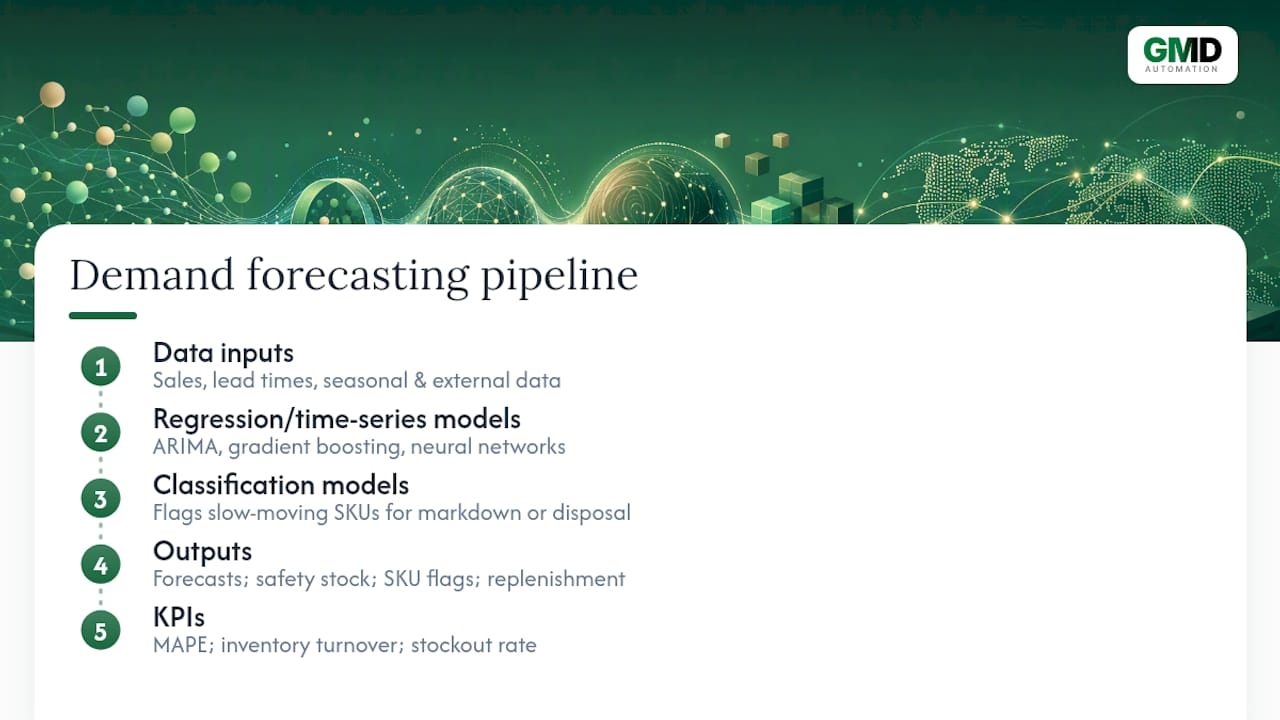
What AI does: regression and time-series models (ARIMA, gradient boosting, neural networks) generate rolling forecasts; classification models flag slow-moving SKUs for markdown or disposal.
Primary benefits: fewer stockouts, lower carrying costs, reduced waste.
KPIs: forecast accuracy (MAPE), inventory turnover, stockout rate.
UK example: a mid-size grocery retailer using AI-driven demand forecasting reduced overstock write-offs by cutting end-of-life product volumes, particularly relevant under UK food waste reduction targets.
Implementation difficulty: medium. Requires clean POS and ERP data; integration with warehouse management systems adds complexity.
2. Supply chain and logistics optimisation
Route optimisation, carrier selection, and exception management are all high-frequency decisions that AI handles faster and more consistently than a planning team working from spreadsheets. AI models weigh fuel cost, delivery windows, vehicle capacity, and real-time traffic data simultaneously.
What AI does: combinatorial optimisation algorithms plan routes; classification models flag shipment exceptions; NLP agents parse supplier communications and update order status automatically.
Primary benefits: lower transport costs, improved on-time delivery, faster exception resolution.
KPIs: on-time-in-full (OTIF), cost per delivery, exception resolution time.
UK example: a third-party logistics provider using AI route planning across the M25 corridor reduced empty-leg mileage and improved OTIF scores for retail clients.
Implementation difficulty: medium to high. Telematics integration and real-time data feeds are needed.
3. Predictive maintenance and asset management
Waiting for equipment to fail is expensive. AI models trained on sensor telemetry, vibration data, and maintenance logs predict failure windows so engineers can intervene before unplanned downtime occurs. This is one of the clearest ROI cases in operations.
What AI does: anomaly detection models monitor sensor streams; classification models assign failure probability scores; alert workflows trigger work orders in CMMS platforms like IBM Maximo or SAP PM.
Primary benefits: reduced unplanned downtime, extended asset life, lower maintenance cost per unit.
KPIs: mean time between failures (MTBF), planned-to-unplanned maintenance ratio, maintenance cost per asset.
UK example: a UK energy company applying predictive maintenance to turbine assets cut unplanned outages and improved planned maintenance scheduling across its generation portfolio.
Implementation difficulty: medium to high. Sensor infrastructure and historian data are prerequisites; OT/IT integration is the main friction point.
4. Quality control and automated inspection
Computer vision models inspect products at line speed, catching defects that human inspectors miss due to fatigue or lighting variation. This is particularly valuable in food manufacturing, pharmaceuticals, and electronics assembly, all significant UK sectors.

What AI does: convolutional neural networks (CNNs) classify images as pass/fail or grade defect severity; models can be retrained as product specifications change.
Primary benefits: higher defect detection rates, lower rework costs, consistent inspection standards.
KPIs: defect escape rate, false positive rate, inspection throughput.
UK example: a pharmaceutical packaging line using vision AI reduced label defect escapes and maintained compliance with MHRA packaging standards.
Implementation difficulty: medium. Camera hardware and labelled training images are the main investment; model retraining cadence needs a defined owner.
5. Customer service and contact-centre workflows
AI workflow automation excels at processing unstructured data, improving triage, and automating recurring document and ticket workflows. In contact centres, this means AI handles first-contact resolution for common queries, routes complex cases to the right agent with context pre-populated, and summarises call transcripts automatically.
What AI does: NLP classifiers triage inbound tickets and voice calls; large language models (LLMs) draft responses or summarise interactions; sentiment analysis flags at-risk customers for escalation.
Primary benefits: lower average handle time, higher first-contact resolution, reduced agent burnout.
KPIs: first-contact resolution rate, average handle time, customer satisfaction (CSAT).
UK example: a UK utilities provider deploying AI triage across its contact centre reduced average handle time on billing queries and freed agents to handle complex complaints.
Implementation difficulty: low to medium. CRM integration is standard; voice AI adds complexity but Gmdautomation's voice agent capability covers this natively.
6. Finance workflows: invoice processing, procure-to-pay, and fraud detection
Invoice processing is one of the fastest wins in finance operations. AI extracts data from unstructured PDFs, matches invoices to purchase orders, flags discrepancies, and routes exceptions for human review. The same document-extraction capability extends to contract review and expense management.
What AI does: optical character recognition (OCR) combined with NLP extracts invoice fields; matching algorithms reconcile against PO and GRN data; anomaly detection models score transactions for fraud risk.
Primary benefits: faster payment cycles, lower processing cost per invoice, reduced duplicate payments and fraud losses.
KPIs: invoice processing cycle time, straight-through processing rate, fraud detection precision/recall.
UK example: a UK professional services firm using AI-driven procure-to-pay automation cut invoice processing time from days to hours and reduced manual data entry errors.
Implementation difficulty: low to medium. ERP connectors exist for SAP, Oracle, and Microsoft Dynamics; document quality is the main variable.
7. HR workflows: recruitment screening and onboarding
High-volume recruitment screening is repetitive and time-consuming. AI models score CVs against job criteria, rank candidates, and schedule interviews automatically. Onboarding workflows use AI to personalise training paths and answer policy questions via conversational agents.
What AI does: NLP models parse CVs and score candidates against role requirements; classification models flag potential bias indicators for human review; conversational AI handles onboarding FAQs and document collection.
Primary benefits: faster time-to-hire, reduced recruiter workload, more consistent candidate evaluation.
KPIs: time-to-hire, recruiter hours per hire, candidate drop-off rate.
UK example: a UK financial services firm using AI screening reduced time-to-hire for graduate roles and maintained Equality Act compliance through regular model audits.
Implementation difficulty: low to medium. Bias monitoring and UK Equality Act compliance checks are non-negotiable; these should be built into the workflow design from day one.
8. IT operations: AIOps and incident detection
IT operations teams deal with alert storms, false positives, and slow mean time to resolution (MTTR). AIOps platforms correlate events across monitoring tools, suppress noise, identify root causes, and trigger automated remediation scripts for known failure patterns.
What AI does: correlation engines group related alerts into incidents; classification models predict incident severity; runbook automation executes remediation steps for known patterns without human intervention.
Primary benefits: lower MTTR, reduced alert fatigue, faster root-cause identification.
KPIs: MTTR, alert-to-incident ratio, automated remediation rate.
UK example: a UK financial services firm using AIOps reduced P1 incident MTTR and cut overnight on-call escalations by automating remediation for the most common failure patterns.
Implementation difficulty: medium. Requires integration across monitoring tools (Datadog, Dynatrace, Splunk); event schema normalisation is the main technical hurdle.
9. Marketing and sales: lead scoring, personalisation, and campaign automation
Lead scoring models rank prospects by conversion probability, so sales teams call the right people first. Personalisation engines serve tailored content and product recommendations in real time. Campaign automation adjusts bid strategies, audience segments, and send times without manual intervention.
What AI does: gradient boosting or neural network models score leads; recommendation engines personalise web and email content; reinforcement learning optimises campaign parameters continuously.
Primary benefits: higher conversion rates, lower cost per acquisition, better sales team productivity.
KPIs: lead-to-opportunity conversion rate, cost per acquisition, email open and click rates.
UK example: a UK SaaS business using AI lead scoring increased sales team contact rates with high-probability prospects and reduced time wasted on cold outreach.
Implementation difficulty: low to medium. CRM and marketing automation platform integrations are well-established; data hygiene is the main constraint.
10. Content generation and management workflows
Generative AI has made content production a genuine workflow category rather than a creative exception. AI drafts product descriptions, internal reports, social media posts, and knowledge base articles at scale. Human editors review and approve; the AI handles volume.
What AI does: LLMs generate first drafts from structured briefs or data inputs; classification models tag and categorise content for CMS routing; scheduling agents publish and distribute across channels automatically.
Primary benefits: faster content production, lower cost per piece, consistent brand voice at scale.
KPIs: content production volume, time-to-publish, editorial review cycle time.
UK example: a UK e-commerce retailer using AI-generated product descriptions reduced copywriting costs and maintained SEO performance across a catalogue of thousands of SKUs.
Implementation difficulty: low. LLM APIs are accessible; the main governance requirement is a human review gate and a clear editorial policy.
11. Risk management and compliance workflows
Compliance monitoring is high-stakes and high-volume. AI models continuously scan transactions, communications, and operational data for policy violations, regulatory breaches, or emerging risk signals. This is especially relevant for UK financial services firms operating under FCA rules.
What AI does: NLP models monitor communications for conduct risk indicators; classification models flag transactions against AML and sanctions lists; anomaly detection identifies unusual patterns in operational data.
Primary benefits: faster breach detection, lower compliance cost, auditable decision trails.
KPIs: breach detection rate, false positive rate, time-to-escalation.
UK example: a UK bank using AI-driven transaction monitoring reduced manual review workload on AML alerts while maintaining FCA reporting standards.
Implementation difficulty: high. Regulatory explainability requirements mean model decisions must be interpretable; UK GDPR data minimisation principles apply to training data.
12. Customer churn prediction and retention
Churn models identify customers showing disengagement signals before they cancel or lapse. Retention workflows then trigger personalised outreach, offers, or service interventions automatically. The economics are straightforward: retaining an existing customer costs far less than acquiring a new one.
What AI does: survival analysis or gradient boosting models score churn probability; event-driven workflows trigger retention actions (email, call, discount) based on score thresholds; outcome data feeds back into model retraining.
Primary benefits: higher retention rates, lower churn-related revenue loss, more targeted retention spend.
KPIs: churn rate, retention campaign conversion rate, customer lifetime value (CLV).
UK example: a UK telecoms provider using churn prediction reduced voluntary churn in its consumer base by targeting high-risk subscribers with proactive service reviews.
Implementation difficulty: low to medium. Requires CRM data and a defined retention playbook; the model is straightforward but the intervention logic needs careful design.
How AI actually optimises workflows: the core mechanisms
AI adds value in workflows through a small set of repeatable capabilities, not through magic. The practical framing that maps most cleanly to operations decisions comes from representing workflows as primitives and patterns: seven primitives (watch, validate, classify, enrich, generate, execute, elicit) that chain into recurring composition patterns.
The seven primitives:
- Watch: monitor a data stream or event source for a trigger condition
- Validate: check a data item against rules, schemas, or learned norms
- Classify: assign a category, label, or score to an input
- Enrich: add context, lookup data, or derived features to a record
- Generate: produce text, code, a plan, or a structured output from a prompt or data
- Execute: take an action in an external system (create a ticket, send an email, update a record)
- Elicit: ask a human for input, approval, or clarification
These primitives chain into four recurring patterns: triage (watch → classify → route), draft and review (generate → validate → elicit), monitoring and escalation (watch → validate → execute or elicit), and sync and transform (enrich → validate → execute). Most of the twelve workflow categories above map to one or two of these patterns.
Common architectures:
- Agentic workflows where an LLM orchestrates tool calls and sub-tasks autonomously
- Classification and scoring pipelines using gradient boosting or neural networks on tabular or text data
- Document extraction pipelines combining OCR, NLP, and structured output schemas
- Event-driven automation where a message queue triggers AI processing on new data
AI handles unstructured inputs (PDFs, emails, images, sensor streams, call transcripts) that rule-based RPA cannot parse. Where RPA remains useful is in the execute step: once AI has classified or generated an output, RPA bots can reliably push that output into legacy systems without an API. The hybrid pattern is AI for judgement, RPA for execution.
Pro Tip: Before selecting a model architecture, map your candidate workflow to one of the four composition patterns above. A triage pattern needs a fast, high-recall classifier; a draft-and-review pattern needs an LLM with a human gate. Matching the pattern to the architecture saves months of rework.
How to pick which workflows to prioritise for AI
The decision backbone is a value × feasibility matrix. Score each candidate workflow on two axes: value (volume of transactions, cost of errors, strategic importance) and feasibility (data readiness, integration complexity, exception rate, reversibility of actions). High value and high feasibility is where you start.
Prioritisation scoring criteria:
- Transaction volume: high-volume workflows justify model investment; low-volume ones rarely do
- Data readiness: does labelled historical data exist? Is it clean and accessible?
- Exception rate: workflows with very high exception rates need more human oversight and are harder to automate fully
- Reversibility: prefer workflows where AI actions can be undone (draft an email, flag a record) over irreversible ones (send a payment, delete a record)
- Verifiability: can you measure whether the AI decision was correct? Workflows with clear ground truth are easier to improve
Pilot checklist:
- Define success criteria before you start (target KPI, baseline, improvement threshold)
- Scope the minimal viable automation (one step, not the whole process)
- Instrument KPIs from day one; do not retrofit measurement
- Assign a named workflow operator who owns the process and the model
- Document the rollback plan: what happens if the model degrades?
Data requirements by workflow type:
| Workflow | Primary data inputs | Typical availability |
|---|---|---|
| Demand forecasting | POS/ERP transaction history, supplier lead times | Usually available; quality varies |
| Predictive maintenance | Sensor telemetry, maintenance logs | Available if IoT infrastructure exists |
| Invoice processing | Scanned/PDF invoices, PO and GRN data | Available in most ERP systems |
| Customer triage | CRM records, ticket history, call transcripts | Available; transcripts may need enabling |
| HR screening | CV text, job descriptions, outcome data | Available; bias audit data often missing |
| Churn prediction | CRM engagement data, usage logs | Available in SaaS; patchy in traditional sectors |
Building AI-powered workflows for ops teams consistently recommends starting with a task inventory and scoring by impact and effort before committing to any pilot. The heuristic holds: recurring reports, data pulls, and document routing are the fastest wins.
Measuring impact: KPIs, dashboards, and expected ROI
Measurement needs to be designed into the workflow, not bolted on afterwards. Segregate two types of metrics: model performance metrics (accuracy, precision, recall, drift indicators) and business outcome KPIs (cost, time, quality). Both matter, but they answer different questions.
Workflow KPI reference:
| Workflow | Primary KPI | Secondary KPI | Monitoring cadence |
|---|---|---|---|
| Demand forecasting | Forecast MAPE | Stockout rate | Weekly |
| Predictive maintenance | MTBF improvement | Planned/unplanned ratio | Monthly |
| Invoice processing | Cycle time (days) | Straight-through rate | Weekly |
| Customer triage | First-contact resolution | Average handle time | Daily |
| HR screening | Time-to-hire | Recruiter hours per hire | Per hiring cycle |
| AIOps | MTTR | Alert-to-incident ratio | Daily |
| Churn prediction | Churn rate | Retention campaign conversion | Monthly |
Operations leaders who combine process maturity with AI investments have shortened payback windows to six–12 months. Leaders in that cohort collect data from more than half their equipment, which gives models the signal density needed to produce reliable predictions.
Payback window benchmark: organisations that pair focused AI pilots with strong data management and COE-style governance are achieving payback in six–12 months, with the fastest movers seeing returns within a single financial year.
Dashboard design matters. Instrument drift alerts (model accuracy dropping below a threshold) separately from business KPIs. A model that is technically performing within spec but producing worse business outcomes needs investigation; the two metrics will diverge before a problem becomes visible to the business.
Why process maturity determines how much value AI delivers
Organisations with discipline in process frameworks such as Lean Six Sigma and BPM are best positioned to embed AI sustainably and realise scale benefits. The reason is structural: AI needs clean process boundaries, defined inputs and outputs, and measurable outcomes. Mature processes already have these; immature ones do not.
EY's practical guidance on AI in operations consistently highlights a targeted approach, strong data management, and designing for scalability as the recurring factors separating successful deployments from stalled pilots.
The case for COE-style governance is empirical. Operations pilots that combined OT/IT collaboration with dedicated teams achieved faster, cheaper, and more reliable production models. One manufacturing example from McKinsey's research involved an in-house advanced process control model that ran ten times faster and at a tenth of the cost of its predecessor, and was later commercialised. The COE structure made that reuse possible.
Organisational prerequisites checklist before commissioning a managed service:
- Data coverage: do you have at least 12 months of clean historical data for the target workflow?
- Named workflow operator: is there a person who will own the process and the model post-deployment?
- API readiness: can your core systems (ERP, CRM, CMMS) expose data via API or file export?
- Governance: is there a COE or cross-functional pod ready to own standards and change control?
- Compliance: have you documented your lawful basis under UK GDPR for any personal data in scope?
Real-world AI process automation wins consistently show that organisations which tick these boxes before starting a pilot reach production faster and sustain performance longer.
Bain's research on AI-powered operations identifies change management as the main barrier to scaling. Their 20/200/2,000 framework gives a practical structure: a senior sponsor, a layer of 200 middle managers who coach adoption, and 2,000 frontline staff who embed new behaviours. Without that human infrastructure, even technically sound deployments stall at pilot stage.
Key takeaways
AI delivers the most value in high-volume, data-rich operational workflows where the cost of slow or inconsistent decisions is measurable, and organisations that pair process maturity with focused pilots achieve payback in six–12 months.
| Point | Details |
|---|---|
| Start with high-volume, reversible workflows | Invoice processing, customer triage, and demand forecasting offer fast wins with low deployment risk. |
| Score pilots on value × feasibility | Data readiness and reversibility matter as much as potential impact when ranking candidates. |
| Assign a workflow operator before go-live | Named ownership prevents model drift and ensures exceptions are caught and escalated. |
| Instrument KPIs from day one | Segregate model performance metrics from business outcome KPIs; drift alerts should be automated. |
| Gmdautomation for UK deployments | Gmdautomation's managed subscription service covers implementation, compliance, and ongoing optimisation with no upfront costs. |
Practical next steps for UK operations leaders
The gap between knowing which workflows AI can optimise and actually running a production deployment is almost always an organisational problem, not a technical one. Here is a compact sequence that works.
Inventory first. Spend two weeks mapping your highest-volume, most error-prone workflows. Score each one on transaction volume, data availability, exception rate, and reversibility. The top three on that matrix are your pilot candidates.
Run the prioritisation matrix. Apply the value × feasibility scoring from the framework above. If two workflows score similarly, prefer the one with cleaner data. Data quality is the variable that kills more pilots than any other.
Choose one pilot, not three. Organisations that try to run multiple AI pilots simultaneously almost always deliver none of them well. Pick the single workflow with the best combination of impact and data readiness, and go deep.
Assign a workflow operator. This person is not a data scientist. They are the operations manager or team lead who owns the process, reviews model outputs daily in the first month, and escalates anomalies. Without them, the model drifts.
Instrument KPIs before launch. Set your baseline, define your improvement threshold, and build the dashboard before the model goes live. Retrofitting measurement is harder than it sounds and creates gaps in your evidence base.
Schedule a 90-day review. At 90 days, assess model performance against KPIs, review exception logs, and decide whether to scale, retrain, or redesign. This cadence keeps the workflow honest.
On governance: for a first pilot, a cross-functional pod (operations lead, data engineer, IT, business analyst) is faster and more practical than standing up a full COE. Build the COE once you have two or three workflows in production and need shared standards for prompt management, model versioning, and vendor oversight.
On procurement: a managed service makes sense when your team lacks MLOps capability, when UK GDPR compliance documentation is a constraint, or when speed to production matters more than building internal capability. Building in-house makes sense when the workflow is highly proprietary, when you have the engineering team, and when long-term model ownership is a strategic priority. Most UK mid-market businesses are better served by a managed service for initial deployments and can build internal capability in parallel.
Gmdautomation's managed AI automation service for UK businesses
If the prioritisation framework above has surfaced two or three strong pilot candidates and your team is ready to move, the practical question is how fast you can get to production without taking on significant technical debt or compliance risk.
Gmdautomation delivers enterprise-grade AI workflow automation as a fully managed monthly subscription, with zero upfront costs and no long-term lock-in. Implementation, operation, maintenance, UK GDPR compliance documentation, and ongoing optimisation are all included in a single predictable fee. That means your operations team gets a production-ready system without hiring a data engineering team or navigating vendor contracts for each component separately.
The service covers the workflow categories most relevant to UK operations teams: AI-powered voice call handling (lead qualification, appointment booking), social media management automation, and enterprise workflow automation across the process types covered in this guide. Every deployment is built for UK compliance from the start, with data processing agreements and audit trails included.
To see how a managed deployment would work for your specific workflow candidates, book a discovery call with the Gmdautomation team. The conversation starts with your workflow inventory, not a product demo.
Useful sources and further reading
-
Bold accelerators: How operations leaders are pulling ahead using AI — McKinsey's operational AI research; essential for ROI benchmarks and data maturity findings. Highly relevant for payback window and COE evidence.
-
Achieving operational excellence with AI — MIT Technology Review; covers process framework prerequisites and the relationship between Lean Six Sigma discipline and AI ROI.
-
AI workflow automation: how to improve workplace efficiency — Atlassian's practical guide to unstructured data handling, triage automation, and agentic workflows.
-
Building AI-powered workflows for ops teams — Practical task inventory and impact/effort scoring methodology; directly applicable to the prioritisation framework.
-
4 ways AI can help business leaders boost operations — EY's operational AI guidance; useful for targeted approach and scalability design principles.
-
What are AI-powered operations and how do they work? — Bain's change management framework (20/200/2,000) for scaling AI adoption; the most practically useful source on the human side of deployment.
-
AI workflow patterns: the real unit of AI adoption in 2026 — Primitives and composition patterns framework; essential for mapping workflows to the correct automation architecture.
-
AI workflow automation pipeline examples for UK businesses — UK-specific pipeline examples and integration guidance from Gmdautomation.
-
AI automation checklist for operations managers — Practical readiness checklist covering data, governance, and pilot design; directly applicable before commissioning any deployment.
-
GMD Automation — AI automation for UK businesses — Primary contact point for managed AI workflow automation services, demos, and UK compliance-ready deployments.
The gap between AI potential and operational reality
Most articles on AI workflow optimisation list the use cases and stop there. The harder question is why so many pilots never reach production, and the answer is almost never the model.
The pattern I see repeatedly in operational AI discussions is this: a team identifies a genuinely strong use case, builds a proof of concept, gets promising results, and then stalls. The stall happens because the data pipeline is not production-grade, the workflow operator was never assigned, the exception handling was not designed, or the compliance documentation was not ready for procurement sign-off.
The implication is uncomfortable but important. Investing in AI workflow automation before your data and governance foundations are solid is not a shortcut to efficiency. It is a way to produce an expensive proof of concept that never scales. The organisations capturing the most value from AI in operations are not necessarily the ones with the most sophisticated models. They are the ones that treated process discipline as a prerequisite, not an afterthought.
For UK operations leaders, the practical conclusion is this: the prioritisation framework and the governance checklist in this guide are not bureaucratic overhead. They are the difference between a pilot that becomes a production asset and one that gets quietly shelved after the initial enthusiasm fades. Start with the inventory. Score honestly. Assign the operator. Then build.