

The right digital transformation strategy for an SME is a phased one: assess where you stand, build a short roadmap around two or three high-value use-cases, roll out in controlled pilots, then reinvest what you save into the next phase. Skip the enterprise playbooks. They assume budgets and IT teams most SMEs don't have.
Start this week with three moves. Run a rapid audit of your three most time-consuming manual processes (invoicing, scheduling, and customer follow-up are the usual suspects). Centralise customer records into one CRM rather than five spreadsheets and two inboxes. Then pick a single automation quick win, such as auto-generated invoices or AI-handled appointment booking, and get it live within a month.
This isn't guesswork. It mirrors the DASAT model (Digital Awareness, Strategy and roadmap, Adoption, continuous improvement Transformation), a cyclic framework built specifically for SME digital transformation, and it aligns with OECD guidance that structured roadmaps and support materially improve SME adoption rates.
- Audit your three most time-consuming manual processes this week.
- Centralise customer data into a single CRM before adding any automation on top.
- Launch one automation pilot (invoicing, booking, or lead follow-up) within 30 days.
Key Takeaways
The most effective digital transformation strategy for an SME is a phased, quick-win-funded roadmap that assesses maturity first and scales only what a pilot proves works.
| Point | Details |
|---|---|
| Start with awareness, not tools | Audit your top manual processes and score your digital maturity before buying anything. |
| Centralise data first | Put customer records into one CRM before layering automation or analytics on top. |
| Prioritise by impact versus effort | Choose quick wins that are high impact and low effort to fund larger projects later. |
| Pilot before you scale | Run a four to eight week pilot with clear KPIs and rollback criteria before wider rollout. |
| Treat adoption as the real project | Leadership sponsorship and role-specific training decide success more than the software itself. |
| Consider a managed partner for speed | Gmdautomation offers a subscription-based, zero-upfront model covering implementation and ongoing optimisation for SMEs without in-house capacity. |
Table of Contents
- What digital transformation means for SMEs and why it matters now
- A staged SME roadmap: awareness, strategy, adoption, improvement
- How to assess your current digital maturity quickly
- Choosing and prioritising projects: quick wins, value drivers and the business case
- Practical technology foundation for SMEs
- People, leadership and change management: securing adoption
- Governance, data strategy and cybersecurity basics for SMEs
- Pilots, KPIs and scaling a successful trial
- Typical costs, pricing models and funding routes
- How a managed AI automation partner can accelerate transformation
- Industry-specific digital transformation use-cases for SMEs
- Risk management strategies specific to SME transformation
- Common SME pitfalls and the simplest path to traction
- How Gmdautomation can take this off your plate
- What is the first step in a digital transformation strategy for an SME?
- How long does SME digital transformation typically take?
- Should an SME build automation in-house or hire a managed partner?
- What's the biggest reason SME digital transformation projects fail?
- Do I need a big budget to start digital transformation as a small business?
- Sources
What digital transformation means for SMEs and why it matters now
Digitisation and digital transformation get used interchangeably, and that's where a lot of SMEs waste money. Digitisation is converting paper invoices into PDFs. Digital transformation is redesigning how you invoice, chase payment, and forecast cash flow so the whole cycle runs with less manual effort and better data. One is a task. The other is a change in how the business operates.
For a business with 15 staff and no dedicated IT department, that distinction decides where money goes. The OECD's analysis of SME digital transformation frames it as central to competitiveness, not a nice-to-have layered on top of "real" operations. A 2025 DASAT framework study makes a similar point: SMEs that treat transformation as a one-off IT project tend to stall, while those that treat it as a repeatable cycle build lasting capability. Salesforce's guidance for small businesses reaches the same conclusion from a practitioner angle, recommending SMEs start with a single source of truth for customer data before layering on automation.
The benefits are concrete when the strategy is right:
- Faster decisions — real-time data replaces guesswork and end-of-month spreadsheet reconciliation.
- Lower cost to serve — automating repetitive admin (quoting, scheduling, chasing invoices) frees staff for higher-value work.
- Better customer experience — centralised records mean any team member can answer a customer query without transferring calls three times.
- Access to new markets — e-commerce, online booking, and digital payments open channels a purely offline competitor can't reach.
The risks are just as real, and they're the reason most transformation efforts underdeliver. A systematic review of SME digital transformation identifies the recurring failure points: fragmented point solutions that don't talk to each other, staff resistance when tools get imposed without training, and unclear ROI because nobody defined success before spending the budget.
Digital transformation doesn't have an end date. It's a continuous cycle, not a project with a finish line. Once you adopt one system, the next gap in your process becomes visible, and the cycle starts again. That's the whole premise behind the DASAT approach.
A staged SME roadmap: awareness, strategy, adoption, improvement
The DASAT-like model gives you four phases, each with a distinct job to do. Treat it as a loop, not a straight line: you'll cycle back through these stages every time you tackle a new area of the business.
- Digital Awareness — understand where you stand and what's actually broken. The objective is honest diagnosis, not technology shopping.
- Strategy and Roadmap — turn that diagnosis into two or three prioritised initiatives with owners, budgets, and timelines attached.
- Adoption and Implementation — roll out in controlled pilots, train staff properly, and measure results against a baseline.
- Continuous Improvement — review what worked, retire what didn't, and feed the savings and lessons into the next cycle.
Each phase needs its own checklist, because skipping steps here is exactly how projects stall.
Digital Awareness:
- Interview staff across departments about where time gets wasted.
- Map your top five manual, repetitive processes.
- Identify data currently trapped in spreadsheets or paper.
- Benchmark against at least one competitor's digital customer experience.
Strategy and Roadmap:
- Rank candidate projects by impact versus effort.
- Set a written objective and success metric for each chosen initiative.
- Assign a named owner for each project, not a department.
- Agree a realistic budget band and timeline before build starts.
Adoption and Implementation:
- Run a pilot with a defined start and end date.
- Train the specific staff who'll use the tool daily, not just managers.
- Track usage weekly, not just at the three-month mark.
- Fix workflow friction fast, before workarounds become habits.
Continuous Improvement:
- Compare pilot results against the baseline set in the strategy phase.
- Decide: scale, adjust, or kill.
- Reinvest savings from successful pilots into the next priority.
- Reassess digital maturity every six to twelve months.
This structure isn't invented for this article. A 2024 SDT-SMEs roadmap study recommends exactly this kind of incremental, maturity-linked rollout, built on ISO/IEC-aligned modelling rather than ad hoc technology adoption. The consistency across independent academic sources is the real signal: nobody credible is recommending a big-bang enterprise rollout for a business your size.
How to assess your current digital maturity quickly
You don't need a consultant with a 40-page questionnaire to know roughly where you stand. A practical SME digital transformation framework recommends scoring across six dimensions: technology, customer focus, culture, governance, people, and sustainability. Score each from 1 (largely manual, no clear owner) to 5 (integrated, automated, measured).
| Dimension | Low maturity signal | High maturity signal |
|---|---|---|
| Technology | Spreadsheets, disconnected tools, no cloud backup | Integrated CRM/ERP, cloud-based, API-connected |
| Data | Customer data spread across inboxes and files | Single customer record, accessible to relevant staff |
| Processes | Manual, undocumented, dependent on one person | Documented, partially automated, monitored |
| People | No digital training, resistance to new tools | Regular training, digital skills part of onboarding |
| Governance | No data policy, unclear ownership | Named data owner, retention policy in place |
| Sustainability | Transformation seen as a one-off project | Reviewed and updated on a regular cycle |
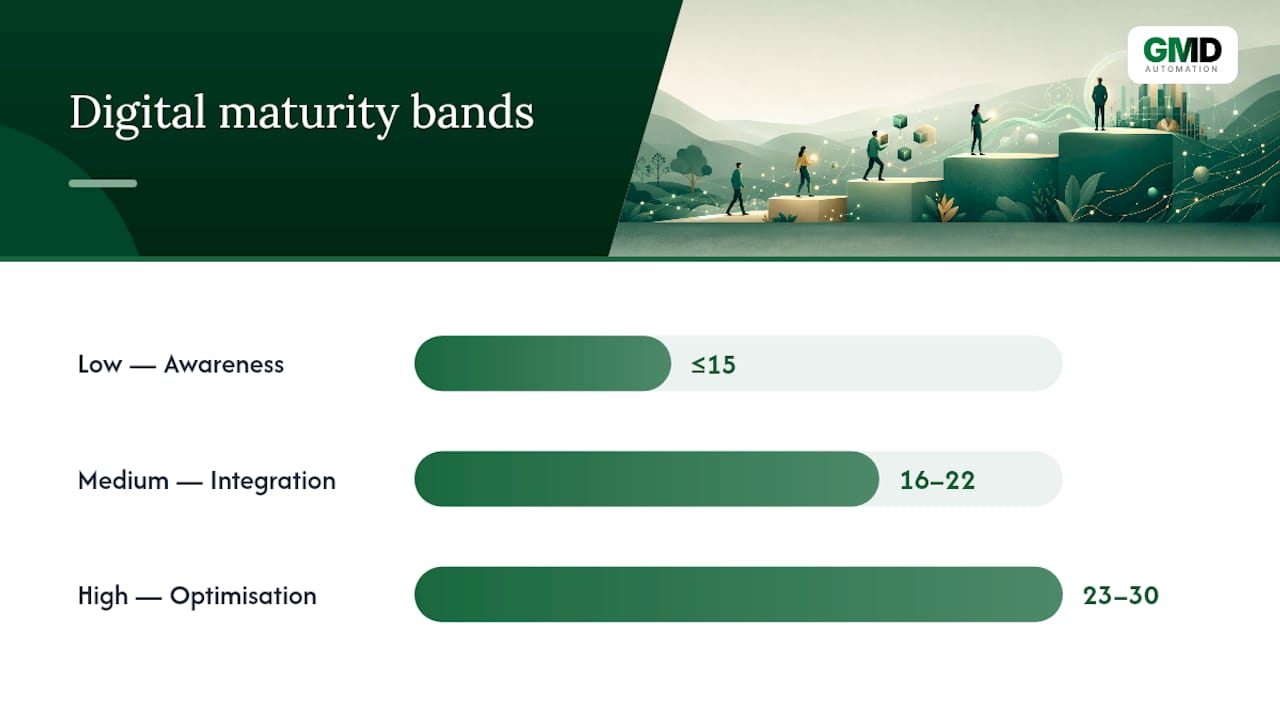
Add up your scores. Fifteen or below puts you in the low band: your priority is the Digital Awareness phase, full stop. Don't buy new software yet. Sixteen to twenty-two is medium: you likely have some tools in place but they're disconnected, so the priority is integration and one strong pilot. Above twenty-two is high maturity: focus shifts to optimisation, analytics, and scaling what already works rather than new adoption.
Most SMEs land in the medium band, and the failure mode there is predictable: they've bought three or four tools that each solve one problem but don't share data. That's the fragmentation risk the Applied Sciences review flags as one of the biggest barriers to progress. A six-dimension framework for UK SMEs makes the same point: treating these dimensions in isolation is where most transformation budgets get wasted.
Choosing and prioritising projects: quick wins, value drivers and the business case
Every SME leader we'd advise faces the same problem: a long list of things that could be digitised and a short list of things that should be digitised first. The fix is a simple impact-versus-effort matrix, scored honestly rather than optimistically.
| Impact / Effort | Low effort | High effort |
|---|---|---|
| High impact | Quick wins — do these first | Major projects — plan carefully, sequence after quick wins |
| Low impact | Fill-ins — do if spare capacity exists | Avoid — rarely worth the resource drain |
Score each candidate project on both axes using your own team's estimate, not a vendor's promise. A CRM migration for a ten-person sales team is usually high impact, moderate effort. A full ERP replacement is high impact but often very high effort, which is why it belongs later in the roadmap, not first.
Once you've ranked candidates, build a one-page business case for each. It doesn't need to be complicated:
- Objective — what specifically improves (e.g. "reduce invoice processing time").
- Metric — the number you'll track (e.g. days from job completion to invoice sent).
- Baseline — where you are now.
- Expected uplift — the realistic target, stated as a range.
- Owner — one named person accountable.
- Cost — setup and ongoing subscription cost.
- Timeline — pilot start and review date.
Typical SME quick wins include centralising customer records into a CRM, automating invoicing so payment terms trigger reminders without manual chasing, and adding basic AI-driven lead qualification so staff only spend time on leads worth pursuing. Guidance from Salesforce's small business resources consistently points to the CRM as the foundational quick win, because every later automation (marketing, support, invoicing) depends on clean customer data existing in one place. A Springer review of SME digitalisation reaches a similar conclusion: incremental adoption, aligned across organisational and financial functions, consistently outperforms attempts to leap straight to advanced systems. You can also use a structured method for identifying automation opportunities in your operations to surface candidates you might otherwise miss.
Pro Tip: Ring-fence the time and cost savings from your first successful quick win and reinvest them directly into the next project's budget. It's far easier to get sign-off for phase two when you can point to real money already saved from phase one.
Practical technology foundation for SMEs
You don't need enterprise software licences to build a solid technical base. You need five categories covered, connected to each other, and secured properly.
- CRM — the single source of truth for customer data; everything else should read from and write to it.
- Cloud storage — accessible from anywhere, backed up automatically, no more "the file's on Dave's laptop."
- Workflow automation — connects your tools so data moves without manual re-entry (a new CRM entry triggers an invoice draft, for example).
- Invoicing and payments — digital, trackable, ideally linked to your CRM and accounting software.
- Basic business intelligence — simple dashboards showing the handful of numbers that actually run your business.
Entry-level options in each category tend to be affordable and quick to deploy, but they come with trade-offs. Cheaper CRM tools are fast to set up but can be limited on automation depth. Free cloud storage plans cap out quickly once you're sharing large files across a growing team. Basic invoicing tools handle the essentials but may lack the reporting depth a growing SME needs within eighteen months. A ScienceDirect review of SME digital transformation backs the starter-tools-first approach directly: SMEs get the most value from off-the-shelf automation and centralised data before they invest in anything custom-built.
| Category | Why it matters | Watch out for |
|---|---|---|
| CRM | Single customer record for sales, service, marketing | Poor integration with existing accounting software |
| Cloud storage | Access anywhere, automatic backup | Storage limits and per-user pricing that scales fast |
| Workflow automation | Removes manual re-entry between systems | Tools that don't support the APIs you actually need |
| Invoicing/payments | Faster cash collection, fewer errors | Limited reporting once transaction volume grows |
| Basic BI/analytics | Visibility without a data analyst | Dashboards nobody actually checks weekly |
Before signing anything, check three things: does it have an open API for future integration, does it support single sign-on so you're not managing six separate logins, and does the vendor offer a documented SLA. On security, the baseline is non-negotiable regardless of budget: automated backups, multi-factor authentication on every account, role-based access control so junior staff can't see payroll data, and a written service-level agreement with every vendor holding your data. A guide to choosing AI tools for enterprise work is worth reading before you commit budget to any single category. For the integration side specifically, Kontrol Media's guidance on aligning technology with business strategy is a useful sanity check before you buy.
People, leadership and change management: securing adoption
Technology fails in SMEs for human reasons far more often than technical ones. The Applied Sciences systematic review names cultural resistance and skills shortages as two of the most persistent barriers, and leadership commitment as the strongest mediating factor for success. That's not a soft observation. It means the CEO's visible involvement predicts outcomes better than the software vendor's feature list does.
Leadership needs to do four things consistently:
- Communicate a clear vision for why the change is happening, not just what's changing.
- Sponsor the project publicly, including attending training sessions themselves.
- Allocate real time and budget, not just verbal approval.
- Assign ownership of early quick wins to specific people who get credit for delivering them.
A training plan doesn't need to be elaborate, but it needs structure:
- Identify which roles need which skills, not "everyone gets the same training."
- Time training close to go-live, not weeks in advance when it'll be forgotten.
- Choose delivery method by role: short video walkthroughs for occasional users, hands-on sessions for daily users.
- Set a success metric for training itself (e.g. 90% of staff completing a task unaided within two weeks).
Watch for adoption red flags early, because they're fixable if caught fast and expensive if ignored. Staff quietly reverting to the old spreadsheet alongside the new system is the clearest warning sign. Falling login or usage numbers after the first fortnight is another. Duplicated data appearing in two systems means someone hasn't trusted the new one enough to stop using the old one. Address each immediately with direct conversation, not another email reminder. A practical resource on how small teams adopt AI automation covers this adoption curve in more depth.
Governance, data strategy and cybersecurity basics for SMEs
Governance sounds like a large-company concern, but for an SME it just means someone is accountable for data decisions before a problem forces the question. A lightweight checklist covers most of what you need:
- Name a data owner for each core system (CRM, accounting, HR records).
- Write a one-page data retention policy: what you keep, for how long, and why.
- Review vendor contracts annually for data handling terms, not just price.
- Keep an incident contact list (who to call first if something goes wrong) somewhere everyone can find it.
Cybersecurity for an SME doesn't require a security operations centre. It requires a handful of habits done consistently: multi-factor authentication on every account that touches customer or financial data, automated backups tested at least quarterly (an untested backup is not a backup), regular patching of software rather than deferring updates, and least-privilege access so staff only see what their role requires.
If internal capability is genuinely limited, external support is often the pragmatic answer rather than a sign of failure. Cyber insurance is increasingly affordable for small businesses and worth pricing against your risk exposure, and a managed IT or security provider can cover the gaps a five-person operations team can't realistically staff themselves. Guidance on setting up business automation includes a useful checklist for exactly this kind of initial setup review.
Pilots, KPIs and scaling a successful trial
A pilot only works if you define what "success" and "failure" look like before you start, not after you've already fallen in love with the tool. The template is short:
- Objective — the specific problem being solved.
- Scope — one team, one process, a defined time window (four to eight weeks is typical).
- Owner — one accountable person, tracking progress weekly.
- Timeline — start date, review date, decision date.
- Measures — the KPIs you'll actually check.
- Rollback criteria — the conditions under which you revert to the old process without shame.
Useful KPIs vary by process, but the ones that consistently matter for SMEs are time saved per task, error rate reduction, revenue generated per qualified lead, average handling time for customer queries, and cost per transaction processed. Pick two or three, not ten. Trying to measure everything is how pilots collapse under their own reporting overhead.
- Track your chosen KPIs weekly during the pilot, not just at the final review.
- Compare results against the baseline you recorded in the maturity assessment.
- If results clear the bar, build the phase-two business case immediately, using real pilot numbers rather than projections.
- If results fall short, diagnose whether the tool, the training, or the process design was the problem before scrapping the whole initiative.
Scaling isn't just "roll it out to everyone at once." Extend to a second team first, incorporate what the pilot taught you about training gaps, and only then move to full deployment. Real examples of this staged approach, including the efficiency gains SMEs typically see, are covered in real-world AI process automation case studies.
Typical costs, pricing models and funding routes
Cost expectations for a first pilot vary by business, but the shape is predictable: staff time for setup and training is usually the largest hidden cost, followed by subscription fees for the tools themselves, then any integration work needed to connect systems that don't talk to each other natively. Vendor setup fees, where they exist, are typically a smaller one-off addition on top.
The choice between pricing models matters more than most SMEs realise upfront:
- Subscription (OPEX) — lower upfront cost, predictable monthly spend, easier to cancel or switch if it doesn't work. The trade-off is ongoing cost that never disappears.
- One-off development (CAPEX) — you own the outcome outright, but upfront cost is high and you carry the maintenance burden yourself.
- Managed service subscription — a single monthly fee covers implementation, operation, and ongoing optimisation, which suits SMEs without an internal IT team, though you're trusting a third party with an operationally important system.
For most SMEs without dedicated technical staff, subscription or managed-service models remove the capital outlay risk that makes CAPEX projects hard to greenlight. That's consistent with what a Forbes commentary on SME digital transformation recommends: treat transformation as an ongoing reallocation of investment funded progressively by earlier wins, rather than one large capital commitment approved once and never revisited.
On funding, don't overlook the obvious routes. Government-backed digital adoption grants exist in various forms and are worth checking against your sector and region. Vendor financing, where a provider spreads setup costs across the subscription term, reduces the initial cash hit. And the simplest funding source of all is the one this whole roadmap is built around: reinvesting the savings from your first quick win into the next project, rather than waiting for a separate budget approval cycle. A guide to bootstrapping workflow automation and a breakdown of how automation investment pays for itself both cover this funding logic in more detail.
How a managed AI automation partner can accelerate transformation
SMEs that hand a specific, well-defined process to a managed AI automation partner typically report faster time-to-value than those building the same capability from scratch internally. The pattern is consistent: less time lost to internal trial-and-error, fewer abandoned pilots, and a materially shorter path from "we should automate this" to "this is running and saving us hours every week." Common outcomes cited across SME automation projects include noticeably reduced admin time on repetitive tasks like appointment booking and lead follow-up, faster response times to customer enquiries once AI handling is in place, and a lower cost-to-serve per customer interaction once the system beds in.
The managed subscription model changes the risk profile of the decision. Instead of a large upfront build cost with uncertain payback, you pay a predictable monthly fee that covers implementation, day-to-day operation, ongoing optimisation, and the security and compliance work that would otherwise require dedicated internal expertise. That structure removes the capital-outlay barrier that stops many SMEs from even starting.
- Reduced manual admin time on repetitive customer-facing tasks.
- Faster customer response times once AI-handled workflows go live.
- Lower cost-to-serve per interaction as volume scales without proportional headcount growth.
- Compliance and security handled as part of the service rather than bolted on separately.
The decision between building in-house and bringing in a managed partner usually comes down to three factors: whether you have spare technical capacity to build and maintain the system yourself, how quickly you need results, and whether the process in question is core enough to your competitive advantage to justify owning it outright. If the answer to the last question is no, and most back-office processes fall into that category, a managed partner is usually the faster and lower-risk route. A shortlist and hiring guide for AI automation agencies walks through this decision in more detail if you're weighing the options.
Pro Tip: Ask any prospective managed partner what happens if you want to change or expand the automation six months in. The answer tells you more about long-term fit than the initial pitch does.
Industry-specific digital transformation use-cases for SMEs
The right first project varies significantly by sector, because the process bottleneck differs.

Retail and e-commerce: Inventory synchronisation between online and physical stock is usually the highest-value quick win, followed by AI-driven customer service for order status queries, which typically account for a large share of support volume.
Professional services (accountants, consultants, agencies): Client onboarding and document collection are the biggest time sinks. Automating intake forms and centralising client communication in a CRM cuts admin hours substantially, often before any billing automation is even considered.
Trades and field services: Appointment booking and scheduling automation, paired with AI voice handling for inbound calls, addresses the classic problem of missed calls during jobs translating directly into lost revenue.
Hospitality: Automated booking confirmations, review-response workflows, and social media scheduling free up owner-operators who are otherwise doing marketing at midnight after a full day on the floor.
Manufacturing and logistics (small scale): Basic BI dashboards pulling from existing systems often deliver more value than a new system purchase, simply by making data that already exists visible and actionable.
The common thread across every sector: the highest-value first project is almost always the process with the highest volume of repetitive, low-complexity work, not the most technically interesting one. That's the recommendation borne out by practitioners who've watched SMEs try to digitise everything simultaneously and stall, versus those who picked one high-volume process and built visible momentum from it.
Risk management strategies specific to SME transformation
The risks in SME digital transformation are different in kind from enterprise risk, mainly because there's no dedicated risk function catching problems before they compound. Four risks deserve specific attention.
Vendor lock-in is a real concern when a small business commits to a single platform without an exit plan. Before signing, check what happens to your data if you leave, and how easily it exports in a usable format.
Over-investment before validation happens when a business commits to an expensive platform before testing whether the underlying process even needs the complexity. The pilot structure covered earlier exists specifically to prevent this: nothing gets scaled until it's proven at small scale first.
Skills gaps compound quickly in a small team, because if the one person who understands the new system leaves, the knowledge often leaves with them. Document processes as you build them, not as an afterthought, and cross-train at least one backup person on any system critical to daily operations.
Cybersecurity exposure rises with every new connected system, and SMEs are frequently targeted precisely because attackers assume defences are weaker than at larger firms. The governance and security basics covered earlier (MFA, backups, least-privilege access) are the minimum bar, not optional extras for later.
Mitigate all four the same way: stage everything, document as you go, and never let a single system or a single person become a point of total failure.
Common SME pitfalls and the simplest path to traction
Three rules consistently separate SMEs that make real progress from those that spend years "in transformation" without visible results.
Rule one: fewer tools, chosen deliberately, beats more tools chosen reactively. The most common trap is buying a new point solution every time a problem surfaces, ending up with six disconnected subscriptions that each solve one narrow issue and none of them talk to each other. A dynamic capabilities perspective on digital transformation frames this well: the real capability that matters isn't owning more technology, it's the organisational ability to sense a problem, seize the right response, and reconfigure quickly. That's a discipline, not a shopping list.
Rule two: adoption is the project, not an afterthought to the project. Plenty of SMEs treat training as a checkbox after go-live rather than a core deliverable with its own budget and timeline. Given that cultural resistance and skills shortages are named repeatedly as leading barriers to SME transformation, treating adoption as secondary is choosing to fail on the metric that matters most.
Rule three: resist the urge to over-engineer the first project. The instinct to build the "proper" enterprise-grade version of a solution before you've even validated the basic version wastes months and budget on complexity nobody asked for yet. Start narrow, prove it works, then expand. Misconceptions around AI adoption in SMEs frequently centre on exactly this: the false belief that meaningful transformation requires enterprise-scale investment from day one.
If there's one thing worth flagging as genuinely underrated, it's how much these three rules matter more than which specific software you choose. The tool is rarely the reason a project fails. The discipline around it usually is. Run the digital maturity check outlined earlier this week, pick the single highest-volume manual process you have, and commit to a four-week pilot before you spend another pound on new software.
How Gmdautomation can take this off your plate
If the roadmap above sounds right but you don't have the internal capacity to run a four-phase transformation on top of your day job, that's precisely the gap Gmdautomation exists to close. Instead of building and maintaining automation systems yourself, or paying an agency's project fees upfront with no guarantee of ongoing support, you get a fully managed, subscription-based service with zero upfront cost. One monthly fee covers implementation, day-to-day operation, security and compliance, and continuous optimisation.
The service covers three practical areas most SMEs prioritise first: AI-powered workflow automation to eliminate manual admin, voice AI agents that handle inbound calls, lead qualification, and appointment booking without a human picking up every phone call, and AI-driven social media management covering content, scheduling, and direct message replies. Every system is built enterprise-grade but deployed at SME speed, with scaling built in as your needs grow.
Judge any automation partner, Gmdautomation included, by outcomes and total predictable cost rather than a feature checklist. If you've completed the maturity check and identified your quick win, the practical next step is to get in touch with Gmdautomation for a tailored evaluation of what a managed pilot would look like for your specific process, timeline, and budget.
What is the first step in a digital transformation strategy for an SME?
The first step is a rapid digital maturity assessment across technology, data, processes, people, and governance, not a technology purchase. Score honestly, identify your biggest manual bottleneck, and use that to choose your first pilot rather than starting with a vendor pitch.
How long does SME digital transformation typically take?
A single pilot phase typically runs four to eight weeks, with a review and scale decision shortly after. The full cycle through all four DASAT phases, awareness, strategy, adoption, and improvement, is ongoing rather than finite, since successful SMEs repeat the loop for each new priority area.
Should an SME build automation in-house or hire a managed partner?
That depends on internal technical capacity and urgency. If you lack spare technical staff or need results within weeks rather than months, a managed subscription partner such as Gmdautomation typically delivers faster time-to-value with lower upfront risk than an in-house build.
What's the biggest reason SME digital transformation projects fail?
Cultural resistance and inadequate training rank among the most cited barriers in the academic literature, often ahead of budget constraints. Treating adoption as a core deliverable, with named ownership and role-specific training, addresses this directly.
Do I need a big budget to start digital transformation as a small business?
No. The evidence consistently points to starting with low-cost, high-impact quick wins, such as CRM centralisation or invoice automation, and reinvesting the savings into larger projects rather than requiring a large upfront capital commitment.
This article is general information, not a substitute for advice from a qualified financial advisor. Consult a qualified financial professional about your own circumstances before acting on anything here.
Sources
- The digital transformation of SMEs (OECD)
- Reviewing and mapping the digital transformation process of SMEs (Applied Sciences, 2026)
- Small business digital transformation guide (Salesforce)
Use these sources to validate any internal maturity assessment against independently reviewed frameworks, particularly before committing budget to a major project.