

For UK enterprises, the best AI tools for work are not standalone productivity apps. They are managed, production-ready automation systems covering workflow orchestration, voice-call agents and social media automation, delivered as a monthly subscription with compliance and support built in. Gmdautomation is a recommended, compliance-first managed option for UK businesses looking to deploy at pace without capital expenditure.
Two facts sharpen that recommendation:
- Organisations with mature AI governance report significantly higher measurable ROI than those with no formal governance structure, according to the State of UK AI Adoption 2026.
- KPMG finds that nearly a third of UK leaders cite limited understanding of usage costs as a barrier to scaling AI, making predictable subscription billing a procurement priority, not a nice-to-have.
Table of Contents
- What does "enterprise-grade AI automation" actually mean?
- Why are UK businesses choosing managed AI automation now?
- How do you choose a managed AI automation provider?
- What does deployment cost and how long does it take?
- What ROI can you realistically expect?
- Six steps to pilot and scale enterprise AI automation
- Key takeaways
- Why the managed subscription model is the pragmatic choice right now
- Gmdautomation: a ready-to-deploy managed option for UK businesses
- Useful sources and further reading
What does "enterprise-grade AI automation" actually mean?
Consumer productivity tools and enterprise AI automation are not the same category. This guide covers only the latter: managed, production-ready systems that integrate with your existing ERP, CRM and telephony infrastructure, operate under compliance guardrails, and are supported by a vendor who takes responsibility for uptime, optimisation and security.
In scope:
- Workflow automation agents (finance approvals, document processing, case routing)
- Voice-call agents (inbound/outbound lead qualification, appointment booking, call handling)
- Social media automation (content scheduling, DM management, engagement workflows)
Out of scope: desktop chatbots, consumer AI writing assistants, standalone image generators.
A system qualifies as enterprise-grade only when it meets all of these attributes:
- Defined SLAs with service credits
- UK data residency and GDPR-compliant controls
- ISO 27001 or equivalent security certification
- Full audit logs and model provenance records
- Human-in-the-loop override capability
- Integration APIs for CRM, ERP and telephony
- Predictable monthly billing with usage dashboards
If a vendor cannot confirm all seven, it is not enterprise-grade regardless of how capable the underlying model is.
Why are UK businesses choosing managed AI automation now?
A substantial proportion of UK businesses now use AI to improve operations, according to ONS analysis covering 2023 to 2026. The shift is not incremental. KPMG's Q1 2026 AI Pulse shows UK leaders increasingly treating AI as a strategic operating model decision rather than a software purchase, with governance, integration depth and workforce redesign at the centre of that conversation.
The ROI case is now concrete. Cross-departmental AI agents deliver substantially higher measurable ROI compared with narrow, single-task bots, with workflow-level agents delivering moderate benefits. The implication is direct: connectivity across your systems matters far more than the sophistication of any individual agent.
Practical benefits UK operations teams report include multiplied call-handling capacity without additional headcount, faster case resolution through automated routing, and a shift from variable, unpredictable AI spend to fixed monthly Opex. For AI automation business benefits specific to UK firms, the operational capacity gains tend to be most visible in customer-facing and back-office workflows first.
How do you choose a managed AI automation provider?
Governance, integration depth and cost predictability matter more than any individual agent feature. Start there.
Vendor evaluation checklist:
- Confirm data residency is UK-based and GDPR controls are documented, not just claimed.
- Ask for audit logs and model provenance records before signing anything.
- Verify real CRM and telephony integration in a sandbox, not a slide deck.
- Check the SLA includes service credits and a defined escalation path.
- Confirm the support model: is there a named account contact or a ticket queue?
- Request a cost-monitoring dashboard and ask how usage overages are billed.
- Review leadership accountability: does the vendor's CEO take ownership of AI governance?
| Question to ask | Why it matters |
|---|---|
| Where is data processed and stored? | UK residency is a GDPR and ICO requirement for most enterprise use cases |
| Can you provide full audit logs? | Required for regulatory review and internal governance |
| Which models power the agents? | Model provenance affects liability and compliance posture |
| What human oversight options exist? | Human-in-the-loop is non-negotiable for regulated workflows |
| How is billing structured? | Token-based models create unpredictable spend; flat subscriptions do not |
Red flags: opaque token billing with no usage cap, no production audit trail, no ISO or GDPR certification, and case studies that cite activity metrics rather than business outcomes.

Trust signals: published SLAs, a working demo agent, case studies with measured before/after KPIs, and transparent subscription pricing that covers implementation and ongoing support.
Pro Tip: Before committing to a full deployment, run a two-week sandbox pilot that connects the vendor's agent directly to your live CRM or telephony system. A vendor who resists this is telling you something important about their integration depth.
What does deployment cost and how long does it take?
| Component | What it typically covers |
|---|---|
| Implementation | Process mapping, agent configuration, compliance setup |
| Integration | API connections to CRM, ERP, telephony |
| Monthly subscription | Operation, monitoring, maintenance, support |
| Optimisation | Ongoing model tuning, prompt refinement, performance reviews |
| Usage caps | Defined call/workflow volumes; overages billed or capped per contract |
A managed subscription model converts all of this into a single predictable monthly figure. KPMG reports that organisations embedding cost reviews into approval processes and using cost-monitoring dashboards report stronger ROI and clearer investment decisions.
Typical deployment timeline:
- Weeks 1–2: process scoping, integration testing, compliance checks
- Weeks 3–4: pilot deployment with live data
- Month 2: performance review, iteration, SLA confirmation
- Month 3 onwards: production scale, cross-departmental expansion
Contract items to insist on: data portability and exit terms, scheduled cost reviews, security certification documentation, and service credits tied to SLA breaches.
What ROI can you realistically expect?
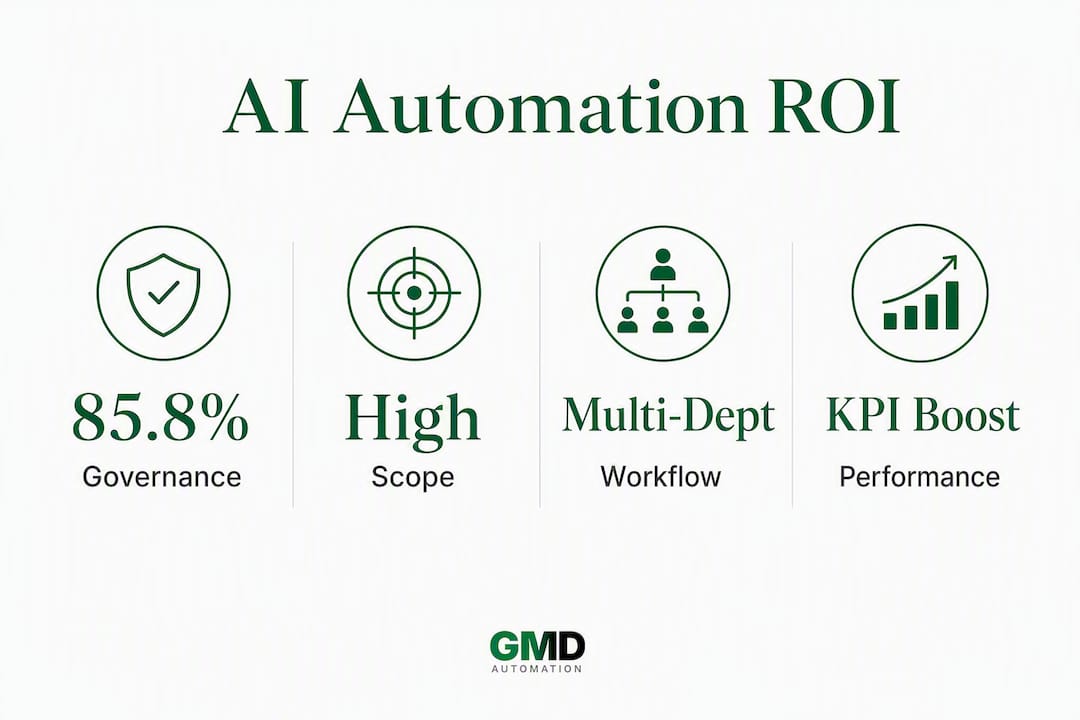
The governance gap is the single biggest ROI driver. Organisations with mature, embedded governance report 85.8% measurable ROI versus 20.0% for those with no formal structure. That is not a marginal difference.
| KPI | Typical pre-automation baseline | Post-deployment range |
|---|---|---|
| Call handling capacity | Fixed to headcount | Multiplied without additional staff |
| Average handling time | Manual, variable | Reduced through automated routing |
| Cost per case | High due to manual processing | Lower with workflow agents |
| Lead conversion | Dependent on response speed | Improved with voice agents |
For real-world AI process automation examples, the pattern is consistent: narrow bots improve one metric; cross-departmental agents improve the business.
Variance in outcomes comes down to three factors: scope (a single-task bot versus a workflow agent spanning multiple departments), data quality at the point of integration, and governance maturity. Firms that treat AI as a software purchase rather than an operational change programme consistently underperform against those that embed compliance guardrails and human oversight from day one.
Six steps to pilot and scale enterprise AI automation
- Define the process and success metrics before selecting a vendor. Know which workflow you are automating and what a good outcome looks like in measurable terms.
- Run a small, integrated pilot connecting the agent to your live CRM or telephony system, not a demo environment.
- Complete governance and compliance checks: data residency, audit log configuration, PII redaction rules, and human-in-the-loop settings.
- Measure and iterate against the metrics defined in step one. A two-week review cycle is standard.
- Scale cross-departmentally once the pilot KPIs are met. Agents that connect across departments deliver significantly higher ROI than those confined to a single function.
- Embed cost monitoring and workforce training as permanent operational disciplines, not one-off tasks.
KPMG and aibl both highlight that boards where the CEO takes accountability for AI report higher confidence and greater measurable value. Leadership ownership is not optional.
For procurement teams: your RFI should require documented data residency, SLA terms with service credits, model provenance records, and a reference customer in a comparable sector.
For IT teams: run a sandbox connectivity test against your CRM and telephony before shortlisting. API integration guidance for AI automation tools covers the key technical checks.
Note also that 42.2% of organisations report shadow AI as somewhat common, with speed cited as the main driver. A fast, approved pilot route reduces the incentive for staff to reach for unapproved tools.
Key takeaways
Managed, subscription AI automation with embedded governance is the category that delivers measurable enterprise ROI for UK businesses in 2026.
| Point | Details |
|---|---|
| Governance drives ROI | Organisations with mature governance report 85.8% measurable ROI versus 20.0% without it. |
| Integration depth matters most | Cross-departmental agents deliver 84.7% measurable ROI versus 24.1% for narrow single-task bots. |
| Subscription billing reduces risk | Flat monthly fees covering implementation, support and optimisation convert variable AI spend into predictable Opex. |
| Pilot before you commit | A two-week integrated pilot with live CRM or telephony data is the fastest way to validate a vendor's real capability. |
| Gmdautomation | Offers managed, compliance-first AI automation on a subscription basis with zero upfront costs and a working demo agent for UK businesses. |
Why the managed subscription model is the pragmatic choice right now
The debate about build-versus-buy has largely settled for mid-market and larger UK firms. Building and maintaining production-grade AI agents in-house requires model expertise, compliance infrastructure, and continuous optimisation capacity that most organisations simply do not have sitting idle. A managed subscription transfers that operational burden to a specialist while giving finance a fixed monthly line item.
What I find most underestimated is the governance piece. Firms that rush to deploy agents without audit logs, PII redaction rules and human-in-the-loop options are not just taking a compliance risk. They are leaving the majority of their potential ROI on the table, as the aibl data makes clear. The feature list of any given agent matters far less than whether it operates inside a governed, integrated system.
The one scenario where a different approach makes sense is a large enterprise with a mature internal AI engineering team and existing compliance infrastructure. For everyone else, the managed subscription model is faster, cheaper and more governable than the alternative.
Gmdautomation: a ready-to-deploy managed option for UK businesses
Zero upfront cost, a predictable monthly subscription, and compliance controls built in from day one. That is the concrete contrast Gmdautomation offers against point-tool purchases or build-it-yourself approaches that leave governance as an afterthought.
Gmdautomation delivers fully managed AI automation covering workflow agents, voice-call handling with AI agents (lead qualification, appointment booking, voice cloning), and social media automation, all on a single subscription that covers implementation, operation, maintenance and ongoing optimisation. GDPR-ready controls and ISO-aligned security are included, not sold as add-ons. Integration with your existing CRM, ERP and telephony systems is part of the deployment, not a separate project.
A working demo agent is available so your team can evaluate the system before any commercial commitment. Procurement can expect a clear proposal covering timeline, integration scope, SLA terms and monthly cost. Case studies with measured outcomes and an API integration guide are available on request.
Request a demo or pilot inquiry at Gmdautomation to see the system running against a workflow relevant to your business.
Useful sources and further reading
The sources below are the primary research cited in this article. Share them with procurement, legal and IT during vendor evaluation.
- Artificial intelligence in UK businesses (ONS, 2023 to 2026) — ONS analysis of AI adoption rates and operational use across UK businesses; useful evidence base for board-level business cases.
- KPMG Quarterly Pulse: Making AI Scale Across the Enterprise — covers leadership accountability, workforce redesign and operating model considerations for scaling AI.
- AI adoption accelerates in UK, but cost visibility gap risks limiting value (KPMG) — the source for cost visibility data and the case for cost-monitoring dashboards in subscription contracts.
- Types of business processes AI can automate in 2026 (Gmdautomation) — practical scope guide for IT and operations teams defining which workflows to prioritise in a pilot.
- Enterprise AI ROI explained: a 2026 guide for leaders (Gmdautomation) — ROI measurement frameworks and KPI benchmarks for finance and operations teams.