

More than half of UK small and medium-sized businesses are now actively using AI, with adoption rates reaching 35–54% in 2026, up sharply from 25% just two years ago. Yet many business owners still believe that meaningful AI requires a large technical team, a six-figure budget, or months of complex setup. That belief is costing them. The reality is that affordable, practical AI is already running inside businesses like yours, handling customer queries, generating content, automating invoicing, and producing actionable insight, often for less than the cost of a part-time employee.
Table of Contents
- Defining affordable AI for business owners
- How UK businesses are adopting affordable AI solutions
- Understanding ROI: the real impact and limits of affordable AI
- Funding and support for affordable AI in the UK
- A practical view: why smart implementation matters more than sticker price
- Start your affordable AI journey with expert support
- Frequently asked questions
Key Takeaways
| Point | Details |
|---|---|
| AI adoption rising | Over half of UK SMEs now actively use AI, showing strong momentum. |
| Entry is affordable | Many AI tools offer free or low-cost tiers suitable for small businesses. |
| ROI varies | Only one third of UK SMEs see significant revenue impact from AI—choose carefully. |
| Funding available | UK grants and programmes can fully fund AI adoption for qualifying businesses. |
| Smart fit matters | Effective results come from piloting tools and fitting them to your workflow, not chasing the lowest price. |
Defining affordable AI for business owners
Affordable AI does not mean cheap AI. It means AI that delivers measurable value relative to what you spend on it. For most UK SMEs, that starts with tools priced somewhere between free and a few hundred pounds per month, covering everything from AI writing assistants and chatbot builders to automated workflow platforms and analytical dashboards.
The confusion usually comes from mixing up cost with value. A free-tier tool that saves your team ten hours a week has enormous value, even if it carries upgrade costs later. Conversely, an expensive bespoke system that nobody uses is simply expensive. The smarter question is not "how much does it cost?" but "what does it return?"
"AI supports and augments staff rather than replacing them. 95% of SMEs report no headcount impact from AI adoption, making the technology a productivity multiplier rather than a job-cutting machine for the vast majority of businesses at this stage."
This distinction matters enormously when you're building a business case for AI internally. You are not investing in automation to lose people. You are investing to free your existing people from repetitive, low-value tasks so they can focus on work that actually grows the business.
Here is a comparison of the three main cost models you will encounter:
| Model | Typical monthly cost | Best for | Key risk |
|---|---|---|---|
| Freemium tools | £0–£50 | Testing and small teams | Limited scale, basic features |
| Paid SaaS AI | £50–£500 | Growing SMEs | Ongoing subscription costs |
| Bespoke AI systems | £500+ or subscription | Complex, high-volume needs | Implementation complexity |
Typical features you can expect from affordable AI automation for SMEs include:
- Task automation: Scheduling, invoicing, email triage, and data entry handled without human input
- Content generation: Blog posts, social media copy, product descriptions, and email sequences
- Customer support: Conversational chatbots available around the clock at a fraction of staffing costs
- Business insights: Analytical tools that surface patterns in your sales, traffic, or customer behaviour data
- Workflow integration: Connecting your existing tools so information moves automatically between platforms
Pro Tip: Before committing to any AI tool, map out where it will sit in your current tech stack. A tool that integrates natively with your existing software will always deliver faster ROI than one requiring manual data transfer or a separate login.
Platforms like AI automation workflows demonstrate how businesses are already linking these capabilities together into coherent systems that run with minimal oversight.
How UK businesses are adopting affordable AI solutions
Now that we've defined affordable AI, let's see how UK SMEs are actually putting it into practice. The most successful adopters share one habit: they start narrow and expand deliberately. They do not try to automate everything at once. They pick one process, one tool, and one measurable outcome, then build from there.

The most common entry point is no-code AI integration with tools businesses already use. Platforms like Xero, Microsoft 365, and Google Workspace all support AI-powered add-ons and third-party integrations that require zero coding knowledge. A bookkeeper using Xero might activate an AI reconciliation feature. A marketing manager using Google Docs might add a writing assistant. Neither requires a developer, and both begin saving time from day one.
According to practical guidance for AI integration for UK SMEs, the most accessible adoption routes fall into four clear categories:
- No-code integrations: Connect AI features directly to tools you already use without writing a single line of code
- Generative AI for marketing: Use AI to produce first drafts of content, social posts, and email campaigns, then refine them with your brand voice
- Conversational AI for customer service: Deploy a chatbot on your website or WhatsApp to handle FAQs, booking requests, and simple support queries around the clock
- Analytical AI for insight: Use AI dashboards to identify your best-performing products, highest-value customer segments, or most common support requests
Here is a practical sequence for introducing AI into your business without disruption:
- Identify one specific task that consumes disproportionate time with low creative or strategic value, such as responding to standard customer enquiries or formatting monthly reports
- Shortlist two or three tools that address that specific task, checking compatibility with your existing platforms and verifying GDPR compliance
- Run a six-week pilot with a small team or single department, tracking the time saved and any errors introduced compared to your current process
- Measure the actual ROI by calculating hours saved multiplied by your average hourly staff cost, then compare that figure against the tool's monthly subscription fee
- Expand or replace based on what the pilot reveals; either roll out to the wider team or select a better-suited alternative
Pro Tip: Tools that plug directly into platforms you already rely on, such as Xero, Google Workspace, or Microsoft 365, will typically be adopted faster by your team because the learning curve is minimal. Staff resistance to AI drops significantly when the tool feels like an extension of something familiar rather than a completely new system.
For businesses using messaging platforms, WhatsApp automation is an increasingly popular route for customer service automation that feels natural to UK consumers and requires very little technical setup to get running effectively.
The quick AI adoption guide available from GMD Automation also walks through these steps in the context of UK-specific tools and compliance considerations, which is worth reviewing before you begin any pilot.
Understanding ROI: the real impact and limits of affordable AI
After seeing how businesses adopt AI, it's crucial to understand the actual returns and what limits their impact. Here is where the picture becomes genuinely interesting, and slightly sobering.
Adoption is surging. But ROI is lagging. Despite 54% of SMEs actively using AI in some form, only around a third are achieving what analysts call strategic ROI, meaning measurable positive impact on revenue or profitability. That gap exists for identifiable reasons, and understanding them is the fastest way to avoid the same mistakes.
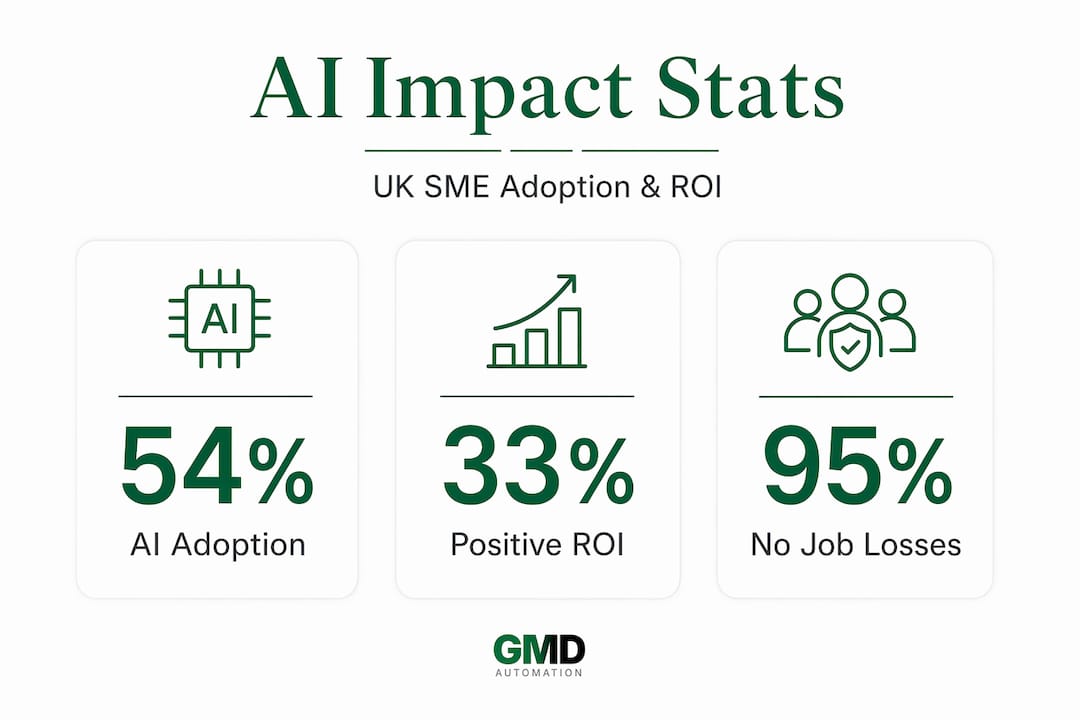
| Metric | Figure | What it means |
|---|---|---|
| UK SMEs actively using AI (2026) | 35–54% | Widespread adoption, but depth varies |
| SMEs reporting strategic ROI | 16–31% | Fewer than half of adopters see revenue impact |
| Businesses reporting no headcount change | 95% | AI augments rather than replaces staff |
| Growth in adoption since 2024 | Up from 25% | Rapid acceleration in uptake |
The gap between adoption and ROI comes down to three recurring problems. First, businesses adopt tools without a clear use case, installing AI for its own sake rather than to solve a specific problem. Second, staff are not trained to use the tool effectively, so it quietly stops being used after the initial excitement fades. Third, data quality and privacy issues create friction, particularly for businesses subject to GDPR, where feeding customer data into a cloud-based AI tool requires careful consideration of data residency and consent.
"Only 31% of UK SMEs see positive ROI from AI adoption, while manufacturers remain particularly cautious due to safety and compliance requirements. Bespoke AI systems are more likely to reduce headcount than generic tools, making the choice of implementation model a critical strategic decision."
This nuance matters. Generic, off-the-shelf AI is unlikely to restructure your workforce. But a custom-built system designed to handle a process that currently employs several people might well do so over time. Understanding which type of AI you are deploying changes the conversation you need to have internally about expectations and change management.
Ways to genuinely improve your AI ROI, based on what is working for network operations and AI and broader SME experience:
- Define success before you start: Know what metric you are trying to move and by how much, before selecting a tool
- Train your team properly: Allocate at least a few hours of structured learning time, not just a quick demo
- Track the right metrics: Measure time saved, error rate reduction, and customer satisfaction changes, not just whether the tool is being used
- Review GDPR compliance early: Check where your data is stored, how it is processed, and whether your privacy policy needs updating
- Revisit and optimise regularly: AI tools improve over time, and your processes should evolve alongside them
The maximising AI ROI resources from GMD Automation address this gap directly, helping businesses move from basic adoption to measurable performance improvement.
Funding and support for affordable AI in the UK
Beyond individual tools, affordable AI often depends on funding and support. Here's how UK business owners can access these.
The most significant opportunity many business owners overlook is fully funded AI training and implementation programmes. The Nine Dots Level 4 AI programme offers funding of up to 100% of costs, with a programme value of approximately £18,000, making it one of the most generous AI adoption support schemes available to UK SMEs. Made Smarter is a government-backed initiative specifically for manufacturers, offering both grant funding and expert advisory support to help production businesses integrate digital and AI technologies.
£18,000 is the approximate value of fully funded AI programmes available to eligible UK SMEs through schemes like Nine Dots, covering everything from initial assessment through to implementation and training.
Here is how to approach securing funding for your AI adoption:
- Assess eligibility first: Check the specific criteria for each programme, as some target particular sectors, regions, or business sizes
- Document your current process costs: Funding applications are strengthened by clear evidence of the problem you are solving and its financial impact
- Identify your chosen tool or system: Many programmes require you to specify what you plan to implement, so your technology selection should come before the application
- Engage a programme adviser: Both Nine Dots and Made Smarter offer pre-application advisory support that significantly improves your chance of a successful application
- Budget for the unfunded elements: Even 100% funded programmes may not cover staff time for implementation, so factor this into your planning
Additional support networks and resources worth knowing about include:
- Innovate UK: Grants and competitions for businesses developing or adopting innovative technologies
- British Chambers of Commerce AI resources: Guidance, case studies, and peer networks for businesses at all stages of AI adoption
- Local Enterprise Partnerships (LEPs): Regional bodies that often administer or signpost to locally specific AI funding
- Growth Hubs: Free business support services available across England, often including digital and AI advisory clinics
- Tech Nation resources: Guidance tailored to UK tech-enabled businesses scaling their digital capabilities
A practical view: why smart implementation matters more than sticker price
Here is an uncomfortable truth that does not get said often enough: the price of an AI tool is almost irrelevant compared to the quality of your implementation strategy. We have seen businesses spend nothing on a free-tier tool and transform a customer service function within eight weeks. We have also seen businesses spend thousands on AI platforms that sat largely unused twelve months later.
The difference is never the tool. It is always the approach.
95% of UK SMEs report no headcount impact from AI adoption, which tells you something important: most businesses are using AI to do more with the same team, not to restructure. That is genuinely good news. It means AI adoption is low-risk in terms of workforce disruption. But it also means that if you are chasing transformation rather than efficiency, you need a more deliberate strategy than simply installing a tool and hoping it pays off.
The businesses extracting the most value from affordable AI share three habits. They pilot ruthlessly, refusing to scale anything until they have clear evidence it works in their specific context. They invest in training, recognising that a tool is only as good as the person operating it. And they stay close to their data, reviewing performance monthly rather than setting things up and forgetting about them.
The pitfalls we see most often are ignoring scalability when choosing tools, skipping staff training because there is no time, and underestimating the data privacy requirements that come with processing customer information through AI systems. GDPR compliance is not optional, and getting it wrong can cost far more than the AI tool ever saved.
Focus on the right tasks for your business, not the most impressive technology. The best AI implementation is the one your team actually uses, on the problem that actually costs you the most time.
Pro Tip: Before scaling any AI tool to your full team, run a structured eight-week pilot with a small group and document every friction point. The issues that emerge in a pilot of five people will be five times worse when rolled out to fifty.
Start your affordable AI journey with expert support
If this guide has clarified your thinking about where affordable AI can genuinely add value to your business, the natural next step is finding a partner who can help you implement it properly rather than leaving you to piece it together alone.
GMD Automation specialises in exactly this challenge for UK businesses. The platform offers AI automation for UK SMEs through fully prepared, enterprise-grade systems deployed on a transparent monthly subscription with zero upfront cost. That means no large capital outlay, no lengthy setup projects, and no hidden fees. Implementation, maintenance, and ongoing optimisation are all included, so you get the benefit of advanced AI without needing an internal technical team to run it. If you are ready to move from curiosity to action, this is a practical and genuinely risk-free place to start.
Frequently asked questions
What types of affordable AI tools are most popular among UK SMEs?
Most SMEs begin with no-code AI integrations for platforms like Xero and Google Workspace, then expand into generative AI for content and conversational AI for customer service as confidence grows.
Is affordable AI likely to reduce staff numbers in small businesses?
95% of SMEs using AI report no headcount reduction, with generic tools augmenting existing teams rather than replacing them; bespoke AI systems carry a greater likelihood of longer-term staffing impact.
How can a UK business access funding for AI adoption?
UK SMEs can apply for fully funded AI programmes such as Nine Dots' Level 4 AI programme, worth up to £18,000, and Made Smarter grants specifically for manufacturers looking to adopt digital and AI technologies.
What are the main obstacles to getting ROI from AI in small businesses?
Only 31% of UK SMEs achieve positive ROI from AI, with the primary barriers being poor tool-to-task fit, inadequate staff training, and GDPR compliance challenges when handling customer data through AI systems.