

IT is the foundational enabler of AI transformation, determining whether organisations achieve scalable, governed, and measurable AI value or stall at the proof-of-concept stage. The role of IT in AI transformation extends far beyond deploying tools. It encompasses modernising architecture, enforcing governance, redesigning operating models, and measuring outcomes that matter to the board. CIOs who treat AI as enterprise infrastructure rather than software are already pulling ahead. This guide explains what that shift demands in practice, and why IT leaders who act now will define their organisation's competitive position for the next decade.
How does IT infrastructure support scalable AI integration?
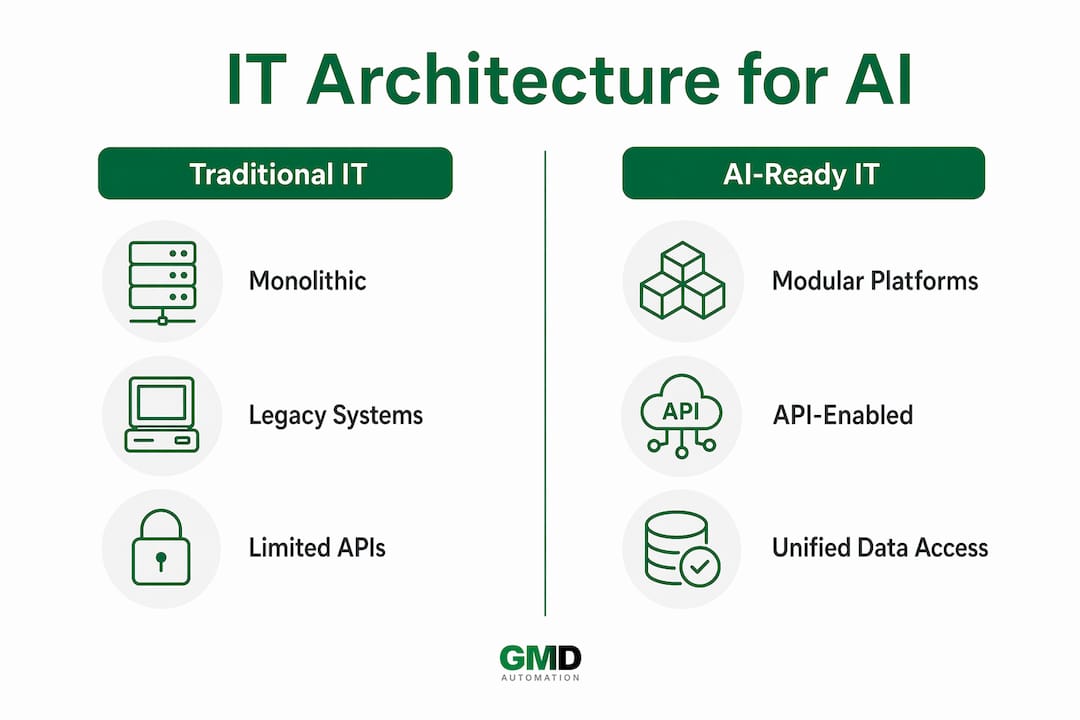
Legacy systems and rigid approval processes are the single greatest technical barrier to AI transformation. When data sits in siloed, monolithic platforms, AI models cannot access the real-time, unified inputs they require to function reliably at scale. The result is AI that works in a pilot but collapses under production conditions.
The architecture required to support AI at enterprise scale has three defining characteristics:
- Modular, API-enabled platforms that allow AI agents and automation tools to connect across systems without bespoke point-to-point integrations. An API-first approach makes it possible to swap components, add new AI capabilities, and scale without rebuilding the entire stack.
- Unified data access with consistent schemas, data quality controls, and real-time pipelines. AI workflows that depend on stale or fragmented data produce unreliable outputs, which erodes trust faster than any governance failure.
- Interoperability between AI agents and enterprise systems, including ERP platforms such as SAP and Oracle, CRM systems, and cloud data warehouses like Snowflake or Databricks. Agent interoperability is the technical prerequisite for autonomous, end-to-end AI workflows.
The practical implication is that IT modernisation is not a precursor to AI transformation. It is AI transformation. Organisations that defer architecture work in favour of deploying AI tools quickly accumulate technical debt that compounds with every new AI initiative.
| Architecture element | Why it matters for AI |
|---|---|
| API-enabled integration layer | Allows AI agents to access and act on data across systems in real time |
| Unified data platform | Provides consistent, trustworthy inputs for AI model inference and training |
| Cloud-native compute | Scales processing capacity to match AI workload demands without capital expenditure |
| Agent interoperability standards | Enables multi-agent workflows to operate across business functions without manual handoffs |

Pro Tip: Before deploying any new AI capability, map your current data flows end to end. Identify where data is duplicated, delayed, or inaccessible. That map will tell you exactly where your architecture investment needs to go first.
A scalable AI architecture for UK enterprises typically begins with consolidating data access before adding AI capability. The organisations that skip this step spend more time debugging data pipelines than realising AI value.
What governance model does IT need for responsible AI?
Fragmentation is the greatest risk in enterprise AI adoption. Without shared standards, AI efforts across business units produce duplication, security exposure, and low adoption rates. Individual teams procure AI tools independently, create shadow AI workflows, and generate compliance risks that IT discovers only after the fact.
The CIO's role has shifted from platform provider to AI orchestrator. That shift requires a governance model built around four disciplines:
- AI portfolio management: a central register of all AI initiatives, their owners, data dependencies, risk classifications, and performance metrics. Without this, no one knows what AI is actually running in the organisation.
- Enterprise-wide AI standards: common frameworks for model documentation, data lineage, bias testing, and output auditing. These standards apply whether the AI is built internally or procured from a vendor.
- Ethics and accountability structures: designated AI governance teams with cross-functional membership, including legal, compliance, HR, and business unit leads. AI decisions that affect customers or employees require human accountability, not just technical oversight.
- Responsible adoption frameworks: processes that assess AI tools before deployment against security, privacy, and regulatory requirements. In the UK context, this includes alignment with the ICO's guidance on AI and data protection, as well as sector-specific obligations in financial services and healthcare.
"IT leaders must balance acceleration with discipline to compound AI investments' impact rather than dilute it." — KPMG, 2025
The governance model also determines how IT co-strategises with business units. The most effective CIOs position IT as a partner in defining AI use cases, not a gatekeeper that approves or rejects requests. That distinction changes the speed and quality of AI adoption across the organisation. Reviewing AI system transparency frameworks gives IT leaders a practical starting point for building accountability into every AI deployment.
Why does process redesign determine AI transformation success?
Scaling AI is not a matter of deploying more models. Success depends on redesigning operating models so that human roles, decision rights, and workflows are rebuilt around AI capabilities rather than simply augmented by them. Organisations that skip this step find that AI accelerates broken processes rather than improving outcomes.
The transition from AI experimentation to scaled transformation requires IT to lead on three fronts:
- Workflow redesign: mapping existing processes to identify where AI can take autonomous action, where it should support human decision-making, and where human judgement must remain primary. A claims processing workflow at an insurer, for example, might have AI handle data extraction and initial triage autonomously, with human adjusters reviewing only flagged cases.
- Decision rights realignment: clarifying which decisions AI can make without human approval, which require human sign-off, and which are off-limits for automation entirely. This is governance made operational. Without it, AI either gets blocked at every step or operates without appropriate oversight.
- Reskilling and new role creation: the shift to human-AI co-working requires new competencies. Roles such as AI workflow designer, model performance analyst, and AI ethics reviewer are appearing in leading organisations. IT must partner with HR to define these roles and build the training pathways that fill them.
Pro Tip: When redesigning a process for AI, start with the output you want and work backwards. Ask what data the AI needs, what decisions it will make, and what a human needs to verify. That sequence prevents the common mistake of automating inputs without changing the decision structure.
The organisations achieving the most from AI are not those with the most models deployed. They are the ones that have genuinely changed how work gets done, who makes decisions, and how performance is measured. IT's role in that change is architectural, organisational, and cultural simultaneously.
How should IT measure the real impact of AI?
Traditional IT metrics, such as cost per transaction or headcount reduction, miss most of the value AI creates. Measuring AI ROI requires a shift to multidimensional outcomes that capture capability changes, not just cost movements.
The concept of Return-on-Autonomy (RoA) reframes the question. Instead of asking "how much did AI save?", RoA asks "what can the organisation now do that it could not do before, and how fast can it do it?" That framing captures the compounding value of AI: faster product development cycles, higher-quality customer interactions, and decision-making that improves continuously as models learn.
| Metric type | Traditional approach | AI-era approach |
|---|---|---|
| Cost measurement | Headcount reduction, cost per transaction | Cost redistribution across AI tools, integration, and oversight |
| Performance measurement | Process cycle time | End-to-end workflow throughput with AI in the loop |
| Value measurement | One-time savings | Return-on-Autonomy: new capabilities enabled by AI |
| Reporting level | IT department | Board-level AI value dashboard |
AI rarely reduces IT costs immediately. New expenditure on AI tools, integration work, and model maintenance often offsets near-term savings. The measurable returns come from solving specific operational problems with precision, not from broad cost-cutting programmes. IT leaders who set that expectation with the board early avoid the credibility damage that comes when AI investments do not show up as cost reductions in the first year.
Leading organisations are also moving to end-to-end process ownership as the measurement unit. Rather than tracking AI performance within a single function, they measure the full workflow from customer request to resolution, with AI performance visible at every stage. That visibility is what makes board-level reporting on AI value credible and specific.
Key takeaways
IT's role in AI transformation succeeds only when infrastructure modernisation, unified governance, operating model redesign, and capability-focused measurement work together as a single integrated strategy.
| Point | Details |
|---|---|
| Infrastructure is the prerequisite | Modular, API-enabled platforms and unified data access must precede AI deployment at scale. |
| Governance prevents fragmentation | A central AI portfolio register and enterprise-wide standards stop duplication and security risks before they compound. |
| Process redesign multiplies AI value | Rebuilding workflows and decision rights around AI capabilities produces far greater returns than layering AI onto existing processes. |
| Measure capability, not just cost | Return-on-Autonomy and end-to-end workflow metrics capture AI value that traditional cost metrics miss entirely. |
| CIOs must become AI orchestrators | The shift from platform provider to strategic co-orchestrator is the defining career and organisational challenge for IT leaders in 2026. |
What I have learned about IT's role in AI transformation
The conversation I keep having with IT leaders is about sequencing. Most organisations want to deploy AI fast, and most IT functions are under pressure to show results quickly. The instinct is to find a use case, deploy a tool, and declare a win. That instinct is wrong, and it is costing organisations real money.
The organisations I have seen stall on AI transformation share a common pattern. They deployed AI on top of architecture that was not ready for it. The models worked in isolation but could not connect to the data they needed in production. The governance was invented after the fact, which meant the business units had already built their own shadow AI workflows. By the time IT tried to unify things, there were dozens of conflicting tools, duplicated data pipelines, and no clear owner for any of it.
The uncomfortable truth is that best-in-class IT teams invest in foundational systems and change work patterns before they scale AI. That takes discipline when the board is asking for AI results every quarter. But the organisations that do it properly compound their AI investments. The ones that skip it spend the next two years cleaning up the mess.
My advice to CIOs is to treat the governance conversation as a commercial conversation, not a compliance one. When you frame AI governance as the mechanism that protects AI investment value and prevents costly rework, the business listens. When you frame it as risk management, it gets deprioritised. The language matters as much as the framework.
— Ravi
How Gmdautomation helps UK businesses scale AI with confidence
Gmdautomation works with UK businesses to deploy enterprise-grade AI automation on infrastructure that is built for scale from day one. Every solution covers implementation, operation, maintenance, and optimisation under a predictable monthly subscription, removing the capital risk that stops many IT leaders from committing to AI at the architecture level. If your organisation is ready to move from AI experimentation to genuine operational transformation, explore Gmdautomation's AI automation solutions to see how a governed, scalable deployment model works in practice. The platform is designed for IT leaders who need speed without sacrificing security or compliance, and it is already operating across multiple UK sectors.
FAQ
What is the role of IT in AI transformation?
IT defines the infrastructure, governance, and operating model that determine whether AI delivers sustained enterprise value. Without IT modernisation, AI initiatives stall at the pilot stage due to data access failures, fragmented governance, and misaligned workflows.
Why do legacy systems block AI transformation?
Legacy monolithic systems lack the API connectivity and real-time data access that AI agents require to function reliably in production. Modular, API-enabled platforms are the technical prerequisite for scalable AI integration.
How should IT govern AI across business units?
IT should maintain a central AI portfolio register, enforce enterprise-wide standards for model documentation and data lineage, and establish cross-functional governance teams that include legal, compliance, and business unit leads.
Does AI reduce IT costs?
AI rarely reduces IT costs directly in the short term. New expenditure on tools, integration, and model maintenance typically offsets near-term savings, with measurable returns appearing in operational productivity and capability improvements rather than cost reduction.
What is Return-on-Autonomy and why does it matter?
Return-on-Autonomy is a performance metric that measures what new capabilities AI enables rather than how much it saves. It gives IT leaders and boards a more accurate picture of AI's compounding strategic value over time.