

Most UK business owners treat AI automation as a line item on the IT budget. That framing is costing them money. 62% of UK businesses with over 50 employees had deployed at least one AI tool by Q1 2026, up from 31% in 2024. The ones seeing real returns are not simply adding AI to existing processes. They are rethinking how work gets done, and the financial case for doing so is compelling. This guide explains exactly how AI automation pays for itself, with the data and practical steps to back it up.
Table of Contents
- Key takeaways
- How AI automation creates direct cost savings
- Why workflow redesign determines your AI ROI
- AI integration with finance and ERP systems
- Beyond automation: the coordination cost advantage
- Practical steps to make sure AI pays for itself
- My honest take on why most AI projects disappoint
- How Gmdautomation helps UK businesses see real returns
- FAQ
Key takeaways
| Point | Details |
|---|---|
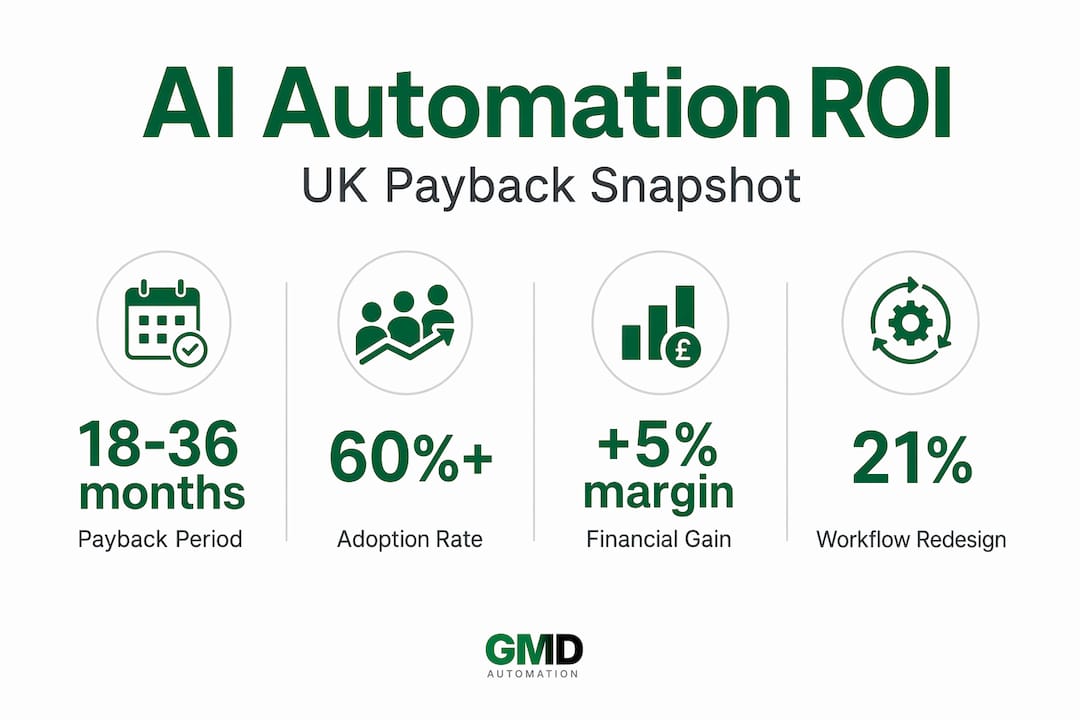
| AI adoption is accelerating fast | Over 60% of mid-sized UK businesses now use AI tools, making adoption a competitive requirement, not an experiment. |
| Workflow redesign drives real returns | Simply layering AI onto existing processes rarely produces significant financial impact. End-to-end redesign is what moves the numbers. |
| Finance integration multiplies gains | AI embedded in ERP and finance systems can deliver 30% faster financial close and up to 10 percentage points of margin growth. |
| Coordination savings are often overlooked | AI's biggest financial payoff comes from reducing friction between tasks and teams, not just replacing manual labour. |
| Leadership commitment determines success | Organisations where senior leaders actively drive AI strategy are significantly more likely to achieve measurable EBIT impact. |
How AI automation creates direct cost savings
Before getting into strategy, it helps to understand the concrete financial mechanics. AI automation replaces or augments a specific set of manual processes: invoice processing, customer query handling, data entry, compliance checks, report generation, and scheduling. Each of these carries a real cost in time, headcount, and error correction.
The financial benefits of AI in these areas compound quickly. When a finance team that previously spent three days closing the books each month can do it in two, that is not just a time saving. It is freed capacity that goes elsewhere without adding headcount. When a customer service team uses AI to handle 60% of routine queries, the remaining staff handle genuinely complex cases faster and with less frustration.
Here are the most consistent areas where businesses see measurable cost savings with AI:
- Labour cost reduction. Repetitive, rules-based tasks that consumed hours of staff time are handled in seconds. This does not always mean redundancies. More often, it means the same team achieves significantly more output.
- Error rate reduction. Manual data handling carries an error rate that triggers rework, compliance risk, and customer complaints. AI applied to structured data processing routinely reduces error rates by 60 to 80%.
- Faster cycle times. From purchase order approval to customer onboarding, AI shortens the time between trigger and completion. That speed has direct cash flow implications.
- Reduced operational overhead. Fewer manual touchpoints mean less coordination, less chasing, and fewer meetings to resolve process failures.
For larger transformation projects, payback periods of 18 to 36 months are typical for UK businesses that started implementing since 2024. That is a credible investment horizon for any decision-maker accustomed to evaluating capital expenditure.
Why workflow redesign determines your AI ROI
Here is something that most AI vendors will not tell you upfront: adding AI to a broken or inefficient workflow does not fix the workflow. It automates the broken parts faster. The financial impact is minimal, and the disappointment is real.
McKinsey's State of AI 2025 report found that only 21% of organisations had redesigned their workflows when deploying AI. That 21% is not a coincidence. Workflow redesign is the single strongest correlate of EBIT impact from AI. The majority of organisations deploying AI without redesigning their processes are leaving the most significant financial returns on the table.
What does redesign actually look like in practice? Consider an accounts payable process. The old workflow might involve a supplier emailing an invoice, a member of staff downloading it, manually entering figures into an ERP, seeking approval by email, then processing payment. AI can automate the data extraction step, but if the approval chain still runs on email and the ERP still requires manual sign-off, the efficiency gain is marginal.

A redesigned workflow replaces the entire sequence. AI captures and validates the invoice, routes it automatically based on supplier and value thresholds, flags exceptions for human review, and triggers payment on approval. The process that took four days now takes four hours. That is where the financial payoff lives.
Pro Tip: Before selecting any AI tool, map your current workflow end to end and identify every handoff point. These are where delays and errors accumulate. The right place to apply AI is not always obvious until you can see the full process on paper.
Redesign does require investment in governance frameworks, policy updates, and often new infrastructure. There are real challenges: data quality, staff resistance, and integration complexity. But organisations that treat these as solvable problems rather than blockers are the ones that appear in the success statistics.
For guidance on the technical architecture that supports redesigned workflows, the scalable AI automation architecture guide for UK enterprises covers the key considerations in depth.
AI integration with finance and ERP systems
For finance leaders asking whether AI automation ROI is worth it, the data from enterprise deployments is increasingly hard to ignore. Gartner projects that 62% of cloud ERP spending will be on AI-enabled solutions by 2027, up from just 14% in 2024. Finance organisations that make this transition are projected to achieve 30% faster financial close by 2028.
| Metric | Current baseline | AI-enabled projection |
|---|---|---|
| Financial close time | Standard monthly close | 30% faster by 2028 |
| Cloud ERP with AI | 14% of spend in 2024 | 62% of spend by 2027 |
| Margin growth potential | Baseline | Up to 10 percentage points by 2029 |
That margin figure deserves attention. Gartner's research indicates that CFOs adopting portfolio AI strategies can unlock up to 10 percentage points of margin growth by 2029. The critical word here is "portfolio." Isolated AI pilots, however well designed, do not produce these results. The gains come from treating AI as an interconnected set of capabilities that improve finance operations across forecasting, reporting, procurement, and cash management simultaneously.
The practical implication for UK finance teams is that the question should not be "which AI tool should we try?" It should be "how do we embed AI across our finance stack in a way that compounds returns over time?"
Gartner also recommends that finance teams invest in data governance and team upskilling alongside any technology deployment. AI produces better outputs when the data feeding it is clean, consistent, and well-structured. This is not glamorous work, but it is the foundation on which financial returns are built.
Pro Tip: If your finance team cannot clearly articulate what a "good" AI output looks like for a given task, the AI will not perform reliably. Define the quality standard before you deploy, not after.
Beyond automation: the coordination cost advantage
Most discussions about the financial benefits of AI focus on task replacement. A human did this task. Now AI does it. Time saved equals money saved. That framing is accurate but incomplete.
AI's biggest economic payoff is not automating individual tasks. It is reducing the coordination costs between tasks, teams, and systems. This insight from Harvard Business Review fundamentally changes how you should think about where AI creates value.
Consider what coordination costs actually look like in a business:
- An account manager waits two days for a risk assessment from the credit team before sending a proposal.
- A project manager spends 30% of their week chasing status updates from five different departments.
- A procurement team cannot close a supplier contract because three internal approvals are stuck in different inboxes.
These are not automation problems. They are coordination problems. And AI, when deployed across the full workflow rather than at individual task level, removes these friction points at scale. An AI system that can simultaneously track contract status, prompt approvers, flag bottlenecks, and update relevant parties is not replacing any single person's job. It is replacing a layer of organisational friction that was silently costing significant time and money.
The AI ROI figures from organisations that have deployed AI this way consistently show returns that task-level automation alone cannot explain. When you remove coordination overhead, you accelerate every process that depended on it. The compound effect is substantial.
Practical steps to make sure AI pays for itself
Knowing the theory is useful. Knowing what to actually do on Monday morning is more useful. Here is a practical sequence that consistently produces results for UK businesses.
-
Set outcome-based objectives. Do not implement AI to "improve efficiency." Implement it to reduce invoice processing time from five days to one, or to cut customer query resolution time by 40%. Specific, measurable objectives tied to existing KPIs give you a clear way to track AI automation ROI.
-
Choose one high-value workflow and redesign it completely. Resist the urge to deploy AI across ten processes simultaneously. Pick the workflow with the highest cost, the most manual steps, or the most errors. Redesign it end to end with AI built in from the start, not bolted on at the end.
-
Build agent-ready infrastructure. AI agents need access to clean data, integrated systems, and clear permission structures. Investing in the API integration layer before deploying AI pays back quickly in avoided failures and rework.
-
Get senior leadership visibly involved. This is not optional. High-performing AI organisations invest over 20% of digital budgets in AI and have active leadership engagement. Organisations where AI is treated as an IT project rather than a business strategy consistently underperform.
-
Measure adoption, quality, and financial impact. Track all three from day one. Adoption tells you if people are actually using the tools. Quality tells you if the outputs are reliable. Financial impact tells you if the investment is paying back. Reporting on all three monthly keeps leadership informed and surfaces problems early.
Pro Tip: For UK SMEs with tighter budgets, start with affordable AI strategies that target processes with the fastest payback. Quick wins build internal confidence and fund the next phase of deployment.
My honest take on why most AI projects disappoint
I have looked at enough AI deployment case studies and financial analyses to spot a pattern that the industry rarely acknowledges directly. Most AI automation projects that fail to pay for themselves do not fail because the technology did not work. They fail because the organisation was not ready to change how it works.
Buying an AI tool and expecting it to transform your finances is like buying a treadmill and expecting to lose weight without changing your diet. The technology is a means to an end. The end requires human decisions, changed habits, and organisational commitment.
What I have seen work repeatedly in UK business contexts is leadership that treats AI not as a technology purchase but as a change management programme with a technology component. The businesses achieving only 5.5% significant EBIT impact are the outliers, and they share one characteristic: the people at the top are personally invested in making it work, not just signing off on a budget line.
The other thing I would push back on is the exclusive focus on cost reduction. The businesses achieving the most impressive AI automation ROI are using it to grow revenue and margins, not just cut headcount. AI that helps your sales team respond to leads faster, or your finance team model scenarios in real time, or your operations team anticipate supply chain issues before they become expensive, these are growth levers. Cost savings are the floor, not the ceiling.
— Ravi
How Gmdautomation helps UK businesses see real returns
If this article has clarified the case for AI automation but you are still uncertain about where to start, Gmdautomation is built precisely for this moment.
Gmdautomation delivers enterprise-grade AI automation for UK businesses through a predictable monthly subscription that covers implementation, operation, maintenance, and ongoing optimisation. There are no large upfront costs and no guesswork. The model is designed so that the financial benefits of AI begin accumulating from deployment, not after a lengthy and expensive build phase. Whether you are looking to redesign a single high-value workflow or deploy AI across your finance and operations stack, Gmdautomation provides the infrastructure, governance support, and technical expertise to make it happen at a pace that suits your business.
FAQ
How long does AI automation take to pay for itself?
For most UK businesses, larger AI transformation projects see payback periods of 18 to 36 months. Smaller, focused deployments targeting a single workflow can pay back within six to twelve months.
Is AI automation worth it for small and mid-sized UK businesses?
Yes, particularly when focused on high-volume, repetitive processes such as invoicing, customer communications, or scheduling. The key is starting with one well-defined use case rather than attempting broad deployment from day one.
Why do some AI automation projects fail to deliver financial returns?
Only 21% of organisations redesign their workflows when deploying AI, which is the primary reason many projects see limited financial impact. Layering AI on top of inefficient processes rarely produces meaningful results.
What is the biggest financial benefit of AI automation beyond cost savings?
Reducing coordination costs between teams and systems is AI's biggest economic payoff, often exceeding the direct savings from task automation. Removing friction from multi-step workflows accelerates every process that depended on that coordination.
How much margin improvement can finance teams realistically expect from AI?
Gartner projects that CFOs using a portfolio AI strategy can unlock up to 10 percentage points of margin growth by 2029, provided AI is integrated across finance functions rather than deployed in isolated pilots.