

AI testing is critical because enterprise AI is probabilistic: the same input can produce different outputs depending on context, model state, and data drift. A single passing test proves almost nothing. What protects your business is a continuous programme of evaluation that generates auditable evidence for regulators, customers, and your own board.
TL;DR
- Untested AI creates silent failures. Voice agents misbook appointments, automated decisions carry bias, and hallucinations reach customers before anyone notices.
- The ICO and UK GDPR require demonstrable fairness, transparency, and accountability for automated decisions. Ofcom adds obligations where voice channels are involved.
- Enterprise AI systems are probabilistic and emergent, so testing must be continuous, not a one-time pre-launch gate.
Start with a readiness checkpoint: map every AI touchpoint in your operations, identify which decisions are customer-facing or regulated, and schedule a structured pilot with a managed service that includes testing as part of the subscription.
Table of Contents
- Why AI behaves differently from traditional software
- What happens when AI goes untested in a UK business
- What an effective AI testing programme must cover
- Practical testing methods for enterprise AI
- KPIs and dashboards: measuring AI testing success
- Roles, governance, and UK compliance: who owns what
- Costs and timeline: pilot to production to monitoring
- A six-step checklist to start testing enterprise AI
- How testing prevented a real customer-facing failure
- Key takeaways
- The part most businesses get wrong about AI testing
- What Gmdautomation includes in a tested, compliant AI deployment
- Useful sources and further reading
Why AI behaves differently from traditional software
Traditional software is deterministic. Feed it the same input and you get the same output, every time. Enterprise AI does not work that way.

AI systems are probabilistic and context-sensitive, so identical inputs may produce different outputs across runs, model versions, or query distributions. This is not a defect; it is how the technology works. The problem is that conventional QA assumptions, scripted tests, pass/fail gates, and static regression suites, were built for deterministic systems.
The arXiv assurance paper on comprehensive AI testing makes this explicit: AI cannot be verified for correctness in the traditional sense and must be evaluated through continuous, pattern-based scoring. Add emergent behaviour, where a model produces outputs its designers did not anticipate, and the gap between traditional QA and what AI actually requires becomes significant.
Two contrasts worth keeping in mind:
- Deterministic software: a broken rule produces a predictable error you can trace and fix.
- Probabilistic AI: a degraded output may appear plausible, pass surface checks, and reach a customer before anyone notices.
The validation gap is especially acute when AI generates code or structured outputs. Static tests check syntax; they rarely verify whether the generated artefact meets the original business intent.
What happens when AI goes untested in a UK business
Untested AI creates silent failures that damage customers and contracts before your team knows there is a problem.
Consider a voice agent handling appointment bookings. If intent routing is poorly calibrated, the agent confidently confirms a booking it has misunderstood. The customer shows up; the slot does not exist. Multiply that across hundreds of calls and you have a reputational problem, not a technical one. Automated decisions that carry demographic bias are harder to spot and carry direct legal exposure under UK GDPR Article 22, which governs solely automated decisions with significant effects on individuals.
UK regulatory position: The ICO requires organisations to be able to explain automated decisions, demonstrate fairness, and provide a human review mechanism. Where voice channels are used, Ofcom's codes of practice on consumer protection apply alongside ICO obligations. Failure to evidence compliance is not a theoretical risk: the ICO has enforcement powers including fines and enforcement notices. Auditable test records are your first line of defence.
AI testing is now an organisational risk control, not an engineering nicety. It must produce evidence that aligns with compliance and procurement requirements, not just a green build status.
What an effective AI testing programme must cover
Testing must evaluate behaviour across the full lifecycle, not just code correctness. Six domains matter for enterprise deployments.
| Domain | What to test | UK compliance note |
|---|---|---|
| Behaviour | Task success rate, output accuracy, edge cases | Baseline for all SLA evidence |
| Fairness | Bias metrics across demographic groups, remediation logs | ICO fairness obligation; UK GDPR Article 22 |
| Robustness | Performance under adversarial inputs, unexpected queries | Reduces silent failure risk |
| Security | Prompt injection, data leakage, access controls | UK GDPR data minimisation; AI security architecture |
| Explainability | Decision audit trails, confidence scores | ICO right to explanation for automated decisions |
| Monitoring | Drift detection, evaluator calibration, incident logs | Ongoing compliance evidence for ICO audits |
AI system transparency is not a feature you add at the end; it is a testing requirement you build in from the pilot stage. For structured outputs from AI agents, validating structured data at the integration layer catches errors that behavioural tests alone will miss.
Practical testing methods for enterprise AI
Use a mix of pre-production simulation, staged rollouts, and continuous production monitoring. No single method is sufficient on its own.
- Shadow mode — run the AI in parallel with the existing process; compare outputs without exposing customers to AI decisions. Metric: agreement rate with human baseline.
- Canary release — route a small percentage of live traffic to the new model version. Metric: task success rate, error rate delta.
- A/B testing — compare two model versions on matched traffic segments. Metric: conversion rate, refusal rate, customer satisfaction score.
- Adversarial testing — deliberately probe with edge cases, out-of-scope queries, and prompt injection attempts. Metric: failure mode frequency, security incident rate.
- Drift detection — monitor production outputs over time for statistical shifts in distribution. Metric: drift index, output entropy.
- Unanswerable test suite — define questions the AI must decline to answer and measure how often it does. Systems tuned for helpfulness fabricate answers when documents do not support them; refusal rate is a reliable indicator of real-world reliability.
Pro Tip: Version-control your prompts and evaluation datasets as engineering artefacts. Run prompt regression tests on every model change and log all evaluator calibrations. This creates the audit trail regulators and procurement teams will ask for.
KPIs and dashboards: measuring AI testing success
Measure trends, not single runs. A single test result tells you almost nothing; a pattern of results over weeks builds genuine confidence and supplies the audit evidence the ICO expects.
| KPI | Target threshold | Cadence | Compliance relevance |
|---|---|---|---|
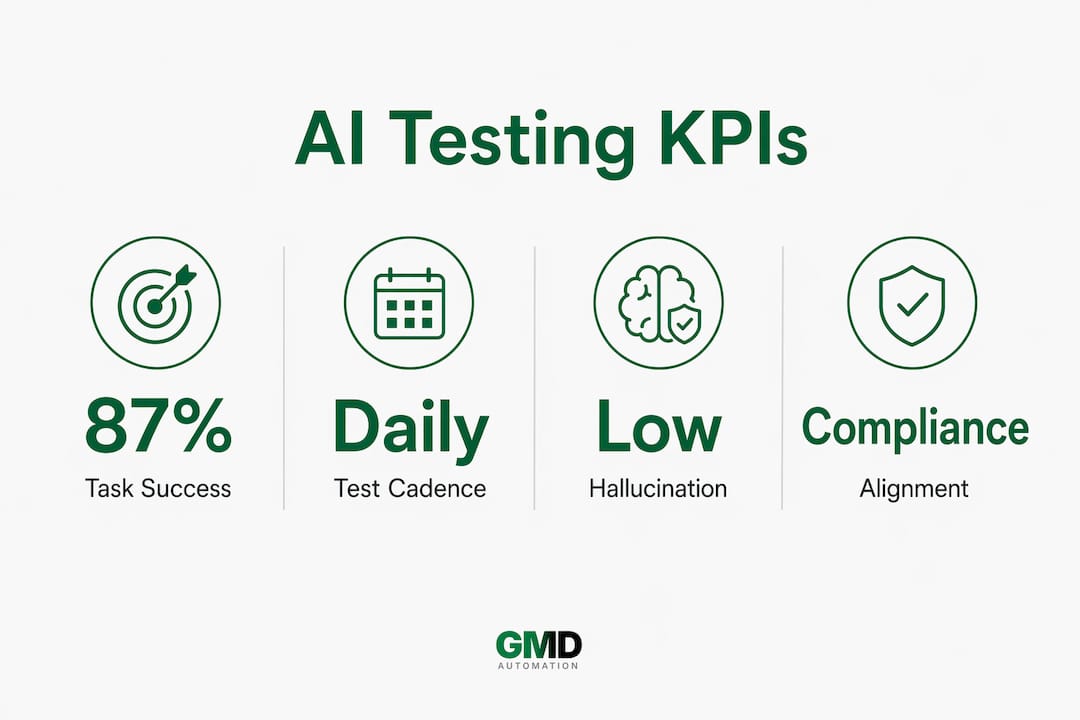
| Task success rate | ≥ 87% | Daily | Core SLA evidence |
| False-positive rate | ≤ 2% | Weekly | Fairness and accuracy |
| Hallucination / grounding score | ≤ 1% | Daily | ICO explainability |
| Refusal rate (unanswerable suite) | ≥ 99% | Weekly | Reliability and trust |
| Drift index | Within ±5% baseline | Continuous | Ongoing compliance |
Present these on an operations dashboard with trend lines, not just current values. Map the hallucination score and refusal rate directly to your ICO compliance evidence pack. For AI SLA definitions that can be contractually enforced, these KPIs translate directly into measurable service commitments.
A continuous testing strategy that scores patterns over time is the difference between a system you can defend to a regulator and one you are hoping will not fail.
Roles, governance, and UK compliance: who owns what
IT leaders must shift from script maintenance to risk assessment and accountability. That is not a cultural preference; it is what the complexity of AI demands.
- IT lead: owns the testing infrastructure, tooling, and integration with CI/CD pipelines; signs off on drift thresholds.
- Product owner: defines acceptable behaviour, edge cases, and the business intent each model version must satisfy.
- QA / accountability layer: runs the test suites, calibrates evaluators, and produces the evidence log. QA becomes the accountability layer that non-engineers can operate and audit.
- DPO / legal: reviews fairness metrics, signs off on automated-decision documentation for ICO compliance, and advises on Ofcom obligations where voice is a channel.
- Compliance lead: maintains the audit trail and maps test evidence to UK GDPR obligations.
"AI tests — but who tests the AI? The answer must be: everyone with a stake in the outcome, operating within a defined governance structure." — Dr Armin Metzger, German Testing Board
Practical AI governance frameworks assign each role a deliverable, not just a responsibility. Without that specificity, accountability diffuses and evidence gaps appear exactly where regulators look first.
Costs and timeline: pilot to production to monitoring
Expect a phased investment rather than a single upfront cost. The three phases have distinct cost shapes.
| Phase | Typical duration | What is included | Budget shape |
|---|---|---|---|
| Pilot | 30–60 days | Readiness audit, shadow mode, baseline KPIs | Fixed project fee or first subscription month |
| Rollout | — | Canary release, A/B, governance setup, dashboard | Monthly subscription, scales with usage |
| Continuous monitoring | Ongoing | Drift detection, calibration, incident response, compliance evidence | Predictable monthly subscription |
For UK mid-market enterprises, a subscription managed service removes the capital expenditure barrier. Implementation, operation, maintenance, and optimisation are bundled into a single monthly fee with no upfront cost.
Pro Tip: Budget a contingency of 10–15% of the monthly subscription for incident investigation in the first three months. Early deployments surface edge cases that calibration resolves quickly, but the investigation time is real.
A six-step checklist to start testing enterprise AI
- Readiness audit (Owner: IT lead + DPO) — map every AI touchpoint, classify decisions by regulatory risk, and document data sources. Evidence: risk register.
- Define acceptable behaviour (Owner: product owner) — write explicit pass/fail criteria for each use case, including what the AI must refuse. Evidence: behaviour specification document.
- Build the test environment (Owner: IT lead) — set up shadow mode and simulation environments; version-control prompts and datasets. Evidence: environment configuration log.
- Run pre-production testing (Owner: QA) — execute behavioural, fairness, robustness, and adversarial suites. Evidence: test results and remediation log.
- Stage the rollout (Owner: IT lead + product owner) — canary release to 5–10% of traffic; monitor KPIs daily for two weeks before full deployment. Evidence: canary dashboard export.
- Activate continuous monitoring (Owner: compliance lead + QA) — deploy drift detection, schedule weekly refusal-rate reviews, and produce monthly compliance evidence packs. Evidence: dashboard reports and ICO-ready audit log.
The entire sequence is executable within 30–60 days for a managed-service procurement. Demand evidence artefacts at each stage from any vendor you engage.
How testing prevented a real customer-facing failure
A UK professional services firm deployed a voice AI agent to handle inbound appointment requests. Within the first week of shadow-mode testing, the QA team identified a grounding failure: the agent was confirming appointment slots that did not exist in the connected calendar system, fabricating plausible-sounding times when the integration returned an ambiguous response.
The intervention was targeted. The team added a structured-output validation layer at the calendar API integration point, tightened the agent's refusal behaviour for ambiguous slot queries, and re-ran the unanswerable test suite. The grounding score improved to 99% before a single live call was handled. No customer was affected.
Two lessons that map directly to the checklist and KPIs:
- Grounding failures are invisible without an unanswerable test suite. A behavioural pass rate alone would not have caught this; the refusal-rate metric did.
- Integration points are where AI testing earns its keep. The failure was not in the model; it was at the boundary between the AI and the calendar system. Testing must cover the full stack, not just the model layer.
Key takeaways
AI testing is critical because enterprise AI is probabilistic, regulated, and continuously changing — a single pre-launch test is not sufficient evidence for compliance, commercial contracts, or customer trust.
| Point | Details |
|---|---|
| AI is not deterministic | Identical inputs can produce different outputs; continuous scoring is the only reliable evidence. |
| Regulatory exposure is real | ICO, UK GDPR, and Ofcom require auditable fairness, explainability, and human review mechanisms. |
| Six domains must be covered | Behaviour, fairness, robustness, security, explainability, and monitoring — all require test evidence. |
| Measure trends, not snapshots | KPIs like refusal rate, drift index, and grounding score must be tracked continuously, not at launch only. |
| Gmdautomation delivers this as a managed service | Testing, monitoring, compliance evidence, and ongoing calibration are included in the subscription with zero upfront cost. |
The part most businesses get wrong about AI testing
Most organisations treat AI testing as a launch gate. They run a round of pre-production checks, get a green light, and move on. The monitoring budget is an afterthought, the QA team returns to other work, and the AI system runs unsupervised until something visibly breaks.
The problem is that AI systems degrade silently. Model provider updates, shifts in query distribution, and changes in connected data sources can all alter behaviour after go-live without triggering any alert. By the time a customer complaint surfaces, the failure has usually been happening for weeks.
The governance argument is equally clear. The ICO does not ask whether you tested before launch; it asks whether you can demonstrate ongoing compliance. A one-time test report satisfies neither the letter nor the spirit of UK GDPR obligations for automated decision-making.
What actually works is treating testing as a permanent operational function, not a project phase. That means a dedicated monitoring dashboard, a defined refusal-rate threshold that triggers review, and a named compliance lead who owns the evidence pack. It also means the QA function needs authority, not just access. Without the ability to pause a deployment when drift thresholds are breached, the accountability structure is cosmetic.
The businesses that get this right tend to be the ones that procure AI as a managed service with testing and monitoring contractually included, rather than bolting QA onto a system that was built without it.
What Gmdautomation includes in a tested, compliant AI deployment
A managed service can deliver tested, compliant AI with continuous monitoring and reporting built into the subscription from day one, not added later.
Gmdautomation's subscription model for UK businesses covers implementation, operation, maintenance, and ongoing optimisation with zero upfront cost. Every deployment includes pre-production behavioural and adversarial testing, shadow-mode validation before go-live, continuous drift detection and KPI dashboards, compliance evidence packs aligned to ICO and UK GDPR requirements, and DPO/legal alignment support where automated decisions or voice channels are involved.
For businesses deploying voice AI agents, workflow automation, or AI-driven communications, the testing and governance infrastructure is part of what you pay for monthly, not a separate engagement. Visit Gmdautomation to request a readiness audit or schedule a structured pilot.
Useful sources and further reading
- ICO guidance on automated decision-making and profiling — the primary UK regulatory reference for Article 22 obligations, fairness requirements, and the right to explanation. Essential for DPOs and compliance leads.
- AI Assurance: A Comprehensive Testing Strategy for Enterprise AI Systems (arXiv) — the most rigorous technical framework for continuous, pattern-based AI evaluation. Useful for IT leads specifying testing requirements in RFPs.
- The unanswerable test suite (Software Testing News) — practical guidance on building refusal-rate tests and why they are a more reliable stability metric than task success rate alone.
- AI tests — but who tests the AI? (German Testing Board) — Dr Armin Metzger's governance framework for shifting QA from script execution to risk accountability. Useful for structuring role responsibilities.
- How to validate AI-generated structured data — practical methods for validating structured outputs at integration points; directly applicable to voice agents and workflow automation.
- AuthorityLayer Enterprise — AI visibility and monitoring — a partner resource for measuring AI visibility and presenting monitoring evidence to stakeholders and procurement teams.
- Gmdautomation — AI automation for UK businesses — the managed service option for UK businesses seeking tested, compliant AI automation with continuous monitoring included in the subscription.