

An AI service level agreement (SLA) is a formal contract that specifies measurable performance standards for AI services deployed within an enterprise, covering uptime, inference latency, accuracy thresholds, and governance obligations. Unlike traditional SLAs, which focus almost entirely on infrastructure availability, AI SLAs address the full behavioural profile of a live AI system. For enterprise executives and IT decision-makers, understanding what is AI SLA in enterprise is the foundation for responsible AI adoption, cost control, and digital transformation at scale. Without these agreements, organisations accept AI risk without any contractual recourse.
What differentiates AI SLAs from traditional service level agreements?
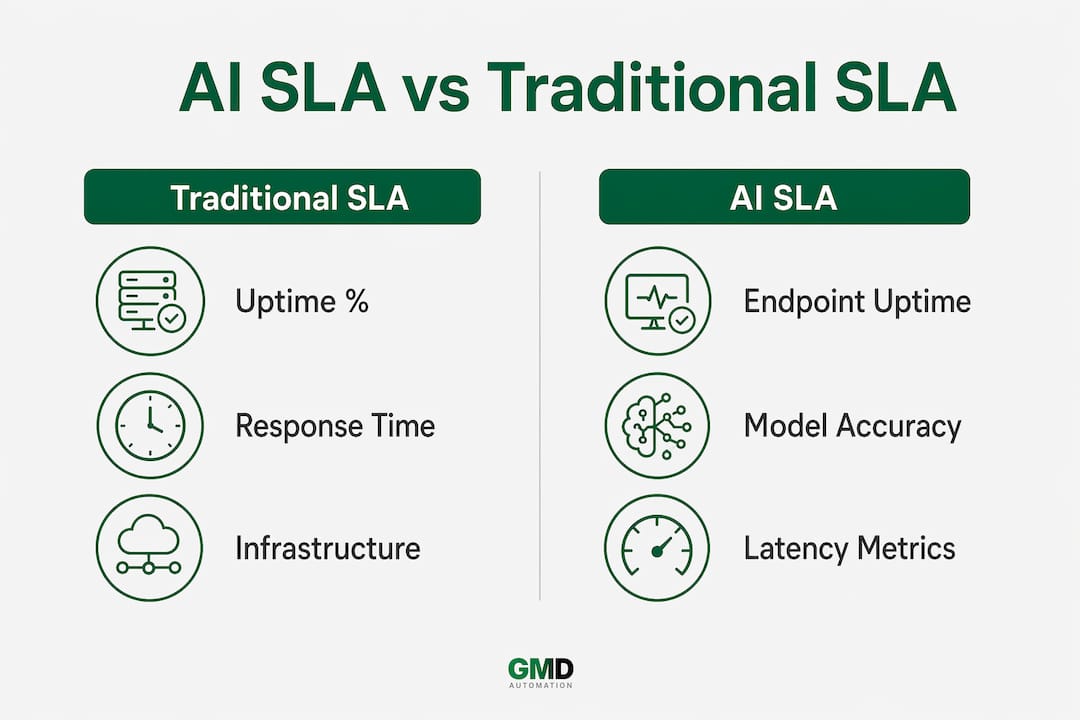
Traditional SLAs measure infrastructure uptime and response time. Standard hyperscaler AI SLAs provide monthly uptime between 99.0% and 99.95%, with financial credits as the sole remedy, capped at 50%–100% of monthly bills. That figure tells you the server is running. It says nothing about whether the AI model is producing accurate, timely, or safe outputs.
AI SLAs go further by introducing model-specific performance commitments. Effective AI SLAs must include KPIs such as inference latency at the p50 and p99 percentiles, accuracy drift thresholds, throughput limits, and human-in-the-loop requirements. These metrics reflect the reality that an AI system can be technically "available" while delivering degraded or harmful outputs.

The most practical approach separates two distinct layers. The first layer covers infrastructure availability, measured by uptime percentages. The second layer covers AI behavioural guarantees, measured by model quality, latency, and governance compliance. Layered contract structures that separate infrastructure availability from AI-specific performance and safety guarantees prevent operational surprises and contractual ambiguity.
| Metric type | Traditional SLA | AI SLA |
|---|---|---|
| Availability | Monthly uptime % | Uptime per endpoint (chat, API, batch) |
| Performance | Response time (ms) | Inference latency at p50/p99 |
| Quality | Not covered | Accuracy drift threshold |
| Governance | Not covered | Human-in-the-loop, audit rights |
| Remedy | Service credits | Credits plus remediation obligations |
Pro Tip: Negotiate endpoint-specific commitments for each AI service surface, such as chat UI, API, batch inference, and moderation, rather than accepting a single blanket uptime figure.
Which KPIs are essential in an effective AI SLA?
A well-constructed AI SLA defines multiple measurable commitments, not a single number. A durable AI SLA defines metrics, evidence export rights, breach severity levels, and regular review cycles to align with real-world AI workload behaviour. Each KPI serves a distinct operational purpose.
The core metrics every enterprise should negotiate include:
- Inference latency (p50/p99). The p50 figure shows typical response speed. The p99 figure reveals worst-case performance under load. Latency SLAs at higher percentiles require reserved provisioned capacity and custom contracts, which carry higher costs but deliver predictable performance for critical workloads.
- Accuracy drift threshold. This defines the maximum acceptable degradation in model output quality over time. Without it, a vendor has no contractual obligation to alert you when a model begins underperforming.
- Throughput commitments. These specify the volume of requests the system must handle within a defined period, preventing bottlenecks during peak demand.
- Data lineage freshness. This confirms how current the training or retrieval data is, which matters directly for outputs in regulated industries such as finance and healthcare.
- Human-in-the-loop requirements. These specify when a human must review or approve AI outputs before they affect a business process or customer outcome.
- Cost per inference. This caps the unit economics of AI usage, protecting against unexpected billing spikes as usage scales.
Remedies must match the severity of each breach. Service credits are typically the sole remedy for SLA breaches but rarely compensate for the business harm caused by AI downtime or degraded outputs. Credits are capped and applied to future bills, not paid in cash. Enterprises should push for remediation obligations and termination rights for repeated failures alongside financial credits.
Pro Tip: Require evidence export rights in your AI SLA. The ability to extract performance logs and audit data independently is the only way to verify vendor compliance without relying on self-reported metrics.
What are common challenges enterprises face with AI SLAs?
The most widespread mistake is treating uptime as a proxy for full service quality. Most enterprise teams find that cloud SLAs cover infrastructure uptime but not model-specific performance metrics like latency and accuracy. A system reporting 99.9% uptime can still produce inaccurate outputs, breach latency thresholds, or fail governance requirements without triggering any contractual remedy.
Four pitfalls appear repeatedly in enterprise AI SLA negotiations:
- Accepting uptime as the only measure. Uptime guarantees do not cover model correctness, output safety, or latency under load. Signing a standard cloud agreement for an AI workload leaves significant operational risk unaddressed.
- Relying solely on service credits. Negotiators benefit from pushing for remediation obligations, termination rights for repeated failures, and audit evidence rights. Credits alone rarely offset the revenue loss or reputational damage from a serious AI failure.
- Ignoring data governance clauses. AI SLA clauses should specify training data restrictions explicitly, prohibiting vendors from training on customer data unless contractually agreed. Omitting this clause risks data sovereignty and regulatory compliance.
- Failing to address governance accountability. AI governance SLAs must extend beyond availability to cover incident response, rollback coordination, approval latency, and evidence retention. Without these provisions, accountability gaps emerge when system ownership shifts or a vendor updates a model unilaterally.
The scarcity of latency and accuracy SLAs in standard vendor offerings is itself a risk signal. When a vendor declines to commit to model quality metrics, that absence reflects the difficulty of guaranteeing AI behaviour at scale. Enterprises that accept this gap inherit the operational and reputational consequences of model failures.
How can enterprises implement and govern AI SLAs effectively?
Effective AI SLA governance starts before contract signature. Enterprise AI implementation costs range from £500,000 to £1.5M with a 12–18 month timeline, and only 5% of pilots transition to sustained production. That figure underscores why governance infrastructure must be planned and budgeted from the outset, not retrofitted after deployment.
A practical governance framework for AI SLAs covers five areas:
- Workflow alignment. Map each AI SLA metric to a specific internal workflow. Inference latency commitments, for example, should align with the response time expectations of the customer-facing process the AI supports.
- Incident response and rollback protocols. Production AI SLAs must cover incident response timelines, escalation procedures, and post-incident reports. Define who owns the rollback decision and how quickly a previous model version can be restored.
- Recurring review cycles. AI model behaviour changes over time as data distributions shift. Schedule quarterly SLA reviews to reassess whether agreed thresholds still reflect real-world performance. A static SLA becomes obsolete within months of deployment.
- Audit rights and evidence retention. Require contractual rights to access performance logs, model version histories, and incident records. This is the foundation of AI governance for businesses and supports regulatory compliance in sectors governed by the FCA, ICO, or NHS digital standards.
- Integration with oversight platforms. Connect AI SLA monitoring to your existing IT governance tools. Automated alerting on metric breaches reduces the lag between a performance failure and a formal escalation.
| Governance element | What to specify | Why it matters |
|---|---|---|
| Incident response | Response time by severity tier | Limits operational disruption |
| Rollback protocol | Trigger conditions and timeline | Prevents prolonged model failures |
| Evidence retention | Log format, duration, export rights | Supports audit and compliance |
| Review cycle | Frequency and parties involved | Keeps SLA aligned with model behaviour |
| Escalation path | Named contacts and authority levels | Removes ambiguity during incidents |
Enterprise AI security architecture considerations should also be embedded in the SLA. Specify which data the vendor can access, how it is encrypted in transit and at rest, and what notification obligations apply in the event of a breach. These clauses protect the enterprise's data sovereignty and satisfy UK GDPR requirements.
Key takeaways
An AI SLA in enterprise is only as effective as the specific, measurable commitments it contains across infrastructure availability, model quality, governance accountability, and contractual remedies.
| Point | Details |
|---|---|
| Define AI-specific KPIs | Negotiate inference latency, accuracy drift, and throughput, not just uptime. |
| Layer your SLA structure | Separate infrastructure availability guarantees from AI behavioural commitments. |
| Go beyond service credits | Push for remediation obligations and termination rights for repeated SLA failures. |
| Protect data governance | Specify training data restrictions and evidence export rights in every AI contract. |
| Build in review cycles | Schedule quarterly SLA reviews to keep commitments aligned with live model behaviour. |
Why AI SLAs are the governance conversation enterprises keep postponing
Most enterprises I speak with have invested heavily in AI pilots. The conversation about SLAs usually happens after something goes wrong, not before. That is the wrong sequence, and it is an expensive one.
The uncomfortable truth is that an AI system can meet every uptime target in its contract while quietly degrading in output quality. Accuracy drift is gradual. It rarely triggers an alert. By the time a business notices the problem, weeks of flawed outputs may have already influenced decisions, customer interactions, or regulated processes. A well-structured AI SLA makes that drift visible and contractually consequential.
I have also seen organisations accept service credits as adequate remedies without questioning what those credits actually cover. A credit applied to next month's bill does not compensate for a compliance breach, a customer complaint, or a failed audit. The importance of AI in enterprises is growing fast enough that the contractual frameworks around it need to grow at the same pace.
The organisations getting this right treat AI SLAs as living governance documents, not one-time legal formalities. They review them quarterly, tie them to internal workflows, and use them to hold vendors accountable in specific, measurable terms. That discipline is what separates enterprises that scale AI successfully from those that remain stuck at the pilot stage.
Start the SLA conversation before you sign the deployment contract. The leverage disappears once the system is live.
— Ravi
How Gmdautomation supports enterprise AI SLA compliance
Gmdautomation builds AI automation systems for UK enterprises that are designed with governance and contractual accountability from the ground up.
Every Gmdautomation deployment includes defined performance commitments, transparent monthly pricing, and ongoing optimisation, so your AI investment aligns with the SLA standards this article describes. The subscription model covers implementation, operation, and maintenance, removing the capital risk that derails most enterprise AI programmes. For organisations that need AI automation built for compliance, Gmdautomation provides the operational structure to meet enterprise SLA requirements without the typical upfront cost or governance uncertainty. Explore what a governed AI deployment looks like for your organisation at Gmdautomation.
FAQ
What is an AI SLA in enterprise?
An AI SLA in enterprise is a formal contract that specifies measurable performance standards for AI services, including uptime, inference latency, accuracy drift, and governance obligations. It goes beyond traditional infrastructure SLAs by covering AI-specific behaviour and accountability.
How does an AI SLA differ from a standard SLA?
A standard SLA measures infrastructure uptime and response time. An AI SLA adds model-specific KPIs such as accuracy drift thresholds, latency at p99 percentiles, and human-in-the-loop requirements that a traditional agreement does not address.
What are the key benefits of an AI SLA for enterprises?
AI SLAs give enterprises contractual recourse when model quality degrades, latency spikes, or governance requirements are breached. They create measurable accountability that supports operational efficiency and regulatory compliance.
Are service credits enough as a remedy for AI SLA breaches?
Service credits are typically capped and applied to future bills, not paid in cash, making them insufficient for serious business impacts. Enterprises should negotiate remediation obligations and termination rights alongside financial credits.
How often should enterprises review their AI SLAs?
Quarterly reviews are the recommended standard, as AI model behaviour shifts over time with changing data distributions. Regular reviews keep SLA thresholds aligned with live system performance and evolving business requirements.