
Most UK business leaders assume that weaving AI into their continuity strategies means expensive infrastructure, specialist consultants, and months of disruption. That assumption is costing organisations dearly. The reality is that AI is quietly becoming the most cost-effective lever available for building genuine operational resilience, cutting recovery times, and staying compliant with frameworks like ISO 22301, all without the capital outlay that once made enterprise-grade continuity planning the preserve of large corporations. This guide cuts through the noise, clarifies what AI business continuity actually involves, and gives you a practical, budget-conscious roadmap for action.
Table of Contents
- What does AI business continuity actually mean?
- Core components: How AI fortifies continuity planning
- Unique risks: New vulnerabilities in the AI era
- Proven impact: Results from AI-powered continuity in action
- Practical steps: Building low-cost, resilient AI continuity plans
- Why real resilience means combining AI with human intuition
- How GMD Automation helps UK businesses stay resilient
- Frequently asked questions
Key Takeaways
| Point | Details |
|---|---|
| Dual-layer approach | Business continuity now involves both enhancing traditional plans with AI and preparing for unique AI-system failures. |
| Affordable resilience | Cloud-based AI tools let most UK businesses improve their continuity at minimal cost, without full self-hosting. |
| Test and adapt | Regular scenario-based drills and hybrid response teams ensure AI continuity plans stay effective as risks evolve. |
| Mitigate new risks | Plan for supplier outages, degraded AI outputs, and include manual fallbacks for critical operations. |
| Lead with explainability | Assign clear accountability and build cross-functional processes so both humans and machines can respond quickly during disruptions. |
What does AI business continuity actually mean?
Before you can act on it, you need to understand what the term genuinely covers. Many leaders hear "AI business continuity" and picture a single, monolithic system that somehow prevents all disasters. The reality is more nuanced and, frankly, more useful.
AI business continuity refers to two interconnected concepts: using AI technologies to enhance traditional business continuity management by automating risk assessment, predictive analytics, and incident response; and developing specific continuity plans for AI-dependent workflows to handle AI-unique failures such as model degradation, data pipeline disruptions, vendor outages, and output hallucinations. You need to think about both lenses simultaneously.
In practical UK terms, this means your organisation must consider how AI tools strengthen your existing business continuity management (BCM) processes, whilst also planning for what happens when those AI tools themselves fail. These are not the same problem, and conflating them is one of the most common mistakes we see.
Key AI-specific threats your continuity plan must account for include:
- Model drift: When an AI model's outputs gradually degrade because the underlying data environment has shifted
- Pipeline failure: Disruptions to the data feeds that power AI-driven decisions
- Vendor downtime: Outages at third-party AI providers that your workflows depend upon
- Output hallucinations: Confident but factually incorrect responses from large language models that could drive poor business decisions
- Prompt injection: Malicious manipulation of AI inputs to produce harmful or misleading outputs
For UK organisations pursuing AI automation for operational resilience, aligning with ISO 22301 through AI-driven risk assessment is both a compliance opportunity and a genuine competitive differentiator. Businesses that get this right can demonstrate measurably superior resilience to clients, partners, and regulators.
"AI business continuity is not a single technology purchase. It is an ongoing organisational capability that must be designed, tested, and matured over time."
Core components: How AI fortifies continuity planning
Now that you understand the definition, let's see how AI is reshaping each stage of modern continuity planning, especially for businesses seeking low-friction, high-value resilience.
The mechanics of AI-enhanced BCM include real-time monitoring of threats from multiple data sources, predictive analysis using historical data, automation of business impact analysis (BIA), business continuity plan creation via natural language processing, and continuous testing through simulations. Each of these replaces or augments a process that previously required significant manual effort.
Here is how these components map to practical continuity stages:
- Risk identification: AI systems ingest data from network logs, weather feeds, supplier databases, and operational systems simultaneously, surfacing risks that human analysts would likely miss or spot too late.
- Business impact analysis: Automated BIA tools can model the financial and operational consequences of specific failure scenarios in hours rather than weeks.
- Plan creation and maintenance: Natural language processing tools generate and update BCP documentation, keeping plans current without requiring a dedicated continuity manager to rewrite them manually after every change.
- Incident response: AI orchestration tools can trigger pre-approved response workflows the moment a threshold is breached, reducing the window between detection and action.
- Continuous testing: Rather than relying on annual tabletop exercises, AI enables ongoing simulation of failure scenarios, exposing hidden vulnerabilities before they become real incidents.
| BCM stage | Traditional approach | AI-enhanced approach |
|---|---|---|
| Risk identification | Manual audits, periodic reviews | Real-time, multi-source automated monitoring |
| Business impact analysis | Weeks of manual modelling | Hours of automated scenario analysis |
| Plan documentation | Annual manual updates | Continuous NLP-driven maintenance |
| Incident response | Human-led, reactive | Automated triggers with human oversight |
| Testing | Annual drills | Continuous simulation and chaos engineering |
Pro Tip: If you are just starting out, focus first on automating your business impact analysis. It delivers immediate, measurable value and requires less integration complexity than full incident response automation.
For UK businesses operating hybrid work models, real-time monitoring across distributed digital environments is not a luxury. It is a baseline requirement for AI automation for BCM that genuinely protects your operations.

Unique risks: New vulnerabilities in the AI era
Understanding what AI does for continuity also means appreciating the new edges it brings, risks few traditional business leaders have faced until now.
When your customer service, logistics, or financial reporting workflows become dependent on AI systems, you inherit a new category of single points of failure. LLM provider outages occur three to five times per year, and context corruption, prompt injection, rate limiting, and degraded outputs represent failure modes that have no direct equivalent in traditional IT continuity planning. Critically, AI can fail without any system going "down" — it simply starts producing subtly wrong outputs that erode decisions quietly over time.
The risks worth building explicit plans around include:
- Single-vendor dependency: Relying on one AI provider means their outage is your outage
- Gradual model degradation: No alarms fire, but decision quality drops steadily
- Prompt injection attacks: Adversarial inputs manipulate AI behaviour in ways that bypass standard security controls
- Accountability blur: When an AI makes a consequential error, who is responsible? Without clear governance, this becomes a legal and reputational problem
- Explainability gaps: Regulators and auditors increasingly expect you to explain AI-driven decisions, and black-box models make this difficult
| Risk type | Likelihood | Potential impact | Mitigation |
|---|---|---|---|
| Vendor outage | High (3-5/year) | Service interruption | Multi-vendor strategy |
| Model drift | Medium | Degraded decisions | Continuous output monitoring |
| Prompt injection | Medium | Security breach | Input validation, guardrails |
| Hallucinated outputs | High | Poor decisions | Human review checkpoints |
| Single-supplier dependency | High | Total workflow failure | Fallback manual processes |
Plans must include manual processes as the ultimate fallback, integrate with ISO 22301, ISO 27001, and ISO 42001, and prioritise graceful degradation over perfect redundancy to minimise costs. This is a crucial distinction. You do not need to build a fully redundant AI infrastructure. You need to build a system that degrades gracefully and can be operated manually when required.
73% of enterprises currently lack an AI-aligned business continuity plan, which means the majority of UK organisations are carrying significant, unacknowledged risk in their AI-dependent workflows right now.
Proven impact: Results from AI-powered continuity in action
After outlining what can go wrong, it is powerful to see how measured, evidence-driven AI resilience strategies have changed real business outcomes.
The numbers are striking. ERCOT's AI-enhanced planning reduced storm-related grid outages from 33% to 7%. Ada Support, deploying AI on AWS EKS, achieved a 30% compute efficiency gain, a 15% cost reduction, and improved AI resolution rates from 20 to 30% up to 77%. Organisations classified as resilience leaders recover 4.2 times faster from disruptions, incur 64% lower recovery costs, and retain customer trust at 2.7 times the rate of their peers.
These are not theoretical projections. They are outcomes from organisations that made deliberate, structured investments in AI-powered continuity, many of which began with modest, cloud-based tooling rather than large infrastructure programmes.
Here is what the evidence tells us about how to replicate these results:
- Start with monitoring before automation: Organisations that first established robust AI-driven visibility into their operations made faster, more confident decisions about where to automate next.
- Diversify AI vendors early: The businesses with the best recovery metrics had already distributed their AI dependencies across multiple providers before incidents occurred.
- Invest in cross-functional teams: IT alone cannot manage AI continuity risk. The highest-performing organisations included legal, operations, and compliance stakeholders in their resilience teams from the outset.
- Test continuously, not annually: Organisations running monthly or quarterly AI-specific simulations identified and resolved vulnerabilities far faster than those relying on annual exercises.
"Resilience leaders do not simply have better technology. They have better processes, better governance, and better-prepared people working alongside that technology."
The 73% of enterprises that currently lack AI-aligned continuity plans are not just missing a compliance checkbox. They are leaving measurable competitive advantage on the table. Faster recovery translates directly to higher customer retention, stronger supplier relationships, and greater ability to win contracts where resilience credentials are evaluated.
Practical steps: Building low-cost, resilient AI continuity plans
With proof that AI-driven continuity works, you can begin to build or strengthen your own strategy without taking on major expense or risk.
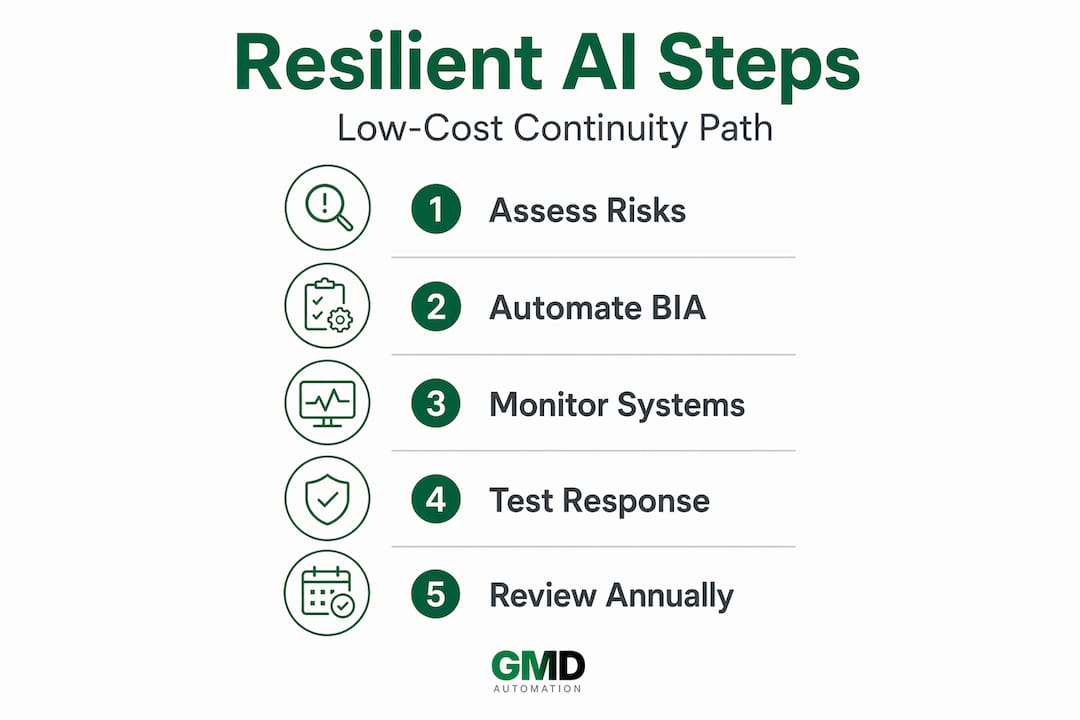
The good news for budget-conscious UK leaders is that AI enhances BCM proactively but also introduces new risks from poor data quality and vendor over-reliance. Self-hosted models reduce dependency but increase infrastructure burden. A hybrid human-AI approach is needed because AI alone is insufficient for all scenarios. This is not a reason to delay. It is a reason to plan intelligently.
Follow these steps to build a low-cost, resilient AI continuity capability:
- Audit your current AI dependencies: Map every workflow that relies on an AI tool or third-party AI service. You cannot plan for failures you have not identified.
- Adopt cloud-based AI monitoring tools: These require no capital expenditure and can begin surfacing risk signals within days of deployment.
- Automate your business impact analysis: Use AI tools to model failure scenarios across your mapped dependencies, prioritising those with the highest potential impact.
- Implement a multi-vendor strategy: Wherever possible, avoid single-supplier dependency by using at least two providers for critical AI functions.
- Integrate with ISO 22301: Frame your AI continuity activities within your existing BCMS to streamline audits and demonstrate compliance to regulators and clients.
- Build a cross-functional resilience team: Include IT, operations, legal, and compliance. Assign clear accountability for AI-specific risk scenarios.
- Design for graceful degradation: Define the manual fallback process for every AI-dependent workflow before you need it.
Pro Tip: Do not wait until your AI continuity plan is perfect before testing it. Run a simple tabletop exercise based on a vendor outage scenario within the next 30 days. The gaps you discover will be far more valuable than any additional planning document.
Key principles to embed throughout your approach:
- Prioritise explainability so that AI-driven decisions can be audited and defended
- Maintain human-in-the-loop checkpoints for high-stakes decisions, even when AI handles routine processing
- Build human-in-the-loop automation into your response workflows so that escalation to human judgement is fast and frictionless
- Review and update your AI continuity plan quarterly, not annually, given how rapidly AI capabilities and risks evolve
Why real resilience means combining AI with human intuition
As you apply these steps, it is worth rethinking what resilience really requires in a world where machines augment but cannot fully replace human judgement.
There is a temptation, particularly when AI tools perform impressively in demonstrations, to treat automation as a complete solution. It is not. The organisations that achieve the most durable resilience are those that treat AI as a precision instrument operated by skilled, informed people, not as a replacement for human decision-making.
Prioritising observability for AI-specific metrics such as latency and output quality, building cross-functional teams that include legal and operations, and focusing on resilience maturity rather than heavy capital expenditure are the distinguishing characteristics of organisations that consistently outperform their peers. This is not about spending more. It is about organising better.
Our view, shaped by working with UK businesses across multiple sectors, is that the biggest risk in AI continuity planning is not under-investment in technology. It is over-confidence in it. A business that has deployed sophisticated AI monitoring but has not trained its operations team to interpret alerts, or has not defined clear escalation paths, is not resilient. It is merely automated.
The organisations that build lasting resilience invest equally in the human capabilities that surround their AI systems: the analysts who interpret model outputs, the legal teams who understand accountability frameworks, the operations managers who can run manual fallback processes under pressure. Human expertise combined with AI automation is the formula that consistently delivers the 4.2x recovery advantage the data shows.
Cost-effective resilience lies in clever, not maximal, application of AI. You do not need to automate everything. You need to automate the right things, monitor them intelligently, and ensure your people are ready to take over when the machines need help.
How GMD Automation helps UK businesses stay resilient
For UK leaders ready to move from theory to action, practical AI automation support is only a step away.
GMD Automation works with UK organisations to deploy enterprise-grade AI continuity solutions without the upfront costs that have historically made this level of resilience inaccessible. Our subscription model covers implementation, ongoing operation, maintenance, and optimisation, so you get a fully managed, scalable AI continuity capability from day one. Whether you are mapping AI dependencies for the first time, automating your business impact analysis, or building the hybrid human-AI response teams that the evidence shows deliver the best outcomes, we provide the expertise and tooling to get you there quickly and affordably. Speak to our team to see how we can strengthen your resilience without straining your budget.
Frequently asked questions
What is the difference between AI business continuity and traditional BCM?
AI business continuity combines standard BCM with AI tools for automated monitoring, risk assessment, and faster incident response, plus contingency planning for AI system failures specifically. Traditional BCM relies primarily on manual processes and periodic reviews.
Does AI business continuity require major capital investment?
No. Most UK organisations can start with cloud-based AI tools for monitoring and BIA automation, multi-vendor strategies, and hybrid teams to avoid large upfront spending. Subscription-based models make enterprise-grade capability accessible from the outset.
What are the most common AI-specific risks to business continuity?
AI-specific risks include vendor service outages occurring three to five times per year, model drift, prompt injection, degraded outputs without system downtime, and single-supplier dependency creating critical points of failure.
How often should AI-focused continuity plans be tested?
Experts recommend annual testing with chaos engineering as a minimum, alongside routine simulations to address AI's rapidly evolving risk profile. Quarterly reviews are advisable given how quickly AI capabilities and threat landscapes change.
What practical first step should UK leaders take to build AI business continuity?
Begin by integrating affordable AI tools for monitoring and business impact analysis, then diversify your AI vendors and form mixed human-AI response teams with clear accountability for AI-specific failure scenarios.