

AI system transparency is the practice of making an AI system's data inputs, decision logic, and outputs understandable and auditable by humans. It is the foundational discipline that separates trustworthy enterprise AI from a black box that nobody can question or govern. For UK professionals deploying or procuring AI in 2026, understanding this concept is no longer optional. Frameworks including the EU AI Act, the NIST AI Risk Management Framework, and GDPR now impose concrete transparency obligations on organisations, with penalties and reputational consequences for those who treat disclosure as an afterthought.
What is AI system transparency and why does it matter?
AI transparency is defined as the degree to which an AI system's behaviour, data sources, and decision processes are visible, interpretable, and accountable to relevant stakeholders. Those stakeholders include regulators, internal auditors, end users, and affected third parties. The concept goes well beyond publishing a model card or adding a disclaimer to a product page.
The importance of AI transparency becomes clear when you consider what opacity costs. A credit-scoring algorithm that cannot explain a rejection exposes a lender to legal challenge under GDPR's right to explanation. A hiring tool whose logic is undocumented creates discrimination liability. A customer-facing chatbot that does not identify itself as AI breaches EU AI Act Article 50. Each of these scenarios is a governance failure that transparency disciplines are specifically designed to prevent.

Transparency also underpins commercial trust. Organisations that can demonstrate clear audit trails and documented decision logic attract partners and customers who are increasingly sceptical of opaque AI claims. The NIST AI Risk Management Framework bundles "Accountable and Transparent" as one of its seven trustworthy AI characteristics, tying decision accountability to responsible people across every stage of the AI lifecycle. That framing matters because it positions transparency not as a technical feature but as an organisational commitment.
How does AI transparency differ from explainability and justifiability?
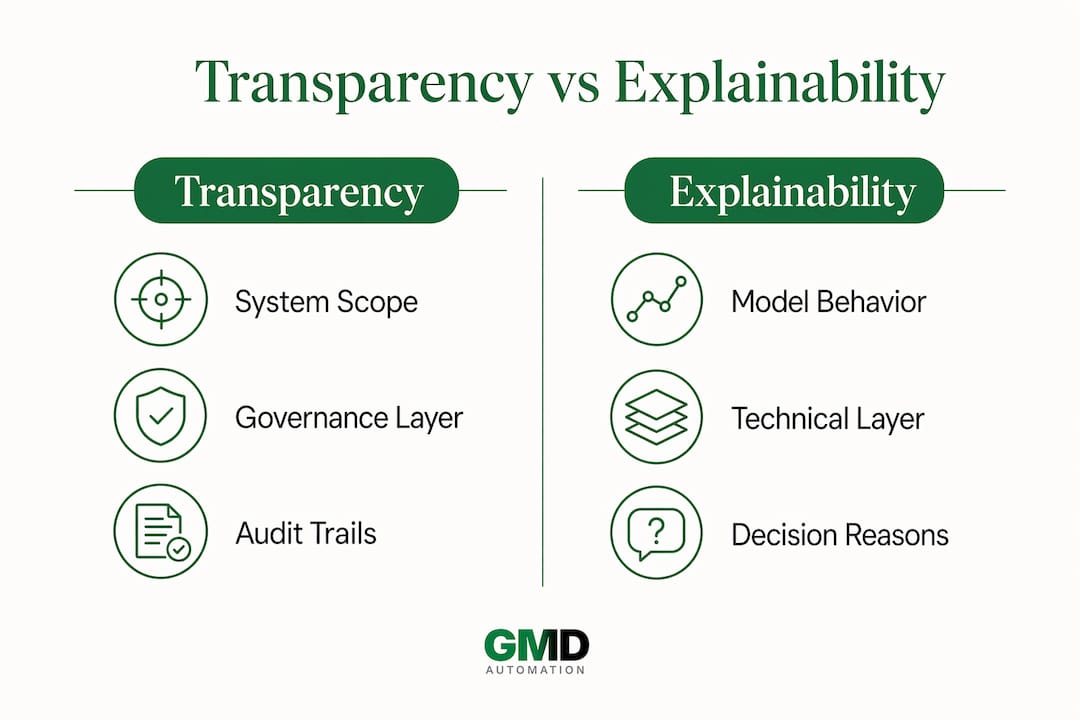
These three terms are frequently conflated, and the confusion leads to real governance gaps. Transparency and explainability are distinct disciplines: transparency involves broader system and organisational disclosures, while explainability specifically focuses on describing how particular outputs are generated for defined audiences.
Think of it this way. Transparency is the governance layer. It asks: who owns this system, what data feeds it, where are the audit logs, and who is accountable when it fails? Explainability is a technique within that layer. It asks: can a data scientist understand why the model produced this output, or can a customer understand why they received this decision? The two operate at different levels of abstraction and serve different audiences.
A third concept, justifiability, takes a different ethical position entirely. Some ethical frameworks emphasise justifiability over maximal transparency of internal workings, shifting focus from opening the black box to providing meaningful reasons for decisions. A justifiability approach asks whether a decision was correct and defensible, not whether every weight in the model is visible. This matters for high-stakes domains such as criminal justice or medical triage, where full technical transparency may be impractical but decision correctness is non-negotiable.
| Concept | Scope | Primary audience | Implementation focus |
|---|---|---|---|
| Transparency | System and organisational level | Regulators, auditors, governance teams | Audit trails, documentation, ownership records |
| Explainability | Model output level | Data scientists, end users, affected individuals | Feature attribution, plain-language summaries |
| Justifiability | Decision correctness level | Ethicists, legal teams, affected parties | Reasoned justification for outcomes |
Pro Tip: When scoping your AI governance programme, map each stakeholder group to the concept they actually need. Regulators need transparency artefacts. Customers need explainability. Legal teams often need justifiability. Conflating these leads to documentation that satisfies nobody.
What do major frameworks and regulations require?
The regulatory picture in 2026 is specific and demanding. Decision-makers who treat transparency as a vague aspiration will find themselves non-compliant with frameworks that have teeth.
- EU AI Act, Article 50. Transparency is mandated for AI systems interacting directly with people or producing synthetic content. Providers must disclose AI involvement at first interaction and apply machine-readable markings to synthetic outputs. The European Commission's 2026 draft guidelines specify the timing and format of these disclosures, emphasising that transparency must be designed into the product experience, not bolted on afterwards.
- NIST AI Risk Management Framework. The framework operationalises transparency through lifecycle governance, requiring organisations to assign accountable individuals at every stage from design through to retirement. It treats transparency as inseparable from risk management, not as a separate compliance exercise.
- GDPR. Articles 13, 14, and 22 require organisations to inform individuals about automated decision-making, including the logic involved and the significance of the outcome. This creates a direct legal obligation to maintain explainability records for any AI system making consequential decisions about people.
- Transparency by design. The EU guidelines make clear that transparency must be integrated throughout the AI lifecycle rather than added at the point of deployment. This principle has practical implications for procurement: if you are buying an AI system that cannot produce audit logs or data lineage records, you are acquiring a compliance liability.
The combined effect of these frameworks is that transparency is now a minimum viable feature for any enterprise AI deployment in the UK and EU, not a differentiator.
What are the common pitfalls in AI transparency?
Knowing what transparency requires is not the same as achieving it. Several failure modes are well-documented and worth understanding before you invest in governance infrastructure.
The most significant is what researchers call the regulatory transparency pitfall: standardised auditing that prioritises compliance over effectiveness, producing documentation that satisfies a checklist without genuinely enabling oversight. This leads directly to ethics-washing or safety-washing, where an organisation can point to a transparency report while the actual decision logic remains opaque and uncontested.
"Transparency measures that are designed primarily to satisfy regulators rather than inform stakeholders create a false sense of accountability. The documentation exists, but nobody can act on it."
A second pitfall is information overload. Disclosures that are technically complete but practically incomprehensible do not serve transparency goals. A 40-page model card that a procurement officer cannot parse is not transparent to that procurement officer. Technical transparency for developers and regulatory explainability for lay audiences must be distinctly addressed to serve all stakeholders effectively.
A third risk is the absence of organisational expertise to act on transparency information. Audit logs and data lineage records are only valuable if someone in the organisation understands them well enough to raise a meaningful challenge. Training users and encouraging interdisciplinary involvement are critical to avoid over-reliance on superficial transparency metrics.
Pro Tip: Before commissioning a transparency audit, ask who in your organisation will read the output and what decision they will make based on it. If you cannot answer that question, the audit will produce a document, not accountability.
How can organisations operationalise AI transparency?
Moving from principle to practice requires specific artefacts, processes, and ownership structures. The following steps reflect current best practice for UK enterprises operating under the EU AI Act and NIST frameworks.
-
Build an AI inventory. An AI inventory documents each AI use case alongside its business owner, technical owner, evidence owner, human review points, and transparency triggers. This is the minimum viable artefact for EU AI Act compliance and the starting point for any governance programme. Most teams underestimate its importance until they face an audit.
-
Implement audit trails and data lineage. Audit trails must document data lineage from raw event ingestion through identity resolution and model input, enabling stakeholders to trace any decision back to its source data. This is not a feature you can retrofit easily. It needs to be specified at the architecture stage, which is why AI automation architecture decisions made early in a deployment have long-term governance consequences.
-
Design user-facing disclosures. User-facing transparency must include AI interaction notifications at first contact and machine-readable markings for synthetically generated content. These are product design requirements, not legal footnotes. They need to be specified in UX briefs and tested with users.
-
Assign governance ownership. Each AI system should have a named individual accountable for its transparency obligations. Diffuse ownership produces diffuse accountability. The NIST framework's lifecycle governance model provides a useful template for assigning these roles across design, deployment, and retirement phases.
-
Create stakeholder-specific dashboards. A single transparency report cannot serve regulators, internal auditors, and end users simultaneously. Organisations that invest in AI governance frameworks build layered disclosure structures: technical documentation for developers, plain-language summaries for affected individuals, and audit-ready records for regulators.
| Artefact | Purpose | Primary owner |
|---|---|---|
| AI inventory | Maps use cases to owners and compliance triggers | Chief AI Officer or equivalent |
| Audit trail | Traces decisions to source data | Data engineering team |
| User-facing disclosure | Notifies users of AI involvement | Product and UX team |
| Governance dashboard | Provides stakeholder-specific transparency views | Compliance or risk function |
Key takeaways
AI system transparency requires an AI inventory, audit trails, user-facing disclosures, and named governance ownership to satisfy EU AI Act and NIST obligations effectively.
| Point | Details |
|---|---|
| Core definition | Transparency makes data inputs, decision logic, and outputs auditable by all relevant stakeholders. |
| Regulatory obligations | EU AI Act Article 50 and GDPR impose specific, enforceable transparency requirements on UK enterprises. |
| Transparency vs explainability | Transparency is the governance layer; explainability is a technique within it serving specific audiences. |
| Common pitfall | Compliance-driven disclosure produces documentation without genuine accountability if not designed carefully. |
| Practical starting point | An AI inventory mapping use cases to owners is the minimum viable artefact for any transparency programme. |
Why transparency is a culture problem, not just a compliance one
I have reviewed AI governance programmes at organisations that had every artefact in place: the inventory, the audit logs, the model cards, the disclosure notices. And yet the systems were not meaningfully transparent, because nobody in the business had the authority or the inclination to act on what those artefacts revealed.
The uncomfortable truth about algorithmic transparency is that documentation without organisational will is theatre. Regulators can mandate disclosures, but they cannot mandate the internal culture that makes those disclosures consequential. I have seen compliance teams produce beautifully formatted transparency reports that the product team had never read. I have seen audit logs that nobody had queried in 18 months. The artefact existed; the accountability did not.
What actually works is embedding transparency into the decision-making culture of the teams building and operating AI systems. That means data scientists who treat explainability as part of their craft, not a post-hoc obligation. It means product managers who ask "how will we disclose this?" at the same time they ask "how will this work?" It means executives who understand that a transparency failure is a reputational and legal risk, not just a governance gap.
The organisations I have seen get this right share one characteristic: they treat transparency as a question of organisational integrity, not regulatory compliance. The frameworks and regulations are the floor. The culture is what determines whether you stay well above it or scrape along the bottom.
— Ravi
How Gmdautomation helps UK businesses build transparent AI systems
Deploying AI without a clear transparency architecture is a risk that UK businesses cannot afford in 2026. Gmdautomation builds enterprise-grade AI automation systems with governance and auditability designed in from the start, not added as an afterthought.
Every system Gmdautomation deploys includes documented data lineage, clear ownership structures, and the audit trail infrastructure that EU AI Act compliance demands. The predictable monthly subscription model means you get implementation, operation, and ongoing optimisation without capital expenditure, and without the opacity that comes from black-box vendor relationships. If you are ready to deploy AI that your board, your regulators, and your customers can trust, explore Gmdautomation's AI automation solutions to see how transparent, governed AI works in practice.
FAQ
What is the AI transparency definition in plain terms?
AI system transparency means that the data feeding an AI, the logic it uses to make decisions, and the outputs it produces are all visible and auditable by relevant stakeholders. It is the governance discipline that makes AI systems accountable rather than opaque.
How does the EU AI Act affect transparency obligations?
Under EU AI Act Article 50, providers of AI systems that interact with people or generate synthetic content must disclose AI involvement at first interaction and apply machine-readable markings to synthetic outputs. These are product design requirements with legal force, not voluntary best practices.
What is the difference between transparency and explainability in AI?
Transparency is the broader organisational and system-level discipline covering audit trails, documentation, and ownership. Explainability is a specific technique within that discipline, focused on describing how a model produced a particular output for a defined audience such as a data scientist or an end user.
What is an AI inventory and why does it matter?
An AI inventory is a document mapping each AI use case to its business owner, technical owner, evidence owner, and transparency triggers. It is the minimum viable artefact for EU AI Act compliance and the foundation of any credible AI governance programme.
What is the regulatory transparency pitfall?
The regulatory transparency pitfall occurs when standardised auditing prioritises compliance over genuine accountability, producing documentation that satisfies a checklist without enabling meaningful oversight. It leads to ethics-washing and undermines the trust that transparency is meant to build.