

AI is no longer a pilot project sitting safely at the edge of your infrastructure. It is embedded in decision-making pipelines, customer-facing services, and sensitive data workflows across UK enterprises. That shift in scope has created a parallel shift in risk. Average breach costs hit $4.88 million in 2024, and organisations running AI without a deliberate enterprise AI security architecture are carrying exposure that conventional security models were never designed to address. This guide gives you a practical framework, layered architectural detail, and the verification methods your team needs to build AI security that holds up under real-world conditions.
Table of Contents
- Key takeaways
- Enterprise AI security architecture fundamentals
- Preparation: assessing posture and establishing governance
- Designing and deploying a layered AI security architecture
- Post-deployment verification and continuous improvement
- My perspective on where enterprise AI security actually fails
- How Gmdautomation supports your AI security architecture
- FAQ
Key takeaways
| Point | Details |
|---|---|
| Architecture before deployment | Design your AI security framework before models go live; incidents cannot be contained retroactively. |
| Zero Trust is non-negotiable | Apply micro-segmentation and dynamic least privilege across every AI service and agent. |
| Five-layer middleware structure | A fixed-order middleware architecture creates the predictable audit trail required for NIST, ISO 42001, and SOC 2. |
| Treat AI agents as principals | Govern agents through external enforcement layers, not internal configuration, since they must be assumed compromiseable. |
| Verify continuously, not periodically | Semantic monitoring and model versioning shorten incident response times and reduce production downtime materially. |
Enterprise AI security architecture fundamentals
What it is and why it differs from traditional security
An enterprise AI security architecture is the structured set of controls, governance policies, and technical layers designed specifically to protect AI systems throughout their lifecycle. This is not simply conventional cybersecurity applied to a new technology. AI introduces threat categories that standard perimeter or endpoint defences were never built to handle.
The core difference is behaviour. A traditional application does what its code specifies. An AI model generates outputs that emerge from training data, prompt context, and model state, none of which are fully predictable at deployment time. That unpredictability creates attack surfaces that sit inside the model itself, not just around it.
Your AI security framework must be built on four principles:
- Least privilege access. Every AI service, agent, and integration should operate with the minimum permissions required. This limits blast radius when any component is compromised.
- Zero Trust. Zero Trust principles including micro-segmentation require dynamic evaluation of identity, device posture, and situational risk context at every access point, not just at the perimeter.
- Segmentation. AI workloads should be isolated from core business systems using network segmentation and data access controls, so that a compromised model cannot traverse your wider estate.
- Continuous authentication. Session-based trust is insufficient. AI agents that call APIs or access datastores need continuous authentication checks rather than a single login credential.
The specific AI risk categories you need to account for include prompt injection attacks, model inversion and extraction, training data poisoning, and emergent behaviours that produce outputs misaligned with your governance requirements. Securing the AI supply chain also means auditing every third-party model, tool, and integration for provenance, licensing, and data handling practices.
Pro Tip: Map every AI component in your estate before you design any control. Shadow AI tools used by departments without IT oversight are one of the most common unaddressed risks in UK enterprise environments.
Preparation: assessing posture and establishing governance
Know your current state before designing controls
Designing an AI security architecture without first assessing your existing security posture is like specifying a firewall before you know your network topology. Start with a full inventory: which AI tools are in use, where training data originates, how models connect to internal systems, and which regulatory frameworks apply to those data flows. For UK businesses, this means mapping against UK GDPR, the ICO's guidance on automated decision-making, and any sector-specific requirements such as those from the FCA or NHS Digital.

Governance needs to be established before implementation, not alongside it. This means defining ownership (who is responsible for each AI system), setting acceptable use policies, and creating a clear escalation path for AI-related security incidents.
AI Impact Assessments examining training data and prompts prior to deployment prevent incidents that cannot be contained once models are live. Treat this as a mandatory gate, not a compliance formality.
| Preparation area | What to assess | Output |
|---|---|---|
| AI asset inventory | All models, tools, and integrations in use | Comprehensive AI register with risk ratings |
| Data classification | Types and sensitivity of data used in AI training and inference | Data handling policies per AI system |
| Compliance mapping | UK GDPR, sector regulations, and international standards | Gap analysis and remediation plan |
| Supplier risk | Third-party AI tool provenance and data handling | Approved vendor list with security conditions |
| Stakeholder alignment | Business, legal, IT, and compliance requirements | Agreed governance framework and ownership matrix |
The tools layer matters here too. You need middleware solutions capable of intercepting AI agent traffic, authentication and authorisation layers that can enforce dynamic access controls, and monitoring solutions with semantic analysis capability. Review your API integration options early in the process, because your security controls will depend heavily on how AI components communicate with the rest of your stack.
Pro Tip: Conduct a pre-launch red team exercise focused specifically on prompt injection and data extraction attempts against any AI model before it touches production data. Most enterprise teams skip this step and pay for it later.
Designing and deploying a layered AI security architecture
The five-layer middleware model
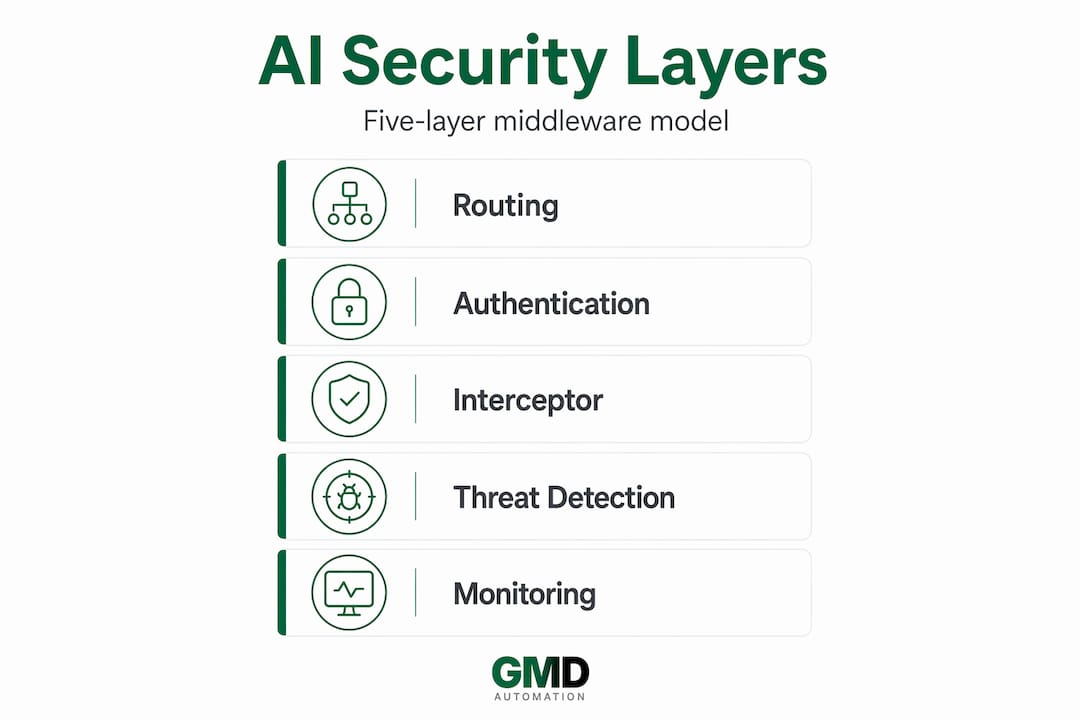
A five-layer middleware architecture with fixed processing order provides a predictable audit trail that satisfies NIST AI RMF, ISO 42001, and SOC 2 requirements. The layers are not optional and the sequence matters. Traffic flows through each layer in order: middleware routing, authentication and authorisation, interceptor proxy, threat detection, and audit and compliance.
Here is how to implement each layer:
-
Middleware routing layer. All AI agent traffic is channelled through a centralised proxy. This single entry point gives you visibility over every request and response, and allows you to apply policy before any AI service is reached. Review AI middleware options for UK enterprises to identify the right architecture for your scale and cloud environment.
-
Authentication and authorisation layer. Implement identity-aware access controls specific to AI services. This goes beyond standard IAM. Each AI agent or service should have its own identity credential, scoped permissions, and session timeout policies. OAuth 2.0 with short-lived tokens and mandatory refresh cycles is the current baseline.
-
Interceptor proxy and protocol normalisation. This layer inspects and normalises AI agent communications. It strips unsafe headers, enforces schema validation on inputs and outputs, and prevents protocol-level attacks that exploit differences between how AI services parse requests versus how security tools expect them to look.
-
Threat detection layer. This is where machine learning in security delivers real value. Pattern-based detection catches known attack signatures. Semantic analysis identifies prompt injection attempts and data extraction queries that do not match any known signature. Behavioural analysis tracks deviation from baseline agent activity, flagging anomalies for investigation.
-
Audit and compliance layer. Every request, response, decision, and policy enforcement action is logged with sufficient context for forensic analysis. Integration with your enterprise SIEM, EDR, and GRC tools at this layer creates a unified security posture view across AI and non-AI systems.
A critical principle underpins this entire structure. AI agents must be treated as principals under governance, not as tools being configured. Enforcement layers must sit entirely outside agent control. Read-only mounts, separate audit boundaries, and externally managed credential stores mean that even a compromised agent cannot tamper with its own oversight trail.
Integrating with existing enterprise security tools
Your cloud security architecture and on-premises security controls need to receive AI security telemetry in formats they already understand. Map AI audit events to your SIEM's existing taxonomy. Feed behavioural anomalies into your EDR workflow for automated containment. Surface AI risk metrics in your GRC dashboards so that compliance teams have visibility without requiring separate tooling.
Post-deployment verification and continuous improvement
Deploying the architecture is not the endpoint. Production AI systems evolve, threats evolve, and UK regulatory expectations around artificial intelligence cyber defence are moving quickly. Your verification and maintenance approach needs to keep pace.
- Model versioning and training data lineage. Model versioning and data lineage allow rapid rollback when an incident occurs, significantly reducing downtime. Every model version should be tagged with its training dataset, fine-tuning configuration, and deployment context.
- Semantic monitoring in production. Continuous monitoring of AI outputs detects emergent behaviours and misuse patterns that pre-deployment testing will not catch. Semantic query logging is particularly effective at identifying data extraction attempts framed as legitimate queries.
- Incident response playbooks. Design specific response paths for AI security incidents: prompt injection confirmed, model producing prohibited outputs, agent accessing unauthorised data. Each path should include immediate containment steps, rollback procedures, root cause analysis requirements, and remediation validation criteria.
- Red and purple team exercises. Schedule AI-aware red team tests at least twice yearly. Purple team exercises, where offensive and defensive teams collaborate, are especially useful for identifying gaps in your detection layer that only become apparent when an attacker operates over an extended period.
- Architecture review cycles. Treat your AI security architecture as a living document. Regulatory changes such as updates to ICO guidance or emerging EU AI Act obligations affecting UK organisations will require architectural adjustments, not just policy updates.
Pro Tip: Build a separate incident response checklist specifically for AI systems and include it in your IT security procedures. Generic incident response processes routinely miss AI-specific remediation steps such as retraining validation and prompt log analysis.
My perspective on where enterprise AI security actually fails
I have seen organisations spend considerable effort building perimeter controls around their AI systems and then leave the interior completely ungoverned. The architecture looks correct on paper. The problems emerge in production.
The most damaging misconception I encounter is treating AI security as a configuration problem rather than an architectural one. Teams reach for settings and access control lists when what they need is enforcement infrastructure that operates entirely independently of the AI system being governed. Agents require enforcement layers external to themselves because assuming any AI component is uncompromiseable is a position the evidence does not support.
What I have found actually works at scale is front-loading investment in remediation infrastructure. Most security teams focus almost entirely on prevention and discover too late that they cannot respond quickly when something goes wrong. Model versioning, semantic logging, and data lineage records are not nice-to-have capabilities. They are the difference between a contained incident and a reportable breach.
The other shift I would push for is treating AI security as a lifecycle commitment, not a deployment gate. The organisations that are handling AI security well in 2026 have built review cycles, red team exercises, and regulatory monitoring into their operating rhythm. The ones struggling are still treating it as a project with a delivery date.
— Ravi
How Gmdautomation supports your AI security architecture
If you are an IT leader or security professional in a UK business working through the complexities of enterprise AI security architecture, Gmdautomation is built for exactly this context.
Gmdautomation deploys enterprise-grade AI systems designed with security, compliance, and scalability at their core, covering implementation, operation, maintenance, and optimisation under a predictable monthly model with no upfront capital expenditure. Their AI automation solutions for UK businesses are structured to integrate with your existing security stack, support UK regulatory requirements, and scale as your AI footprint grows. If you want to move from architectural planning to a live, governed AI deployment without carrying the implementation risk yourself, Gmdautomation is a practical next step. Explore their scalable AI architecture approach to understand what a production-ready deployment looks like in practice.
FAQ
What is enterprise AI security architecture?
Enterprise AI security architecture is the structured set of technical controls, governance policies, and monitoring layers designed to protect AI systems from threats, ensure compliance, and govern AI agent behaviour across an organisation's entire technology estate.
How many layers should an AI security architecture have?
A five-layer middleware structure covering routing, authentication and authorisation, interceptor proxy, threat detection, and audit is the current best practice. This fixed-order design creates a predictable, auditable control path that satisfies major compliance frameworks including NIST AI RMF and ISO 42001.
Why does Zero Trust matter specifically for AI security?
Zero Trust prevents AI agents and services from operating with implicit trust based on network location. Because AI components can be compromised at the model or prompt level, dynamic identity verification and least privilege access must be enforced at every interaction, not just at the boundary.
How do UK businesses verify their AI security architecture is working?
Verification combines model versioning for rollback capability, semantic monitoring of production outputs, AI-aware red and purple team exercises, and continuous integration of AI telemetry into your existing SIEM and GRC tools. Periodic architecture reviews aligned to regulatory updates are also required.
What is the biggest mistake enterprises make with AI security?
The most common failure is treating AI security as a configuration task rather than an architectural one. Teams apply access controls without building independent enforcement infrastructure, which means a compromised AI agent can potentially interfere with its own governance trail.