

AI governance for businesses is defined as the comprehensive operating system of policies, roles, and controls that spans the full AI lifecycle, directing how AI systems are developed, deployed, monitored, and held accountable. Most business leaders treat governance as a compliance checkbox. The ones building durable AI programmes treat it as the structural foundation that makes everything else possible. Frameworks such as the NIST AI Risk Management Framework, the EU AI Act, and the OECD AI Governance Playbook have formalised what good governance looks like. The standard industry term is responsible AI governance, and understanding it is now a prerequisite for any organisation deploying AI at scale.
What is AI governance for businesses, and why does it matter?
AI governance for businesses is the formal system that determines how an organisation builds, uses, and oversees AI. It covers every stage from data sourcing and model training through to deployment, monitoring, and decommissioning. Without it, AI systems operate without accountability, creating legal exposure, reputational risk, and operational failures that compound over time.
The importance of AI governance is not abstract. The OECD AI Governance Playbook structures governance across four focus areas: strategy, risk and compliance, workforce readiness, and operational management. Each area embeds governance into daily decision-making rather than treating it as a periodic audit exercise. That distinction matters enormously for business leaders who want AI to scale without creating new liabilities.

Regulatory pressure is accelerating the urgency. The EU AI Act classifies AI systems by risk level and mandates specific controls for high-risk applications, including transparency obligations and human oversight requirements. UK businesses operating across borders face overlapping AI regulations from companies in multiple jurisdictions. Governance provides the architecture to meet those obligations without rebuilding compliance processes from scratch each time a new regulation arrives.
The business case extends beyond compliance. UNESCO's AI ethics recommendation establishes transparency, fairness, and human oversight as core governance values, and organisations that embed these values operationally build measurably stronger stakeholder trust. Trust translates directly into customer retention, partner confidence, and talent attraction in a market where AI scepticism remains high.
What are the essential components of an AI governance framework?
A functional AI governance framework contains four interconnected components. Each one is necessary. None of them works in isolation.
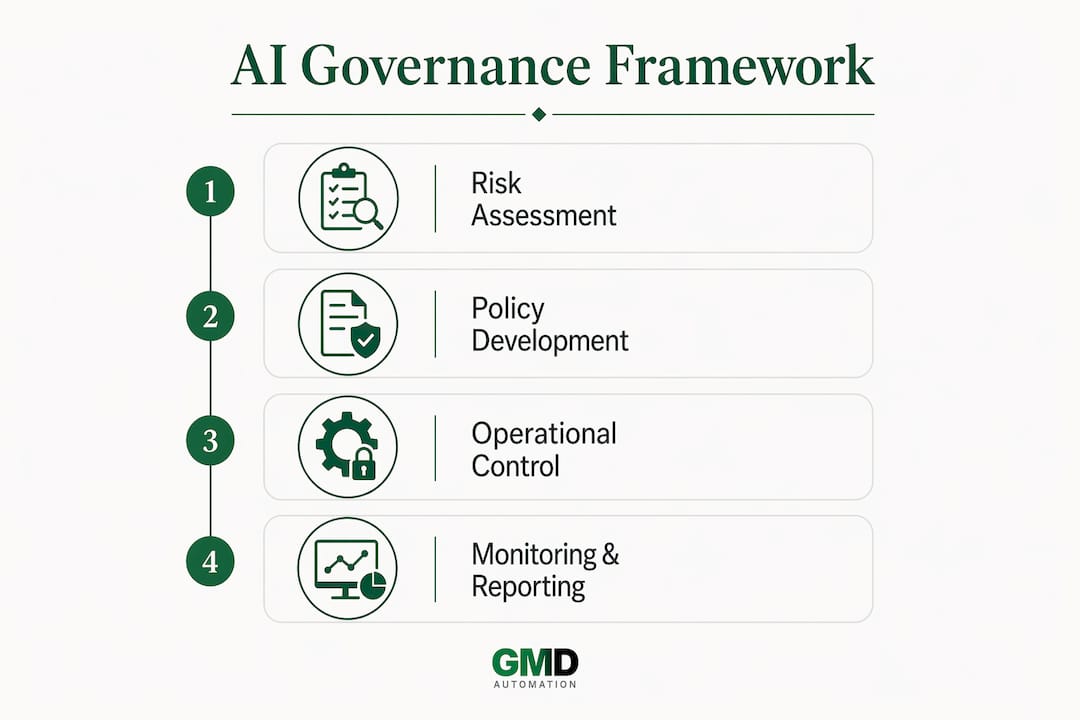
Policies and standards define the rules of engagement for AI use across the organisation. This includes acceptable use policies, data handling standards, model documentation requirements, and criteria for what constitutes a prohibited or restricted AI application. Microsoft Azure's AI governance guidance specifically stresses documentation and enforcement aligned to ethics, compliance, and business goals, with workload-specific adaptations for different deployment contexts.
Roles and accountability structures assign clear ownership at every stage of the AI lifecycle. This means:
- An executive sponsor who holds board-level accountability for AI risk
- An AI ethics board or governance committee with cross-functional representation
- Model owners responsible for ongoing performance and compliance of individual systems
- A designated AI risk officer or equivalent role coordinating governance activities
Risk assessment and classification categorises AI systems by their potential impact on people, operations, and regulatory obligations. High-risk systems, such as those used in hiring, credit decisions, or medical triage, require more rigorous controls than low-risk automation tools. The NIST AI RMF positions its GOVERN function as foundational to all risk lifecycle activities, establishing the risk culture and role clarity that makes consistent risk management possible across the enterprise.
Operational processes translate policy into practice. These include model approval gates before deployment, continuous monitoring of model performance and fairness, audit trails that capture decision logic, and incident response procedures for when models behave unexpectedly.
Pro Tip: Build your AI system inventory before writing a single policy. You cannot govern what you cannot see, and most organisations discover they have significantly more AI in production than their IT register acknowledges.
How does AI governance address risk management and compliance?
Risk management and compliance are not separate workstreams bolted onto governance. They are the primary outputs of a functioning governance system. The OECD's Due Diligence Guidance for Responsible AI outlines a six-step continuous cycle covering impact assessment, mitigation, tracking, communication, and remediation. That cycle is designed to run continuously, not annually.
A structured approach to AI risk management follows this sequence:
- Map your AI systems. Catalogue every AI application in use, including third-party tools and embedded AI features in existing software. An accurate AI system inventory is the single source of truth for risk mapping, approval gating, and shadow AI control.
- Classify by risk level. Assign each system a risk tier based on its potential impact on individuals, regulatory exposure, and operational criticality.
- Apply proportionate controls. High-risk systems require bias audits, explainability documentation, and human-in-the-loop oversight. Lower-risk systems may need only periodic performance reviews.
- Monitor continuously. Track model performance, fairness metrics, and data drift in production. A mature governance model treats incident response as a continuous loop because model drift and context shifts create new risks after deployment, not just before it.
- Document for audit readiness. Maintain records of model decisions, training data provenance, and approval history. Regulators under the EU AI Act and ISO 42001 expect this documentation to be retrievable on demand.
The following table maps the major regulatory frameworks to their primary governance requirements:
| Framework | Primary focus | Key business obligation |
|---|---|---|
| EU AI Act | Risk classification and human oversight | Conformity assessments for high-risk AI systems |
| NIST AI RMF | Risk culture and lifecycle management | GOVERN, Map, Measure, Manage functions |
| ISO 42001 | AI management system certification | Documented policies, objectives, and continual improvement |
| OECD AI Principles | Responsible stewardship and transparency | Due diligence cycle and stakeholder communication |
| UNESCO AI Ethics | Human rights and dignity | Ethical impact assessments and readiness evaluations |
What are the practical challenges of implementing AI governance?
The most common failure in AI governance implementation is treating it as a documentation project. Organisations produce policies, appoint a committee, and consider the work done. Effective governance requires operational mechanisms and continuous monitoring to move from intentions to results. The gap between the two is where most programmes stall.
Shadow AI is the most immediate practical challenge. Employees adopt AI tools independently, often through free consumer applications or unapproved SaaS integrations, creating ungoverned systems that process sensitive data outside any control framework. Without a continuously updated AI system inventory, these systems remain invisible to governance teams until something goes wrong.
Additional implementation challenges include:
- Cultural resistance. Governance is often perceived as slowing down AI adoption. Framing it as a risk reduction mechanism rather than a bureaucratic hurdle changes the conversation with business units.
- Cross-functional coordination. Effective governance requires legal, IT, data science, HR, and operations to work from a shared framework. Siloed governance produces inconsistent controls and audit gaps.
- Overreliance on policy without tooling. Written policies without automated enforcement mechanisms are aspirational, not operational. Monitoring dashboards, approval workflow tools, and automated policy checks are what make governance real.
- Workforce readiness. The OECD AI Governance Playbook identifies workforce readiness as one of its four core focus areas. AI literacy across the organisation, not just in technical teams, determines whether governance policies are understood and followed.
Pro Tip: Run a shadow AI audit before your governance programme launches. Survey department heads, review SaaS procurement records, and check browser extension policies. The results will reshape your risk classification priorities immediately.
What tools and structures support ongoing AI accountability?
Sustaining AI governance over time requires both organisational structures and technology infrastructure. Neither alone is sufficient. The enterprise AI security architecture that supports governance must be designed for continuous operation, not point-in-time compliance.
The following comparison illustrates how governance structures differ by organisational maturity:
| Governance element | Early-stage organisation | Mature organisation |
|---|---|---|
| AI oversight body | Ad hoc working group | Formal AI ethics board with board reporting |
| System inventory | Spreadsheet-based, manually updated | Automated registry with real-time risk classification |
| Monitoring | Periodic manual reviews | Continuous automated dashboards with alerting |
| Incident response | Reactive, case-by-case | Documented continuous improvement loop |
| Regulatory alignment | Single jurisdiction | Cross-jurisdictional policy adaptability |
Generative AI and agentic systems introduce specific governance challenges that traditional model monitoring does not address. These systems can produce outputs that drift significantly from their original design intent as context and usage patterns evolve. Governance structures must account for this by treating agentic model behaviours as subject to continuous review rather than one-time approval.
Executive reporting is the accountability mechanism that keeps governance visible at board level. Quarterly AI risk reports, incident summaries, and compliance status updates give leadership the information needed to make informed decisions about AI investment and risk tolerance. Transparency practices, including publishing AI use policies externally, also signal to customers and regulators that governance is genuine rather than performative. For businesses exploring AI system transparency as part of their governance approach, the connection between internal controls and external communication is direct.
Key takeaways
Effective AI governance requires a continuously maintained system of policies, roles, operational controls, and monitoring, not a one-time compliance exercise.
| Point | Details |
|---|---|
| Define governance as an operating system | Governance spans the full AI lifecycle from data sourcing through decommissioning, not just deployment. |
| Build your AI inventory first | An accurate, continuously updated system registry is the foundation for risk mapping and shadow AI control. |
| Align to major frameworks | NIST AI RMF, EU AI Act, and ISO 42001 each provide structured obligations that a governance framework must address. |
| Treat incident response as a loop | Model drift and context shifts mean risks evolve after deployment, requiring continuous monitoring and fast correction cycles. |
| Pair policy with operational tooling | Written policies without automated enforcement, monitoring dashboards, and approval workflows do not constitute governance. |
Why governance is the competitive edge most leaders overlook
I have worked with business leaders who view AI governance as the price of admission to regulated markets. They are not wrong, but they are missing the larger point. The organisations that treat governance as a strategic capability, rather than a compliance cost, make better AI decisions faster. They know what systems they have, what risks those systems carry, and how to respond when something changes. That knowledge is operationally valuable independent of any regulatory requirement.
The uncomfortable reality is that most AI programmes fail not because of bad models but because of bad governance. Ungoverned AI creates technical debt, reputational exposure, and internal confusion about who owns what. I have seen well-funded AI initiatives collapse because no one could answer a basic audit question about a model that had been in production for eighteen months.
The NIST AI RMF insight that resonates most with me is this: without foundational governance structures defining risk culture and roles, technical risk management cannot be consistently scaled. That is not a theoretical observation. It is what happens in practice when governance is treated as someone else's problem.
My advice to business leaders is to start with the inventory, appoint a named owner for AI governance, and build the operational controls before the regulatory deadline forces you to. The organisations that govern AI well now will spend less time firefighting and more time deploying AI that actually delivers value.
— Ravi
How Gmdautomation supports AI governance for UK businesses
Gmdautomation builds AI automation systems for UK businesses that are designed with governance, compliance, and security as core requirements rather than afterthoughts. Every system deployed through Gmdautomation includes documentation, monitoring infrastructure, and the operational controls that responsible AI governance demands. For business leaders who want to adopt AI without inheriting ungoverned technical debt, Gmdautomation's subscription model covers implementation, ongoing operation, and continuous optimisation under a single predictable cost. Explore AI automation for UK businesses to see how governance-compatible AI deployment works in practice.
FAQ
What is AI governance in simple terms?
AI governance is the set of policies, roles, and controls that determine how an organisation builds, deploys, and oversees AI systems to keep them safe, fair, and compliant. It covers the full AI lifecycle from data sourcing through to decommissioning.
Which AI governance frameworks should UK businesses follow?
UK businesses should align with the NIST AI Risk Management Framework, ISO 42001, and the EU AI Act if they operate in European markets. The OECD AI Governance Playbook also provides a practical 12-directive structure covering strategy, risk, workforce readiness, and operations.
What is shadow AI and why does it matter for governance?
Shadow AI refers to AI tools adopted by employees without IT or governance team approval, creating ungoverned systems that process sensitive data outside any control framework. An accurate AI system inventory is the primary mechanism for identifying and managing shadow AI before it creates regulatory or operational risk.
How does AI governance differ from AI ethics?
AI ethics defines the values and principles that should guide AI use, such as fairness, transparency, and human dignity. AI governance is the operational system that translates those values into enforceable policies, controls, and accountability structures across the organisation.
How often should an AI governance framework be reviewed?
Governance frameworks require continuous review rather than annual updates, because model drift, new deployments, and evolving regulations create new risks on an ongoing basis. The OECD's due diligence guidance and BCG research both treat governance as a continuous improvement loop rather than a periodic exercise.