

Scaling AI agents comes down to one thing: treating agents as a governed product, not a demo. That means a product owner, a TRiSM programme (trust, risk and security management), AgentOps discipline, right-sized infrastructure, and KPIs tied to business outcomes from day one — before you add a second use case.
Before you touch infrastructure, get these in place:
- Assign a named product owner accountable for outcomes, not just uptime
- Stand up programmatic guardrails (policy enforcement, audit logs, human-in-the-loop escalation)
- Build AgentOps tooling: versioning, tracing, evaluation gates, rollback
- Right-size compute and inference serving before scaling concurrent agents
- Track one primary KPI (cost per resolved transaction, or task success rate) from week one
The technology leader owns architecture and reliability; the business sponsor owns the ROI metric. Both need to sign off before an agent moves past its first live use case.
Key Takeaways
Scaling AI agents reliably requires a product-centric mindset, programmatic TRiSM controls, disciplined AgentOps, right-sized infrastructure, and one clearly owned KPI, in that order.
| Point | Details |
|---|---|
| Diagnose before scaling | Most pilots stall on data quality, brittle integrations, or missing governance, not the model itself. |
| Follow the six-step gate sequence | Define outcomes first, then productise, then build data, platform, AgentOps and governance in order. |
| Manage KV cache early | Disaggregated inference and cache offload prevent GPU bottlenecks before they force a hardware spend. |
| Enforce TRiSM programmatically | Identity, RBAC, audit logs and human-in-the-loop escalation must be built into code, not policy documents. |
| Consider a managed route | Gmdautomation's subscription model covers implementation, hosting and compliance groundwork to shorten time-to-value. |
Curated further reading and primary sources
- Gartner's scaling AI guidance for the product-centric, CI/CD-driven framing used throughout this article.
- NVIDIA Dynamo for technical detail on disaggregated inference and KV cache offload.
- HBR on treating agents like team members for organisational design and escalation patterns.
Table of Contents
- Why agent pilots stall before they reach production
- A six-step framework to scale AI agents from pilot to portfolio
- Technical checklist: infrastructure components and scaling patterns
- AgentOps: running many agents without losing control
- TRiSM: programmatic guardrails for agentic AI
- When to build versus when to buy an agent platform
- How a managed subscription accelerates the path to production
- Frequently asked questions
- Sources
Why agent pilots stall before they reach production
Most agent pilots die from the same five causes: patchy source data, integrations that break the moment a downstream system changes its schema, no operational tooling to catch failures, missing governance for who can approve what, and no agreed measure of return. None of these are exotic problems. They're the same failure modes that killed early RPA and MLOps rollouts, just wearing a new coat.
A logistics firm ran a booking agent for several weeks with strong demo results, then watched it stall at a low task completion rate in production. The fix wasn't a better model. It was adding a structured retrieval layer so the agent stopped guessing at incomplete customer records.
That single change, standardising the data the agent could see, significantly improved completion rates. It illustrates the wider pattern: scaling AI means standardising deployment patterns and instrumenting monitoring long before you worry about model choice.
Each failure mode maps directly onto the six-step framework below:
- Data quality issues → Step 3 (data and knowledge strategy)
- Brittle integrations → Step 4 (platform and infrastructure)
- No operational tooling → Step 5 (AgentOps and CI/CD)
- Missing governance → Step 6 (continuous evaluation and TRiSM)
- No ROI metric → Step 1 (outcomes and measurement, defined first)
A six-step framework to scale AI agents from pilot to portfolio
Enterprises that move from a single working agent to a portfolio of them follow a broadly consistent sequence. Skipping steps is the single biggest predictor of a stalled rollout.
- Define outcomes and ROI. Pick one business metric (cost per resolved case, revenue per qualified lead) before writing a single prompt. Gate: a signed-off KPI with a baseline measurement. Read more on enterprise AI ROI.
- Productise the agent. Treat it like software: a backlog, a release cadence, an owner. Gartner's guidance on scaling AI frames this as the difference between a project and a product.
- Build the data and knowledge strategy. Standardise retrieval, clean source systems, and define what "ground truth" looks like for the agent's domain.
- Stand up the platform. Orchestration, inference serving and secure connectors need to exist before you add a second use case.
- Implement AgentOps and CI/CD. Version prompts and skills, automate evaluation, and build rollback paths.
- Establish governance and continuous evaluation. Audit trails, escalation paths and drift monitoring run permanently, not once at launch.
Before advancing past each gate, confirm:
- The KPI has a measured baseline, not just a target
- At least one integration has survived a schema change without manual patching
- A rollback has been tested, not just documented
Technical checklist: infrastructure components and scaling patterns
Get the architecture wrong and every later step gets harder. The components that matter for agentic systems, specifically, go beyond a standard model API integration:
- Orchestration layer to sequence multi-step agent tasks and tool calls
- Model and inference serving sized for concurrent, often long-context, requests
- KV cache management to stop memory exhaustion as context windows grow
- Vector stores for retrieval-augmented grounding
- Durable execution (state persistence, replayable workflows) so long-running tasks survive restarts
- Secure connectors into CRM, ERP and ticketing systems, with scoped credentials
On the serving side, disaggregated inference and KV cache offload are the proven levers for avoiding GPU memory bottlenecks once agents hold longer conversational context or chain multiple tool calls. Cost-aware routing (sending simple queries to smaller models, complex reasoning to larger ones) and caching repeated retrieval results both cut inference spend without touching reliability.
A recurring mistake is treating an agent deployment as a single stateless call rather than an event-driven workflow. Long-running, multi-step agent tasks need durable timers and state persistence to survive infrastructure churn, not just a retry loop bolted on afterwards.
Pro Tip: When GPU memory or latency spikes appear, check KV cache utilisation before you reach for more GPUs. Offloading cache to CPU memory or disaggregating the prefill and decode stages often solves the bottleneck at a fraction of the cost of scaling hardware.

AgentOps: running many agents without losing control
Running one agent reliably is easy. Running twenty, across teams, is an operations problem first and a model problem second.
- Version every prompt and agent skill in a registry, tested against offline and online evaluation gates before release
- Use canary or blue/green rollouts for any change to a live agent
- Trace every agent decision so a human can reconstruct why it acted
Track these SLOs continuously, the same way you'd track uptime for any production service, detailed further in this guide to AI system uptime:
- Latency per transaction
- Task success rate against defined outcomes
- Groundedness or hallucination rate
- Cost per transaction
Keep an incident runbook: who gets paged, how the agent gets paused, and what triggers a rollback. A practical approach to output benchmarking helps set the evaluation thresholds that feed these alerts.
TRiSM: programmatic guardrails for agentic AI
TRiSM (trust, risk and security management) is what stops a scaled agent fleet from becoming an unmanaged liability. In practice, it means policies enforced in code, not in a document nobody reads: an agent physically cannot execute an action outside its permitted scope, and every action it does take gets logged.
Required controls include:
- Identity and role-based access control scoped per agent, not shared credentials
- Encryption in transit and at rest, with data residency respected per jurisdiction
- Real-time audit logs covering inputs, outputs and tool calls
- Defined escalation paths for low-confidence or high-stakes decisions
For anything touching money, contracts or customer-facing commitments, route the decision through a human-in-the-loop approval step rather than letting the agent act autonomously. Our guide to AI governance and security architecture cover the underlying controls in more depth.
When to build versus when to buy an agent platform
Weigh six factors before committing budget: strategic fit, time to value, regulatory exposure, how much customisation the use case genuinely needs, total cost of ownership, and whether you have the in-house AgentOps skills to run it.
| Criteria | Build in-house | Buy managed |
|---|---|---|
| Control | Full, but slower to ship | Shared, faster to ship |
| Time to production | Months | Weeks |
| Cost shape | High upfront, variable ongoing | Predictable subscription |
| Compliance burden | Owned entirely by your team | Partly absorbed by vendor |
Most enterprises land on a hybrid: a managed platform for the plumbing (orchestration, hosting, compliance tooling), with custom integrations layered on top. Transition to full internal ownership once the use case is proven and the volume justifies the investment, not before.
How a managed subscription accelerates the path to production
Most of the six-step framework above involves genuine capital and hiring cost, particularly AgentOps tooling, compliance infrastructure and hosting. Gmdautomation removes the upfront half of that equation: a monthly subscription covers implementation, operation, maintenance and optimisation. The platform and compliance groundwork are already built rather than something your team assembles from scratch.
That's the practical difference for a technology leader evaluating build versus buy. Instead of spending the first two quarters standing up orchestration, monitoring and audit logging, a managed deployment starts from a system already engineered for security and compliance, letting your team focus on Step 1 and Step 2 of the framework, defining outcomes and productising the agent, rather than infrastructure plumbing. Examples of what that looks like in practice are covered in scalable AI deployment patterns.
If you're weighing whether to build this internally or accelerate with a managed route, start with a discovery conversation on the Gmdautomation platform to see how the subscription model maps against your existing roadmap.
Frequently asked questions
What does it actually mean to "scale" an AI agent? It means moving an agent from a single, manually monitored use case to a governed, repeatable capability running across multiple workflows with automated evaluation, versioning and audit trails, not simply adding more compute.
What's the biggest technical bottleneck when scaling agentic AI? GPU memory and inference latency tend to bite first, particularly as agents hold longer context windows. Disaggregated serving and KV cache offload are the standard mitigations.
How long does it typically take to go from pilot to production? Timelines vary by complexity, but organisations following a structured six-step gate process generally move from validated pilot to first production use case within a moderate timeframe, provided data and integration work happens early rather than late.
Should we build our own agent platform or buy a managed one? It depends on regulatory exposure, in-house AgentOps skills and how differentiated the use case needs to be. Many enterprises start with a managed platform for infrastructure and compliance, then build custom integrations on top.
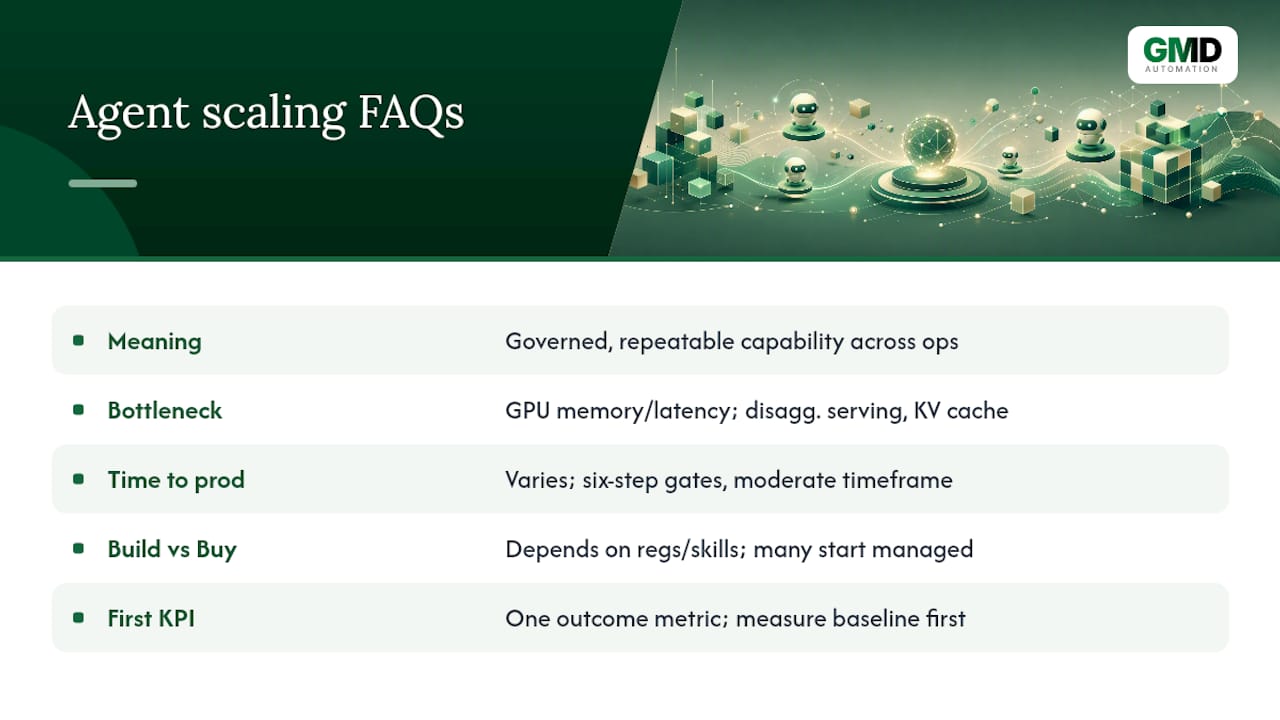
What KPI should we track first when scaling AI agents? Pick one outcome metric tied to the business, such as cost per resolved transaction or task success rate, and measure a baseline before deployment. Adding more metrics before the first one is trusted usually slows decision-making rather than helping it.