

Scalable AI deployment is defined as the practice of building AI systems that maintain performance, reliability, and cost control as workloads grow from pilot to enterprise scale. The best examples of scalable AI deployments share three traits: modular architecture, disciplined cost management, and human oversight built in from the start. Organisations like Stripe and Verizon Connect have demonstrated that AI automation at scale is not a future ambition. It is a present operational reality, and the technical decisions made early determine whether a deployment survives contact with production traffic.
1. What are the leading examples of scalable AI deployments in finance and compliance?
Stripe's AI agent system is the most instructive example of production-grade AI deployment in a regulated, high-volume environment. The system processes $1.4 trillion in annual payment volume and has scaled to over 100 agents. That scale demands architecture that is both auditable and cost-efficient.
The system uses the ReAct agent framework, which combines reasoning and acting in iterative loops. Agents are orchestrated via directed acyclic graphs (DAGs), which enforce execution order and make compliance audits straightforward. Async microservice workflows handle the unpredictable latency of large language model (LLM) calls without blocking other processes.

The financial outcomes are concrete. Token caching reduced costs by 60%, and review handling time fell by 26%. The system achieved a 96% helpfulness rating from compliance reviewers. Human oversight is embedded at decision points, which satisfies regulatory requirements without slowing throughput.
Key architectural choices that made this work:
- DAG orchestration for transparent, auditable agent workflows
- Async microservices to absorb LLM latency spikes without cascading failures
- Token caching as the primary cost control lever
- Human-in-the-loop checkpoints at high-risk decision nodes
Pro Tip: If you are building AI agents for compliance use cases, define your audit trail requirements before you choose your orchestration framework. Retrofitting auditability into an existing agent system is significantly more expensive than designing for it from day one.
2. How did Verizon Connect scale agentic AI for fleet management to 100,000 users?
Verizon Connect faced a problem that many large enterprises recognise: enormous volumes of IoT data arriving faster than human analysts could process it. Fleet telematics generates continuous streams of location, engine, and driver behaviour data. The challenge was turning that raw volume into decisions that field managers could act on immediately.
The solution was a serverless AI agent architecture built on AWS Lambda and Amazon Bedrock. Agents use dynamic reasoning loops via the Strands Agents framework, which allows them to decide which tools to call based on the query context rather than following a fixed script. AWS Step Functions and Amazon SQS handle orchestration and concurrency control, preventing any single data burst from overwhelming the system.
The cost management decision was particularly instructive. The team transitioned from Claude to Amazon Nova 2 Lite for routine queries, which cut input token costs by 70% while preserving answer quality for the majority of use cases. More capable models are reserved for complex, multi-step reasoning tasks.
- AWS Lambda for serverless, event-driven agent execution
- Amazon Bedrock as the managed model layer
- Step Functions and SQS for workflow orchestration and queue management
- Model tiering to match cost to query complexity
Pro Tip: Model tiering is one of the most underused cost controls in AI deployments. Route simple, high-frequency queries to lighter models and reserve your most capable models for genuinely complex tasks. The savings compound quickly at scale.
3. What infrastructure enables ultra-high throughput AI inference?
Superhuman's inference platform represents the upper boundary of what production AI deployments currently achieve. The system serves custom large language models at over 200,000 queries per second with sub-second latency, built on the Databricks FMAPI platform. The engineering decisions behind that number are worth examining in detail.
The team applied FP8 quantisation to reduce the numerical precision of model weights without meaningful accuracy loss. This technique delivers significant throughput gains per GPU. Multiprocessing improvements allowed multiple inference requests to share GPU resources concurrently. Together, these changes produced a 60% per-GPU throughput gain, which directly reduces the hardware cost per query.
Load balancing at this scale requires more than round-robin distribution. The team implemented routing logic that avoids GPU hotspots, where a single accelerator receives disproportionate traffic and becomes a latency bottleneck. Autoscaling follows an asymmetric pattern: scale up quickly when demand rises, scale down conservatively when demand falls.
Autoscaling strategies for inference platforms should be asymmetrical. Fast scale-up with cautious scale-down prevents the latency spikes that occur when a system scales down too aggressively and then struggles to recover during the next traffic surge.
The practical lesson for decision-makers is that partnering with a managed inference provider removes the need to build and maintain this GPU infrastructure internally. The engineering complexity is real, but it does not have to be your engineering complexity.
4. Which architectural features support scalable AI deployments?
The data-identity-billing triangle is the most useful framework for evaluating AI infrastructure. It holds that three factors determine deployment success more than model quality: where your data lives, how identity and access are enforced, and whether the cost model aligns with your workload profile.
Serverless architectures suit variable, unpredictable workloads because you pay per invocation rather than for reserved capacity. Provisioned throughput suits high-volume, predictable workloads where the per-unit cost of reserved capacity falls below the per-invocation serverless rate. Most enterprise deployments use both, routing workloads to the appropriate tier based on volume and latency requirements.
| Feature category | Serverless approach | Provisioned approach |
|---|---|---|
| Cost model | Pay per invocation | Fixed monthly reservation |
| Best for | Variable, bursty workloads | High-volume, predictable traffic |
| Latency profile | Cold-start risk on low traffic | Consistent, low latency |
| Governance | Managed by provider | Greater operator control |
| Scaling speed | Near-instant | Requires capacity planning |
Integration with existing data ecosystems matters as much as the model layer. Platforms that connect natively to AWS data lakes, BigQuery, or Azure Data Factory reduce the data movement overhead that inflates both cost and latency. Infrastructure decisions should align with your existing cloud investments, not force a parallel stack.
5. What best practices help businesses scale AI from pilot to production?
The most common reason AI pilots fail to reach production is the absence of a defined ROI metric before deployment begins. Defining ROI and structuring a phased rollout creates the accountability structure that keeps scaling decisions grounded in business outcomes rather than technical enthusiasm. You need to know what success looks like before you can measure whether you have achieved it.
Containerisation via Kubernetes-native deployments gives teams the portability to move workloads between cloud providers and edge environments without rewriting infrastructure code. This matters when governance requirements dictate data residency or when latency requirements push processing closer to the data source. A scalable architecture roadmap built around containers from the outset avoids expensive refactoring later.
Observability is not optional at enterprise scale. Automated trace collection and regression testing catch quality degradation before it reaches end users. Failing traces pulled from production logs become the test cases for the next release cycle. FinOps practices applied to AI workloads, tracking cost per inference, cost per agent session, and cost per resolved query, give finance and engineering teams a shared language for capacity decisions.
Best practices that consistently appear in successful AI implementations:
- Define a measurable ROI metric before the pilot begins
- Containerise models for portability across hybrid and edge environments
- Implement observability from day one, not as a retrofit
- Apply FinOps disciplines to track cost at the workload level
- Select platforms that offer consistent tooling across your full deployment footprint
Pro Tip: Treat your AI deployment's cost-per-query metric the same way you treat cost-per-unit in manufacturing. When that number rises unexpectedly, it signals a capacity planning problem, a model routing inefficiency, or a data pipeline issue. It is always telling you something specific.
Key takeaways
Scalable AI deployments succeed when architecture, cost management, and governance are designed together from the start, not added incrementally after the pilot.
| Point | Details |
|---|---|
| Finance and compliance AI | Stripe's DAG orchestration and token caching cut costs by 60% and review time by 26%. |
| Fleet and IoT scale | Verizon Connect's serverless architecture served 100,000 users with a 70% reduction in token costs. |
| Inference at volume | Superhuman's FP8 quantisation and asymmetric autoscaling delivered 200,000 QPS at sub-second latency. |
| Infrastructure selection | The data-identity-billing triangle is the primary framework for evaluating AI platform choices. |
| Scaling best practices | Define ROI first, containerise for portability, and apply FinOps disciplines from the outset. |
Why architecture decisions matter more than model choices
The pattern I keep seeing across every serious AI deployment is that organisations spend the most time debating which model to use and the least time on the infrastructure decisions that actually determine whether the deployment survives at scale. Stripe did not achieve a 60% cost reduction because they found a better model. They achieved it through token caching and async architecture. Verizon Connect did not scale to 100,000 users by upgrading their LLM. They did it by tiering their models and building serverless orchestration around the workload profile.
The uncomfortable truth is that most AI deployments fail in production not because the AI is wrong, but because the surrounding system cannot handle the load, the cost, or the compliance requirements. I have seen organisations build genuinely impressive pilots that collapse the moment real traffic hits them, because nobody modelled the cost curve or stress-tested the concurrency limits.
My strong view is that the data-identity-billing triangle should be the first conversation in any enterprise AI project, not the last. Where does your data live? Who controls access? What does the cost model look like at 10x your pilot volume? Answer those three questions before you write a single line of agent code. The enterprise AI ROI framework exists precisely because these questions need structured answers, not gut instinct.
Multi-cloud strategies add resilience, but they also add complexity. My advice is to consolidate on one primary cloud platform until your deployment is stable, then introduce secondary providers for specific workloads where the cost or latency case is clear. Premature multi-cloud is one of the fastest ways to double your operational overhead without doubling your capability.
— Ravi
Gmdautomation: AI automation built for UK enterprises
UK business leaders who have read through these case studies often ask the same question: how do we get from where we are now to a production-grade AI deployment without the capital risk or the internal engineering overhead?
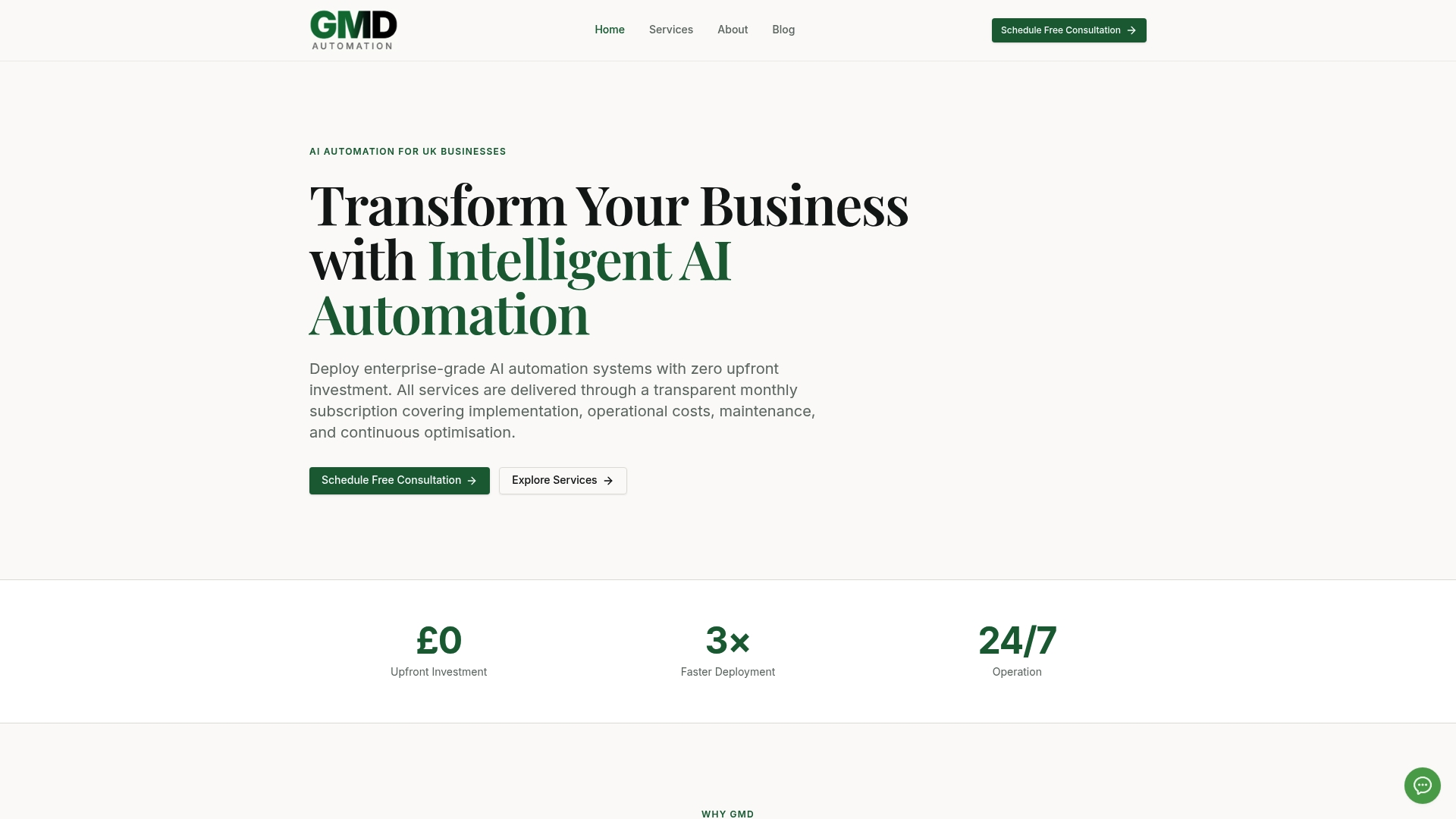
Gmdautomation builds and operates enterprise-grade AI systems for UK businesses under a monthly subscription model that covers implementation, operation, maintenance, and ongoing improvement. There are no upfront costs and no need to hire a specialist infrastructure team. Systems are designed for security, compliance, and the kind of workload growth that the Stripe and Verizon Connect examples illustrate. If your organisation is ready to move from pilot thinking to production deployment, Gmdautomation is worth a conversation.
FAQ
What is a scalable AI deployment?
A scalable AI deployment is an AI system designed to maintain performance and cost control as user numbers, data volumes, or query rates increase. It typically combines modular architecture, managed infrastructure, and automated cost controls.
How did Stripe scale its AI agent system?
Stripe scaled to over 100 agents using DAG orchestration, async microservices, and token caching, which reduced costs by 60% and cut review handling time by 26%.
What is the most cost-effective way to scale AI inference?
Model tiering is the most direct cost control: route high-frequency, simple queries to lighter models and reserve more capable models for complex tasks. Verizon Connect reduced input token costs by 70% using this approach.
What does the data-identity-billing triangle mean for AI infrastructure?
It means that deployment success depends on three factors beyond model quality: where your data is stored, how access is controlled, and whether the pricing model matches your workload profile.
How do businesses move from AI pilot to full production?
The proven path starts with a defined ROI metric, followed by containerised deployment, observability tooling, and FinOps disciplines to track cost at the workload level before scaling further.