

Automatic scaling of AI systems is the process by which AI workloads adjust compute, storage, and network resources in real time through intelligent orchestration layers that predict and respond to demand without manual intervention. For IT professionals and business leaders, understanding how AI systems scale automatically is the difference between infrastructure that buckles under pressure and one that absorbs demand spikes without a single support ticket. The industry term for this capability is autoscaling, and it spans everything from Kubernetes Horizontal Pod Autoscalers to multi-agent AI control planes that rewrite their own configuration policies. Done well, autoscaling cuts costs, reduces latency, and removes the operational drag of manual capacity planning.
How do AI systems scale automatically in real time?
AI autoscaling replaces fixed CPU and memory thresholds with predictive models that read multiple telemetry signals simultaneously. AI-driven Kubernetes scaling uses signals such as request rate, latency, queue depth, and custom metrics to drive proactive decisions across the Horizontal Pod Autoscaler (HPA), Vertical Pod Autoscaler (VPA), and node provisioning layers at once. That multi-signal approach catches demand shifts minutes before a single-metric threshold would fire.
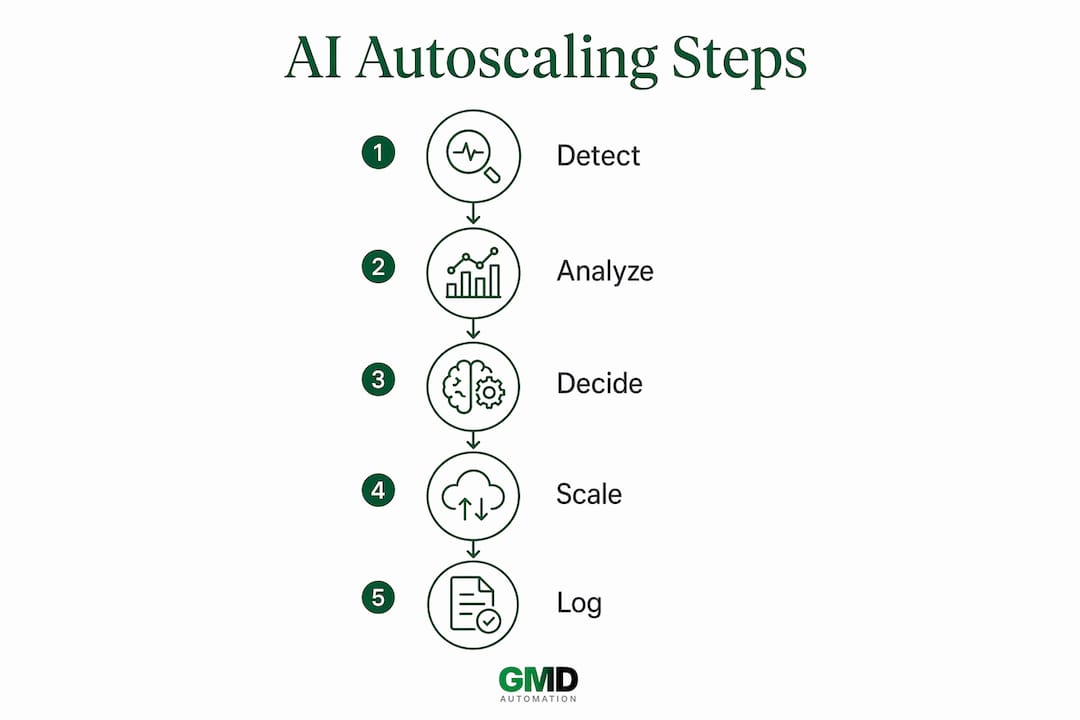
The core orchestration stack works in four layers:
- Telemetry collection. The system gathers GPU utilisation, VRAM pressure, P99 latency, and queue depth continuously. These composite signals are far more reliable than GPU utilisation alone, which can mislead autoscaling decisions by appearing high even when throughput is low.
- Predictive modelling. An AI model forecasts near-future workload demand from the telemetry stream. It fires scaling actions before queues back up, not after users notice slowdowns.
- Orchestration execution. Kubernetes HPA and VPA adjust pod counts and resource requests. Cluster Autoscaler or Karpenter provisions or deprovisions nodes. KEDA external scalers connect the loop to event queues and custom metrics via the Custom Metrics API.
- Guardrail enforcement. Policies set minimum and maximum replica counts, cooldown periods between scaling events, and cost ceilings. These guardrails prevent runaway spend and protect service-level agreements during oscillation events.
Pro Tip: Never rely on a single metric as your scaling trigger. Queue depth and P99 latency together give you a far earlier and more accurate signal than GPU utilisation alone, which regularly flatlines while inference queues are already building.
The practical result is measurable. BlitzScale autoscaling cuts serving GPU time by 49% and reduces tail latency by up to 94% compared with traditional non-autoscaling serving engines. That is not a marginal gain. It means the same GPU budget can serve roughly twice the traffic at a fraction of the response time.

How do multi-agent control planes improve automated AI scaling?
Standard Kubernetes autoscalers react to thresholds. Multi-agent AI control planes reason about them. A multi-agent LangGraph system wraps the Kubernetes control plane with specialised agents that handle telemetry ingestion, decision-making, and configuration patching as distinct responsibilities. Each agent operates with its own context window and tool set, then coordinates through a shared state graph.
The key capabilities this architecture adds are:
- Persistent memory. A checkpointer backed by SQLite or Postgres stores the full scaling history. The system uses that history to recognise oscillation patterns before they repeat, something a stateless HPA cannot do.
- RAG-augmented decisions. Agents blend real-time telemetry with past incident data using a retrieval-augmented generation approach. A spike that looks novel to a threshold rule may match a documented pattern from three months ago.
- Dynamic configuration patching. When an agent decides to change scaling behaviour, it patches the autoscaler manifest directly. No human needs to approve routine adjustments, though audit logs capture every change for compliance review.
- Auditability. Every scaling decision carries a reasoning trace. That trace satisfies enterprise governance requirements and makes post-incident analysis straightforward.
Pro Tip: Build your persistent memory store from day one, even if your workload is small. Oscillation prevention depends on historical context, and retrofitting a checkpointer into a live production system is significantly harder than including it at deployment.
For IT leaders, the compliance benefit is as significant as the performance benefit. A system that logs why it scaled, not just that it scaled, is far easier to defend in a regulated environment. Gmdautomation builds this auditability into its scalable AI automation architecture for UK enterprises, treating governance as a first-class design requirement rather than an afterthought.
What challenges exist in scaling GPU workloads?
GPU autoscaling introduces cost and latency trade-offs that CPU autoscaling does not. Provisioning a GPU node from zero takes 8–15 minutes. For a latency-sensitive inference endpoint, that gap is unacceptable. The solution is not to abandon scale-to-zero but to apply it selectively.
| Scenario | Recommended approach | Primary benefit |
|---|---|---|
| Batch inference, non-urgent | Scale to zero with Karpenter | Eliminates idle GPU cost entirely |
| Real-time inference, latency-sensitive | Maintain warm pods, scale replicas | Keeps response times under SLA |
| Bursty traffic with predictable patterns | Predictive pre-scaling with warm pool | Balances cost and latency |
| Development and staging environments | Full scale-to-zero | Maximum cost reduction |
Modern orchestration tools achieve mean time to recovery for inference endpoints of under 5 minutes when warm-pool management is configured correctly. That figure assumes the system pre-scales based on historical traffic patterns rather than waiting for a cold-start event.
Node consolidation policies compound the savings. When demand drops, Karpenter and Cluster Autoscaler bin-pack remaining workloads onto fewer nodes and terminate the rest. Spot instance usage reduces GPU node costs further, provided the workload tolerates interruption. Composite scaling metrics, combining queue depth, KV-cache pressure, and P99 latency, give the autoscaler earlier signals than GPU utilisation alone, which means consolidation decisions are more accurate and less likely to trigger a premature scale-down.
The role of AI in resource allocation extends beyond simple threshold management. Predictive pre-scaling, informed by historical traffic data, is what separates a cost-efficient GPU fleet from one that either idles expensively or cold-starts constantly.
How do modular architectures enable AI system expansion?
Monolithic AI models hit a scalability ceiling that modular architectures do not. Modular participatory AI systems outperform monolithic large language models by 15.4% across 15 standard tasks and solve more than 15% of problems that monolithic models fail entirely. The reason is specialisation. Each module handles a defined task, scales independently, and can be updated without redeploying the entire system.
Hardware and software must co-evolve to realise this benefit fully. Full-stack co-optimisation across algorithms, chips, packaging, and communication fabrics targets a 10X improvement in compute efficiency by 2030. That ambition reframes the scaling question: the gains come not from adding more data centre capacity but from making every layer of the stack work together more efficiently.
Network topology is where distributed training either succeeds or stalls. Near-linear training scalability at 8 nodes, reaching 7.5X of the theoretical ideal, requires OS-bypass networking such as Elastic Fabric Adapter, communication redesign to reduce cross-node traffic, and advanced compression. Without those changes, adding nodes yields diminishing returns because the network becomes the bottleneck.
For business leaders, the practical implication is straightforward. A modular architecture lets you scale the parts of your AI system that are under pressure without touching the parts that are not. That means faster iteration, lower risk per deployment, and a system that grows with your operational needs rather than requiring a full rebuild. Reviewing AI system integration best practices before committing to an architecture pays dividends when your workload doubles unexpectedly.
Key takeaways
Automated AI scaling works because predictive, multi-metric orchestration replaces reactive threshold rules, enabling systems to adjust resources before performance degrades rather than after.
| Point | Details |
|---|---|
| Multi-signal telemetry is non-negotiable | Queue depth, P99 latency, and KV-cache pressure trigger scaling earlier and more accurately than GPU utilisation alone. |
| Persistent memory prevents oscillation | Storing scaling history in SQLite or Postgres lets multi-agent systems recognise and avoid repeat instability patterns. |
| GPU cold-start requires a warm-pool strategy | Provisioning from zero takes 8–15 minutes; warm pods are the correct choice for latency-sensitive inference endpoints. |
| Modular architectures outperform monolithic ones | Participatory modular AI systems exceed monolithic model performance by 15.4% and solve problems monolithic models miss. |
| Full-stack co-optimisation drives long-term efficiency | Aligning algorithms, chips, and networking is the path to sustained compute efficiency gains beyond data centre expansion. |
Why I think most teams are still scaling AI the wrong way
Most teams I speak with are still treating AI autoscaling as a DevOps problem. They set a CPU or GPU threshold, wire up an HPA, and call it done. That approach worked for stateless web applications in 2018. It does not work for GPU inference workloads in 2026.
The fundamental error is using a single metric as the scaling signal. GPU utilisation looks clean and measurable, but it lies. A GPU can report 80% utilisation while inference queues are already saturated and tail latency is climbing. By the time the autoscaler fires, users have already experienced degraded performance. Composite metrics, particularly queue depth and P99 latency together, give you the signal you actually need.
The second mistake is treating scaling as a stateless operation. Every scaling event carries context: what triggered it, what happened last time a similar pattern appeared, whether the previous scale-up caused an oscillation. Multi-agent control planes with persistent memory use that context. Stateless autoscalers discard it. The difference in reliability is significant, especially in regulated environments where you need to explain every infrastructure decision.
My honest recommendation is to invest in the orchestration layer before you invest in more GPU capacity. A well-designed multi-agent control plane with proper guardrails and audit logging will extract more performance from your existing hardware than adding nodes ever will. The AI agent architecture guide for IT leaders is a good starting point for understanding what that layer should look like in practice.
— Ravi
How Gmdautomation helps UK businesses scale AI with confidence
Gmdautomation builds enterprise-grade AI automation systems for UK businesses that need to scale without the capital risk of building infrastructure from scratch.
Gmdautomation's deployment model covers implementation, operation, maintenance, and ongoing adjustment under a single monthly subscription, with no upfront costs. Every system ships with the orchestration layers, guardrail policies, and audit logging described in this article, configured for UK compliance requirements from day one. For IT leaders who want to move from reactive threshold scaling to predictive, multi-metric autoscaling, Gmdautomation provides the architecture and the operational support to make that transition without disrupting existing workflows. Visit Gmdautomation to see how UK businesses are deploying production-ready AI systems that scale to demand automatically.
FAQ
What is AI autoscaling?
AI autoscaling is the automated adjustment of compute resources, such as GPU pods and nodes, in response to real-time workload signals including queue depth, latency, and request rate. It removes the need for manual capacity planning by using predictive models and orchestration frameworks like Kubernetes HPA and KEDA.
Why does GPU autoscaling take longer than CPU autoscaling?
Provisioning a GPU node from zero takes 8–15 minutes due to driver initialisation, container image pulling, and hardware allocation. Warm-pool management mitigates this by keeping a minimum number of GPU pods running for latency-sensitive endpoints.
What metrics should trigger AI autoscaling?
Queue depth, P99 latency, and KV-cache pressure are more reliable scaling triggers than GPU utilisation alone. GPU utilisation can appear high even when throughput is low, leading to premature or missed scaling decisions.
How do modular AI architectures improve scalability?
Modular AI systems allow individual components to scale independently, reducing the risk and cost of scaling the entire system. Research shows modular participatory AI systems outperform monolithic models by 15.4% across standard benchmarks.
What is the role of persistent memory in AI autoscaling?
Persistent memory, stored in a database such as SQLite or Postgres, gives multi-agent control planes a record of past scaling events. That history allows the system to detect oscillation patterns and avoid repeating instability, which stateless autoscalers cannot do.