

Enterprise AI ROI is defined as the measurable return an organisation generates from AI investments, expressed not as a single figure but as a progression of value across distinct maturity stages. With 71% of global CIOs reporting their AI budgets would be frozen or cut if value is not demonstrated within two years, the pressure to understand and articulate AI investment return has never been more acute. Frameworks from Atlassian, KPMG, and IMD now converge on one principle: calculating AI ROI requires matching your metrics to your maturity stage, not forcing a revenue figure onto an early-stage experiment. Tools like GitHub Copilot and Microsoft 365 Copilot have made this concrete, showing that early wins in developer productivity do not automatically translate into enterprise-wide financial returns without deliberate measurement.
What are the stages of enterprise AI ROI?
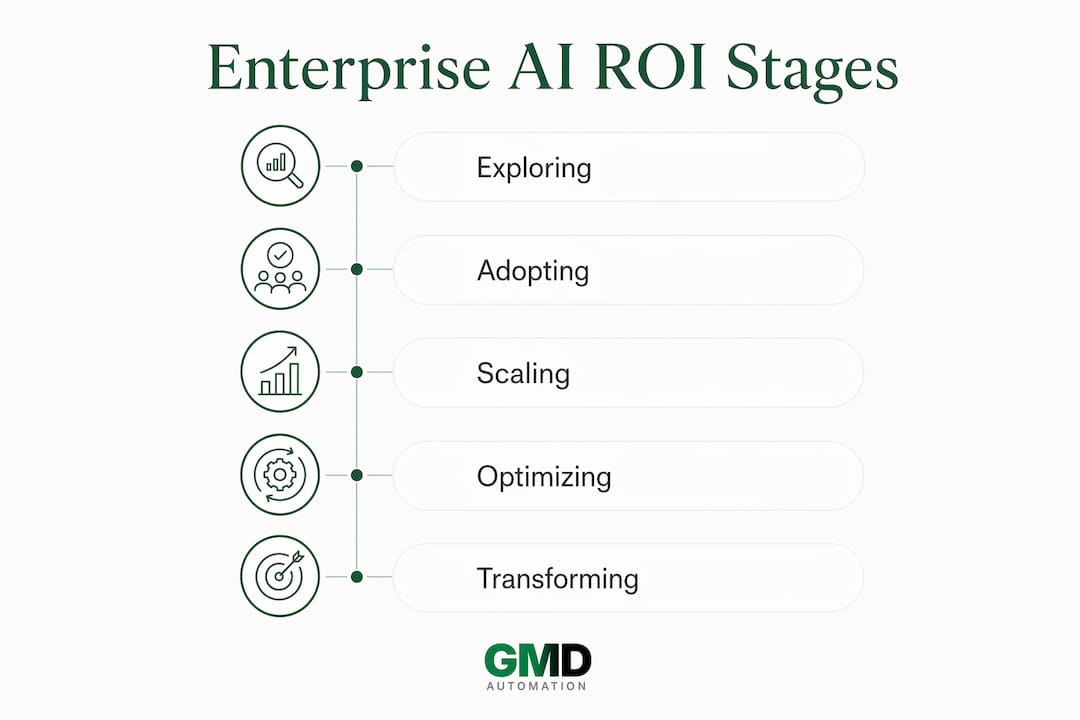
Atlassian's four-stage framework treats AI ROI as a ladder, where each rung demands different metrics and different expectations from leadership. Forcing a single ROI figure onto an early deployment is the most common mistake enterprises make, and it consistently leads to premature project cancellations.
The four stages are:
- Exploring. The focus here is adoption and experimentation. Metrics include the number of active users, frequency of AI feature usage, and qualitative feedback on workflow fit. Revenue attribution is not appropriate at this stage.
- Optimising. Operational efficiency takes centre stage. You measure cost savings, time reduction per task, and error rate improvements. A customer service team using an AI triage tool, for example, would track average handling time and ticket deflection rates.
- Enhancing. Quality improvement becomes the primary signal. Accuracy, consistency, and customer outcomes matter more than raw speed. A legal team using AI contract review would measure clause accuracy rates and reduction in review cycles.
- Transforming. Innovation metrics dominate. New products launched, new revenue streams created, and entirely new business models enabled by AI are the relevant measures here.
Pro Tip: Map your current AI deployments to one of these four stages before your next board review. If you are measuring Exploring-stage tools against Transforming-stage revenue expectations, you will always appear to be failing.
The shift from individual gains to collective impact is equally important. ROI compounds as usage moves from lone superusers to enterprise-wide adoption, which means early pilot numbers will always understate eventual returns. This is why stage-gated measurement, rather than a single upfront calculation, gives leadership a far more accurate picture of AI impact on business.

| Stage | Primary metric | Example signal |
|---|---|---|
| Exploring | Adoption rate | Percentage of team using AI weekly |
| Optimising | Cost and time savings | Reduction in cost per support ticket |
| Enhancing | Quality and accuracy | Improvement in output consistency scores |
| Transforming | Revenue and innovation | New products or services enabled by AI |
How can enterprises measure AI ROI beyond traditional financial models?
Traditional software ROI models assume predictable, deterministic outputs. AI does not behave that way. Output quality varies with data quality, model version, and user behaviour, which means a conventional cost-benefit spreadsheet will produce misleading results if applied without modification.
KPMG advises that effective AI ROI measurement must couple financial outcomes with operational indicators including adoption rate, workflow integration depth, and output reliability. Full cost modelling must also account for integration work, training, and governance overhead, none of which appear in a basic licence cost calculation. Pilots that look profitable in isolation frequently fail to translate into scaled financial ROI because these hidden costs are only discovered at deployment.
The key operational indicators to track alongside financial metrics are:
- Adoption rate. The percentage of intended users actively engaging with the AI tool on a weekly basis. Low adoption is the earliest warning sign that ROI assumptions are broken.
- Workflow integration depth. Whether the AI output is being used directly in decisions or merely reviewed and discarded. Shallow integration produces shallow returns.
- Output reliability. Accuracy and consistency of AI outputs under real-world conditions, not just controlled testing environments.
- Stress-tested assumptions. ROI measurement should include explicit testing of whether individual productivity gains translate to team-level value, since this translation often fails silently.
Pro Tip: Before signing off on any AI business case, ask your team to show you the adoption threshold required for the ROI model to hold. If the model requires 80% adoption but your organisation has never exceeded 60% on any digital tool, the business case needs revision.
The discipline of operational attribution audits integrating both financial and operational performance metrics is what separates credible AI ROI claims from faith-based projections. This is not optional governance. It is the foundation of any AI investment return that will survive scrutiny from a CFO or board.
What financial frameworks do CFOs use to calculate AI ROI?
Three distinct financial frameworks have emerged as the standard approaches for enterprise AI ROI calculation in 2026, each suited to a different type of AI investment. Applying the wrong framework to the wrong investment type is a reliable way to produce a misleading business case.
Enterprise AI projects typically require 12 to 18 months for positive ROI, and the choice of framework determines how accurately you track progress toward that threshold.
- Total Economic Impact (TEI) is used for process automation and cost displacement. It captures direct cost savings, avoided headcount growth, and productivity recapture. A finance team automating invoice processing would use TEI to quantify hours saved and error reduction value.
- Net Present Value (NPV) and payback period analysis applies to infrastructure and platform investments. These models discount future cash flows to account for the time value of money, making them appropriate for multi-year AI platform deployments where benefits accrue gradually.
- Productivity multiplier models are designed for AI copilots and productivity tools like Microsoft 365 Copilot or GitHub Copilot. These models calculate the financial value of time recaptured per user, multiplied across the user base, then adjusted for an adoption discount factor.
| Framework | Best suited for | Key metric |
|---|---|---|
| Total Economic Impact | Process automation | Cost displaced per process |
| NPV and payback period | Platform and infrastructure | Discounted cash flow over 3 to 5 years |
| Productivity multiplier | Copilots and productivity tools | Time value recaptured per user |
Establishing a performance baseline before deployment is non-negotiable. Successful AI ROI leaders measure metrics like revenue per sales representative, cost per support ticket, and time-to-close before any AI tool goes live. Without a baseline, you cannot separate AI impact from background business improvement.
What strategic missteps undermine AI ROI realisation?
The most damaging mistake in enterprise AI programmes is treating technical success as business ROI. A model that performs well in a controlled test environment tells you nothing about whether it will change financial outcomes at scale. This conflation is what produces the "faith-based investment" pattern that IMD identifies as the primary cause of AI programme failure.
The most common strategic missteps are:
- Misaligned value drivers. IMD's research shows that organisations entering strategic limbo typically pursue multiple value drivers simultaneously, such as productivity, expansion, and customer relevance, without committing to one. Mixed priorities produce incoherent metrics and no clear success criteria.
- Absent kill criteria. Without pre-defined thresholds at which a project is stopped or redirected, underperforming AI investments accumulate sunk cost and political momentum that makes them impossible to cancel rationally.
- Underinvestment in change management. Change management constitutes 20 to 30% of the budget in successful AI ROI projects. Most organisations allocate less than 10%, which is the primary reason payback timelines are exceeded. This is a budget allocation problem, not a technology problem.
- Equating pilot success with scaled ROI. A pilot with ten power users will always outperform a scaled deployment with average users. The gap between pilot and production is where most AI ROI assumptions break down.
"The question is not whether AI can perform the task. The question is whether your organisation will actually change how it works as a result."
Governance discipline is the structural answer to all of these risks. A portfolio management approach, with stage gates, defined metrics per stage, and explicit decision criteria for continuation or cancellation, converts AI investment from a series of bets into a managed programme with predictable returns.
How should business leaders apply AI ROI insights in practice?
Translating frameworks into practice requires a deliberate sequence of decisions before any AI tool is procured or deployed. The AI automation ROI business case process starts with use case selection, not technology selection.
The practical steps for maximising AI investments are:
- Select use cases with measurable financial outcomes. Avoid use cases where success can only be described qualitatively. If you cannot name the financial metric that will move, the use case is not ready for investment.
- Align expectations to maturity stage. Brief your board and executive team on which stage each AI programme occupies and what metrics are appropriate. Managing executive expectations about stage-appropriate metrics is as important as the measurement itself.
- Embed governance from day one. Define adoption thresholds, accuracy benchmarks, and kill criteria before deployment, not after the first quarterly review.
- Track operational and financial metrics in parallel. Use the KPMG dual-track approach: financial outcomes alongside adoption, workflow fit, and reliability indicators.
- Identify your AI partners carefully. The right AI partner brings deployment discipline and measurement frameworks, not just technology.
Pro Tip: Run a 90-day operational review on every AI deployment before presenting financial ROI to the board. Use that window to validate adoption rates, identify workflow integration gaps, and recalibrate your financial model with real usage data rather than pilot projections.
Early wins with AI copilots, such as measurable reductions in first-draft time for proposals or faster data retrieval in finance teams, provide the adoption evidence needed to justify scaling. These wins are most valuable when they are documented with baseline comparisons and presented as stage-appropriate signals rather than premature revenue claims.
Key takeaways
Enterprise AI ROI is realised through staged, metric-aligned measurement rather than a single upfront calculation, and organisations that match their metrics to their maturity stage consistently outperform those that do not.
| Point | Details |
|---|---|
| ROI is a staged progression | Match metrics to your maturity stage: adoption first, then efficiency, quality, and innovation. |
| Full cost modelling is non-negotiable | Include integration, training, and governance costs or your business case will understate true investment. |
| Change management is underfunded | Allocate 20 to 30% of project budget to change management or expect payback timelines to slip. |
| Baselines determine credibility | Measure performance before deployment to separate AI impact from background business improvement. |
| Kill criteria prevent sunk cost | Define thresholds for stopping or redirecting projects before deployment, not after failure. |
Why I stopped trusting single-number AI ROI claims
The most revealing moment in any AI investment conversation is when someone presents a single ROI percentage for an enterprise AI programme. That number almost always conceals more than it reveals. In my experience working with enterprise AI deployments, the organisations that report the highest ROI figures in year one are frequently the same ones that quietly wind down their programmes in year two, because the number was built on pilot-stage adoption rates applied to full-scale cost models.
What actually works is the staged approach. When you accept that an Exploring-stage deployment should be measured on adoption and workflow fit rather than revenue attribution, you stop setting programmes up to fail. You also stop giving executives the false confidence that comes from a headline ROI figure that has not been stress-tested against real-world adoption curves.
The change management finding is the one I find most consistently ignored. Organisations will spend millions on AI licences and integration work, then allocate a fraction of that to the human change process that determines whether anyone actually uses the tool. The technology almost never fails. The adoption does.
My practical advice: treat your first AI deployment as a measurement exercise as much as a technology exercise. The data you collect on adoption, workflow fit, and output reliability in the first 90 days is worth more than any vendor ROI projection. It gives you the foundation to build a credible, defensible business case for the next stage of investment.
— Ravi
How Gmdautomation helps UK enterprises realise AI ROI
Gmdautomation builds and deploys enterprise-grade AI automation systems for UK businesses, with a subscription model that covers implementation, operation, maintenance, and ongoing optimisation. There are no upfront capital costs, which removes the largest single barrier to building a credible AI ROI business case. Every deployment is designed around specific, measurable use cases with defined performance baselines, so you are measuring AI impact on business from day one rather than retrofitting metrics after the fact. If you are ready to move from framework to deployment, explore AI automation for UK businesses and see how Gmdautomation structures ROI measurement into every engagement from the outset.
FAQ
What does enterprise AI ROI mean?
Enterprise AI ROI is the return an organisation generates from AI investments, measured across multiple stages of maturity rather than as a single financial figure. It encompasses adoption metrics, operational efficiency gains, quality improvements, and eventually innovation outcomes.
How long does it take to see positive AI ROI?
Enterprise AI projects typically require 12 to 18 months to reach positive ROI, depending on the complexity of the deployment and the organisation's adoption rate.
Why do most AI ROI calculations fail?
Most AI ROI calculations fail because they apply revenue-attribution metrics to early-stage deployments, underestimate change management costs, and do not establish performance baselines before deployment. KPMG's full cost modelling approach addresses all three of these failure points.
What is the best financial framework for calculating AI ROI?
The best framework depends on the investment type. Total Economic Impact suits process automation, NPV and payback period analysis suits platform investments, and productivity multiplier models suit AI copilot tools like Microsoft 365 Copilot.
How do you avoid strategic limbo in AI investment?
IMD's research shows that committing to a single value driver, whether productivity, expansion, or customer relevance, and aligning all execution and metrics to that driver is the most reliable way to avoid the mixed-priority failure pattern.