
The safest way to update a production AI system is to treat every change as a governed infrastructure deployment: version your model artefacts immutably, promote through shadow and canary stages, gate on automated quality scores, and keep a tested rollback path live at all times. That single discipline separates teams that ship AI updates confidently from those that discover regressions in production at 2 AM.
Before you touch anything in production, these controls need to be in place:
- Immutable model artefacts and a model registry with lineage, training data cut-off, and signed release notes
- Environment pinning across agent code, runtime, and model checkpoint (no floating version references)
- Progressive rollout route (shadow traffic first, then canary at 1–5% of live requests)
- Autorater or CI gate that must pass before any promotion step
- Observability hooks covering quality signals, latency, error rates, and downstream parser health
- Rollback trigger defined in advance: a specific metric threshold that fires an automated revert
Your immediate next step, executable within an hour: pin your current model to an exact checkpoint identifier in your deployment manifest and add a shadow route that duplicates live traffic to the new candidate without serving its responses to users.
Key takeaways
Zero-downtime AI updates require versioned artefacts, staged progressive rollouts with defined metric thresholds, automated CI gates including autorater evaluation, and a tested rollback path that any on-call engineer can execute in under five minutes.
| Point | Details |
|---|---|
| Pin artefacts before anything else | Register every model checkpoint with an exact identifier and compatibility matrix entry before touching production. |
| Stage every promotion | Shadow traffic for 24 hours minimum, then canary at 1–5%, with autorater and latency gates at each step. |
| Define rollback thresholds in advance | Set numeric triggers (error rate, autorater delta, parser failure rate) before deployment, not after you see the data. |
| UK compliance is structural | GDPR, data residency, and auditability requirements must be built into the update pipeline from the start, not retrofitted. |
| Gmdautomation manages the pipeline | Gmdautomation's managed service covers upgrade governance, compliance evidence, and tested rollback paths for UK organisations. |
Table of Contents
- Why do AI updates break production systems?
- How do you control model versions and environments?
- How do progressive rollouts protect you during model updates?
- What is blue–green deployment for AI systems?
- How do feature flags give you runtime control over model behaviour?
- What does a CI/CD pipeline look like for AI model updates?
- What metrics should you monitor during a live AI update?
- How do you test an AI update before it reaches production?
- What are the trade-offs between fine-tuning, model editing, and RAG?
- What should your rollback and incident playbook contain?
- What does a field-tested deployment playbook look like?
- What UK compliance requirements apply to AI system updates?
- Field lessons from UK production deployments
- How a managed service removes AI update risk
- Editorial perspective: the gap between update theory and production reality
- Sources
Why do AI updates break production systems?
Standard software updates fail in predictable ways: a changed API contract, a missing dependency, a configuration mismatch. AI updates carry all of those risks plus several that are unique to learned systems, and the unique ones are the ones that catch teams off guard.
Model drift and behavioural regressions are the most insidious. A new checkpoint may score higher on your offline benchmark yet subtly change output formatting, tone, or reasoning chains in ways that break downstream parsers or violate user expectations. The model has not "broken" in any classical sense; it has simply learned a slightly different distribution. Your monitoring will not catch it unless you are explicitly comparing output distributions, not just error rates.
Dependency and ABI changes compound the problem. Tool versioning is the dominant operational failure vector for AI agent fleets: tool runtime changes and model drift together account for the majority of production agent failures. Upgrading a runtime library that your agent uses to call external tools can silently change the serialisation format of tool outputs, which the model then misparses.
State and session desynchronisation hits hardest in conversational or multi-turn systems. If you cut over to a new model mid-session, the new model receives a conversation history it was not trained to continue. Responses become incoherent, or the model hallucinates context it never had.
Configuration and schema mismatches are the quiet killers. A prompt template that worked with model version A may produce structured output in a format that version B no longer reliably generates, breaking every downstream consumer that parses that output.
Upgrading an AI system is not like deploying a new binary. The semantics of the system live inside billions of parameters, not in an API contract you can diff. A model that passes every unit test can still regress on the 0.3% of production inputs that your test suite never covered — and those inputs are often the ones your most important users send.
The practical implication: you cannot rely on deterministic correctness checks alone. You need statistical quality gates, behavioural diffing, and staged exposure to real traffic before any new model version touches all users.
How do you control model versions and environments?
Determinism starts at the artefact level. If your deployment manifest references a model by a floating alias such as gpt-4o-latest or claude-3-5-sonnet, you have already lost control of your update surface. Every implicit upgrade that the provider ships becomes an unplanned production change.
Immutable artefacts and exact identifiers
Pin every model to an exact checkpoint identifier or image digest. For self-hosted models, store the checkpoint in a content-addressed registry and reference it by hash. For API-hosted models, use the provider's dated snapshot identifier (e.g. gpt-4o-2024-08-06) and treat any change to that identifier as a formal deployment event. Apply the same discipline to prompt templates: version them in source control alongside the model identifier they were validated against.
Model registry and lineage
A model registry is not optional for production systems. Each registered artefact should carry: training data cut-off date, evaluation artefact references, the prompt template version it was validated with, a compatibility matrix entry (which agent code versions and runtime versions it has been tested against), and signed release notes. Google Cloud's operational guidance recommends decoupling the reasoning engine from a specific model version so teams can swap models without large rewrites — a model registry is the mechanism that makes that decoupling auditable.
Environment control and promotion rules
Maintain three named environments: staging, shadow, and production. Promotion between them requires a passing gate, not a calendar date. Your compatibility matrix should record which combinations of agent code version, runtime version, and model checkpoint have been validated together. Any untested combination is blocked from production.
Pre-upgrade checklist:
- Register the new model artefact in the registry with full lineage metadata
- Pin the exact checkpoint identifier in the staging deployment manifest
- Verify the compatibility matrix entry exists for this agent code × runtime × model triple
- Disable auto-updaters on all transitive runtime dependencies
- Confirm a tested rollback snapshot exists for the current production state
Pro Tip: Disable auto-update flags on every package manager and container runtime in your agent environment. A single transitive dependency that silently upgrades overnight can invalidate your entire compatibility matrix without triggering any alert. Pin everything, including the pinning tool itself.
How do progressive rollouts protect you during model updates?
The three patterns — shadowing, canary deployment, and A/B testing — are not interchangeable. Each serves a different validation purpose, and using the wrong one at the wrong stage wastes time or misses regressions.
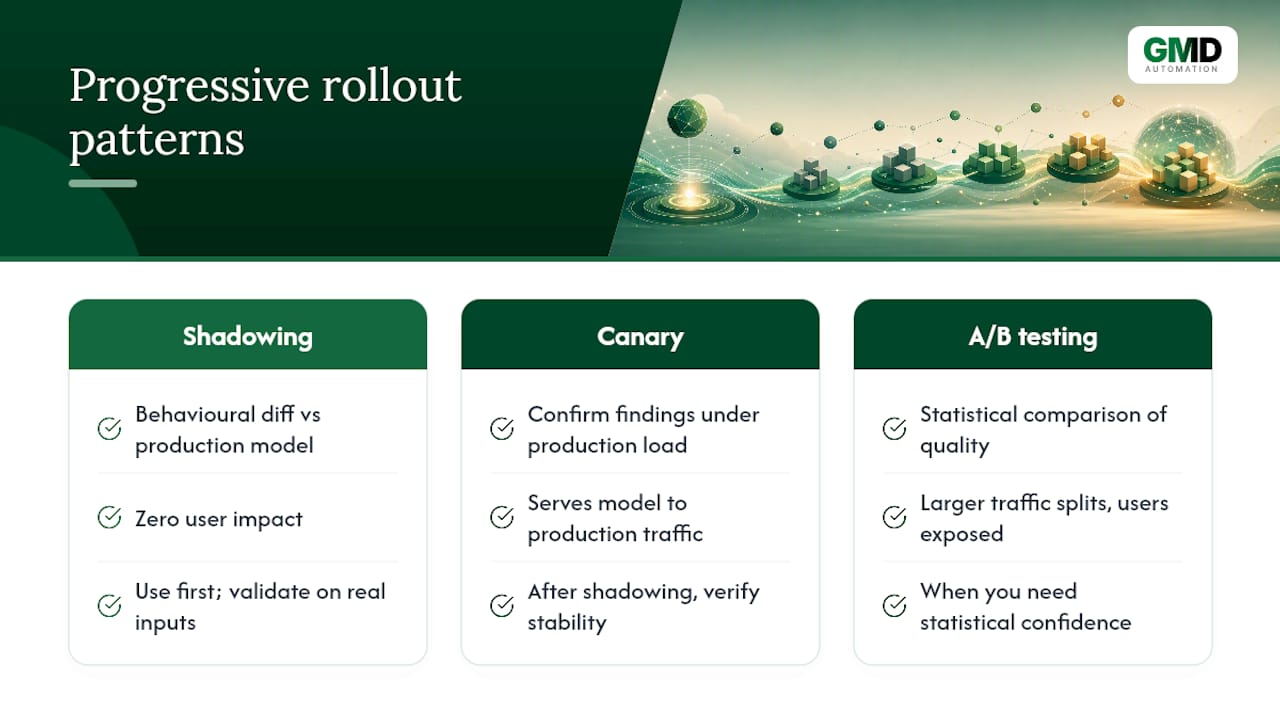
Shadowing duplicates live traffic to the candidate model and captures its responses without serving them to users. Use it first. It gives you a behavioural diff against the current production model on real inputs, with zero user impact. Run shadow traffic for at least 24 hours across a representative traffic window before considering a canary promotion.
The purpose is to validate quality and stability under real conditions before full exposure. Canary is where you confirm that shadow-stage findings hold under production load and that your observability stack is catching what it should.
A/B testing is for comparative quality measurement when you need statistical confidence that the new model is genuinely better, not just different. It requires larger traffic splits and longer run times than a canary, and it is most appropriate when the update changes a quality dimension you care about (accuracy, user satisfaction, task completion rate) rather than just a dependency version.
Promotion and rollback thresholds
Define these thresholds before you start the rollout, not after you see the data:
Canary analysis compares the distribution of these metrics between the canary slice and the production baseline. Automated rollback fires when any rollback trigger is breached for more than five consecutive minutes. Human review is required before promotion if the autorater pass rate delta is within the promote threshold but trending downward.
Pro Tip: Capture raw model outputs during shadow and canary runs using deterministic test prompts injected alongside live traffic. Store them in a structured log with the model version tag. This gives you a reproducible behavioural diff you can replay against any future candidate.
What is blue–green deployment for AI systems?
Blue–green deployment runs two complete model fleets simultaneously: the current production fleet (blue) and the new candidate fleet (green). Traffic switches from blue to green in a single, near-instantaneous operation once green has passed all validation gates. The blue fleet stays live and idle for a defined hold period, ready for instant reversion.
For stateless inference services, the switchover is straightforward: update the load balancer or API gateway routing rule. For stateful or conversational systems, the approach requires more care.
Handling state and session persistence
Before cutting over, tag every active session with its current model version. During the switchover window, new sessions route to green; existing sessions continue on blue until they complete or time out (session draining). Do not force-migrate active sessions to the new model mid-conversation. The cost of a slightly longer drain window is far lower than the cost of a mid-session coherence failure.
For systems that maintain persistent state (memory stores, tool-call histories, user preference caches), take a snapshot of the blue state before cutover and verify that the green model's state schema is compatible. If schemas differ, run a migration step in staging before the live cutover, not during it.
Cutover sequence:
- Confirm green fleet health checks are passing
- Verify state schema compatibility between blue and green
- Take a snapshot of blue production state
- Begin session draining: new sessions to green, existing sessions complete on blue
- Switch load balancer rule to green once drain is complete
- Monitor green for the defined hold period (minimum 30 minutes)
- Decommission blue only after hold period passes without a rollback trigger
Pro Tip: Keep the blue fleet's deployment manifest and model pointer in version control with a clear label. If you need to roll back, the reversion is a single manifest apply, not a manual reconstruction. Treat the rollback path as a first-class deployment, not an afterthought.
How do feature flags give you runtime control over model behaviour?
Feature flags let you change what a model does in production without redeploying. At inference time, the flag system resolves which model version, prompt template, or tool-calling configuration a given request should use.
The design patterns that matter in practice:
- Model selection flags: route requests to model A or model B based on user segment, request type, or a percentage rollout. The flag value is resolved at the start of the inference call.
- Prompt template flags: version your prompt templates separately from your model and gate new templates independently. A prompt change can cause as much behavioural shift as a model upgrade.
- Tool-calling behaviour flags: enable or disable specific tool integrations at runtime. If a new tool integration causes downstream failures, you can disable it without a rollback.
- Output format flags: gate structured output schemas to specific model versions. This prevents a model upgrade from silently breaking a downstream parser that expects a specific JSON structure.
For safe defaults, every flag should have a defined fallback value that routes to the last known-good configuration. Group related flags into a single release bundle when a behaviour change requires coordinated updates across model, prompt, and tool configuration — releasing them independently creates intermediate states that neither version supports correctly.
Pro Tip: Wire your feature flag system directly to your observability stack. When a guardrail metric trips — say, parser failure rate crosses its rollback threshold — the flag system should automatically revert the relevant flag to its safe default without waiting for a human to notice. This is the fastest rollback path available.
What does a CI/CD pipeline look like for AI model updates?
The pipeline for an AI model update is not the same as a standard software pipeline. It has an additional evaluation stage that runs before any deployment artefact is promoted, and it treats model quality as a first-class gate alongside test coverage and schema validation.
Pipeline stages in order:
- Artefact build: register the new model checkpoint in the registry with full lineage metadata; build and tag the container image with an immutable digest
- Unit and integration tests: run deterministic tests against the agent code, tool integrations, and output parsers; block promotion on any failure
- Autorater evaluation: run the new checkpoint against your gold evaluation dataset using an automated LLM-as-judge; Google Cloud's operational guidance shows that autoraters can compress what was previously months of human evaluation into hours
- Schema and manifest validation: lint the deployment manifest, validate output format schemas, and check the compatibility matrix entry
- Shadow deployment: route duplicated live traffic to the candidate; run for the defined soak period; capture behavioural diffs
- Canary promotion: route 1–5% of live traffic; monitor against the promotion/rollback thresholds defined in your runbook
- Gated merge and full rollout: require a human sign-off for major version changes; automated promotion for patch-level updates that pass all gates
Agent-assisted dependency upgrade loops that sort updates by risk, fetch changelogs, run the full test suite, and gate merges on green results can substantially reduce the manual time spent on routine dependency rounds. Reserve hand review for major version bumps where behavioural changes are likely.
For security-sensitive environments, separating LLM reasoning from execution using a deterministic constraint engine and an execution layer prevents the model from making direct file edits, which is the right architecture for any pipeline that touches production infrastructure.
PR and merge policy checklist:
- No merge without a green autorater score at or above the defined threshold
- No merge without schema validation passing on all output format definitions
- No merge without a compatibility matrix entry for the agent code × runtime × model triple
- Major version changes require a named operator approval in the merge request
- All deployment manifests are linted and stored in version control
Pro Tip: Treat your deployment manifest as the single source of truth for the desired state of your AI system. Document-driven upgrade pipelines that reconcile live state to a declared manifest make upgrades idempotent and auditable — if something goes wrong, you can replay the manifest from any prior state.
What metrics should you monitor during a live AI update?
Observability for AI updates goes beyond the standard SRE metrics. Latency and error rates tell you whether the system is running; they do not tell you whether it is producing good outputs. You need both.
Quality signals:
- Autorater pass rate (compared against production baseline)
- Domain-specific accuracy on held-out test prompts injected into live traffic
- Downstream parser failure rate (the canary metric most likely to catch output format regressions)
- User-facing task completion rate where measurable
Infrastructure signals:
- P50, P95, P99 latency per model version
- Token cost per request (a new model that costs 40% more per call will surface in your budget before your SLO)
- 5xx error rate by model version tag
- Tool-call success rate for each integrated tool
Canary analysis in practice:
Compare metric distributions between the canary slice and the production baseline, not just point-in-time values. A canary that shows higher mean quality but a longer tail of very low-quality responses is a regression, even if the average looks fine. Set alerting thresholds on the 5th percentile of your quality distribution, not just the mean.
Automated rollback triggers should fire when any rollback threshold is breached for a sustained window (five minutes is a reasonable default for most production systems). Alerts should page the on-call engineer simultaneously, not sequentially after the automated action.
Pro Tip: Instrument your system to capture model outputs on a deterministic set of test prompts that are injected alongside live traffic at a fixed rate. Store the outputs with model version tags and run an automated drift detection job that compares the distribution of outputs across versions. This gives you a continuous behavioural health signal that does not depend on user behaviour changing.
How do you test an AI update before it reaches production?
Testing an AI update requires a matrix of test types, not a single suite. Each type catches a different failure mode, and skipping any tier means accepting a class of risk.
| Test type | Objective | Test inputs | Acceptance criteria |
|---|---|---|---|
| Unit tests | Verify agent code, parsers, tool integrations | Deterministic synthetic inputs | 100% pass, no regressions |
| Integration tests | Verify end-to-end request flow | Representative synthetic requests | All critical paths pass |
| Offline benchmark | Measure quality against gold dataset | Held-out evaluation set | Autorater score ≥ defined threshold |
| Adversarial / safety | Detect harmful outputs, prompt injection, jailbreaks | Adversarial prompt library | Zero policy violations |
| Synthetic load | Verify latency and throughput under load | Replayed production traffic patterns | P95 latency within SLO |
| Shadow run | Behavioural diff against production | Live duplicated traffic | Output distribution within defined bounds |
Spotify's approach to verifying LLM-generated migrations at scale makes the point clearly: separating the verification runtime from the agent runtime and leveraging existing CI systems for end-to-end checks reduces false failures and makes fleet-wide rollouts feasible. The same principle applies to model updates — your CI system is the authoritative validator, not the agent that generated the change.
Combining automated and human review:
Automated autoraters handle volume. Human review handles edge cases and major version changes.
Tests to run at each promotion stage:
- Staging: unit tests, integration tests, offline benchmark, adversarial safety checks
- Shadow: behavioural diff analysis, synthetic load test, downstream parser validation
- Canary: live metric monitoring against promotion/rollback thresholds, sampled human review of canary outputs
- Full rollout: confirm all canary gates passed, obtain human sign-off for major versions, archive test artefacts in the registry
What are the trade-offs between fine-tuning, model editing, and RAG?
There is no single right answer to how you update what a model knows or how it behaves. The choice depends on how much the knowledge needs to change, how quickly, and how much risk you can accept.
Continued pre-training and fine-tuning update the model's parametric weights directly. They are the most thorough approach for large-scale behavioural changes but carry the highest risk of catastrophic forgetting, where the model loses previously reliable capabilities while acquiring new ones. KUP benchmark research shows that continued pre-training approaches struggle to reason over the indirect implications of updates — a model that has memorised a new fact may still fail to apply it correctly when the question is phrased indirectly.
Local model editing (approaches in the style of MEND, SERAC, and ConCoRD) targets specific parametric changes without full retraining. Stanford Engineering's analysis notes that auxiliary memory approaches can avoid catastrophic mixing when thousands of edits accumulate, and that periodic distillation back into parametric weights is a practical consolidation strategy.
Retrieval-augmented generation (RAG) and external memory keep updated knowledge outside the model's weights entirely. The LOKA framework addresses the specific problem of conflicting updates by allocating updated knowledge to adaptive memory units and using a learning-based router to activate the right memory selectively at inference time. This approach sidesteps catastrophic forgetting and makes knowledge updates reversible, but it introduces retrieval latency and requires careful management of the memory store's consistency across model versions.
Practical guidance on combining methods:
- Use RAG for knowledge that changes frequently (product catalogues, regulatory updates, current events)
- Use fine-tuning for stable behavioural changes that need to be deeply integrated (tone, reasoning style, domain expertise)
- Use model editing for targeted factual corrections where full retraining is disproportionate
- Combine RAG with periodic distillation: run RAG for six to twelve months, then distil the most stable retrieved knowledge back into a fine-tuning run to reduce retrieval overhead
Pro Tip: Treat every model edit as a deployment candidate, not a permanent fix. Validate it through your standard shadow and canary pipeline before consolidating it into parametric weights. An edit that looks correct on your evaluation set may have unintended side effects on adjacent reasoning chains that only surface under production traffic.
What should your rollback and incident playbook contain?
A rollback that requires three people to coordinate and twenty minutes to execute is not a rollback — it is a recovery. The goal is a tested, single-operator action that completes in under five minutes.
Immediate actions (runbook template):
- Confirm the triggering metric and its current value against the rollback threshold
- Execute traffic reroute: update the load balancer or API gateway rule to point to the blue fleet or the previous model pointer
- Toggle the relevant feature flag to its safe default if the rollback is flag-controlled
- Confirm that the rollback is serving correctly: check error rates and quality signals on the reverted traffic
- Page the incident lead and open an incident channel
Escalation and decision authority:
The on-call engineer has unilateral authority to execute an emergency rollback without approval. Planned rollbacks (where the trigger is a quality concern rather than an active outage) require sign-off from the incident lead. The evidence threshold for an emergency rollback is any single rollback trigger breached for more than five consecutive minutes. For a planned rollback, the threshold is a sustained quality degradation trend over a longer observation window, defined in the runbook before the deployment begins.
Post-incident actions:
- Preserve the full audit log: model version, deployment timestamp, triggering metric values, rollback timestamp, and operator actions
- Run a root cause analysis within 48 hours and record findings in the upgrade manifest
- Update the compatibility matrix to mark the failed combination as blocked
- Add the failure mode to the adversarial test suite so it is caught in future offline evaluations
- Schedule a runbook rehearsal within two weeks if the rollback took longer than the target time
Pro Tip: Test your rollback path in staging every time you test a new deployment. A rollback that has never been executed is a rollback that will fail when you need it most. Treat it as a required gate in your pre-deployment checklist, not an optional drill.
What does a field-tested deployment playbook look like?
The playbook below is the sequence that production teams in UK organisations have found reliable. Each stage has a defined entry condition, required artefacts, and a numeric gate that must pass before promotion.
Stage sequence:
- Candidate registration: register the model artefact in the registry; record lineage, training data cut-off, evaluation artefact references, and compatibility matrix entry; obtain an initial human review sign-off
- Sandbox validation: run unit tests, integration tests, offline benchmark, and adversarial safety checks; require 100% pass on deterministic tests and autorater score at or above the defined threshold
- Shadow run: deploy to shadow environment; run for a minimum of 24 hours across a representative traffic window; capture behavioural diffs; require output distribution within defined bounds before promotion
- Canary ramp: route 1% of live traffic; monitor for a minimum of two hours; increase to 5% if all metrics are within thresholds; require autorater pass rate at or above baseline minus 1% and no rollback triggers breached
- Gated activation: for major version changes, require a named operator sign-off; for patch-level changes, automated promotion if all canary gates pass; update the deployment manifest to record the new production state
- Audit closure: archive all test artefacts, evaluation results, and operator approvals in the registry; update the upgrade manifest with the full deployment record; close the incident channel if one was opened
Gating table with example thresholds:
| Stage | Required artefacts | Example threshold |
|---|---|---|
| Sandbox | Unit test results, autorater score, adversarial test report | Autorater ≥ 95% of baseline |
| Shadow | Behavioural diff report, output distribution analysis | Output distribution within 2 standard deviations of baseline |
| Canary | Live metric dashboard, sampled human review | Error rate ≤ baseline; autorater ≥ baseline − 1% |
| Gated activation | Operator sign-off (major versions), manifest update | Named approval recorded in audit log |
| Audit closure | Full artefact archive, upgrade manifest | All artefacts stored; manifest signed |
For scalable AI deployments, the playbook above maps directly onto the DevOps practices that UK engineering teams are already running for infrastructure changes. The difference is the addition of the autorater gate and the behavioural diff analysis — two steps that have no equivalent in a standard software deployment.
Pro Tip: Encode the entire playbook as a deployment manifest. Document-driven upgrade pipelines that declare the desired state and reconcile live state to it make every upgrade idempotent and auditable. If a stage fails, you replay the manifest from the last successful checkpoint rather than reconstructing the state manually.
What UK compliance requirements apply to AI system updates?
UK organisations operating production AI systems face specific legal and operational constraints that go beyond standard software governance. These are not optional considerations — they affect how you design your update pipeline from the start.
Data residency and audit trails
The UK GDPR and the Data Protection Act 2018 require that personal data processed by AI systems remains within defined geographic boundaries unless adequate safeguards are in place. For model updates, this means:
- Model training data and evaluation artefacts that contain personal data must be processed and stored within the UK or in jurisdictions with an adequacy decision
- Audit logs recording model lineage, training inputs, and evaluation results must be retained and accessible to regulators and auditors for the retention period specified in your data processing agreements
- Immutable audit logs are not just good practice — they are a compliance requirement for any system making automated decisions that affect individuals
GDPR and automated decision-making
Article 22 of the UK GDPR restricts solely automated decisions that produce legal or similarly significant effects on individuals. When you update a model that makes such decisions, you must:
- Reassess the lawful basis for processing under the new model version
- Update your Data Protection Impact Assessment (DPIA) to reflect any changes in the model's decision logic
- Verify that the right to erasure can still be honoured — if the model has been fine-tuned on personal data, erasure requests may require retraining or switching to an external memory approach where the data can be deleted without retraining
- Document the data minimisation measures applied during the update process
Procurement and managed service contracts
For UK organisations procuring managed AI services, the contract should specify:
- SLA for update notification: how much advance notice the provider gives before a model version change
- Change control process: whether the customer has approval rights over major version changes
- Evidence retention: what audit artefacts the provider retains, for how long, and in what format
- Rollback guarantees: the provider's contractual commitment to restore the previous model version within a defined time window if an update causes a regression
For UK enterprise AI architecture, building compliance evidence into the update pipeline from day one is substantially cheaper than retrofitting it after a regulatory enquiry.
Field lessons from UK production deployments
The mistakes that cause the most damage in UK production environments are rarely the ones that appear in architecture diagrams. They are the ones that happen when teams are under time pressure or when the update seems routine.
The most common operational mistake is upgrading the runtime and the agent code in the same deployment. It feels efficient. When something goes wrong — and something usually does — you cannot isolate whether the failure came from the runtime change, the agent code change, or the interaction between them. Change one variable at a time. It is slower in theory and faster in practice.
Insufficient staging soak time is the second pattern. Teams run shadow traffic for two hours, see no obvious regressions, and promote to canary. The regression surfaces 18 hours later when a specific traffic pattern that only appears during business hours triggers a downstream parser failure. Twenty-four hours of shadow traffic across a full business cycle is a minimum, not a target.
Missing snapshot restores are the third. A team executes a rollback correctly — traffic rerouted, feature flag reverted — but the model's external memory store still contains state written by the new version. The reverted model now reads state it was not designed to interpret. Always snapshot the full system state, including external memory and tool-call caches, before any cutover.
Practical lessons:
- Never deploy on a Friday afternoon or on a day when your senior engineers are on leave. This is not superstition; it is risk management.
- Keep model and prompt versioning under source control with the same rigour as application code. A prompt change that is not version-controlled is an untracked production change.
- Always require a tested rollback path before any deployment proceeds. "We can roll back if needed" is not the same as "we have tested the rollback in staging this week."
Cultural changes worth scheduling:
- Quarterly runbook rehearsals where the team executes a full rollback drill in a staging environment
- Post-mortems after every incident, however minor, with findings recorded in the upgrade manifest
- Periodic drills where a senior engineer deliberately introduces a regression in staging to verify that the observability stack catches it within the defined alerting window
How a managed service removes AI update risk
Keeping a production AI system updated without downtime requires a full-time operational discipline: versioned artefacts, tested rollback paths, compliance evidence, and an on-call engineer who knows the runbook. For many UK organisations, that is a significant overhead on top of the core business problem the AI system is solving.
Gmdautomation handles the operational layer directly. The subscription model covers implementation, ongoing maintenance, compliance evidence generation, and upgrade pipeline management, so your team does not need to build and maintain the runbook infrastructure described in this guide. Every deployment follows the staged validation sequence above, with autorater gates, canary analysis, and tested rollback paths included as standard. Audit logs and model lineage records are retained in a format that satisfies UK GDPR and procurement requirements, removing the compliance overhead from your internal team.
Before engaging any managed AI provider, ask these questions: What is the SLA for rollback after a failed update? What audit artefacts do you retain, and for how long? Do customers have approval rights over major version changes? What is the staging fidelity of your test environment relative to production?
Gmdautomation's managed AI automation services are built to answer all of those questions with specifics, not generalities. To see how the upgrade pipeline works in practice, request a technical runbook review directly through the site.
Editorial perspective: the gap between update theory and production reality
The playbooks in this guide are correct. They are also, in most UK production environments, partially implemented at best. The gap is not a knowledge problem — it is a prioritisation problem. Teams know they should pin artefacts and run shadow traffic. They skip it because the update looks routine, the deadline is close, or the staging environment is not representative enough to be worth the delay.
The uncomfortable truth is that the updates most likely to cause production incidents are the ones that look routine. A minor model version bump that the provider describes as "improved instruction following" is a behavioural change, meaning the model is more likely to do exactly what the prompt says. This means any ambiguity in your prompt templates that the previous model was quietly tolerating will now surface as a regression. The teams that get burned are the ones who read "minor update" and skipped the shadow stage.
There is also a cultural dimension that the technical literature underweights. The runbook is only as good as the team's willingness to use it under pressure. When a deployment is running late and the canary looks mostly fine, the pressure to promote early is real. The discipline to hold the canary for the full observation window, even when the metrics look acceptable, is what separates teams with reliable update records from teams that have exciting post-mortems.
The single most underrated control in this entire guide is the tested rollback path. Not the rollback plan — the tested rollback. A rollback that has been executed in staging this week, by the engineer who will be on call during the deployment, is a fundamentally different thing from a rollback procedure written in a document. The former is a muscle memory. The latter is a liability.
Sources
- How I use Claude Code to tackle dependency upgrades without losing a weekend - DEV Community
- AI agent version management: safe upgrade patterns | Zylos Research