

AI legal intake means using conversational systems to answer phone, chat, form and SMS enquiries around the clock, qualify the caller, run a conflict check and book a consultation before a human ever sees the file. The structured intake principles Law Practice Today outlines still apply. Firms handling high enquiry volumes or time-critical claims should pilot it now, with the EU AI Act's disclosure requirements and a provider such as GMD Automation setting the compliance baseline.
TL;DR:
- AI legal intake systems unify multiple communication channels into a single pipeline, enabling faster and more qualified responses for high-volume, time-sensitive cases.
- Speed of response directly correlates with higher conversion rates and faster matter opening, especially in practice areas like personal injury, immigration, and family law.
- Vendors must ensure data encryption, conflict checks before promises, and clear disclosure of AI involvement to meet compliance standards, including the EU AI Act.
- Proper pilot programs should define baseline metrics, test scoring accuracy, and establish escalation procedures before full deployment.
- Managed providers offer a turnkey solution with ongoing tuning, reducing the need for internal engineering capacity and minimizing integration risks.
Table of Contents
- How does AI legal intake actually work?
- What ROI can you actually expect from automated intake?
- What compliance checks should a vendor pass before you sign?
- How do you run a low-risk AI intake pilot?
- How does a managed provider lower the risk of getting this wrong?
- Practical cautions worth taking seriously
- How to trial GMD Automation's AI intake system
- Sources
How does AI legal intake actually work?
Most systems unify four channels into one intake stream: phone calls, web chat widgets, online forms and SMS. Instead of a receptionist juggling four inboxes, every enquiry lands in a single pipeline where the same conversational engine handles it, regardless of how the person got in touch.
Once a lead makes contact, the system runs through a fairly consistent sequence:
- Holds a natural conversation to gather the basics: what happened, when, and what the person is asking for.
- Scores the enquiry against the firm's own criteria for case value, urgency and practice-area fit.
- Runs a conflict screen against existing client and matter records before anything is promised.
- Drafts an engagement letter or retainer for review, rather than waiting for a paralegal to start from a blank template.
- Books the consultation directly into the fee earner's calendar, no phone tag required.
Underneath, this runs on a few distinct layers: a conversational AI model that handles language, a scoring model that ranks the lead, an orchestration layer (sometimes called a playbook) that decides what happens next, and connectors into the firm's phone system and case management platform. That last piece matters more than vendors usually admit. Connector support for tools such as Clio or Salesforce, plus calendar sync, is what determines whether intake actually shortens time to matter opening or just creates another dashboard nobody checks. Firms exploring the conversational layer in more depth can look at how conversational AI IVR systems handle call routing before committing to a specific architecture.
What ROI can you actually expect from automated intake?
Speed is the whole game here. Industry commentary is consistent on one point: firms that respond first convert a disproportionate share of enquiries, and a system that answers in seconds rather than hours changes that maths directly.
Vendor-reported pattern: firms running AI intake typically report faster first-response times and a higher share of qualified leads converting to booked consultations, though the exact uplift depends heavily on practice area and existing intake discipline.
The practice areas that benefit most share two traits: high enquiry volume and time-critical windows. Personal injury, immigration and family law all fit that pattern, since a missed evening call often means a lost client to a competitor firm.
To build an internal business case, weigh three inputs against each other:
- Staff hours currently spent on unqualified calls and voicemail follow-up.
- The conversion lift from answering every enquiry immediately instead of during business hours only.
- Faster matter opening, which compounds through billing cycles over a year.
Even a modest lift in booked consultations, multiplied across a firm's monthly enquiry volume, tends to outweigh the efficiency gains firms report from workflow automation more broadly.
What compliance checks should a vendor pass before you sign?
Any system touching client data at first contact needs to satisfy the same standards you'd apply to a paralegal handling sensitive intake, arguably a higher one, because it runs unsupervised outside office hours.
- Data must be classified at the point of intake, encrypted in transit and at rest, with a full audit trail and a defined retention period.
- Conflict checks need to run before any advice or promise is given, with supervision controls that let a partner review flagged decisions without breaking privilege.
- Callers must be told they're speaking with an AI system, with consent captured and logged, in line with disclosure requirements under the EU AI Act for systems classed as higher risk.
- Vendor documentation should show, not just claim, encryption standards and audit logging that a regulator would recognise.
Pro Tip: Ask for a sample audit log before you sign anything. If a vendor can't show you what a flagged, human-reviewed decision looks like in their system, that's a governance gap you'll inherit, not solve.
Firms wanting a broader checklist on model transparency and documentation can review how AI system transparency is assessed before the procurement conversation goes any further.
How do you run a low-risk AI intake pilot?
A pilot is where most of the real evaluation happens, not the sales demo. Structure it in three phases:
- Pre-pilot. Define baseline metrics (current response time, conversion rate, staff hours on intake) and confirm integration endpoints: your case management system, phone provider, and calendar. Set consent and conflict-check gates before any live call touches the system.
- Pilot run. Keep it tight, over some weeks. Score a sample of recent intakes through the system first to see expected conversion uplift and false-positive rates before it ever handles a live caller. Build in human fallback and clear escalation rules for anything borderline.
- Post-pilot. Tune the scoring model against real results, assign who audits flagged decisions on an ongoing basis, agree service-level targets with the vendor, and set the scale plan for rolling out beyond the pilot practice group.
The Lead Lab's guidance on qualified leads is worth a read here too. Intake scoring and B2B lead qualification solve near-identical problems: deciding, fast, whether this particular enquiry is worth a fee earner's time.
How does a managed provider lower the risk of getting this wrong?
A managed subscription typically bundles four things a firm would otherwise have to assemble itself: onboarding against your existing systems, secure deployment, model tuning based on real intake data, and ongoing optimisation as call volumes shift.
GMD Automation structures this as a zero-upfront-cost monthly subscription, with a free-trial evaluation approach designed to prove value on real intakes before you commit to full deployment.
Bring to any demo:
- A sample set of recent enquiries (anonymised) to score against the live system.
- Your current case management and phone stack, so integration gaps surface early.
- The names of whoever will audit flagged or borderline decisions in production.
Practical cautions worth taking seriously
Build in-house only if you already have engineering capacity to maintain a model over years, not months. Most firms don't, and a managed agent closes that gap faster.
The three integration mistakes I see repeated most: skipping the conflict-check gate before go-live, connecting to case management late instead of first, and letting the pilot run without a defined escalation path for ambiguous matters.
The multi-model consensus approach, where disagreement between models routes the matter to a human rather than auto-deciding, is the single control I'd insist on before anything else. Automation should narrow what a partner has to review, never remove the review itself.
— Ravi
How to trial GMD Automation's AI intake system
Gmdautomation offers a monthly subscription model that includes onboarding, deployment, compliance documentation, and ongoing tuning, with no upfront licensing cost to get started.
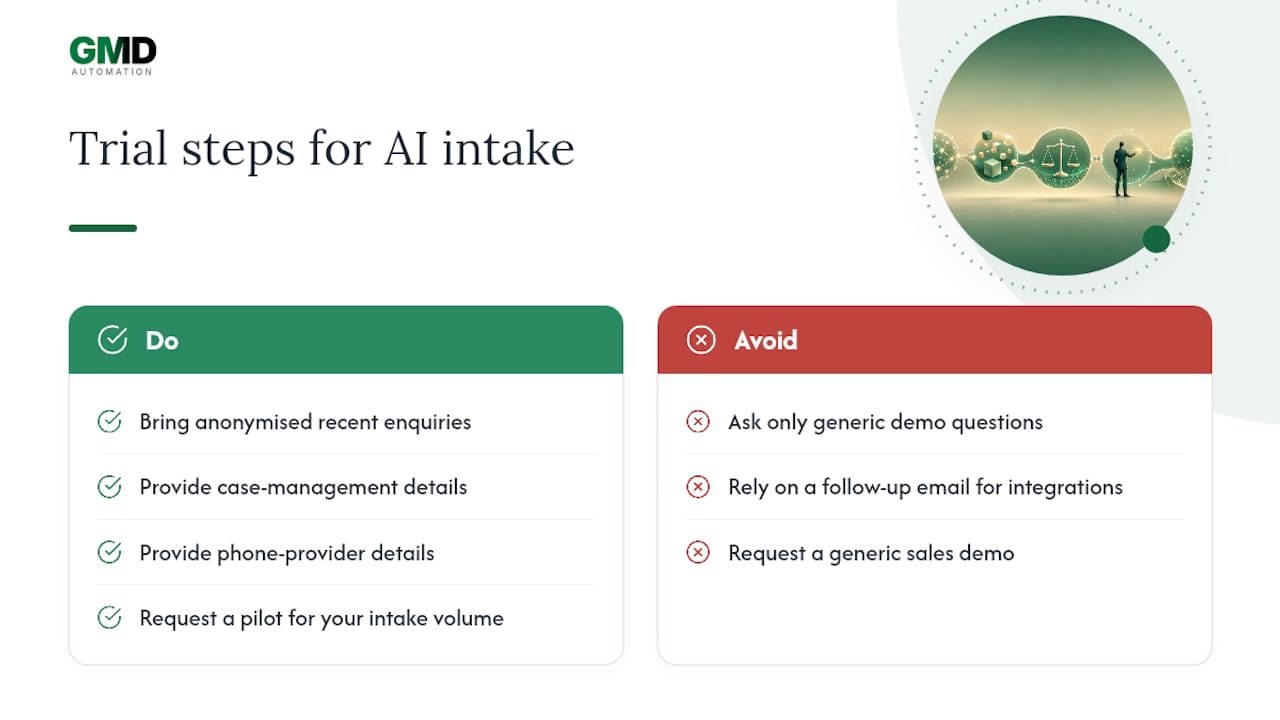
Requesting a demo is straightforward. Bring a handful of recent, anonymised enquiries so the team can show how the system would have scored and routed them, and have your case management and phone provider details ready so integration questions get answered on the spot rather than in a follow-up email. Before the call, it's worth reading the procurement checklist for AI vendors and the notes on connecting AI tools to existing systems, so you walk in with the right questions rather than generic ones.
Head to GMD Automation and request a pilot scoped to your own intake volume, not a generic sales demo.
Sources
Start with the EU AI Act compliance checklist and Law Practice Today's intake guidance for procurement review.
- The importance of client intake — Law Practice Today
- EU AI Act compliance checklist for 2026 · AI Act Icon