

No-capex AI solutions are AI tools and platforms that require zero upfront capital investment, letting UK businesses deploy intelligent automation with no licensing fees, hardware purchases, or implementation costs paid in advance. The industry term for this model is operational expenditure (OpEx) AI, where costs are incurred only when the software is actively used. Examples of no-capex AI solutions include EzyConn, PanelsAI, Ollama, LM Studio, and Agentic PIM. Each delivers real automation capability without the financial commitment that traditionally blocked smaller businesses from adopting AI. For UK decision-makers weighing cost against capability in 2026, these tools represent a genuinely different way to start.
1. What are the best no-capex AI solutions for UK businesses?
The strongest examples of no-capex AI solutions fall into four categories: forever-free chatbot platforms, pay-as-you-go AI credits, open-source local inference tools, and AI automation layers. Each category suits a different workflow and business size. The right choice depends on your volume of AI interactions, your data privacy requirements, and how much technical resource you have available.
Choosing between these categories is easier when you understand what each one costs at scale, not just at the free tier. The sections below break each category down with real figures and named tools.

2. Forever-free AI chatbot platforms: EzyConn
EzyConn is a forever-free AI chatbot platform that UK businesses can deploy in under five minutes with no credit card required. The free tier includes 2 user seats and 100 AI conversations per month, powered by GPT-4 class models. That is a meaningful capability for a small business handling routine customer enquiries.
The deployment process requires no developer involvement. EzyConn integrates directly with Microsoft Teams and Slack, which means your team can manage conversations inside tools they already use. The chatbot also handles multilingual interactions at zero licensing cost.
The practical impact is significant. Businesses using EzyConn report customer response times dropping from several hours to instant, eliminating missed enquiries overnight. For a sole trader or small team, that shift in responsiveness is difficult to achieve any other way without spending money.
- Free seats: 2 users included at no cost
- Monthly conversations: 100 AI interactions on the free plan
- Model quality: GPT-4 class, not a stripped-down alternative
- Integrations: Microsoft Teams, Slack, website widget
- Setup time: Under 5 minutes, no developer needed
Pro Tip: If your business receives more than 100 enquiries per month, map which queries are repetitive before upgrading. You may find that FAQ caching handles the majority, keeping you on the free tier longer.
3. How pay-as-you-go AI platforms like PanelsAI eliminate fixed costs
PanelsAI operates on a credit system where $1 buys approximately 2 million credits, equivalent to around 300 GPT-4-style conversations. There is no monthly subscription and no minimum spend. Credits do not expire, so you pay only when AI is actively working for your business.
This model removes the "use it or lose it" problem that makes traditional SaaS subscriptions expensive for businesses with variable demand. A retailer running a seasonal campaign in november can spend heavily on AI that month and spend nothing in january. The cost tracks actual usage rather than a fixed calendar commitment.
Pay-as-you-go AI is particularly well suited to:
- Variable workloads: Marketing agencies, seasonal retailers, and project-based consultancies
- Pilot programmes: Testing AI on one workflow before committing to a wider rollout
- Cost-conscious SMEs: Businesses that need AI capability but cannot justify a monthly subscription during quiet periods
- Multi-model workflows: Teams that want to mix free open-source models with paid GPT-4 calls for complex tasks only
Pro Tip: Track your credit consumption by workflow type for the first 30 days. Most businesses find that 20% of their AI tasks consume 80% of their credits. Identifying that 20% early lets you decide whether to automate it further or handle it manually.
The OpEx approach to AI spending means businesses retain agility. Capital is preserved for investments that create genuine competitive advantage, while routine automation runs on variable cost.
4. Open-source AI tools and local inference for privacy and cost control
Open-source AI models like Llama and Mistral are now used by UK SMEs to run production workflows at zero licensing cost. The misconception that free tools are inferior to paid alternatives no longer holds. These models handle routine tasks reliably, with proprietary models reserved for genuinely complex queries.
Local inference tools take this further. Ollama and LM Studio allow businesses to run AI models directly on standard hardware, whether that is an office server or a virtual private server (VPS) in the cloud.
"Running inference locally provides full control over AI usage and reduces ongoing operational expenditures." — Workshop.ai
The privacy benefit is concrete, not theoretical. When AI runs locally, your customer data, financial records, and internal documents never leave your infrastructure. For UK businesses subject to UK GDPR, this removes a significant compliance risk that comes with sending data to third-party API endpoints.
- Download Ollama from the official site and install it on a standard machine or VPS
- Pull a model such as Llama 3 or Mistral 7B using a single command line instruction
- Connect your application via Ollama's local API, which mirrors the OpenAI API format
- Test with your actual workflows before switching production traffic to the local model
- Monitor performance and fall back to a paid API for tasks where the local model underperforms
LM Studio provides a graphical interface for teams without command line experience. It runs the same open-source models but through a desktop application, making it accessible to non-technical staff.
5. How Agentic PIM enables zero-capex catalogue management
Agentic PIM is an open-source AI automation layer built for product catalogue management. It uses a team of specialised AI agents to handle product creation, description writing, and category assignments without human input for each item. Retailers and distributors with large product ranges benefit most.
The system is open source, which means there is no licensing fee. It can run with free or low-cost AI models, including the open-source options covered above. Daily token budgets are configurable, giving businesses precise control over how much AI processing runs each day.
| Feature | Detail |
|---|---|
| Licensing cost | Open source, zero licence fee |
| AI model compatibility | Works with free and paid models |
| Key automations | Product creation, descriptions, categorisation |
| Cost control mechanism | Configurable daily token budgets |
| Deployment type | Self-hosted or cloud |
The token budget feature is the most underappreciated aspect of Agentic PIM. Configurable daily token budgets let a business process 500 products on a busy day and 50 on a quiet one, without any manual adjustment. Cost scales with actual catalogue activity rather than a fixed monthly fee.
For UK e-commerce businesses managing thousands of SKUs, this removes one of the most labour-intensive back-office tasks at a cost that can genuinely be zero if paired with open-source models.
6. How do these no-capex AI tools compare for UK SMEs?
Choosing the right tool comes down to three factors: the nature of your AI workload, your technical capability, and your data sensitivity. The table below maps each tool category to those factors.
| Tool / Category | Best for | Technical requirement | Data privacy | Cost at low usage |
|---|---|---|---|---|
| EzyConn (chatbot) | Customer-facing enquiries | None | Data sent to cloud | Free |
| PanelsAI (pay-as-you-go) | Variable AI workloads | Low | Data sent to cloud | Pay per use |
| Ollama / LM Studio (local) | Sensitive data workflows | Medium | Fully local | Zero API cost |
| Agentic PIM (AI layer) | Catalogue management | Medium | Self-hosted option | Zero licence fee |
EzyConn is the fastest route to AI automation for a business with no technical resource. PanelsAI suits teams that want flexibility without a monthly commitment. Ollama and LM Studio are the right choice when data privacy is non-negotiable. Agentic PIM solves a specific problem, product catalogue management, better than any general-purpose tool.
For practical real-world deployment examples across these categories, the patterns are consistent. Businesses that start with one tool on one workflow and measure results before expanding tend to get better outcomes than those that deploy broadly from day one.
Pro Tip: Combine categories rather than choosing one. Use EzyConn for customer-facing chat, Ollama for internal document processing, and PanelsAI for occasional high-complexity tasks. The total monthly cost can remain very low while covering multiple workflows.
There is also a hybrid approach worth noting. Cloudflare Workers combined with Gemini Web can handle 70% of customer service queries through cached FAQ matching, with generative AI triggered only for complex questions. This keeps infrastructure costs at zero on free tiers while maintaining a high-quality customer experience.
Key takeaways
No-capex AI solutions give UK businesses access to genuine AI automation without upfront investment, provided you match the tool to the workflow and monitor usage from day one.
| Point | Details |
|---|---|
| Start with a free chatbot | EzyConn's free tier covers 100 conversations monthly with no credit card required. |
| Use pay-as-you-go for variable demand | PanelsAI credits do not expire, so cost tracks actual usage rather than a fixed calendar. |
| Run open-source models locally for privacy | Ollama and LM Studio eliminate API costs and keep sensitive data inside your infrastructure. |
| Automate catalogues with Agentic PIM | Configurable token budgets let catalogue automation scale with actual product activity. |
| Combine tools across workflows | Using multiple no-capex tools together keeps total cost low while covering more business processes. |
Why I think most UK businesses are still thinking about AI costs the wrong way
The conversation I hear most often from UK business owners goes like this: "We want to use AI but we cannot justify the investment right now." The assumption buried in that sentence is that AI requires a capital commitment before it delivers value. That assumption was accurate in 2021. It is not accurate now.
The tools covered in this article are not compromises or workarounds. Llama and Mistral run production workloads for SMEs. EzyConn handles real customer enquiries at zero cost. PanelsAI gives you GPT-4 quality responses for fractions of a penny each. The quality gap between free and paid AI has narrowed to the point where it only matters for a narrow set of genuinely complex tasks.
The risk I see is different. Businesses that adopt no-capex AI tools without monitoring usage tend to hit unexpected costs when they scale. A chatbot that handles 100 conversations a month for free handles 10,000 conversations a month at a real cost. That is not a problem with the tool. It is a planning failure. Set usage alerts from day one, track which workflows consume the most AI processing, and review your cost model every quarter.
The OpEx model for AI also changes how you should think about ROI. You are not amortising a large upfront cost over three years. You are paying for what you use this month. That means you can stop, change, or expand without financial penalty. For a business still working out where AI adds the most value, that flexibility is worth more than any feature list.
My honest recommendation: pick one workflow, deploy one tool, measure the result over 60 days, and then decide whether to expand. The small teams AI guide from Gmdautomation covers exactly this kind of phased approach, and it reflects how the most successful deployments I have seen actually work.
— Ravi
Deploy AI automation with no upfront cost through Gmdautomation
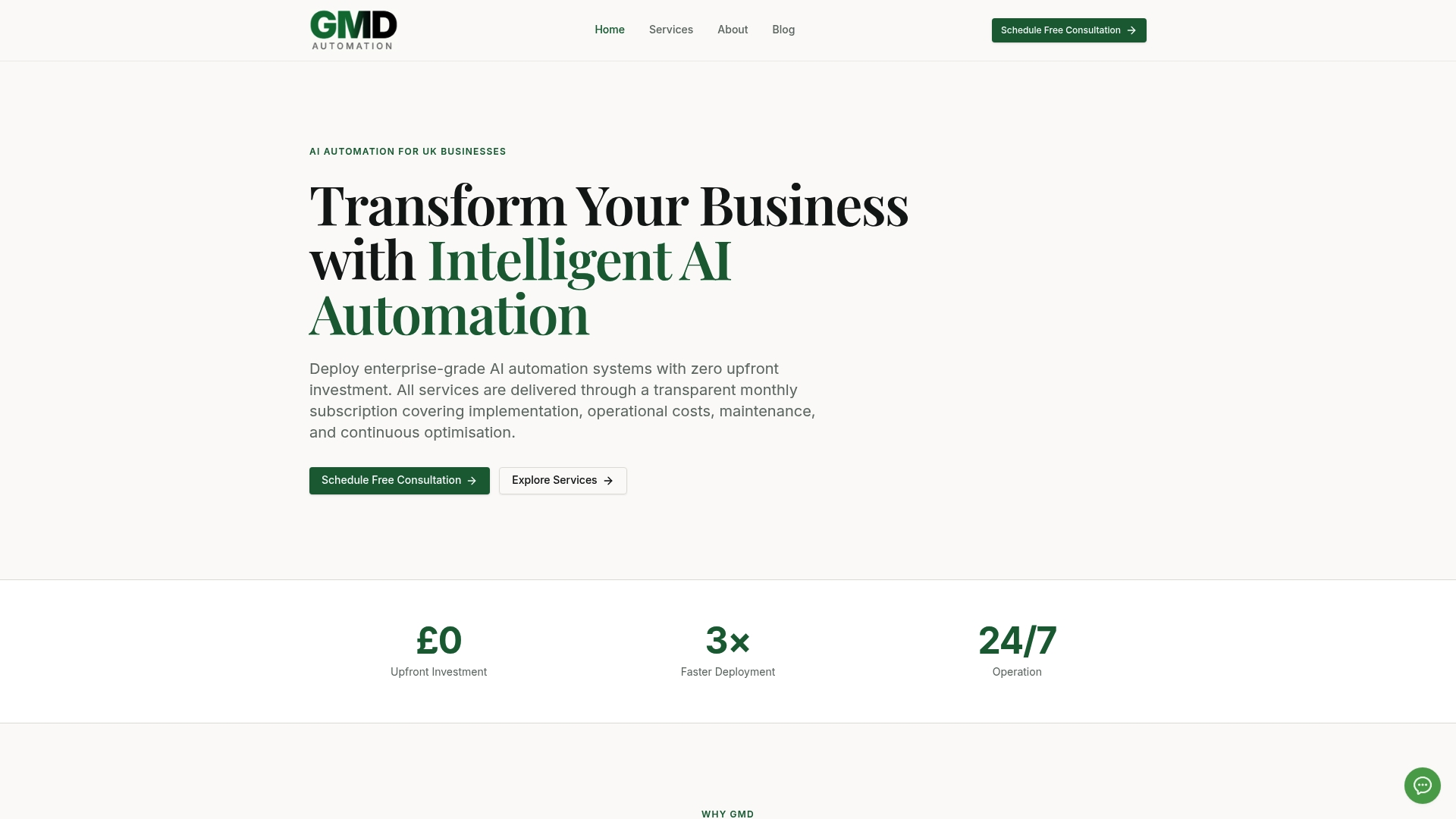
Gmdautomation builds and deploys AI automation systems for UK businesses on a predictable monthly subscription that covers implementation, operation, maintenance, and ongoing improvement. There is no upfront investment and no hidden setup fee. If you are ready to move beyond free-tier tools and want an enterprise-grade AI system deployed rapidly and managed for you, Gmdautomation is built for exactly that. Explore AI automation for UK businesses and see how a fully managed, no-capex model works in practice. You can also review affordable AI automation tools to understand the wider market before making a decision.
FAQ
What are no-capex AI solutions?
No-capex AI solutions are AI tools and platforms that require no upfront capital expenditure. Costs are incurred only through usage, subscriptions, or pay-as-you-go credits rather than licences or hardware purchases.
Which no-capex AI tool is easiest to deploy for a small UK business?
EzyConn is the fastest option, deployable in under five minutes with no developer and no credit card. The free tier covers 2 user seats and 100 conversations per month using GPT-4 class models.
Are open-source AI models reliable enough for business use?
Open-source models like Llama and Mistral now run reliable production workflows for SMEs at zero licensing cost. They are best suited to routine tasks, with paid models reserved for complex queries.
How does pay-as-you-go AI differ from a monthly subscription?
Pay-as-you-go AI, such as PanelsAI, charges only when AI is actively used. Credits do not expire, so businesses with variable demand avoid paying for unused capacity each month.
Can no-capex AI tools handle sensitive business data safely?
Local inference tools like Ollama and LM Studio run AI models entirely on your own hardware. No data is sent to external APIs, which removes the compliance risk associated with cloud-based AI platforms.