

Outbound calling AI uses voice agents to dial prospects, qualify them, and book meetings at a volume no human team can match, typically at a fraction of the cost per conversation. It works best once you've solved integration and compliance first, not after; skip that step and you'll scale problems, not pipeline.
TL;DR:
- Successful outbound AI dialing hinges on thorough integration and compliance to avoid scaling issues and legal risks.
- Compliance measures such as early disclosure, real-time Do Not Call checks, and strict call data security are essential to prevent fines and blacklisting.
- Pilot campaigns should focus on metric benchmarks like answer rate, live transfer rate, and cost per booked meeting, especially on warm lists.
- A managed subscription service simplifies ongoing maintenance and reduces deployment risk, typically taking six to ten weeks for full-scale UK campaigns.
Table of Contents
- What does outbound calling AI actually do?
- How does the AI outbound calling pipeline actually work?
- What compliance checks matter before you pilot?
- How do you evaluate, pilot, and scale an outbound AI campaign?
- What results should you expect, and what goes wrong?
- How does a managed subscription reduce deployment risk?
- What does a realistic pilot-to-deployment timeline look like?
- What does an AI outbound calling programme actually cost?
- How should you manage data and security for AI-generated calls?
- How does this change the way your sales team works?
- Where does AI outbound calling fall short, and how do you handle it?
- What does AI voice quality actually sound like now?
- What actually matters when you cut through the AI outbound calling hype?
- Ready to pilot outbound calling AI without the deployment risk?
- Sources
What does outbound calling AI actually do?
Strip away the marketing language and AI telemarketing systems do a handful of jobs well: they call a list, hold a real conversation, and route the outcome somewhere useful. The tasks that matter most for sales operations are:
- Qualification and lead scoring — the agent asks discovery questions live on the call and tags the lead in your CRM based on the answers.
- Appointment booking with calendar sync — checks real-time availability and books directly into a rep's calendar, no back-and-forth email.
- Warm and hot transfers — passes a qualified prospect to a human rep mid-call, ideally with a short spoken briefing so the rep doesn't start cold.
- Payment reminders and collections — routine, scriptable calls that don't need a human but still need to be handled sensitively.
- Re-engagement campaigns — waking up dormant leads or renewal-due customers without burning rep hours on low-probability dials.
A typical booking flow looks like this: disclose that the caller is an AI agent, qualify with two or three questions, check the calendar API, offer a slot, confirm by voice, and log the full outcome to the CRM. That last step matters more than people assume. Every call needs an auditable trail of what was said and what was agreed, both for quality control and for compliance if a complaint ever surfaces.
How does the AI outbound calling pipeline actually work?
Behind every natural-sounding call sits a chain of engineering decisions, and each one shows up in your answer rates whether you notice it or not — this is explained in detail in the AI & Automation | RevRing Product overview, which covers orchestration and dialler features critical to success.
Answering machine detection (AMD) is the first checkpoint. A two-stage approach, analysing the ringing pattern before connection and the greeting audio after, catches far more voicemails than a single-pass system. Twilio's AMD documentation points to accuracy above 94% when the pipeline is properly tuned, which directly cuts wasted agent minutes talking to an answerphone.
Statistic to remember: AMD accuracy above 94% isn't a nice-to-have benchmark; it's roughly the difference between a pilot that looks viable and one that quietly burns budget on voicemail transcripts.
Latency is the second checkpoint. Anything above roughly 300 milliseconds between a prospect finishing a sentence and the agent responding starts to feel unnatural, and prospects notice the lag before they notice anything else. The rest of the stack has to support that speed:
- Carrier interconnect quality, which determines call setup time and audio clarity.
- Number provisioning and STIR/SHAKEN authentication, which protects caller ID reputation.
- Integration endpoints for CRM, calendar, dialler APIs, and webhooks that fire on call completion.
- A dedicated warm-transfer API that can hand a live call to a human rep without dropping the line.
Get these details right on our agent architecture, and the call sounds like a person. Get them wrong, and the prospect hangs up before the pitch even starts.
What compliance checks matter before you pilot?
STIR/SHAKEN and AMD solve the technical side of outbound calling. Compliance solves the side that gets companies fined or blacklisted, and it deserves the same rigour.
Disclosure is the first item on any checklist. Prospects should hear, early in the call, that they're speaking with an AI agent, phrased naturally rather than buried in fine print. This isn't just good manners. It builds trust for the rest of the conversation and protects you if a complaint escalates.
Beyond disclosure, the operational basics that keep a campaign lawful and reputation-safe are:
- Real-time Do Not Call (DNC) suppression checked against every number before it dials, not batch-updated overnight.
- Calling windows that respect local time zones and quiet hours.
- Instant, one-word opt-out handling that removes the number from every future list immediately.
- Recording, retention and access controls that limit who inside (and outside) your organisation can hear a call.
- Encryption in transit and at rest, with a retention policy that doesn't keep call data indefinitely by default.
Pro Tip: Ask any vendor to show you their privacy policy before you ask about pricing. A vendor that can't produce a clear, public document describing how recordings are stored and who can access them, similar in clarity to Google's privacy policy, is not ready for a live pilot.
When the answer touches personal data at scale, loop in legal or compliance early rather than after the first campaign goes live.
How do you evaluate, pilot, and scale an outbound AI campaign?
Running a pilot without a plan is how teams end up with a mountain of call logs and no clear verdict. Work through it in order:
- Fix your data first. Clean the list, segment by intent or recency, confirm calling hours, and run every number against your suppression list before dialling anything.
- Validate integrations during onboarding. Test the CRM write-back, calendar booking, and reporting dashboard with dummy calls before a single real prospect hears the agent's voice.
- Run a genuine pilot, not a demo. Track answer rate, live-transfer rate, meetings booked per 1,000 dials, and cost per booked meeting. These four numbers tell you almost everything.
- Set a go/no-go threshold in advance. Decide what "good enough" looks like before you see the results, not after.
- Lock down the operational contract. SLAs, security documentation, change control on scripts, and an agreed cadence for optimisation reviews.
Pro Tip: Measure outcomes, not dials. A campaign that makes 10,000 calls and books 40 meetings is doing better than one that makes 30,000 calls and books 35, even though the second one "did more".
Our operations checklist walks through this in more depth if you want a working template rather than a summary.
What results should you expect, and what goes wrong?
Numbers vary wildly by list quality, but a few patterns hold consistently across outbound sales AI deployments. A cold, purchased list will answer worse and convert worse than a warmed list of existing contacts or recent inbound leads, often by a wide margin. Treat any vendor quote that ignores this distinction with scepticism.
The benchmark that actually matters: a well-run pilot on a warm list should produce noticeably higher live-transfer rates than the same script on a cold list. If your numbers don't move between the two, something upstream (telephony, script, or targeting) is broken.
The most common failure modes are predictable once you know to look for them:
- Voicemail waste, when AMD isn't tuned and half your "conversations" are actually recordings.
- Numbers landing on "Spam Likely" tags because STIR/SHAKEN authentication wasn't configured on the outbound trunk.
- Weak objection handling, where the agent freezes or loops when a prospect pushes back.
- Clumsy transfers that leave the rep guessing what was already said.
Telephony quality and list hygiene shift these numbers more than script tweaks ever will. If your pilot metrics look poor, check the plumbing before you rewrite the conversation.
How does a managed subscription reduce deployment risk?
Building this stack yourself means owning carrier relationships, AMD tuning, compliance monitoring, and script optimisation as ongoing jobs, not one-off projects. A managed subscription model folds all of that into a single monthly relationship, which is precisely how Gmdautomation structures its AI automation service for UK businesses: implementation, operation, maintenance and optimisation covered under one predictable fee.
The practical benefit shows up over time, not on day one. Carrier rules around caller ID reputation shift, compliance expectations tighten, and conversational scripts need retuning as objections evolve. A managed provider absorbs that maintenance instead of leaving it on your operations team's desk.
When evaluating any managed provider, ask for three things in writing: an SLA covering uptime and response times, a documented onboarding timeline, and a clear description of how often the conversational flows get reviewed and improved. If a vendor can't answer those three questions specifically, that's a red flag worth taking seriously before you sign anything.
What does a realistic pilot-to-deployment timeline look like?
Vendor pages often advertise deployment "in days," and for a prebuilt template with no custom integration, that's plausible. The reality for most UK sales teams stretches longer, and it's worth planning for the honest version rather than the marketing one.
Week one typically covers data cleansing, list segmentation, and script drafting alongside compliance sign-off. Week two is integration testing: CRM write-back, calendar sync, and a handful of internal test calls to catch obvious script or AMD issues before real prospects hear anything. From there, a genuine pilot usually runs two to four weeks against a defined segment, long enough to gather statistically meaningful answer-rate and booking-rate data without dragging on so long that market conditions shift underneath you.
Full deployment follows only after the go/no-go metrics clear your threshold. Even then, roll out in phases rather than switching the entire book of business over at once, expanding call volume in stages while watching for any drop in transfer quality or answer rate as scale increases. Vendor overviews that promise same-week enterprise deployment are usually describing the template, not the integration work most CRMs and compliance reviews actually require.
Budget six to ten weeks from kickoff to confident full-scale running for a mid-sized campaign with proper CRM integration. Teams that skip the pilot phase entirely tend to discover their compliance gaps in production, which is the expensive way to learn them.
What does an AI outbound calling programme actually cost?
Costs break into three components, and vendors that quote only one of them are giving you an incomplete picture.
Setup fees cover initial configuration: script building, CRM and calendar integration, number provisioning, and AMD tuning against your specific list type. This is a one-off cost and varies significantly depending on how much custom integration work your CRM requires.
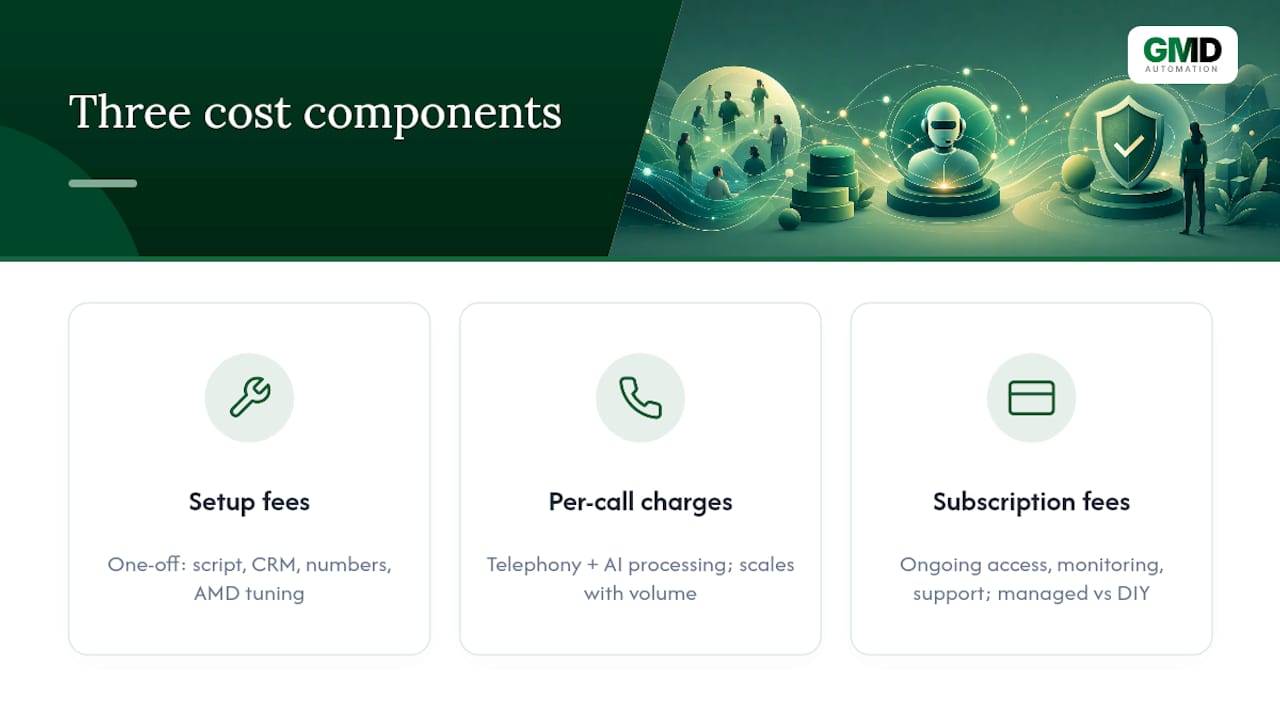
Per-call or per-minute charges cover the actual usage: telephony costs, AI processing, and often a margin on top. These scale with volume, which is exactly why the "cost per booked meeting" metric matters more than the per-minute rate in isolation. A cheap per-minute rate on a poorly qualified list can produce a worse cost per meeting than a slightly pricier rate on a well-targeted one.
Subscription or platform fees cover ongoing access, monitoring, and support. This is where the biggest difference between providers shows up. A fragmented DIY stack means paying separately for telephony, the AI platform, integration maintenance, and compliance monitoring, each with its own renewal and its own support queue. A managed subscription model, like the one Gmdautomation runs for UK businesses, folds implementation, operation, maintenance and optimisation into one predictable monthly fee with no upfront capital outlay.
When comparing quotes, ask each vendor to break down all three components separately, then calculate cost per booked meeting using your own expected answer and conversion rates rather than theirs.
How should you manage data and security for AI-generated calls?
Every AI outbound call generates a recording, a transcript, and structured data about the prospect's responses, three data assets that didn't exist in the same form with human dialling and that need their own handling policy.
Recordings and transcripts should sit encrypted at rest and in transit, with access restricted to people who genuinely need it for quality review or compliance audits, not the whole sales floor. Retention policy matters as much as encryption: decide upfront how long call data is kept and why, rather than defaulting to "forever" because nobody set a deletion rule. Google's terms and similar major-platform documentation illustrate the level of explicit detail buyers should expect any vendor handling personal data to publish.
Third-party access is the detail most teams forget to check. If your outbound AI vendor uses a subcontracted telephony provider or a separate transcription service, that's a second party with access to prospect conversations, and it should appear in the vendor's documentation, not surface as a surprise during a data subject access request.
Build a simple internal policy before launch: who can listen to recordings, how long transcripts live in the CRM, and what happens to the data if you switch vendors later. A vendor unable to explain their own subcontractor chain, similar to the transparency shown in Brevo's privacy policy, isn't ready to handle live prospect data at volume.
How does this change the way your sales team works?
The biggest shift isn't technological, it's organisational. Reps stop spending their mornings dialling numbers that go to voicemail and start spending them on qualified conversations that an AI agent already booked or warm-transferred. That's a genuine change to how a working day feels, and it needs managing, not just announcing.

Expect some resistance in the first few weeks. Reps who built their pipeline habits around volume dialling may see AI outbound calling as a threat rather than a tool, particularly if leadership frames it as a headcount conversation instead of a capacity one. The framing that tends to land better: the AI handles the repetitive qualification and scheduling grind, freeing reps for the parts of the job that actually need a human, negotiation, relationship-building, and closing.
Warm transfers change rep behaviour too. When an agent hands over a call with a short spoken briefing on what the prospect already said, reps arrive at the conversation already informed rather than starting cold, which noticeably changes how confident they sound on the call.
Give the team visibility into the metrics, answer rates, meetings booked, and let them see the AI agent as something that improves their close rate rather than something watching over their shoulder. Teams that treat the rollout as a workflow change, not just a tooling purchase, adapt faster and complain less.
Where does AI outbound calling fall short, and how do you handle it?
No outbound calling AI system handles every conversation correctly, and pretending otherwise sets your team up for a bad surprise mid-pilot.
Voice AI still struggles with heavy accents, background noise on the prospect's end, and genuinely unusual objections that fall outside the script's decision tree. Natural language understanding has improved substantially, but an agent trained on typical qualification questions can lose the thread when a prospect asks something unexpected or goes on a tangent unrelated to the call's purpose.
The practical fix isn't better AI alone, it's better fallback design. Build explicit escalation triggers: if the conversation deviates from the expected pattern more than twice, or if sentiment analysis flags frustration, the call routes to a human rep rather than pushing forward with a script that no longer fits. Multilingual and strong-accent calls should have a lower automatic-escalation threshold, since misunderstanding compounds fast once the agent starts guessing at intent.
Error logging matters as much as error prevention. Every call the agent handles poorly should feed back into script refinement, not disappear into a call log nobody reviews. Vendors serious about this will show you their process for reviewing failed calls and updating conversational flows, not just their success-rate marketing.
What does AI voice quality actually sound like now?
Voice quality has moved past the robotic, monotone caricature most people still picture when they hear "AI phone call." Modern text-to-speech engines produce natural pacing, appropriate pauses, and tonal variation that responds to conversational context, agreement sounds warmer, pushback sounds more measured.
Natural language understanding is the part that decides whether that voice quality actually matters. A great-sounding voice attached to an agent that misparses a simple "maybe next month" as a firm no is worse than a slightly flatter voice with sharper comprehension. The best systems combine both: low-latency speech generation paired with intent recognition trained specifically on sales objections rather than generic conversation.
Where this still shows seams is interruption handling. Real conversations involve people talking over each other, correcting themselves mid-sentence, or trailing off. Agents that can't gracefully handle an interruption tend to either barrel through, which sounds robotic, or freeze, which sounds broken. Ask any vendor for a live demo call rather than a recorded sample, since recorded samples are inevitably the best-case takes. A genuine live call, ideally on a noisy mobile line, tells you far more about real-world performance than a polished marketing clip ever will.
What actually matters when you cut through the AI outbound calling hype?
The conventional pitch around outbound sales AI focuses almost entirely on scale, more dials, more coverage, more hours worked. That's the least interesting part of the story, and it's not where campaigns actually fail or succeed.
What determines whether a pilot works is boring, technical, and rarely mentioned in vendor demos: whether AMD is tuned properly, whether STIR/SHAKEN is configured on the outbound trunk, and whether the compliance documentation exists before the first call goes out. Teams that skip straight to "how many calls can it make" end up with campaigns that dial fast and convert badly, because nobody checked the plumbing.
The metric worth obsessing over isn't dial volume, it's cost per booked meeting, measured against a genuinely warm list. If that number doesn't beat what your current team achieves manually, the AI isn't solving the problem you think it's solving. Prioritise the pilot's go/no-go thresholds before you look at a single vendor demo, not after. That order, compliance and metrics first, vendor selection second, is the single biggest predictor of whether a rollout succeeds or quietly gets shelved after three months.
— Ravi
Ready to pilot outbound calling AI without the deployment risk?
Gmdautomation is the alternative to stitching together telephony, AMD tuning, and compliance monitoring yourself, one predictable monthly subscription that covers implementation, operation, maintenance and optimisation, with zero upfront capital cost.
That structure suits sales operations teams who want the benefits covered in this guide, qualified meetings booked at scale, warm transfers with proper briefings, disclosure and DNC handling done correctly, without hiring a telephony specialist or a compliance lead to manage it internally. If your team read the implementation checklist above and thought "we don't have the bandwidth to run this ourselves," that's exactly the gap a managed subscription closes.
Get in touch through Gmdautomation to scope a pilot against your own list and see what a compliance-first rollout looks like for your sales operation before you commit to anything larger.