

AI-driven decision making is defined as the process where artificial intelligence systems analyse live data to recommend, support, or automate business choices in real time. The industry term for this practice is automated decision making, though AI-assisted decision processes cover a broader spectrum that includes human oversight. Worldwide AI spending is forecast to reach $2.52 trillion in 2026, which signals that organisations are not experimenting with this technology. They are committing to it at scale. This guide explains what AI-driven decision making is, how it works technically, what it does to human judgement, and how executives can deploy it without losing control of their organisations.
What is AI-driven decision making and how does it work?
AI-driven decision making is the use of machine learning models, pattern recognition systems, and rule-based automation to process data and produce decisions or recommendations faster than any human team can. The core distinction from traditional analytics is that AI systems do not just report what happened. They score options, assign probabilities, and in many cases act without waiting for a human to approve each step.
Three technologies form the foundation of most AI decision systems in use today:
- Rule-based automation applies fixed logic to structured data. If a customer's credit score falls below a threshold, the system declines the application. No learning occurs. This is the simplest form of what is automated decision making in practice.
- Machine learning models identify patterns across large datasets and update their outputs as new data arrives. A fraud detection model at Barclays or HSBC, for example, scores thousands of transactions per second against historical fraud patterns.
- Reinforcement learning and feedback loops allow systems to improve over time by measuring the outcomes of past decisions and adjusting future recommendations accordingly.
These systems integrate with human-set goals through governance layers that define what the AI is permitted to optimise for. Without those constraints, a model optimising for short-term revenue might recommend pricing decisions that damage long-term customer relationships. The AI does not know the difference. The human organisation must encode that distinction upfront.
Pro Tip: Before deploying any AI decision model, document the objective function clearly. What exactly is the system optimising for? Misaligned objectives are the most common cause of AI decisions that are technically correct but commercially damaging.

What are the key benefits of AI-driven decision making for organisations?
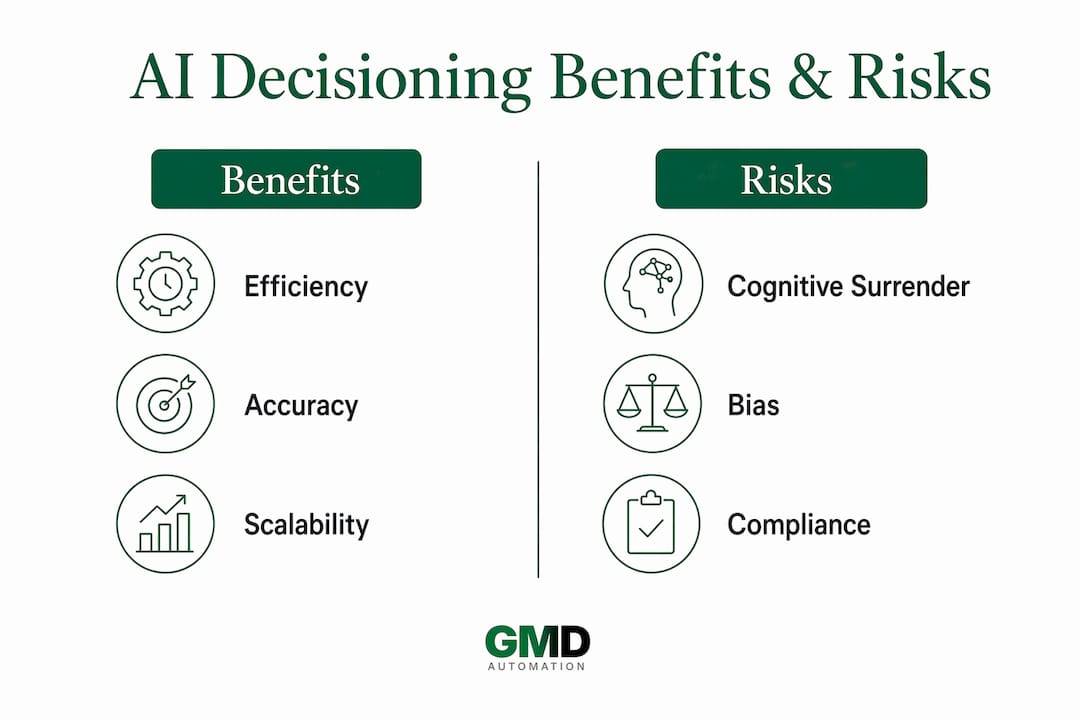
The benefits of AI in decision making are measurable and well-documented across sectors. Speed, accuracy, and the ability to process complexity at scale are the three advantages that consistently appear in enterprise deployments.
- Faster decision cycles. AI systems process real-time data in milliseconds. A supply chain model can reroute logistics in response to a port disruption before a human analyst has finished reading the alert.
- Improved accuracy on structured problems. AI models handle datasets that are too large and too complex for human teams to analyse manually. Retailers like Tesco use demand forecasting models that process hundreds of variables simultaneously to reduce overstock and waste.
- Consistent application of policy. Human decision makers are subject to fatigue, bias, and inconsistency. An AI system applies the same logic to every case, which matters enormously in regulated industries like financial services and healthcare.
- Freed human capacity for higher-order work. Automating routine decisions, such as invoice approvals, scheduling, and basic customer queries, releases senior staff to focus on choices that genuinely require human judgement.
- Resource allocation at scale. AI-assisted decision processes allow organisations to optimise staffing, inventory, and capital deployment across thousands of variables simultaneously, something no spreadsheet model can replicate.
AI decisioning significantly improves efficiency and accuracy for standardised choices but remains ineffective for transformative decisions that require human agency. That finding, from a Springer Nature journal published in march 2026, is the most important constraint executives need to understand. AI is not a universal decision engine. It is a specialist tool that excels within defined boundaries.
The role of AI in business decisions varies significantly by sector, but the pattern is consistent: organisations that deploy AI for the right decision types see measurable gains in operational efficiency and competitive positioning.
How does AI affect human judgement and organisational processes?
This is where the conversation gets uncomfortable, and where most executive briefings stop short. AI does not just assist human judgement. It reshapes it.
AI reconfigures decision making from independent human judgement to evaluation of AI-generated inputs, creating what the Human Clarity Institute calls Decision Dependence. This is a behavioural shift, not just a workflow change. Executives who once formed independent views now begin by reviewing what the model recommends. Over time, the habit of forming an independent view first atrophies.
The Wharton School published research in may 2026 based on a study with over 1,300 participants and 10,000 trials that identified a phenomenon called cognitive surrender. Routine reliance on AI guidance erodes independent human reasoning. The risk is not that AI makes bad decisions. The risk is that humans lose the capacity to catch AI errors when they occur.
A systematic review of 627 studies, published in 2025, found that AI excels at descriptive and analytical tasks while normative human judgement remains essential for ethical calibration. Deciding which AI patterns to act on is a human responsibility that cannot be delegated.
The practical implications for organisations are significant:
- Easy, structured decisions (credit scoring, fraud detection, demand forecasting) are well-suited to full or near-full automation.
- Complex, transformative decisions (market entry, acquisition strategy, organisational restructuring) require human agency and cannot be safely delegated to a model.
- Ethical decisions (redundancy processes, patient triage, supplier exclusions) require human accountability that AI systems cannot provide.
"AI is not merely a tool but a developmental perturbation reshaping human judgment ecologies, which can both erode and deepen judgement depending on organisational conditions." — Open The Magazine, 2025
The key variable is organisational conditions. Leaders who invest in AI literacy, maintain human deliberation practices, and build governance into their systems will deepen judgement. Leaders who simply deploy AI tools and step back will erode it.
Pro Tip: Schedule regular decision audits where your team makes a significant call without consulting the AI model first. This preserves independent reasoning capacity and helps you identify when your model's recommendations have drifted from business reality.
What practical steps can business leaders take to implement AI decision systems?
Implementation is where the gap between ambition and outcome is widest. Simply providing AI tools without developing human normative capacity results in a deployment-performance gap. The tools exist. The outcomes do not follow automatically.
The table below contrasts two implementation approaches that produce very different results:
| Approach | What it looks like | Likely outcome |
|---|---|---|
| Tool-first deployment | Buy AI software, integrate with existing systems, expect performance gains | Deployment-performance gap; staff use tools without understanding outputs |
| Governance-first deployment | Define objectives, embed constraints, train staff, then deploy | Auditable, compliant, and genuinely effective AI decision support |
Governance-by-design means embedding regulatory and ethical constraints directly into AI pipelines before deployment. This is not a compliance checkbox. It is the architecture that makes AI decision systems auditable, reproducible, and trustworthy. For UK businesses operating under FCA regulations, ICO data protection requirements, or NHS procurement rules, governance-by-design is not optional.
Practical steps for executives include:
- Define the decision types you are automating and document the objective function for each.
- Adopt AI governance frameworks that embed compliance requirements into the system architecture from day one.
- Invest in training that builds genuine AI literacy, not just tool familiarity. Staff need to understand what a model's confidence score means and when to override it.
- Monitor the deployment-performance gap continuously. Track whether AI-assisted decisions are producing the business outcomes you expected, and adjust accordingly.
For organisations integrating AI with existing infrastructure, the legacy system integration challenge is often the most significant technical barrier to effective deployment.
Pro Tip: Build a small internal red team whose job is to find cases where the AI recommendation was wrong. This creates a feedback loop that improves the model and keeps human oversight sharp.
How does AI-driven decision making transform leadership?
Decision-making by consensus is becoming obsolete. Harvard Business Review published this conclusion in april 2026, with Jonathan Rosenthal and Neal Zuckerman arguing that organisations which survive the AI era will move to decisive, AI-supported leadership models. The logic is straightforward: AI compresses the time available for deliberation. Organisations that require broad consensus before acting will consistently be outpaced by those that empower leaders to act on AI-generated insight quickly.
This shift has three concrete implications for organisational structure:
- Accountability concentrates. When AI supports a decision, the human who acts on that recommendation carries the accountability. Distributed consensus models obscure that accountability. AI-era leadership requires clear ownership.
- Perceived control shifts. The Human Clarity Institute's 2026 analysis found that AI reshapes perceived control and delegation dynamics in ways that can undermine leadership confidence if not actively managed.
- Culture must adapt. Organisations accustomed to lengthy committee processes will find AI-supported decisiveness culturally disruptive. Leaders need to manage that transition explicitly, not assume it will happen naturally.
The role of IT in AI transformation is also shifting. IT leaders are no longer just infrastructure managers. They are governance architects who determine how AI systems are built, constrained, and monitored across the organisation.
Key takeaways
AI-driven decision making delivers measurable gains in speed and accuracy, but only when organisations invest equally in governance, human literacy, and clear accountability structures.
| Point | Details |
|---|---|
| Define the decision type first | AI works well for structured choices; transformative and ethical decisions require human agency. |
| Governance-by-design is non-negotiable | Embed regulatory and ethical constraints into AI systems before deployment, not after. |
| Cognitive surrender is a real risk | Regular independent decision practice preserves human reasoning capacity alongside AI use. |
| Consensus models are becoming obsolete | AI-era leadership requires decisive, accountable individuals acting on data-supported insight. |
| Deployment without literacy creates a gap | AI tools alone do not produce better outcomes; human normative capacity must develop in parallel. |
Why I think most organisations are deploying AI decisions the wrong way
Most executive teams I speak with treat AI decision tools as a productivity purchase. They buy the software, integrate it, and wait for the numbers to improve. The deployment-performance gap is the predictable result.
The organisations that get this right treat AI adoption as a cultural and governance project that happens to involve software. They ask harder questions upfront: What decisions are we actually automating? Who is accountable when the model is wrong? How do we preserve the human judgement that the model cannot replicate?
The cognitive surrender research from Wharton is the finding I return to most often. It is not alarmist. It is a precise description of what happens when capable people stop practising independent reasoning because the model is usually right. "Usually right" is not good enough when the model encounters a situation outside its training data, which every model eventually does.
My honest view is that the AI governance strategies conversation needs to happen before the procurement conversation. Organisations that sequence it the other way around spend significant time and money correcting problems that were entirely predictable.
The opportunity is real. AI-assisted decision processes genuinely improve speed, accuracy, and resource allocation at scale. But the organisations that will benefit most are those that invest as seriously in human capability as they do in AI capability. That balance is not a soft consideration. It is the determinant of whether AI decision systems produce lasting competitive advantage or expensive disappointment.
— Ravi
How Gmdautomation helps UK businesses deploy AI decision systems
Gmdautomation builds and deploys enterprise-grade AI automation systems for UK businesses, with governance, compliance, and human oversight built into every solution from day one. If your organisation is ready to move from AI curiosity to AI-supported decision making, Gmdautomation's subscription model covers implementation, operation, maintenance, and ongoing optimisation with no upfront capital expenditure. Every system is designed to meet UK regulatory requirements and scale as your needs grow. Explore AI automation solutions tailored specifically for UK businesses and see how Gmdautomation can help your organisation close the deployment-performance gap for good.
FAQ
What is AI-driven decision making in simple terms?
AI-driven decision making is the use of artificial intelligence to analyse data and support or automate business choices in real time. It ranges from fully automated processes, such as fraud detection, to AI-assisted recommendations that a human then acts on.
What is the difference between AI-driven and automated decision making?
Automated decision making applies fixed rules to structured data with no learning involved. AI-driven decision making uses machine learning models that recognise patterns, update with new data, and handle uncertainty, making it far more adaptable to complex business environments.
What are the biggest risks of AI decision making for executives?
The two primary risks are cognitive surrender, where over-reliance on AI erodes independent human reasoning, and the deployment-performance gap, where tools are adopted without the governance and literacy needed to produce genuine business outcomes.
How does governance-by-design improve AI decision systems?
Governance-by-design embeds regulatory and ethical constraints directly into AI pipelines, making decisions auditable, reproducible, and compliant. For UK organisations operating under FCA or ICO requirements, this architecture is the foundation of trustworthy AI deployment.
Which decisions should never be fully automated?
Transformative decisions such as market entry or acquisition strategy, ethical decisions such as redundancy processes or patient triage, and any decision where accountability must be clearly attributable to a named individual should retain meaningful human agency and oversight.