

Most IT professionals have used a chatbot. Far fewer have deployed an AI agent, and fewer still can explain precisely why those two things are fundamentally different. Understanding what is AI agent architecture means confronting a genuinely new paradigm. These are not upgraded autocomplete systems. They are autonomous, goal-directed programmes that perceive inputs, reason about what to do, execute actions against real tools and APIs, evaluate results, and loop back until the job is done. For any organisation serious about automation, understanding this architecture is not optional background reading. It is the foundation.
Table of Contents
- Key takeaways
- Core components of AI agent architecture
- Orchestration and multi-agent patterns
- Enterprise controls and production readiness
- Advanced techniques for robustness and trust
- My perspective on what actually works in enterprise AI agents
- How Gmdautomation puts this architecture into practice
- FAQ
Key takeaways
| Point | Details |
|---|---|
| Iterative loop is the core | AI agents operate via a continuous perceive-reason-act-evaluate cycle, not single responses. |
| Four foundational components | Perception, reasoning, action, and memory combine to enable autonomous multi-step task completion. |
| Orchestration patterns matter | Choosing between single-agent, sequential, or hierarchical patterns determines how well agents scale. |
| Governance is non-negotiable | Production-grade agents require policy enforcement, authorisation scopes, and auditable runtime tracing. |
| Separation of concerns improves reliability | Keeping decision logic separate from execution runtime reduces failure points and strengthens security. |
Core components of AI agent architecture
If you ask most people what makes an AI agent different from a chatbot, they will say something about intelligence or capability. The actual answer is architectural. A chatbot receives a prompt and returns a response. An AI agent receives a goal and pursues it across multiple steps, adapting as it goes. That distinction comes entirely from how the system is built.
AI agent architecture is built around four foundational layers working in concert:
- Perception. The agent ingests inputs from its environment. This might be a user message, a database query result, a webhook payload, or a file. The perception layer normalises these inputs into a format the reasoning layer can process.
- Reasoning. A large language model (LLM) sits at the centre of most modern agent designs. It reads the current context, including prior memory and available tools, and decides what action to take next. This is not a lookup table. It is generative decision-making.
- Action. The agent invokes tools. That might mean calling an API, querying a database, writing to a file system, sending an email, or triggering another agent. Actions have real-world consequences, which is exactly what makes governance so critical.
- Memory. Agents maintain context across steps. Short-term memory holds the current conversation or task thread. Long-term memory persists across sessions using vector stores or structured databases.
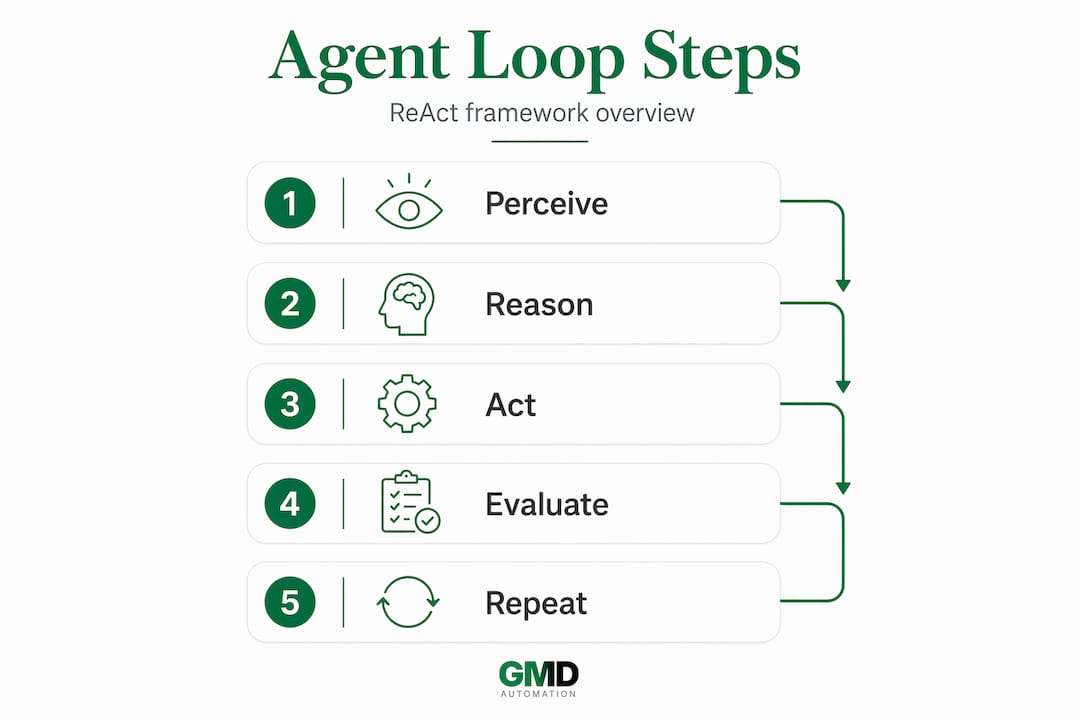
What ties these together is the iterative agent loop: perceive, reason, act, evaluate the result, then loop back. The agent does not stop after one response. It continues until a stopping condition is met, whether that is task completion, a maximum step count, or an explicit signal to pause for human review.
A widely adopted implementation of this loop is the ReAct framework, which interleaves reasoning and action via an explicit Thought-Action-Observation cycle. The agent writes out its reasoning (Thought), selects a tool and parameters (Action), receives the tool's output (Observation), then reasons again with updated context. This explicit interleaving reduces hallucinations because the model is forced to ground each reasoning step in concrete evidence before proceeding.
Pro Tip: When evaluating agent frameworks for enterprise deployment, look for support of explicit reasoning traces. Hidden or implicit chain-of-thought processes are harder to audit and debug in production.
Orchestration and multi-agent patterns
Not every task fits inside a single agent loop. Some workflows are too complex, too long, or require specialised capabilities that no single agent should handle alone. This is where orchestration comes in, and understanding the patterns available is central to AI agent design principles for enterprise use.
Agent orchestration patterns range from the straightforward to the sophisticated. Here are the four main types you will encounter:
-
Single-agent loops. A single agent handles the full task end to end. Suitable for bounded, well-defined problems where context fits within one session. Simple to monitor, easy to debug.
-
Sequential pipelines. Multiple agents are chained, with the output of one becoming the input for the next. Useful when tasks have clearly defined stages, such as research followed by summarisation followed by formatting. Each agent specialises in one stage.
-
Parallel workers. Multiple agents run concurrently on independent subtasks. A supervisor agent distributes work, collects results, and synthesises a final output. This pattern dramatically reduces latency for large-scale document processing or multi-source data gathering.
-
Hierarchical supervision. A planner agent breaks down a high-level goal into subtasks and delegates each to specialist sub-agents. Results feed back up the hierarchy. This mirrors how human teams are organised, with a manager coordinating specialists.
The choice of pattern is an architectural decision, not just a performance one. Hierarchical systems introduce coordination overhead and failure propagation risks. Sequential pipelines can create bottlenecks. For teams exploring scalable AI automation architecture, matching the pattern to the actual workflow complexity is the first design question to answer.
Effective orchestration also depends on how well tools are managed. Each agent in a pipeline needs a precisely scoped set of tools. Giving every agent access to every available tool is an anti-pattern. It increases attack surface, makes debugging harder, and inflates token usage in LLM contexts.
Enterprise controls and production readiness
This is where a lot of teams underestimate the work involved. Getting an agent to complete a task in a demo environment is satisfying. Getting it to do so reliably, securely, and in compliance with UK data regulations in a production environment is a different undertaking entirely.
Production-grade agents require a management layer that sits above the agent loop and handles the concerns that the loop itself cannot address:
- Governance and policy enforcement. Every tool call is a potential risk surface. Authorisation constraints must be enforced at the execution boundary using scoped access tokens. An agent should only be able to invoke the tools and data it is explicitly permitted to use, verified at runtime, not assumed.
- Observability. You cannot manage what you cannot see. Structured logging of every step in the agent loop, including reasoning traces, tool inputs, tool outputs, and final decisions, is not optional in enterprise settings. It is the foundation of incident response and continuous improvement.
- Cost controls. LLM inference is metered. An agent in an infinite loop, or one that calls expensive APIs unnecessarily, can generate significant costs within minutes. Rate limiting, step budgets, and cost thresholds need to be built into the management layer.
- Human approval gates. For sensitive actions such as financial transactions, customer data modifications, or external communications, agents should pause and request human authorisation before proceeding.
The Cloud Security Alliance's Agentic NIST AI RMF Profile extends traditional risk management frameworks specifically to cover autonomous agents. It addresses runtime behavioural measurement, tool-use risk mapping, incident management, and governance categories that standard AI RMF profiles simply do not handle. If your organisation follows NIST guidance, this profile is the right starting point for AI agent compliance planning.
For IT leaders connecting agents to existing infrastructure, understanding API integration for AI automation is equally important. Agents interact with business systems through APIs, and those integrations must be secured, versioned, and monitored with the same rigour as any other production API.
Pro Tip: Build retry logic and idempotency into every tool call from day one. Agents in production will encounter transient failures. Without idempotency, retries can cause duplicate actions with real business consequences, such as sending the same email twice or debiting an account twice.
Advanced techniques for robustness and trust
Once your foundational architecture is in place, several advanced techniques separate agents that merely work from agents you can trust at scale.
The single most impactful change teams can make is adopting structured tool calling with typed schemas. Rather than relying on the LLM to format a tool call correctly through free-text parsing, function calling via JSON schemas makes tool invocation deterministic. The model selects the function and provides arguments that are validated against the schema before execution. This eliminates an entire class of runtime errors that plague prompt-based agent designs.
The second critical technique is separating the decision-making LLM from the execution runtime. The LLM reasons and selects actions. A separate execution harness actually runs those actions, enforces sandboxing, handles retries, applies policy checks, and records results. This separation means you can swap LLMs without rewriting your execution infrastructure, and you can apply security controls at the execution layer without interfering with reasoning quality.

The table below contrasts key approaches in agent design for teams weighing architectural choices:
| Approach | Fragile pattern | Resilient pattern |
|---|---|---|
| Tool invocation | Free-text prompt parsing | Typed JSON schema function calling |
| Error handling | No retries, fail on first error | Retry with exponential backoff and checkpointing |
| Memory management | Full history in context window | Compacted summaries plus vector retrieval |
| Security enforcement | Trust LLM to respect instructions | Enforce authorisation at execution boundary |
| Auditability | Post-hoc log review | Real-time evaluation probes with audit trails |
The final technique worth implementing early is automated evaluation probes embedded in workflows. Rather than validating agent outputs after the fact, evaluation probes run continuously during execution and generate machine-readable audit logs. This is the difference between hoping your agent behaved correctly and having evidence that it did. For regulated industries operating in the UK, that evidence is not just useful. It is expected.
For teams wanting to go deeper on how LLMs interact with tools in practice, the concept of AI function calling is worth studying in detail before committing to an agent framework.
My perspective on what actually works in enterprise AI agents
I have reviewed a lot of AI agent deployments, and the pattern I keep seeing is teams who nail the agent loop but underinvest in everything around it. The loop itself, the perceive-reason-act cycle, is genuinely well-supported by modern frameworks. What trips organisations up is what comes after the prototype. The runtime harness. The authorisation model. The observability tooling. The memory management strategy when context windows fill up. In my experience, production teams spend far more engineering effort on these surrounding concerns than on the loop itself.
The other thing I think practitioners consistently underestimate is the governance piece. There is a tendency to treat governance as a compliance checkbox, something you bolt on before an audit. That is the wrong framing. Governance at the tool execution boundary is an architectural decision. If authorisation scopes are not designed in from the start, retrofitting them onto a production agent system is genuinely painful work.
What gives me confidence about the direction the field is heading is the emergence of frameworks like the CSA Agentic NIST AI RMF Profile. They signal that the industry is moving past the "get it working" phase and towards the "trust it in production" phase. For UK enterprises in regulated sectors, that shift cannot come fast enough.
My practical advice: before you deploy any agent beyond a pilot, build and stress-test your management layer. Simulate tool failures, infinite loops, and unauthorised action attempts. Your agent loop will handle the happy path. Your management layer is what handles reality.
— Ravi
How Gmdautomation puts this architecture into practice
Building an AI agent from first principles against all the considerations above is a substantial undertaking. Most UK enterprises neither need nor want to build a custom orchestration harness, governance layer, and observability stack from scratch.
Gmdautomation's platform is built around the layered agent architecture described in this guide. Governance, security, authorisation controls, and observability are part of the deployment from day one, not retrofitted later. The system is designed to integrate with existing business workflows and legacy APIs without significant capital expenditure, using a predictable monthly subscription that covers implementation, operation, and ongoing optimisation. For IT decision-makers who want the benefits of enterprise-grade AI automation without the infrastructure overhead, it is worth exploring what Gmdautomation deploys in practice.
FAQ
What is AI agent architecture?
AI agent architecture is the layered design of an autonomous AI system, combining perception, reasoning, action, and memory components within a continuous iterative loop. Unlike chatbots, agents pursue goals across multiple steps and adapt based on the results of each action.
How does an AI agent differ from a chatbot?
A chatbot responds to a single prompt and stops. An AI agent operates in a continuous perceive-reason-act-evaluate loop, using tools and memory to complete multi-step tasks autonomously until a goal is reached or a stopping condition is triggered.
What are the main components of AI agent architecture?
The four core components are perception (input processing), reasoning (LLM-based decision-making), action (tool and API execution), and memory (short-term and long-term context storage). These work together inside the agent loop.
What does AI system integration mean for agent deployments?
AI system integration refers to connecting agent architectures to existing business systems, databases, and APIs so agents can read data and take actions within live workflows. Secure, schema-validated tool calling is the standard approach for reliable integration.
Why do enterprise AI agents need a governance layer?
Governance enforces authorisation constraints at tool execution boundaries, controls costs, enables observability, and supports compliance with frameworks like the CSA Agentic NIST AI RMF Profile. Without it, agents operating in production environments present unacceptable security and operational risks.