

For UK businesses that cannot afford a failed AI rollout, Gmdautomation is the recommended starting point: a fully managed service with no upfront costs, a subscription model that covers implementation through to ongoing optimisation, and a compliance posture built around UK GDPR from day one. That matters because a significant majority of AI proof-of-concepts fail to scale, and most of those failures trace back to governance gaps and poor pilot design, not the technology itself.
TL;DR: If you want a managed, done-for-you rollout with compliance built in, Gmdautomation is the clearest choice for UK enterprises. For self-serve workflow automation, platforms like Rippling, BambooHR, or Workday HCM cover employee onboarding well. For connecting your existing stack, Zapier or Microsoft Power Automate handle the integration and governance layer.
Quick shortlist by buyer type:
- Managed, risk-free rollout for UK enterprises: Gmdautomation — no upfront costs, subscription model, UK compliance focus
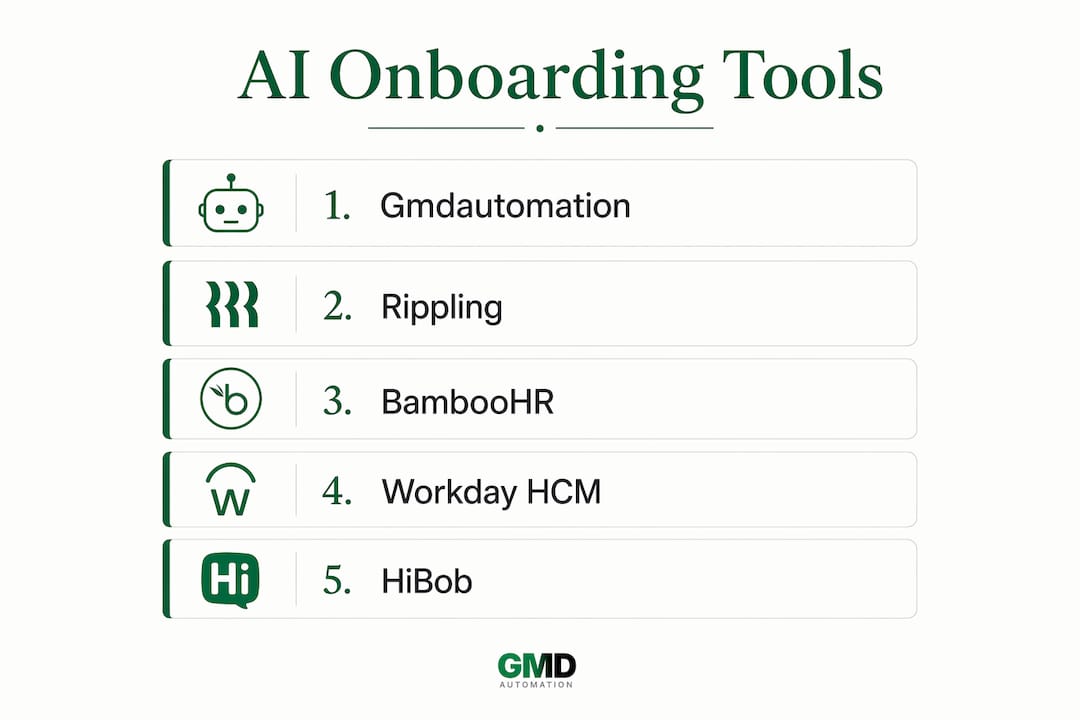
- Employee onboarding and HR automation: Rippling, BambooHR, Workday HCM, HiBob
- Customer and project-based onboarding: Valuecase, Rocketlane, Enboarder
- Integration and governance layer: Zapier (connects 9,000+ apps, trusted by 3 million+ businesses), Microsoft Power Automate, Make, n8n
- Training and knowledge onboarding: Trainual, Docebo, Guru, Tango
Table of Contents
- How do these AI onboarding platforms compare for risk-free adoption?
- What does each tool actually deliver for a risk-free onboarding programme?
- How should you evaluate and choose an AI onboarding tool?
- How was this shortlist selected?
- How do you run a risk-free AI onboarding pilot?
- What timelines and costs should you budget for?
- Key takeaways
- Why the "risk-free" framing matters more than vendors admit
- Gmdautomation: managed AI onboarding built for UK businesses
- Selected sources and further reading
How do these AI onboarding platforms compare for risk-free adoption?
The table below covers the 28 platforms most commonly evaluated by UK HR and operations teams. Columns reflect the dimensions that actually determine whether a rollout is low-risk or not.
| Platform | Best for | AI depth | Risk-free signals | Integrations | Security & compliance | Pricing model | Support & onboarding | Scalability |
|---|---|---|---|---|---|---|---|---|
| Gmdautomation | UK enterprises: managed, compliant rollout | Workflow automation, voice AI, social AI agents | Managed pilot, no upfront costs, subscription model | API, HRIS, custom connectors | UK GDPR focus, compliance-first architecture | Monthly subscription (all-inclusive) | Dedicated managed service, ongoing optimisation | High; scales with subscription tier |
| Valuecase | Customer-facing onboarding workflows | Content gen, workflow automation | Free trial available | CRM, project tools | Standard SaaS compliance | Per-seat subscription | CSM support | Moderate |
| Rocketlane | Billable professional services onboarding | Workflow automation, status updates | Free trial | PSA, CRM, Slack | Standard SaaS | Per-seat subscription | Onboarding team | High |
| Asana | Enterprise work management with AI insights | AI status updates, risk surfacing | Free tier, enterprise trial | 9,000+ apps, API | SOC 2, ISO 27001 | Per-seat; enterprise pricing | Dedicated CSM (enterprise) | High |
| ClickUp | Customisable internal employee onboarding | Workflow automation, AI writing | Free tier, sandbox | 9,000+ apps | SOC 2 Type II | Freemium to enterprise | In-app guides, CSM | High |
| Monday.com | Visual workflow configuration | Workflow automation, AI summaries | Free trial | 9,000+ apps, API | ISO 27001, SOC 2 | Per-seat subscription | Onboarding support | High |
| Rippling | HR + IT employee provisioning | Workflow automation, LLM actions | Free demo | HRIS, payroll, SSO | SOC 2 Type II | Per-seat; modular | Dedicated support | High |
| BambooHR | SME employee onboarding | Workflow automation | Free trial | HRIS, ATS, payroll | SOC 2 | Per-employee pricing | Support team | Moderate |
| Trainual | Structured training and role-based learning | Content gen, learning automation | Free trial | HRIS, Slack, Zapier | SOC 2 | Per-seat subscription | Onboarding team | Moderate |
| Docebo | Enterprise LMS + onboarding automation | AI content gen, learning automation | Free trial | LMS, HRIS, SSO | SOC 2, ISO 27001 | Enterprise pricing | Dedicated CSM | High |
| Tango | Process documentation and playbooks | Process capture, AI step generation | Free tier | Chrome extension, LMS | SOC 2 | Freemium to enterprise | Self-serve + support | Moderate |
| Workday HCM | Large enterprise HCM and HR automation | Workflow automation, AI insights | Enterprise demo | Full HRIS, ERP, SSO | SOC 2, ISO 27001 | Enterprise licensing | Dedicated implementation | Very high |
| Intelogos | Specialist onboarding automation | Niche automation features | — | Standard integrations | Standard SaaS | — | — | Moderate |
| Greenhouse | Recruiting-to-onboarding continuity | Workflow automation | Free demo | ATS, HRIS, SSO | SOC 2 Type II | Per-seat subscription | Onboarding support | High |
| Guru | Contextual knowledge delivery | AI search, knowledge cards | Free tier | Slack, HRIS, browser ext. | SOC 2 | Freemium to enterprise | Self-serve + support | Moderate |
| Leena AI | Chat-based HR query automation | Conversational AI, LLM actions | Free demo | HRIS, Slack, Teams | SOC 2 | Per-seat subscription | Dedicated CSM | High |
| Breezy HR | SME recruiting + onboarding | Workflow automation | Free trial | ATS, HRIS | SOC 2 | Per-seat subscription | Support team | Moderate |
| Enboarder | New-hire experience and engagement | Workflow automation, nudges | Free demo | HRIS, Slack, Teams | SOC 2 | Per-seat subscription | Onboarding team | High |
| Talentech | Integrated talent and onboarding | Workflow automation | — | ATS, HRIS | Standard SaaS | — | — | Moderate |
| HiBob | People analytics + onboarding workflows | Analytics, workflow automation | Free demo | HRIS, payroll, SSO | SOC 2, ISO 27001 | Per-seat subscription | Dedicated CSM | High |
| Gusto | Payroll + basic onboarding (US-primary) | Workflow automation | Free trial | Payroll, HRIS | SOC 2 | Per-employee pricing | Support team | Low–moderate |
| Teamwork.com | Project-based onboarding orchestration | Workflow automation | Free trial | PM tools, CRM, API | SOC 2 | Per-seat subscription | Support team | High |
| Zapier | Integration and governance layer | BYOM, LLM actions, workflow automation | Free tier, sandbox | 9,000+ apps | SOC 2 Type II, audit logs | Freemium to enterprise | Self-serve + support | Very high |
| Make | Visual workflow integration builder | Visual automation, connectors | Free tier | 9,000+ apps | SOC 2 | Freemium to enterprise | Self-serve | High |
| n8n | Self-hosted open-source automation | Custom connectors, self-hosted LLM | Self-hosted sandbox | Open API, custom | Self-managed; SOC 2 option | Open-source / cloud | Community + paid support | High |
| Microsoft Power Automate | Microsoft 365 enterprise automation | Copilot agents, low-code, hyperautomation | Free trial (M365) | Full Microsoft stack, API | ISO 27001, SOC 2, UK data centres | M365 licensing / per-flow | Microsoft support tiers | Very high |
| Lindy.ai | Emerging AI automation exploration | AI agents, LLM actions | Free tier | Limited public connectors | — | Freemium | Self-serve | Early-stage |
| Kissflow | BPM-style low-code onboarding processes | Workflow automation, BPM | Free trial | API, HRIS, ERP | SOC 2 | Per-seat subscription | Onboarding support | High |
Gusto's UK availability is limited; confirm current product scope before procurement.
What does each tool actually deliver for a risk-free onboarding programme?
Gmdautomation
Gmdautomation is the only fully managed option in this list built specifically for UK businesses. Rather than handing you a platform and a knowledge base, it deploys production-ready AI systems on your behalf: workflow automation, voice AI agents for lead qualification and appointment booking, and AI-driven social media management. The subscription covers implementation, operation, maintenance, and optimisation, with zero upfront costs. For HR and operations teams that lack the internal engineering resource to run a safe pilot alone, that distinction is significant. UK GDPR compliance is built into the architecture, not bolted on afterwards.

Employee onboarding platforms
Rippling sits at the intersection of HR and IT provisioning. It automates device setup, app access, and payroll alongside the HR record, which means a new hire can be fully provisioned before their first day. The G2 review base reflects strong satisfaction with its unified lifecycle management.

BambooHR takes a simpler route: clean document workflows, e-signatures, and structured onboarding checklists for SME HR teams. It does not try to do everything, and that restraint is part of its appeal. G2 reviewers consistently highlight ease of use for smaller HR functions.
Workday HCM is the enterprise-grade option. Full HCM coverage, deep ERP integrations, and AI-assisted workflow insights make it the natural choice for large organisations that need onboarding to connect directly to finance and operations systems. The implementation timeline reflects that complexity. G2 reviewers note its power alongside its configuration overhead.
HiBob pairs people analytics with onboarding workflows, which is useful for growing companies that want to measure new-hire engagement alongside completing the administrative tasks.
Greenhouse handles the recruiting-to-onboarding handoff. If your attrition problem starts at the offer stage, the continuity between ATS and onboarding workflows is worth examining. G2 reviewers rate it highly for structured hiring processes.
Enboarder focuses on the new-hire experience rather than the administrative record. Automated nudges, manager prompts, and engagement checkpoints make it the right pick when you are trying to reduce 90-day attrition, not just complete paperwork.
Customer and project onboarding platforms
Valuecase provides an end-to-end customer onboarding toolkit with prebuilt playbooks, making it well-suited to teams that run high-volume, repeatable customer onboarding processes.
Rocketlane merges project delivery with customer onboarding. If your onboarding is billable and client-facing, the project-centric model and automation features reduce the manual coordination that typically inflates delivery costs.
Teamwork.com takes a similar project-management approach, useful when onboarding is structured as a series of deliverables with dependencies rather than a simple checklist.
Training and knowledge platforms
Trainual builds structured curricula tied to role-based checklists. G2 reviewers highlight how quickly teams can build and assign onboarding content without a dedicated L&D function.
Docebo scales that up to enterprise LMS territory: AI-assisted content generation, SCORM support, and deep HRIS integrations for organisations running global training programmes.
Tango captures processes as step-by-step documentation automatically. It is particularly useful for creating onboarding playbooks from existing workflows without asking subject-matter experts to write anything from scratch.
Guru surfaces knowledge at the point of need via browser extension and Slack integration. New hires get answers without interrupting colleagues, which reduces the support load that typically spikes in the first 30 days.
Integration and governance platforms
Zapier connects any AI to 9,000+ apps and provides action-level restrictions, audit logging, and managed company connections. Centralised audit logs and action-level restrictions are practical controls that prevent shadow automation and unsafe data flows. For teams assembling a stack from multiple SaaS tools, Zapier is the governance layer that keeps automations auditable.
Microsoft Power Automate is the natural choice for organisations already running Microsoft 365. Copilot Studio and Power Automate support low-code agent building, HR automation, and hyperautomation with enterprise governance options and UK data centre availability.
Make offers a visual workflow builder for teams that want to build integrations without code. Its connector marketplace covers most common SaaS tools.
n8n is the self-hosted option for security-conscious buyers who need data residency control. Open-source, customisable, and deployable on your own infrastructure.
Kissflow applies BPM logic to onboarding processes: structured approval workflows, low-code form building, and process governance for organisations that treat onboarding as a formal business process.
Lindy.ai is an emerging player worth watching but lacks the public documentation and track record to recommend for enterprise procurement at this stage.
Leena AI handles conversational HR queries via chat, reducing the volume of repetitive questions that HR teams field during onboarding. Gartner reviewers note its effectiveness for policy lookup and employee Q&A.
Breezy HR combines recruiting and onboarding in a single SME-friendly platform, useful when you want to avoid managing two separate tools for the hiring and onboarding stages.
Talentech and Intelogos are included for completeness; both have limited public documentation on specific AI features and pricing, so treat them as candidates to evaluate directly with vendors rather than shortlist on published specs alone.
Pro Tip: Starting with high-value, low-risk tasks such as automated nudges, status updates, and document checklists lets you measure real value within the first 30 days while keeping human judgement in place for anything that requires a decision.
How should you evaluate and choose an AI onboarding tool?
Procurement and technical fit checklist
- Define the onboarding type first. Employee onboarding (HR provisioning, training, compliance) and customer onboarding (product activation, account setup, success milestones) require different tooling. Conflating them leads to over-engineered or under-featured purchases.
- Map your existing stack. List your HRIS, ATS, LMS, CRM, and communication tools before shortlisting. A platform that does not integrate with your HRIS creates manual data entry, which defeats the purpose.
- Confirm UK GDPR compliance and data residency. Ask vendors where data is stored, whether UK or EU data centres are available, and how they handle subject access requests. For a UK enterprise AI security posture, this is non-negotiable.
- Require a sandbox or pilot environment. Any vendor that cannot offer a sandboxed test environment before production deployment is a procurement risk. The sandbox should mirror your production configuration, not a stripped-down demo.
- Assess AI depth honestly. There is a difference between a platform that uses AI for status-update summaries and one that deploys autonomous agents handling end-to-end onboarding tasks. Clarify which category you are buying.
- Check SLA terms in writing. Uptime guarantees, support response times, and escalation paths should be in the contract, not the sales deck.
- Evaluate change management requirements. A tool that requires significant retraining of HR staff or IT reconfiguration adds hidden cost. Factor in internal time as a real budget line.
- Confirm rollback procedures. If the automation produces errors or the vendor changes model behaviour, what is the process to revert? This should be documented before you sign.
Questions to ask vendors during demos and RFPs
- What access controls and role-based permissions are available, and how are they audited?
- Where is our data stored, and can we specify UK or EU data residency?
- What model governance controls exist if the underlying LLM is updated or changed?
- What does the pilot scope include, and what are the defined success criteria?
- What is the rollback procedure if the pilot does not meet KPIs?
- Are audit logs available in real time, and can they be exported to our SIEM?
- What liability caps apply to data incidents during the pilot?
Red flags to watch for
- Vague SLAs with no defined response times or uptime commitments
- No sandbox or trial environment before production access
- Unclear data usage terms, particularly around whether your data trains shared models
- Contracts with automatic annual renewals and no exit clause
- Vendors who cannot name a specific UK GDPR compliance contact or Data Protection Officer
How was this shortlist selected?
The platforms in this comparison were assessed against six criteria applied consistently across all 28 entrants.
- Relevance to risk-free onboarding: Does the platform offer a trial, sandbox, managed pilot, or structured onboarding support that reduces adoption risk?
- UK availability and compliance signals: Is the platform available to UK buyers? Does it carry UK GDPR, SOC 2, or ISO 27001 documentation?
- AI capability depth: Does the platform use AI for substantive automation (agents, content generation, LLM-powered actions) or only for surface-level features such as summaries?
- Integration breadth: Can it connect to the HRIS, ATS, LMS, or CRM systems most UK organisations already run?
- Support model: Is there a dedicated implementation team, a CSM, or a managed service, or is the buyer left to self-serve from documentation?
- Documented case studies or pilot offers: Has the vendor published evidence of successful deployments, or do they offer a structured pilot with defined success metrics?
Information was drawn from vendor product pages, independent review platforms including G2, industry analysis from MIT Technology Review, and Gmdautomation's own service documentation. Platforms with no publicly available AI feature documentation (Talentech, Intelogos, Lindy.ai) are included for completeness but flagged accordingly. Pure workflow tools and managed services are treated as distinct categories because the buyer's job-to-be-done differs: one requires internal engineering resource, the other does not.
How do you run a risk-free AI onboarding pilot?
Phase-by-phase pilot template
- Scoping (weeks 1–2). Define the onboarding process you are automating, the systems it touches, and the success KPIs. Agree these in writing with the vendor before any technical work begins. A formal pilot contract with defined success KPIs and a rollback clause materially reduces procurement friction and aligns both parties on acceptance criteria.
- Sandbox setup (weeks 2–3). Deploy the tool in a sandboxed environment connected to test data only. Validate integrations, access controls, and audit logging before any live data enters the system.
- Limited rollout (weeks 3–6). Run the automation for a defined cohort: a single team, a single onboarding workflow, or a single customer segment. Keep human approval gates in place for any action that modifies a record or sends external communications.
- Evaluation (weeks 6–8). Measure against the KPIs agreed in scoping. Review audit logs, error rates, and user feedback. Decide: scale, adjust, or roll back.
- Scale or rollback (weeks 8–12). If KPIs are met, expand to the full onboarding population with a phased schedule. If not, the rollback procedure agreed in the pilot contract takes effect with no penalty.
KPIs worth measuring
- Time to completion: How long does the onboarding process take end-to-end compared to the pre-automation baseline?
- Error rate: How many records require manual correction after automated processing?
- New-hire time to competence: How quickly do new employees reach full productivity, measured by manager assessment or task completion rates?
- Support load reduction: How many HR or IT support tickets are raised during the onboarding period compared to the baseline?
- New-hire NPS: What do new hires report about the onboarding experience at the 30-day mark?
Security and compliance checklist for the pilot
- Confirm UK GDPR lawful basis for processing new-hire data within the automation
- Verify data residency: UK or EU data centres only
- Require SOC 2 Type II or ISO 27001 certification from the vendor
- Enable audit logging from day one of the sandbox phase
- Set role-based access controls so only named individuals can modify automation logic
- Establish a human-in-the-loop gate for any automated action that sends external communications or modifies payroll or benefits data
Contract clauses to request
- Defined pilot length (typically 30–90 days) with no obligation to continue
- Data deletion or return clause at pilot end
- Model governance terms: notification required if the underlying model changes
- Liability cap for data incidents during the pilot period
- Rollback commitment: documented procedure and timeline
Pro Tip: Limit the blast radius of your pilot by choosing a single, well-documented onboarding workflow rather than automating the entire process at once. A scoped pilot produces cleaner KPI data and makes the scale-or-rollback decision straightforward.
What timelines and costs should you budget for?
Typical pilot and rollout timeline
- Managed service pilot (e.g. Gmdautomation): Scoping and deployment can begin within days; meaningful KPI data typically available within 4–6 weeks. Some agentic onboarding vendors claim agents can be live in under an hour for initial install, though enterprise-grade configuration with HRIS integrations realistically takes longer.
- Self-serve SaaS pilot (e.g. Rippling, BambooHR, ClickUp): Sandbox setup typically takes 1–2 weeks; a meaningful pilot with real cohort data runs 4–8 weeks.
- Enterprise platform implementation (e.g. Workday HCM, Docebo): Full implementation spans 3–6 months. Pilot scopes can be carved out earlier, but the full value of enterprise platforms requires complete configuration.
- Integration layer setup (e.g. Zapier, Power Automate): Initial connections can be live within hours; governance configuration and testing add 1–3 weeks for a production-ready setup.
Realistic enterprise pilot timelines run 4–12 weeks for meaningful time to value, depending on integration complexity.
Cost items to budget for
- Subscription or managed-service fees: The primary recurring cost. Managed services like Gmdautomation bundle implementation and optimisation into the monthly fee, removing the upfront capital expenditure that typically inflates self-serve deployments.
- Integration effort: Connecting the automation tool to your HRIS, ATS, or LMS requires either internal engineering time or a systems integrator. Budget this explicitly; it is frequently underestimated.
- Internal change management: Staff training, process documentation updates, and manager briefings are real costs. For a 30-day pilot, this is modest; for a full rollout, it can equal the software cost.
- Contingency: Reserve 15–20% of the total pilot budget for unexpected integration issues or scope adjustments. Most pilots encounter at least one data-quality problem that was not visible during scoping.
The 80–90% PoC failure rate cited by MIT Technology Review is largely attributable to governance gaps and poor data strategy, not technology cost. Investing in scoping and change management upfront reduces that risk more reliably than choosing a cheaper platform.
Key takeaways
The clearest path to a successful AI onboarding rollout is a scoped, governed pilot with defined KPIs and a rollback clause agreed before any automation touches live data.
| Point | Details |
|---|---|
| Start with a managed pilot | A scoped pilot with defined KPIs and a rollback clause reduces the risk that derails most AI proof-of-concepts. |
| Require sandbox and audit logs | No sandbox before production access is a procurement red flag; audit logs must be live from day one. |
| Budget for integration and change management | Integration effort and internal training are frequently underestimated and can equal the software cost. |
| Match the tool to the onboarding type | Employee provisioning, customer activation, and training onboarding require different platforms; conflating them leads to poor fit. |
| Gmdautomation for UK enterprises | Gmdautomation offers a managed, subscription-based rollout with no upfront costs and UK GDPR compliance built in. |
Why the "risk-free" framing matters more than vendors admit
The phrase "risk-free onboarding" appears on almost every vendor's homepage. Most of the time it means a 14-day free trial with a credit card required. That is not the same thing as a managed pilot with defined success criteria, a rollback clause, and a vendor who shares accountability for the outcome.
The 80–90% PoC failure rate is not a technology problem. It is a governance and scoping problem. Organisations that skip the sandbox phase, skip the KPI definition, or skip the contract clause asking what happens if the automation produces errors are the ones that end up with a failed rollout and a 12-month contract they cannot exit.
The tools in this list are genuinely capable. The difference between a successful deployment and a failed one is almost never the platform choice. It is whether the buyer demanded a proper pilot structure and whether the vendor was willing to put that structure in writing. A vendor who resists a rollback clause is telling you something important about how confident they are in their own product.
For UK businesses specifically, the compliance dimension adds a layer that US-centric vendor documentation often glosses over. UK GDPR is not identical to the EU GDPR in every operational detail, and data residency matters for regulated industries. Choosing a vendor with documented UK compliance posture is not bureaucratic caution; it is the difference between a deployment that passes your legal team's review and one that stalls for six months.
MIT Technology Review warns that 80–90% of AI proof-of-concepts fail to scale, emphasizing that governance and scoping—not technology—are the primary reasons for these failures.
Gmdautomation: managed AI onboarding built for UK businesses
Most AI automation platforms hand you a tool and a knowledge base. Gmdautomation hands you a running system. The subscription model covers implementation, operation, maintenance, and ongoing optimisation with zero upfront costs, which means your first invoice arrives after your system is live, not before it is built.
For HR and operations teams evaluating AI automation for UK businesses, the practical difference is significant: no internal engineering resource required to deploy, no capital expenditure to justify to the finance team, and a compliance posture that addresses UK GDPR from the architecture up. The offering spans workflow automation, voice AI agents for call handling and lead qualification, and AI-driven social media management, all delivered as production-ready systems.
The pilot structure is straightforward: agree the scope, define the KPIs, and measure against them. If the system does not perform, the subscription model means you are not locked into a multi-year licence. To see what a managed pilot looks like for your specific onboarding process, book a consultation with the Gmdautomation team.
Selected sources and further reading
- MIT Technology Review: Finding value with AI automation — Analysis of why most AI proof-of-concepts fail to scale and what governance disciplines improve success rates.
- Zapier: Integration and governance platform — Documentation on connecting AI to 9,000+ apps with audit logging, action restrictions, and managed connections.
- Microsoft Power Automate and Copilot — Microsoft's enterprise automation and agent-building platform for organisations running Microsoft 365.
- ICO: UK GDPR guidance — The Information Commissioner's Office guidance on UK GDPR obligations, lawful basis, and data subject rights.
- Gmdautomation: Free trial AI automation evaluation guide — Practical guidance on structuring and evaluating free trials and pilots for AI automation solutions in the UK.
- Gmdautomation: Enterprise AI security architecture — UK-specific guidance on security architecture for enterprise AI deployments.
- Gmdautomation: AI automation checklist for operations managers — Operational checklist covering pilot readiness, risk mitigation, and rollout governance.
- G2 reviews: Rippling, BambooHR, Workday HCM, Greenhouse, Trainual, Tango, Intelogos — Independent user reviews across the major HR and onboarding platforms referenced in this article.