

Most business owners recognise something is wrong long before they know what to do about it. Tasks pile up, errors creep in, good staff spend hours on work that adds no strategic value. These are the signs your business needs AI automation, and identifying them early is the difference between proactive growth and reactive scrambling. This article gives you a practical, no-nonsense checklist of ten indicators to watch for, plus honest guidance on avoiding the pitfalls that catch even well-prepared organisations off guard.
Table of Contents
- Key takeaways
- Signs your business needs AI automation: core readiness criteria
- 1. High volume of repetitive manual tasks
- 2. Frequent errors affecting quality or compliance
- 3. Delayed or inconsistent customer communications
- 4. Scaling challenges overwhelming your current team
- 5. Approval and processing backlogs
- 6. Inconsistent sales or service follow-ups
- 7. Fragmented data across multiple systems
- 8. Competitors gaining ground through automation
- 9. Disproportionate resource drain on administrative work
- 10. Lack of system integration causing process friction
- Common pitfalls and how to avoid them
- How to take your next steps toward AI automation
- My honest take on recognising when the signs are real
- See how Gmdautomation can help UK businesses act on these signs
- FAQ
Key takeaways
| Point | Details |
|---|---|
| Spot the right signals | Repetitive errors, scaling bottlenecks, and communication delays are the clearest indicators for AI adoption. |
| Stabilise before automating | Refine and document your processes before deploying AI, or you will simply accelerate existing problems. |
| Integrate, don't isolate | AI delivering real value comes from embedding it into workflows, not using it as a standalone tool. |
| Apply a break-even lens | Calculate setup time versus time saved before committing, especially for tasks that change frequently. |
| Measure across time horizons | Track engagement, performance, and business impact metrics across 30 to 180 days to judge success accurately. |
Signs your business needs AI automation: core readiness criteria
Before you scan a checklist, there is one foundational question worth asking: is the process you want to automate stable, repeatable, and clearly defined? Automating a broken process does not fix it. It accelerates the breakage. This principle underpins every sign and decision framework in this article.
The processes most suited to automation share three characteristics. They happen frequently (daily or weekly at minimum). They follow consistent, documentable logic. And they do not require nuanced human judgement in the majority of cases.
Equally, there are processes you should protect from automation entirely: client relationship management at the strategic level, creative problem solving, and any workflow that is still being defined or revised regularly. Automating these too early locks in assumptions that will prove wrong within months.
Pro Tip: Before assessing which tools to use, write out the step-by-step logic of any candidate process as if you were explaining it to a new employee. If you cannot document it clearly, it is not ready to automate.
A few additional criteria worth reviewing:
- Task frequency: does this happen more than ten times per week?
- Error cost: does a mistake here have financial, reputational, or compliance consequences?
- Staff time: is skilled labour being consumed by work a rule-based system could handle?
- Data availability: does the process rely on structured, accessible data?
If the answer to most of these is yes, read on.
1. High volume of repetitive manual tasks
Your team spends significant time on tasks that follow the same logic every time: data entry, invoice processing, report generation, appointment scheduling. This is the clearest of all business automation needs. When skilled employees spend more than a quarter of their week on work that follows a fixed pattern, the cost is not just time. It is opportunity cost, the strategic thinking and customer engagement that never happens because the inbox won't empty.

2. Frequent errors affecting quality or compliance
Human error in repetitive tasks is not a performance problem. It is a systems problem. When the same type of mistake recurs across different team members, that is a process telling you it needs a different kind of handling. In regulated industries common across the UK, including financial services, healthcare administration, and legal, recurring errors carry compliance risk that compounds quickly.
3. Delayed or inconsistent customer communications
If follow-up emails go out late, onboarding sequences vary depending on who handled the enquiry, or customer queries sit unanswered for hours, the issue is not effort. It is capacity. AI tools for efficiency in customer communications can maintain consistent response times and messaging quality regardless of team size or time of day, without replacing the human conversations that actually matter.
4. Scaling challenges overwhelming your current team
Growth should not mean your admin burden triples. If every new client, product line, or market expansion requires a proportional increase in headcount for operational support, that is a structural indicator. When to implement AI solutions is often right at this inflection point: before hiring more people to handle volume that a well-configured system could manage at a fraction of the cost.
5. Approval and processing backlogs
Purchase orders sitting in inboxes for days. Expense reports queued for a fortnight. Content approvals blocking the marketing calendar. Backlogs of this kind signal a workflow designed for lower volume. They also signal a recognition opportunity: the approval logic itself is often simple and rule-based, exactly the kind of process AI handles well.
6. Inconsistent sales or service follow-ups
Deals are lost not because the prospect was uninterested, but because follow-up was delayed or forgotten. This is one of the more costly signs of operational inefficiency, and one of the most addressable. Automated follow-up sequences, triggered by specific behaviours or time intervals, maintain momentum without relying on individual memory or workload capacity.
7. Fragmented data across multiple systems
Your CRM holds one version of customer data. Your finance platform holds another. Your support tool holds a third. Nobody reconciles them consistently, so decisions are made on incomplete pictures. Recognising this automation opportunity often unlocks broader value: a properly integrated AI system does not just automate tasks, it creates a single, coherent data layer that improves decision-making across the business.
Pro Tip: Data fragmentation is often a precursor sign. If your teams regularly export spreadsheets to combine information from separate systems, you are already spending hidden labour hours on a problem that integration and automation can eliminate.
A comparison of common fragmentation symptoms versus what integrated AI addresses:
| Fragmentation symptom | What automation addresses |
|---|---|
| Manual data exports between systems | Automated data sync and enrichment |
| Inconsistent customer records | Single source of truth across platforms |
| Reporting requiring manual collation | Real-time dashboards with live data |
| Duplicated data entry across tools | Single input, multiple system updates |
8. Competitors gaining ground through automation
When you notice a competitor responding to enquiries faster, onboarding clients more smoothly, or scaling without apparent headcount growth, they are almost certainly using automation to do it. This is not a reason to panic, but it is one of the more reliable external indicators for AI adoption. AI tools for efficiency are no longer exclusive to enterprise budgets. UK SMEs are deploying them at scale.
9. Disproportionate resource drain on administrative work
When you audit how your team's time is actually spent, the result is often sobering. A meaningful share of hours goes to work that is administrative, repetitive, and low on strategic value. This is not a criticism of the people involved. It is a structural problem. When to implement AI solutions is when this pattern becomes visible and measurable, because at that point you have the data to build an honest business case.
10. Lack of system integration causing process friction
Manual handoffs between tools, copy-pasting between platforms, re-keying data that already exists somewhere else. These are signs of a technology stack that was built incrementally rather than designed. API integration between systems is often the foundation on which automation is built, and recognising the integration gap is the first step toward addressing it.
Common pitfalls and how to avoid them
Knowing the signs is only half the work. The other half is avoiding the mistakes that turn a promising automation project into a costly disappointment.
The most common error is automating a process that has not been fully defined. Poorly defined processes are the single biggest bottleneck in automation projects. A system can only follow logic you have given it. If that logic is ambiguous or incomplete, the output will reflect that ambiguity at speed.
The second major error is using AI as a standalone tool rather than integrating it into existing workflows. Research shows that only 16% of organisations in production with AI achieve high measurable value, largely because the majority deploy it without proper workflow integration. The same research finds that 71% of organisations embedding AI directly into processes see moderate or substantial value.
The break-even framework is worth applying before any deployment. The calculation is straightforward: estimate how long the automation will take to set up, then divide by the time saved per run multiplied by frequency. Automation ROI timelines typically require revisiting within six months as APIs and workflows evolve, so factor in ongoing maintenance from the outset.
Automation requires dedicated monitoring, particularly during the first 90 days after deployment, when edge cases and unexpected inputs are most likely to surface.
Other pitfalls worth noting:
- Automating without governance: rules-based guardrails for AI exist in fewer than half of surveyed organisations, creating compliance and quality risk.
- Underestimating change management: employees in AI-adopting firms report higher disruption levels, which means communication and training are not optional.
- Setting unrealistic value timelines: meaningful business impact metrics typically take between 30 and 180 days to become visible, not days.
How to take your next steps toward AI automation
Once you have identified your signs and assessed your readiness, the path forward has a logical sequence.
- Refine first: document and stabilise the target process before any technology is introduced. Fix obvious inefficiencies manually before asking a system to replicate them.
- Evaluate partners carefully: look for providers with experience in your sector, transparent pricing, and clear support arrangements. In the UK context, data governance and compliance compatibility matter from day one.
- Prioritise data quality: an automation system is only as reliable as the data flowing through it. Audit your data sources before integration.
- Set time-bound expectations: define what success looks like at 30, 60, and 90 days. Use measurable engagement and performance metrics to assess progress rather than relying on subjective impressions.
- Build in governance: define what decisions the AI system can make autonomously and where human sign-off remains mandatory.
- Plan for iteration: scalable AI architecture allows you to start with one high-value process and expand as confidence and capability grow.
My honest take on recognising when the signs are real
I have seen a consistent pattern across UK businesses that delay AI adoption: they notice the signs early, attribute them to temporary workload pressures, and wait. By the time the inefficiency is undeniable, it has already cost them in staff turnover, missed revenue, and competitive positioning.
What strikes me most is how often the signals are visible in staff behaviour before they appear in financial data. When capable people start spending significant energy on work they find tedious and repetitive, they leave or disengage. That is a leading indicator most business owners miss entirely.
The other mistake I see regularly is the rush to automate everything once the decision is made. Businesses go from zero to ambitious deployment plans without asking which processes are genuinely ready. The ones that get it right start with one workflow, measure it honestly, and let the results build the case for expansion.
My genuine advice: do not wait for the signs to become a crisis. But equally, do not automate in a hurry. The businesses I have seen do this well treat it as a disciplined capability-building exercise, not a technology project.
— Ravi
See how Gmdautomation can help UK businesses act on these signs
If several of the signs in this article feel familiar, the next step is straightforward: assess which of your processes are genuinely ready and find a partner who can deploy without the typical cost and complexity barriers.
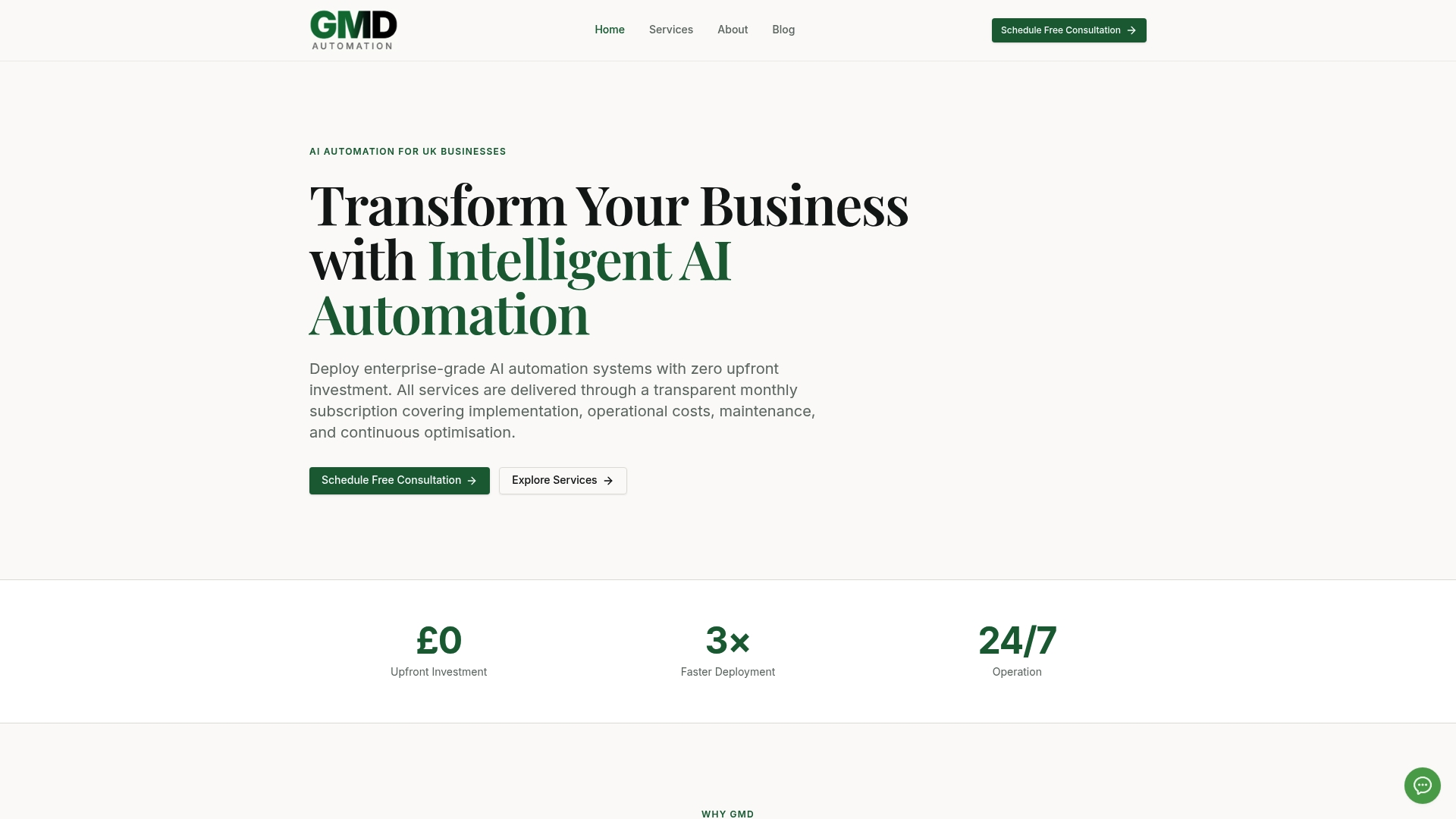
Gmdautomation works with UK businesses to deploy enterprise-grade AI automation on a predictable monthly subscription. There are no upfront costs, no long implementation delays, and no requirement to manage the technical infrastructure yourself. The service covers deployment, ongoing maintenance, and iterative optimisation, so the value compounds over time rather than degrading. Whether you are addressing a single high-friction workflow or planning a broader operational transformation, Gmdautomation provides the technical capability and sector-appropriate governance to do it properly.
FAQ
What are the clearest signs your business needs AI automation?
The most reliable indicators are high volumes of repetitive manual work, recurring errors in rule-based tasks, scaling challenges that require disproportionate headcount growth, and persistent communication delays with customers or prospects.
How do you know if a process is ready to automate?
A process is ready when it is stable, well-documented, follows consistent logic, and occurs frequently. Processes that are still being defined or require frequent human judgement are not suitable candidates yet.
What is the biggest risk when implementing AI automation?
Automating a poorly defined or broken process is the most common and costly risk. Automation amplifies existing processes, so any underlying inefficiency or ambiguity will be replicated at greater speed and scale.
How long does it take to see real value from AI automation?
Meaningful business impact typically becomes measurable between 30 and 180 days after deployment, depending on the complexity of the process and the quality of integration with existing systems.
Do small UK businesses benefit from AI automation?
Yes. AI tools for efficiency are no longer limited to large enterprises. UK SMEs across professional services, retail, and operations are deploying affordable automation solutions that deliver measurable returns without significant capital investment.