

AI in resource allocation is defined as the use of machine learning, reinforcement learning, and autonomous agent systems to distribute people, budget, and capacity across projects with greater accuracy than manual methods allow. For business leaders and resource managers, this is no longer a theoretical advantage. Research published in Scientific Reports shows that integrating deep reinforcement learning with digital twin technology achieves a resource recovery index of 0.83, outperforming traditional methods by significant margins. The role of AI in resource allocation now spans three core functions: capacity analysis, demand forecasting, and multi-variable optimisation. Each function addresses a distinct failure point in how organisations currently manage their resources.
How does AI improve capacity analysis and resource visibility?
AI-powered capacity analysis solves a problem that spreadsheets and siloed project tools cannot: fragmented data. Most organisations track resource utilisation across multiple systems, and no single project manager sees the full picture. AI consolidates this data from multiple sources into one view, surfacing overallocation risks before they become delivery failures.
The practical impact is significant. A resource manager using AI can see, in real time, that a senior developer is allocated at 140% capacity across three concurrent projects. Without AI, that overallocation only becomes visible when a deadline slips. With AI, the warning arrives weeks earlier, when there is still time to act.
Key capabilities AI brings to capacity analysis include:
- Cross-project dependency tracking: AI processes historical utilisation data alongside live project timelines to identify where one project's delay will cascade into another.
- Individual performance modelling: AI accounts for each team member's actual delivery rate, not just their nominal availability.
- Real-time utilisation dashboards: Resource managers receive live signals rather than weekly status reports.
- Overallocation alerts: AI flags risks invisible to managers focused on a single project view.
Pro Tip: Before deploying any AI capacity tool, map your current data sources. AI is only as accurate as the inputs it receives. Fragmented or inconsistent data will produce fragmented insights.
James McCann, a practitioner cited in project management research, notes that the greatest value of AI in capacity analysis is not the algorithm itself. It is the consolidation of information that was always there but never visible in one place at the right time.

In what ways does AI enhance demand forecasting and predictive resource planning?
AI demand forecasting uses historical delivery data to predict future resource needs with a level of detail that human planners cannot replicate at scale. The core advantage is pattern recognition across large datasets. AI identifies where scope tends to expand, which project phases consume more effort than estimated, and which resource types are consistently underestimated.
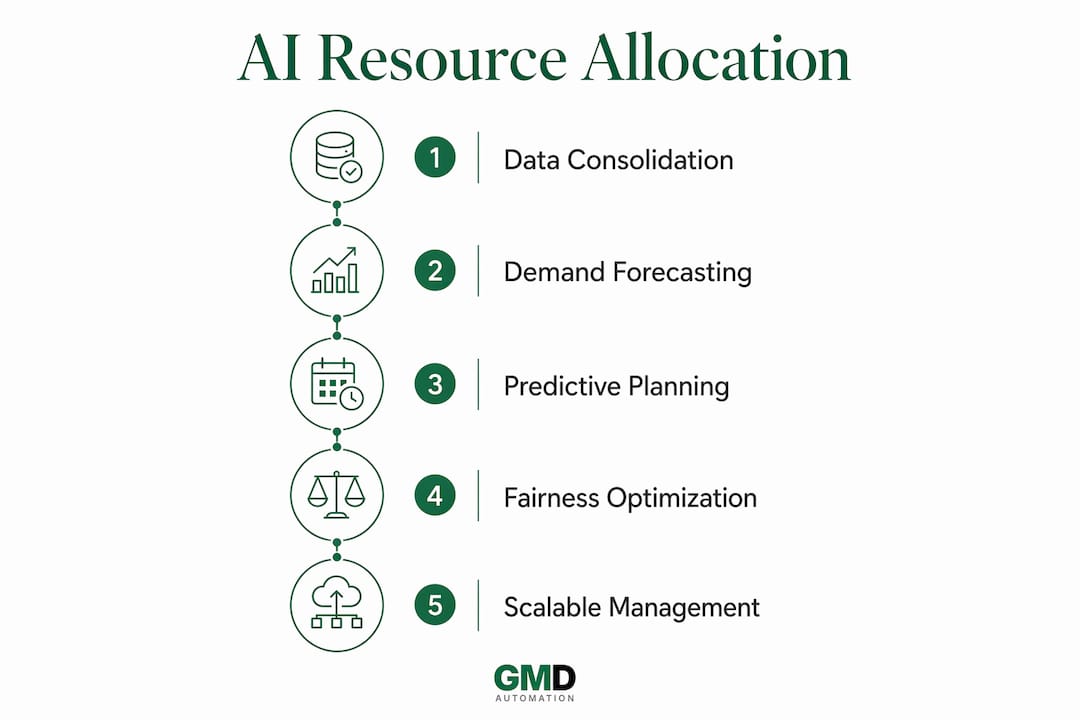
AI demand forecasting models account for phase-specific effort consumption and common underestimation patterns, directly reducing project cost overruns. Cost overruns remain one of the top contributors to project failure, as documented in PMI's 2024 Pulse of the Profession report. That finding matters because it means AI's forecasting capability addresses a measurable, recurring business problem rather than a theoretical one.
The forecasting benefits break down into four areas:
- Scope expansion modelling: AI learns from past projects where scope grew beyond the original brief and applies that learning to current plans.
- Phase-level resource prediction: Rather than estimating total project effort, AI models resource consumption phase by phase, improving accuracy at each stage.
- Underestimated resource identification: AI flags resource types that organisations consistently underbook, such as testing capacity or stakeholder management time.
- Scenario planning: AI runs multiple resource scenarios simultaneously, showing managers the cost and timeline implications of different allocation decisions before they commit.
The result is a shift from reactive resource management to genuinely predictive planning. Managers stop firefighting and start making decisions based on forward-looking data.
What complexities and benefits does AI optimisation introduce to resource allocation?
AI optimisation in resource allocation does more than match available people to open tasks. It balances capacity, skills, project priority, and fairness simultaneously. That complexity is both its strength and its most significant implementation challenge.
Balancing efficiency and fairness
Boltzmann-Softmax control parameters allow AI systems to tune dynamically between maximising throughput and preventing any single resource or team from monopolising capacity. This matters in practice because pure efficiency optimisation tends to concentrate work on the highest performers, burning them out and creating single points of failure. The Boltzmann-Softmax mechanism suppresses extreme dominance without degrading overall system performance.
The role of explainable AI
Explainable AI (XAI) is not optional in enterprise resource allocation. When an AI system recommends that a senior analyst be moved from Project A to Project B, the resource manager needs to understand why. Without that explanation, trust breaks down and managers override AI recommendations on instinct rather than evidence. Combining transformer-based deep learning, reinforcement learning agents, and XAI produces systems that are both accurate and auditable.
Multi-agent systems and automation
LLM-based autonomous agent systems in multi-agent architectures reduce allocation delays and increase resource utilisation compared to manual, rule-based methods. These systems automate the evaluation of project requirements and individual skill profiles with minimal human intervention. The AI agent architecture underlying these systems determines how well they handle competing priorities across departments.
The key considerations when deploying AI optimisation are:
- Define your fairness criteria before deployment. AI will optimise for whatever you measure. If fairness is not a defined metric, the system will not protect it.
- Require explainability from day one. Any AI system that cannot explain its recommendations will face stakeholder resistance.
- Avoid overselling AI capabilities. AI optimisation handles quantifiable variables well. It does not fully account for team dynamics, morale, or political factors.
- Build human override into the workflow. AI recommendations should inform decisions, not replace the judgement of experienced managers.
Pro Tip: Ask any AI vendor to demonstrate how their system explains a specific allocation recommendation. If the answer is a black-box score with no reasoning, treat that as a red flag.
| Optimisation factor | AI capability | Human judgement required |
|---|---|---|
| Capacity matching | High accuracy at scale | Low |
| Skills alignment | Strong with structured data | Medium |
| Fairness and equity | Requires explicit tuning | High |
| Team dynamics and morale | Limited | High |
| Regulatory compliance | Strong with XAI layer | Medium |
How is AI scaling resource allocation in large and complex enterprises?
Scale is where AI creates its most decisive advantage over manual resource management. A resource manager can track dozens of people. An AI system can track thousands, across geographies, departments, and project types, without degradation in accuracy.
Research on large-scale AI systems shows that advanced scaling methods can handle a 100x increase in managed agents with only a 5.5x increase in computational execution time. That ratio is what makes enterprise-grade AI resource allocation economically viable. The Adaptive Hard-Cap Controller (AHC++) maintains fairness targets even under sudden demand shocks, preventing resource concentration from destabilising the wider system.
For UK enterprises integrating AI with existing cloud and distributed infrastructure, scalable AI automation architecture is the foundation that determines whether the system performs under real operational load. Without it, AI tools that work in pilot programmes fail when deployed at full organisational scale.
| Scale scenario | Manual management | AI with AHC++ |
|---|---|---|
| 50 resources, 10 projects | Manageable | Marginal gain |
| 500 resources, 100 projects | Significant gaps | Strong performance |
| 5,000 resources, 1,000 projects | Not viable | Designed for this |
AI-managed services that model dependencies between technological resources, including energy and compute capacity, demonstrate how intelligent resource distribution extends beyond people management into infrastructure and sustainability planning.
What are key ethical and practical considerations when implementing AI for resource allocation?
AI-driven resource management faces real barriers beyond the technical. Data confidentiality and ethical concerns are the two most cited obstacles to adoption in cross-departmental AI systems. Both require deliberate governance, not just good intentions.
The core ethical and practical challenges include:
- Data privacy: AI systems require access to individual performance data, utilisation history, and project outcomes. That data is sensitive. Organisations must define clear data governance policies before deployment.
- Autonomous decision-making risks: Fully autonomous AI allocation decisions, without human review, create accountability gaps. Who is responsible when an AI-driven decision harms a team member's workload or career progression?
- Cross-departmental bias: AI trained on historical data inherits historical biases. If certain teams or roles have been consistently underresourced in the past, the AI may perpetuate that pattern.
- Regulatory compliance: AI system transparency is increasingly a regulatory expectation, particularly for organisations operating under UK data protection frameworks.
Human judgement remains the necessary complement to AI recommendations. The most effective implementations treat AI as a decision-support layer, not an autonomous authority. Managers who understand both the AI's outputs and its limitations make better decisions than those who either ignore AI entirely or defer to it without question.
Key takeaways
AI in resource allocation delivers its greatest value when capacity analysis, demand forecasting, and fairness-aware optimisation work together within a transparent, human-supervised system.
| Point | Details |
|---|---|
| Capacity analysis | AI consolidates fragmented data to surface overallocation risks before delivery failures occur. |
| Demand forecasting | Machine learning identifies scope expansion patterns and phase-level underestimates to reduce cost overruns. |
| Fairness and efficiency | Boltzmann-Softmax control parameters allow AI to balance throughput with equitable resource distribution. |
| Scalability | AHC++ handles a 100x increase in managed agents with only a 5.5x rise in computational load. |
| Human oversight | AI works best as a decision-support system; human judgement remains essential for social and operational factors. |
Why I think most organisations are still getting AI resource allocation wrong
The conversation around AI in resource management tends to focus on the technology. Which algorithm, which platform, which integration. That focus misses the harder problem, which is organisational readiness.
I have seen organisations deploy capable AI systems and then watch managers override every recommendation within six weeks. Not because the AI was wrong, but because no one had built trust in its outputs. The system could not explain its reasoning clearly, so experienced managers fell back on instinct. The AI became an expensive dashboard that nobody used.
The fix is not a better algorithm. It is explainability built into the system from the start, combined with a change management process that brings resource managers into the design of the AI's decision criteria. When managers help define what "fair" and "optimal" mean in their context, they are far more likely to act on what the AI recommends.
The other oversight I see consistently is treating AI optimisation as a one-time deployment. Resource allocation is not a static problem. Project portfolios change, team compositions shift, and business priorities evolve. An AI system that is not continuously monitored and recalibrated will drift from reality within months. Managed AI operations that include ongoing optimisation are not a luxury. They are what separates a system that works long-term from one that delivers a short-term proof of concept and then quietly fails.
The organisations getting this right are the ones treating AI as a collaborative tool, not a replacement for experienced resource managers. They use AI to see what humans cannot see at scale, and they use human judgement to interpret what the AI cannot fully understand.
— Ravi
How Gmdautomation supports AI-powered resource allocation for UK businesses
Gmdautomation builds AI automation systems for UK businesses that need enterprise-grade performance without the capital expenditure of building in-house. Their platform covers implementation, operation, maintenance, and ongoing optimisation under a predictable monthly subscription, removing the financial risk that stops many organisations from adopting AI at scale.
For business leaders and resource managers, Gmdautomation offers systems designed for security, compliance, and high performance from day one. Onboarding is fast, scaling is flexible, and the platform is built to handle the complexity of real organisational resource management. If you are evaluating how AI can improve your allocation decisions, explore Gmdautomation's AI solutions to see what enterprise-grade deployment looks like in practice.
FAQ
What is the role of AI in resource allocation?
AI in resource allocation analyses capacity data, forecasts demand, and optimises the distribution of people and budget across projects. It surfaces risks and inefficiencies that manual methods miss at scale.
How does AI improve demand forecasting for resource managers?
AI identifies patterns of scope expansion and resource underestimation from historical project data, reducing cost overruns. PMI's 2024 Pulse of the Profession report identifies cost overruns as a leading cause of project failure.
What is explainable AI and why does it matter for resource allocation?
Explainable AI (XAI) provides transparent reasoning behind allocation recommendations, which builds stakeholder trust and supports regulatory compliance. Without it, managers tend to override AI decisions based on instinct rather than evidence.
Can AI handle resource allocation at enterprise scale?
Research shows AI systems using the Adaptive Hard-Cap Controller (AHC++) can manage a 100x increase in resources with only a 5.5x rise in computational load, making large-scale enterprise deployment viable.
Should AI replace human judgement in resource allocation decisions?
AI works best as a decision-support system, not a replacement for human judgement. Social factors, team dynamics, and operational context require human interpretation that purely mathematical optimisation cannot replicate.