

Artificial intelligence in supply chain operations refers to the use of advanced algorithms and autonomous agents to improve forecasting, automation, and decision-making across the entire value chain. The practical examples of AI in supply chain operations now span demand planning, logistics automation, digital twins, and agentic workflows that act without human prompting. Demand forecasting alone reaches 87% adoption among leading organisations, making it the most mature AI application in the field. For UK supply chain professionals, understanding where AI delivers measurable results is the starting point for any credible digital transformation programme.
1. How AI improves demand forecasting and inventory management
Demand forecasting is the most proven AI use case in supply chain operations. Forecast accuracy improves by 20%–40% with machine learning models, releasing significant working capital that would otherwise sit in excess stock. That improvement translates directly into better service levels and lower carrying costs, two metrics every supply chain director tracks.
Traditional forecasting relies on historical averages and static safety stock calculations. AI replaces that with dynamic models that read signals from weather data, promotional calendars, social trends, and supplier lead times simultaneously. The result is a system that adjusts replenishment orders before a stockout occurs rather than reacting after the fact.

Agentic AI takes this further by initiating purchase orders autonomously within governed approval thresholds. The system does not wait for a planner to review a report. It acts, flags exceptions, and escalates only the decisions that genuinely require human judgement.
| AI technique | Application | Operational benefit |
|---|---|---|
| Machine learning regression | Demand signal processing | 20%–40% forecast accuracy gain |
| Agentic AI | Autonomous replenishment | Reduced stockouts and excess inventory |
| Dynamic safety stock models | Real-time buffer adjustment | Lower working capital requirement |
| Anomaly detection | Demand spike identification | Faster response to market shifts |
Pro Tip: Start demand forecasting AI with your top 20% of SKUs by revenue. Proving accuracy gains on high-value lines builds the business case for wider rollout far faster than a broad pilot.
2. AI-driven automation in logistics and shipment processing
Logistics is where AI automation produces the most visible time savings. AI-driven systems save over 600 hours of manual email processing daily in freight operations, with one provider processing 5,500 shipments daily through automated workflows. That scale of throughput is simply not achievable with human teams alone.
The core mechanism is an email-to-order AI agent. It reads incoming freight requests, extracts shipment details, cross-references capacity and rate data, and generates booking confirmations without a human touching the inbox. Exceptions, such as missing information or rate disputes, are routed to a human operator with a pre-populated summary.
The real-world AI automation gains from this approach go beyond cost reduction. Throughput increases because the system runs continuously. Error rates fall because the AI applies consistent rules every time. And planners shift from data entry to exception management, which is a far better use of their expertise.
Key capabilities that make logistics AI work at scale:
- Email parsing agents that extract structured data from unstructured freight requests
- Rate matching engines that compare carrier quotes against contracted rates in real time
- Exception routing that flags incomplete or anomalous bookings for human review
- Audit trails that log every automated decision for compliance and dispute resolution
Pro Tip: Deploy logistics AI agents modularly. Connect one agent to your email inbox first, then link it to your transport management system once accuracy is proven. Modular AI deployment avoids the risk of monolithic replatforming and keeps your team in control at each stage.
3. Agentic AI workflows and administration cost reduction
Agentic AI is the category that separates analytics from execution. Agentic AI workflows reduce supply chain administration costs by 40%–60% through proactive replenishment and production resequencing. A global consumer goods company achieved savings at that level by deploying agents that monitor supplier delays and automatically resequence production schedules to protect customer service levels.
The distinction between standard AI analytics and agentic AI matters enormously for UK business leaders evaluating where to invest. Analytics surfaces a problem. An agentic system surfaces the problem, analyses root causes, generates options, and executes the chosen response within defined guardrails.
"AI agents enable fully integrated cross-functional optimisation, overcoming traditional trade-offs in supply chain decisions. They can optimise revenue, costs, and risk simultaneously, extending decision capabilities beyond human limits." — BCG, 2026
Multi-agent AI systems perform multistep workflows that analyse data, investigate root causes, summarise findings, and generate execution materials autonomously. That orchestration accelerates problem detection and remediation in complex supply chains where speed of response is a competitive advantage.
Practical agentic AI use cases in supply chain administration:
- Supplier delay management. An agent detects a late inbound shipment, identifies affected production orders, proposes a resequencing plan, and notifies the relevant plant manager for approval.
- Invoice reconciliation. An agent matches purchase orders, goods receipts, and supplier invoices, flagging discrepancies and initiating dispute workflows without manual intervention.
- Capacity reallocation. When demand spikes unexpectedly, an agent reallocates production capacity across sites and updates the master production schedule in the ERP system.
- Carrier performance monitoring. An agent tracks on-time delivery rates by carrier, flags underperformance against contracted SLAs, and drafts escalation communications.
Understanding AI agent architecture is the foundation for deploying these workflows without creating governance gaps.
4. Digital twins and simulation models in supply chain planning
Digital twins are virtual replicas of physical supply chain networks. Evolutionary AI builds and continuously updates these models to simulate production, inventory, and logistics decisions across complex global operations. BASF's agricultural solutions division uses this approach to manage thousands of supply chain decisions across volatile demand patterns and multi-site production networks.
The value of a digital twin is scenario testing without operational risk. A supply chain leader can simulate the impact of a port closure, a raw material shortage, or a sudden demand surge before committing resources. The AI identifies bottlenecks, models alternative routings, and ranks options by cost and service impact.
Industries with complex, seasonal, or highly regulated supply chains gain the most from digital twins. Pharmaceuticals use them to model cold chain constraints and batch release schedules. Agricultural businesses use them to account for harvest variability and regional distribution requirements. Both sectors share the characteristic of high consequence for getting decisions wrong.
| Planning approach | Digital twin advantage | Without AI simulation |
|---|---|---|
| Scenario planning | Tests hundreds of options in minutes | Manual analysis of a handful of scenarios |
| Bottleneck identification | Flags constraints before they cause disruption | Identified only after delays occur |
| Cross-site coordination | Optimises across all sites simultaneously | Managed site by site with limited visibility |
| Capital cost management | Models inventory reduction without service risk | Relies on experience and rule of thumb |
5. Challenges and best practices in scaling AI across supply chains
Scaling AI beyond a pilot is where most organisations stall. Many AI projects fail due to lack of cross-functional alignment and unclear decision rights in operational frameworks. The technology is rarely the problem. The organisational design is.
Human-in-the-loop oversight is non-negotiable for safe AI deployment. Without traceable, explainable outputs, AI systems can fail in edge cases that differ from their training data. Supply chain operations encounter edge cases constantly, from geopolitical disruptions to sudden regulatory changes.
The biggest bottleneck to AI scaling is organisational design and human-speed decision cycles that hinder machine-speed execution. AI can generate a replenishment recommendation in seconds. If the approval process takes three days, the operational benefit disappears.
Best practices for scaling AI in supply chain operations:
- Define decision rights before deployment. Specify which decisions AI executes autonomously, which require human approval, and which remain fully human-controlled.
- Use modular architecture. Specialised AI agents linked incrementally to existing ERP infrastructure avoid the disruption of wholesale system replacement.
- Monitor model health continuously. Governance frameworks that track model accuracy and business alignment prevent performance drift over time.
- Invest in data quality first. AI models are only as accurate as the data they consume. Dirty master data produces confident but wrong recommendations.
- Align incentives across functions. Procurement, logistics, and finance often have conflicting KPIs. AI that optimises for one function at the expense of another will face internal resistance.
Understanding why AI automation outperforms manual outsourcing is useful context for building the internal case for scaling investment.
Key takeaways
AI in supply chain operations delivers measurable gains across forecasting, logistics automation, agentic decision-making, and simulation, but only when deployed with clear governance and modular architecture.
| Point | Details |
|---|---|
| Demand forecasting accuracy | Machine learning improves forecast accuracy by 20%–40%, directly reducing excess stock and working capital. |
| Logistics automation scale | AI agents process thousands of shipments daily, saving hundreds of hours of manual effort each day. |
| Agentic AI cost reduction | Autonomous workflow agents cut supply chain administration costs by 40%–60% in documented cases. |
| Digital twins for planning | Simulation models test hundreds of scenarios in minutes, identifying bottlenecks before they cause disruption. |
| Governance is the bottleneck | Most AI projects stall due to unclear decision rights, not technology limitations. |
The uncomfortable truth about AI adoption in UK supply chains
The conversation around AI in supply chains tends to focus on the technology. I think that is the wrong place to start. After working with UK businesses on AI deployment, the pattern I see most often is not a technology failure. It is an organisational one.
Teams adopt AI tools without agreeing on who owns the output. A demand planning AI generates a replenishment recommendation, and three people in three different functions all have the authority to override it. The result is that the AI runs, the humans override it anyway, and the organisation concludes that AI does not work. The AI worked fine. The governance did not.
The role of AI in augmenting human decisions rather than replacing them is the framing I find most useful for UK supply chain leaders. AI surfaces trade-offs faster and at greater scale than any human team can. But someone still needs to set the rules, own the exceptions, and be accountable for the outcomes.
Agentic AI is genuinely exciting. The ability to automate multistep workflows across procurement, logistics, and production planning is a step change in what is operationally possible. But I would caution against treating it as a quick fix. The organisations seeing 40%–60% administration cost reductions did not get there in a quarter. They built incrementally, proved value at each stage, and expanded from a position of confidence rather than urgency.
The UK businesses that will lead on AI in supply chains are not the ones with the biggest technology budgets. They are the ones that combine clear decision rights, modular deployment, and a genuine commitment to human oversight. That combination is harder to build than any AI model. It is also far more durable.
— Ravi
How Gmdautomation helps UK businesses deploy AI in their operations
Gmdautomation builds and deploys AI automation systems for UK businesses, covering the full cycle from implementation through to ongoing maintenance and performance monitoring. The approach is designed for supply chain and operations teams that need proven AI capability without the capital expenditure of building in-house.
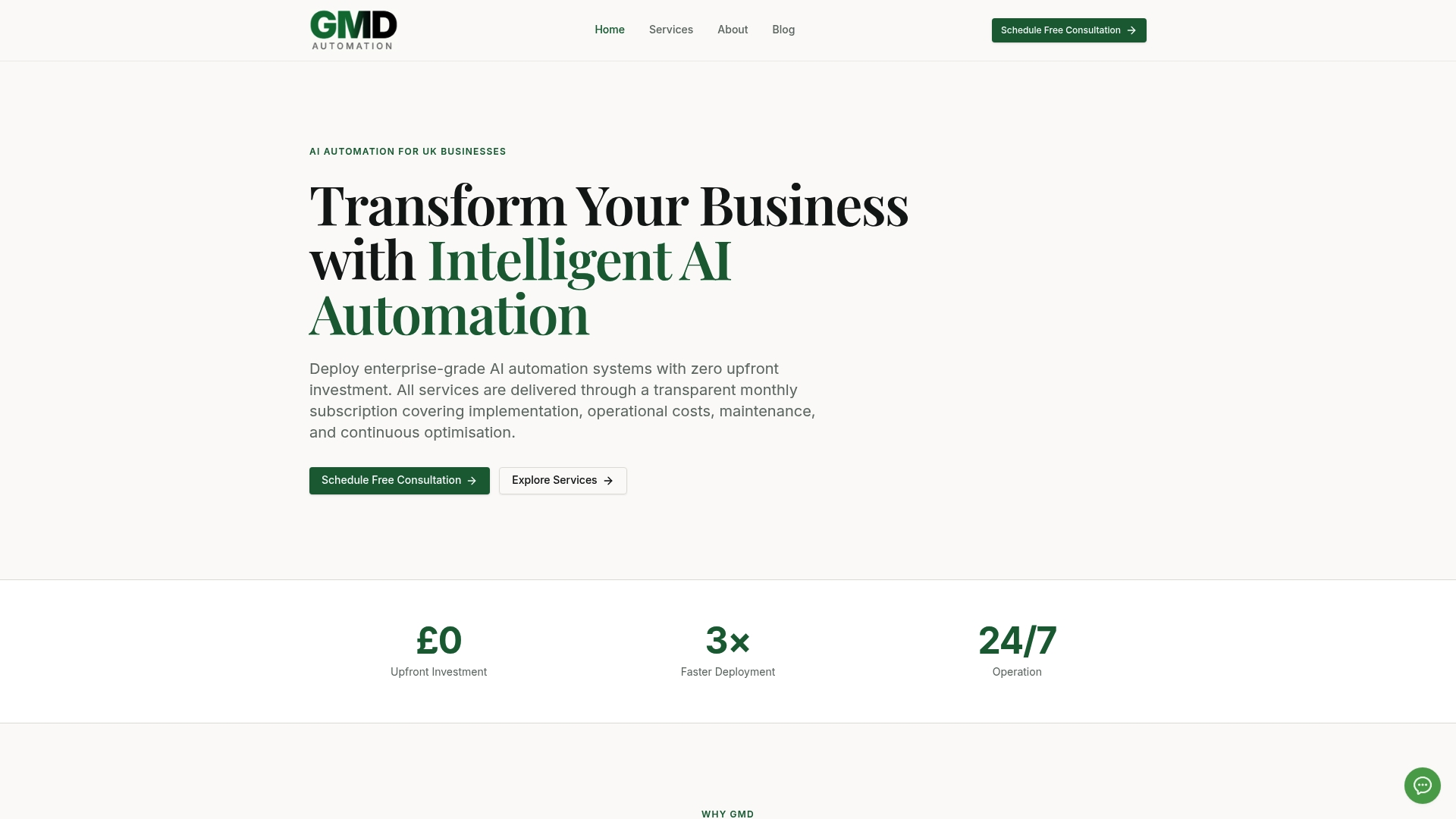
Every system Gmdautomation deploys operates on a predictable monthly subscription, covering implementation, operation, and optimisation. There are no upfront costs and no ambiguity about what is included. For supply chain leaders who have seen AI pilots stall due to budget overruns or unclear ownership, that model removes two of the most common barriers before the project begins. If you want to see how AI automation for UK businesses applies to your specific operations, Gmdautomation offers a demo built on the same systems it deploys for clients.
FAQ
What are the main examples of AI in supply chain operations?
The main examples include demand forecasting with machine learning, autonomous logistics agents that process shipments, agentic workflows for administration tasks, and digital twin simulation models for production planning. Each application targets a specific operational bottleneck with measurable results.
How much can AI improve demand forecasting accuracy?
Machine learning models improve forecast accuracy by 20%–40% compared to traditional statistical methods. That improvement directly reduces excess inventory and releases working capital across the supply chain.
What is agentic AI and how does it differ from standard AI analytics?
Agentic AI autonomously reasons, initiates actions, and executes decisions within governed workflows, whereas standard AI analytics only surfaces insights for humans to act on. The distinction matters because agentic systems can respond at machine speed, which is where the largest cost reductions occur.
Why do AI projects in supply chains fail to scale?
Most AI projects stall due to unclear decision rights and lack of cross-functional alignment rather than technology limitations. Defining who owns AI outputs and how exceptions are handled is the prerequisite for moving from pilot to production.
Is human oversight still necessary when using AI in supply chain operations?
Human-in-the-loop oversight remains essential because AI systems can fail in edge cases that differ from their training data. Governance frameworks that monitor model accuracy and maintain traceability protect operations from confident but incorrect AI outputs.