

Managed AI operations is defined as the continuous service model for maintaining, governing, optimising, and scaling artificial intelligence systems after they go live in a business environment. Most organisations treat deployment as the endpoint, yet the real work begins the moment an AI system touches production data and real users. 77% of organisations lack written AI governance policies, which means the majority of businesses running AI tools are doing so without the controls needed to keep them safe, compliant, or effective. For business owners and IT leaders, understanding what managed AI operations involves is the first step toward turning AI from a costly experiment into a dependable business capability.
What is managed AI operations and why does it matter?
Managed AI operations, often discussed under the broader term AI operations management or MLOps, refers to the full lifecycle of care applied to AI systems beyond their initial build. This includes governance, performance monitoring, model retraining, security controls, and strategic alignment with business goals. It is not a single tool or platform. It is an operational discipline.
The distinction matters because AI systems degrade without active management. A model trained on last year's data will drift as business conditions change. A customer-facing AI agent will produce inconsistent outputs if its prompts are never reviewed. Without a managed approach, these failures accumulate quietly until they cause visible damage to operations or customer trust.
Platforms such as Microsoft Azure OpenAI and AI Ops frameworks from providers including Saama and INSIDEA have formalised this discipline. They offer structured approaches to monitoring, anomaly detection, and continuous improvement that go far beyond what most internal IT teams can sustain alone.
What are the core components of AI operations management?
Managed AI operations is built on several interdependent practices. Each one addresses a specific failure mode that unmanaged AI systems routinely encounter.
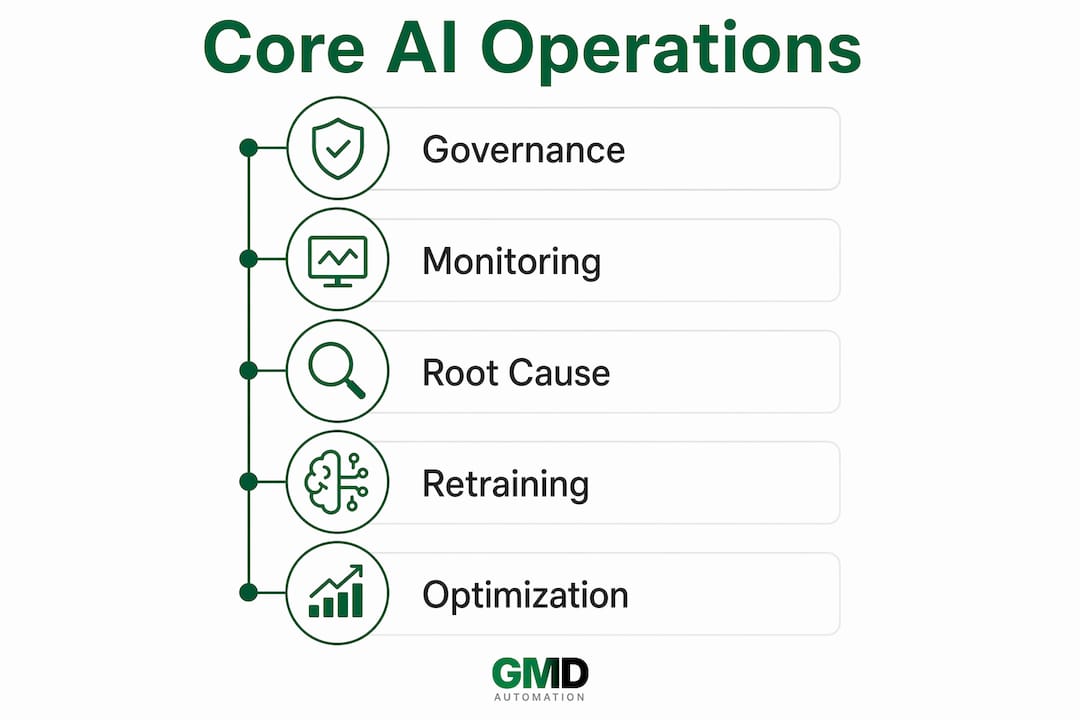
Governance and access control form the foundation. This means defining who can configure, query, or modify an AI system, and under what conditions. AI governance strategies covering role-based access and compliance frameworks are not optional extras. They are the controls that prevent AI tools from being misused or producing outputs that create legal or reputational risk.
Continuous performance monitoring tracks how an AI system behaves in production. This includes detecting data drift, where the inputs the model receives no longer match the data it was trained on, and runtime anomalies, where outputs fall outside expected parameters. Drift monitoring and prompt tuning are essential managed AI tasks that most internal teams lack the capacity to perform consistently.

Root-cause analysis is the process of diagnosing why an AI system produced a wrong or unexpected output. Managed AI frameworks can generate root-cause summaries in under 30 seconds, which means problems are identified and resolved before they compound.
Model retraining and prompt optimisation keep AI systems current. As business processes evolve, the instructions and data feeding an AI agent must evolve with them. This is an ongoing cycle, not a one-off task.
Pro Tip: Set a fixed review cadence for your AI systems, at minimum quarterly, covering prompt performance, output accuracy, and alignment with current business objectives. Treat it like a financial audit, not an IT ticket.
How does managed AI differ from traditional AI deployment?
The difference between traditional AI deployment and managed AI operations is the difference between installing software and running a service. Traditional deployment treats the go-live date as the finish line. Managed AI treats it as the starting line.
Managed AI extends far beyond basic maintenance. It involves continuous strategic alignment, accountability for outcomes, and proactive adaptation as business needs shift. The table below captures the key contrasts.
| Dimension | Traditional AI Deployment | Managed AI Operations |
|---|---|---|
| Ownership after launch | Handed to internal team | Retained by specialist provider |
| Performance tracking | Ad hoc or absent | Continuous, with defined metrics |
| Model updates | Triggered by failure | Proactive, on a scheduled cycle |
| Governance | Informal or none | Documented policies and controls |
| Business alignment | Set at project start | Reviewed and adjusted regularly |
| Cost model | Large upfront capital spend | Predictable monthly subscription |
The practical implication is significant. Businesses running AI without managed operations are effectively flying blind. They have no reliable signal on whether their AI is performing well, degrading, or creating risk. Managed AI connects AI initiatives directly to measurable business value, which is what separates organisations that see sustained returns from those that abandon AI projects after 12 months.
Pro Tip: When evaluating a managed AI provider, ask specifically how they measure AI performance against your business outcomes, not just technical uptime. If they cannot answer that question clearly, keep looking.
What benefits do managed AI operations deliver in 2026?
The business case for managed AI operations is grounded in measurable outcomes, not theoretical potential.
-
Operational efficiency at scale. Managed AI frameworks identify up to 38% of manual tasks as automatable within a given workflow. That figure represents real headcount capacity freed for higher-value work.
-
Faster incident resolution. Anomaly detection and rapid root-cause analysis reduce the time between a problem occurring and a fix being applied. This directly reduces downtime and the operational cost that comes with it.
-
Reduced compliance risk. Governance controls built into managed AI services mean your AI tools operate within defined boundaries. This matters particularly for UK businesses subject to data protection obligations under the UK GDPR.
-
Sustained AI performance. Without active management, AI systems degrade. With it, they improve. Senior AI engineers on retainer provide the expertise needed to keep systems current as both technology and business requirements evolve.
-
Improved decision-making transparency. Managed AI includes explainability and auditability features that allow business leaders to understand why an AI system produced a given output. This builds internal trust and supports regulatory compliance.
"The real power of managed AI services lies in linking AI capabilities to business priorities like friction reduction, service quality improvement, and decision-making enhancement." Source: What Managed AI Actually Means for Mid-Market Operators
For UK businesses pursuing digital transformation, these benefits compound over time. An AI system that is well-governed, continuously monitored, and regularly updated delivers more value in month 18 than it did in month one. That trajectory is only possible with managed operations in place. You can explore the full picture of AI automation business benefits to see how these gains apply across sectors.
How can organisations adopt managed AI operations successfully?
Adopting managed AI operations is a strategic decision, not a technical one. The organisations that get it right start with clarity on what they want AI to do and why.
-
Define the use case before selecting a provider. Managed AI services are most effective when scoped around specific, measurable business outcomes. Reducing customer query resolution time by 40% is a use case. "Using AI to improve customer service" is not.
-
Partner with providers who own the full lifecycle. The right managed AI partner covers implementation, ongoing operation, governance, and adaptation. Service-level accountability for uptime, escalation, and performance is non-negotiable. Ask to see the SLA before signing anything.
-
Establish autonomy guardrails before go-live. Defining autonomy thresholds before production deployment prevents AI agents from executing actions outside their intended scope. This is one of the most commonly skipped steps and one of the most consequential.
-
Integrate into existing architecture. Managed AI does not replace your current systems. It operates within them. Work with providers who understand your existing technology stack and can demonstrate how their AI layer connects to it. A guide to scalable AI architecture for UK enterprises covers the technical considerations in detail.
-
Plan for a minimum 12-month operational cycle. AI systems need time to be tuned, evaluated, and improved. Businesses that expect results within 90 days and then disengage are the ones that report AI disappointment. The value curve for managed AI is long, and the organisations that commit to it fully are the ones that see it.
Pro Tip: Before signing a managed AI contract, request a sample performance report from the provider. It should show model accuracy trends, anomaly logs, and business outcome metrics, not just system uptime. If they cannot produce one, that tells you everything.
Aligning AI with business goals from the outset is the single most important factor in whether managed AI operations deliver the returns you are expecting.
Key takeaways
Managed AI operations delivers sustained business value only when governance, continuous monitoring, and strategic alignment are built in from the start, not added later.
| Point | Details |
|---|---|
| Governance is non-negotiable | 77% of organisations lack AI policies; managed AI fixes this with role-based controls and compliance frameworks. |
| Deployment is not the finish line | AI systems degrade without active management; continuous care is what sustains performance and ROI. |
| Measurable efficiency gains | Managed AI frameworks identify up to 38% of manual tasks as automatable, freeing capacity for higher-value work. |
| Autonomy guardrails prevent risk | Define what your AI can and cannot do before it goes live to avoid out-of-scope actions. |
| Choose providers with full lifecycle ownership | SLAs, escalation processes, and senior engineering support separate genuine managed AI from basic maintenance contracts. |
Why most businesses are still getting AI operations wrong
I have spoken with enough IT leaders and business owners to know that the managed AI conversation almost always starts in the wrong place. The question is usually "which AI tool should we buy?" when it should be "who is going to run this thing after we switch it on?"
AI agents are not software installations. They behave more like living products. They need feeding with updated prompts, evaluation sets, and fresh data. They need monitoring for drift. They need someone who notices when outputs start degrading before a customer or a regulator does. Most internal IT teams are not staffed or trained for that. It is not a criticism. It is simply not what they were built to do.
The pitfall I see most often is the absence of autonomy guardrails. Businesses deploy AI agents with broad permissions and then wonder why the system occasionally does something unexpected. The fix is straightforward but it has to happen before go-live, not after an incident.
The other common mistake is treating managed AI as an IT function rather than a business function. The moment you separate AI operations from business outcomes, you lose the accountability that makes it work. The best managed AI arrangements I have seen treat the provider as a strategic partner with skin in the game, measured against business metrics, not just server uptime.
If you are evaluating managed AI operations for your organisation, start by reading the enterprise AI ROI guide to understand how to frame the investment correctly. The organisations that get this right do not just run better AI. They run better businesses.
— Ravi
How Gmdautomation supports managed AI operations for UK businesses
Gmdautomation builds and operates AI automation systems for UK businesses under a fully managed model. That means implementation, ongoing operation, governance, and continuous optimisation are all covered under a single predictable monthly subscription with no upfront capital cost.
Every system Gmdautomation deploys is built for security, compliance, and sustained performance from day one. The team handles prompt tuning, drift monitoring, anomaly detection, and regular performance reviews so your internal team does not have to. If you are ready to move from AI experimentation to AI that actually delivers, explore Gmdautomation's managed AI solutions and see how the model works in practice.
FAQ
What is managed AI operations in simple terms?
Managed AI operations is the ongoing service of maintaining, monitoring, and improving AI systems after they are deployed. It covers governance, performance tracking, model updates, and alignment with business goals.
How does managed AI differ from standard IT support?
Standard IT support reacts to technical failures. Managed AI operations proactively monitors AI performance, tunes models, enforces governance policies, and adapts systems as business needs change.
What are the main benefits of managed AI for UK businesses?
The primary benefits include identifying up to 38% of manual tasks as automatable, faster anomaly detection, reduced compliance risk under UK GDPR, and sustained AI performance over time rather than gradual degradation.
How long does it take to see results from managed AI operations?
Most organisations see measurable efficiency gains within the first three to six months, but the full value of managed AI compounds over a 12-month-plus operational cycle as systems are tuned and improved continuously.
Do i need a large internal AI team to use managed AI services?
No. Managed AI services are specifically designed to reduce the burden on internal teams. Providers like Gmdautomation supply the senior AI engineering expertise needed to operate and optimise systems on your behalf.