

AI automation is defined as the use of software systems to execute business processes end-to-end, without human intervention at each step. It outperforms manual outsourcing on cost, speed, and accuracy, and the gap is widening. IBM reduced annual operating costs by over $4.5 billion through AI integration, while JPMorgan Chase saved $1.5 billion by deploying AI across 250,000 employee desktops. For business leaders weighing AI vs manual outsourcing, the data no longer leaves room for ambiguity.
Why AI automation beats manual outsourcing on economics
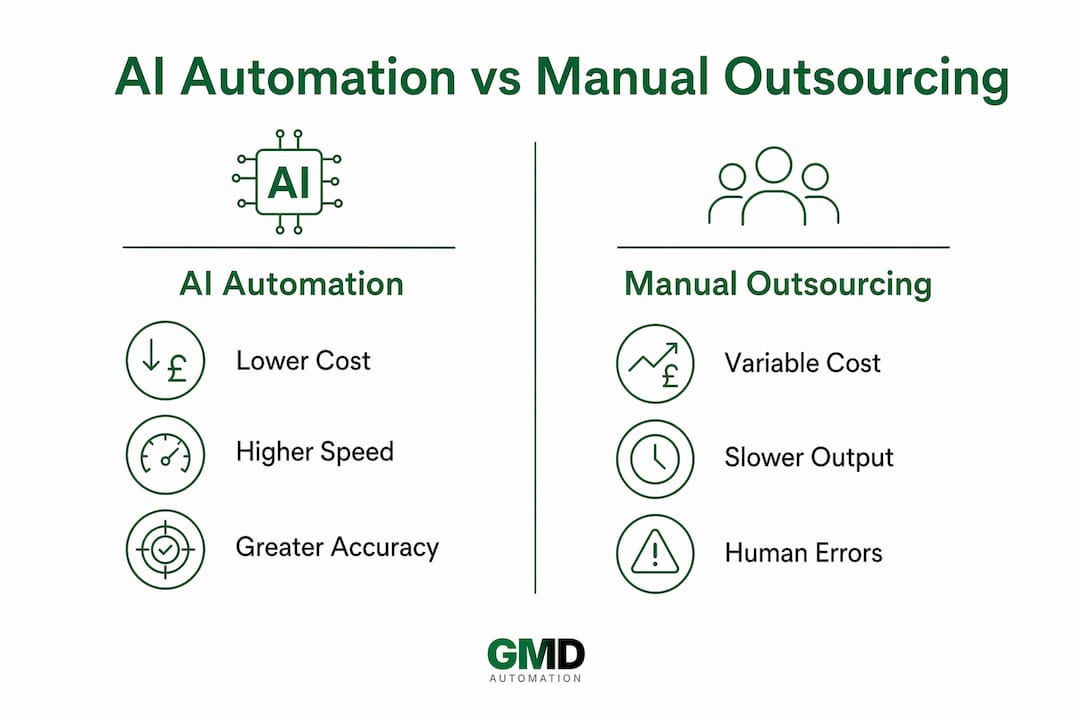
The core reason AI automation beats manual outsourcing is unit economics. Manual outsourcing trades headcount for output. AI trades a fixed monthly cost for near-unlimited throughput. That is a fundamentally different cost structure.

AI-augmented operations achieve five times the throughput at comparable cost to offshore headcount, with 70–80% straight-through processing rates reached within six months. Straight-through processing means a transaction or task completes from start to finish with zero manual touch. At 70–80%, the labour cost per unit collapses.
Manual outsourcing carries costs that compound over time:
- Headcount scaling costs: Adding capacity means hiring, onboarding, and managing more people.
- Error remediation: Human error rates in repetitive data tasks typically require rework cycles that consume 15–25% of total processing time.
- Coordination overhead: Offshore teams require management layers, quality assurance staff, and communication infrastructure.
- Attrition risk: Staff turnover in outsourcing operations disrupts continuity and inflates training costs.
AI eliminates most of these costs structurally. The system does not resign, require annual leave, or need retraining when a process changes.
Pro Tip: Before deploying AI, audit your current process for redundant steps and approval loops. Automating a bloated workflow does not save money. It locks in inefficiency at machine speed.
Does workflow redesign determine AI's advantage over manual outsourcing?
Yes. Workflow redesign is the single biggest determinant of whether AI automation delivers on its promise. The technology is not the constraint. The process architecture is.
Automating broken processes amplifies complexity rather than reducing it. Bain & Company describes this as "workflow debt," the accumulation of unnecessary process steps that AI magnifies when deployed without prior simplification. A manual outsourcing team can absorb process chaos through informal workarounds. An AI system cannot. It executes exactly what it is told, at scale.
"Business value from AI arises not from individual task improvement but from redesigning entire workflows to enable continuous, efficient task chains." — MIT Sloan Management Review
The architectural shift required is from task optimisation to end-to-end workflow orchestration. Manual outsourcing optimises individual tasks. A data entry team gets faster at data entry. AI, when properly deployed, chains tasks together so that the output of one step becomes the input of the next, with no human handoff in between. That is where the real throughput gains appear.
Task clustering, the practice of grouping AI-compatible tasks into continuous execution sequences, reduces the number of human-to-machine handoffs. Each handoff is a delay and a potential error point. Eliminating handoffs is not a marginal improvement. It is a structural one. Manual outsourcing, by contrast, is built around handoffs. Work moves between teams, time zones, and systems. Coordination is the product, not just the method.
How does the hybrid model balance AI speed with human judgement?
The most effective operating model in 2026 is not pure AI and not pure outsourcing. Hybrid models combining AI with human oversight outperform both approaches when applied correctly. The key is assigning work to the right layer.
AI handles the first pass on repetitive, rules-based tasks. Humans own the output, apply contextual judgement, and manage exceptions. This is not a compromise. It is a deliberate architecture.
A practical hybrid workflow looks like this:
- AI ingests and classifies incoming data, documents, or requests at volume.
- AI drafts outputs, such as reports, responses, or processed records, based on defined rules.
- A human reviewer checks flagged exceptions, approves edge cases, and owns the final deliverable.
- Offshore or specialist staff handle tasks requiring contextual knowledge, client relationships, or regulatory judgement.
- AI logs and audits every step, creating a compliance trail without additional administrative effort.
This structure means your offshore team spends time on work that genuinely requires human intelligence. They are not manually keying data or reformatting documents. The result is higher output quality, lower cost per transaction, and a more motivated team.
Pro Tip: Map your task inventory into three buckets: automate fully, automate with human review, and keep fully human. Most businesses find the middle bucket is larger than expected, and that is where hybrid models generate the most value.
What are the real-world benefits of AI automation over manual outsourcing?
The benefits of AI automation over manual outsourcing are measurable across cost, speed, accuracy, and capacity. The corporate examples set the scale.
IBM's AI-driven cost reduction of over $4.5 billion came from applying AI across HR, finance, and IT operations. That is not a technology project. It is an operational transformation. JPMorgan Chase's $1.5 billion saving came from deploying AI to 250,000 employees, not replacing them, but augmenting their daily workflows. Santander is targeting over €430 million in cost cuts by 2028 through AI-driven process simplification. These are not pilot programmes. They are enterprise-wide commitments.
For mid-sized UK businesses, the same principles apply at a smaller scale. The efficiency of AI automation translates directly into competitive advantage across sectors including financial services, professional services, logistics, and healthcare administration.
The practical advantages break down as follows:
- Speed: AI processes tasks in seconds that take human teams hours. Invoice processing, compliance checks, and customer query routing are common examples.
- Accuracy: Removing manual data entry from core workflows cuts error rates significantly. Fewer errors mean less rework, fewer client complaints, and lower remediation costs.
- Capacity on demand: AI scales instantly. A manual outsourcing team needs weeks to recruit and onboard additional staff. An AI system handles a volume spike the same day.
- Auditability: Every AI action is logged automatically. Manual outsourcing requires separate quality assurance processes to achieve the same level of traceability.
- Cost predictability: AI runs on a fixed cost model. Manual outsourcing costs fluctuate with volume, attrition, and currency exchange rates for offshore arrangements.
For business leaders building the internal case for AI investment, the AI automation ROI calculation is now well-established. The question is no longer whether AI delivers returns. It is how quickly you can redesign your workflows to capture them.
Key takeaways
AI automation outperforms manual outsourcing by restructuring cost, removing handoffs, and enabling five times the throughput at comparable expense, provided workflows are redesigned before deployment.
| Point | Details |
|---|---|
| Economics favour AI | AI delivers five times the throughput at comparable cost to offshore headcount within six months. |
| Redesign before automating | Deploying AI on broken workflows amplifies complexity. Simplify processes first. |
| Hybrid models win | Combining AI for repeatable tasks with human oversight for judgement produces the best outcomes. |
| Corporate savings are proven | IBM, JPMorgan Chase, and Santander have each committed billions in savings to AI-driven automation. |
| Predictable costs matter | AI runs on fixed monthly costs. Manual outsourcing costs fluctuate with volume, attrition, and staffing. |
Why I think most businesses are still approaching this the wrong way
I have spoken with enough business leaders to know that the majority treat AI as a bolt-on. They find a task that feels automatable, deploy a tool, and wait for the savings to appear. They rarely do, at least not at the scale expected.
Leaders who treat AI as a redesign catalyst rather than a tool see fundamentally different returns. The distinction matters because it changes what you do before you deploy anything. Redesign-first leaders map their entire workflow, identify the handoffs, remove the redundant steps, and then automate. Bolt-on leaders automate the existing mess and wonder why the numbers do not move.
There is also a financial discipline issue that does not get discussed enough. Executives must avoid funding new AI investments based on savings from previous automation projects that have not yet materialised. I have seen this pattern cause real damage. A business commits to a second wave of AI investment, funded by projected savings from the first wave. The first wave underdelivers. The second wave is now underfunded. The whole programme stalls.
The businesses getting this right are the ones where leadership has made workflow modernisation a board-level priority, not an IT project. They pair AI deployment with genuine workforce restructuring, not redundancy, but redeployment of human talent toward work that actually requires human intelligence. That combination is what produces the returns you read about in the IBM and JPMorgan case studies. The enterprise AI roadmap matters as much as the technology itself.
— Ravi
How Gmdautomation helps UK businesses move beyond manual outsourcing
Gmdautomation builds and deploys AI automation systems for UK businesses, with zero upfront costs and a fixed monthly subscription that covers implementation, operation, and ongoing optimisation.
For business leaders ready to move past the limitations of manual outsourcing, Gmdautomation offers enterprise-grade AI systems that are deployed rapidly and built for compliance and security from day one. There is no capital expenditure, no lengthy procurement cycle, and no ambiguity about what you are paying for each month. The focus is on practical workflow transformation, not theoretical capability. If you are ready to see what AI automation can deliver for your operation, visit Gmdautomation to learn more or request a demonstration.
FAQ
How much can AI automation save compared to manual outsourcing?
Corporate examples show savings in the billions: IBM cut over $4.5 billion in annual costs, and JPMorgan Chase saved $1.5 billion. Mid-sized businesses see proportional gains, particularly in processing speed and labour cost reduction.
Does AI automation replace offshore outsourcing teams entirely?
No. The most effective model combines AI for high-volume, repetitive tasks with human staff for judgement, exceptions, and client-facing work. Hybrid models consistently outperform pure AI or pure outsourcing approaches.
What is straight-through processing and why does it matter?
Straight-through processing means a task completes from start to finish with no manual intervention. AI-augmented operations reach 70–80% straight-through processing rates within six months, which directly reduces labour cost per transaction.
Why do some AI automation projects fail to deliver ROI?
The most common cause is automating existing broken workflows rather than redesigning them first. AI magnifies process complexity when deployed on inefficient legacy methods. Workflow simplification must precede automation deployment.
How quickly can AI automation be deployed for a UK business?
Deployment timelines vary by complexity, but providers like Gmdautomation offer rapid deployment with no upfront capital requirement. Most businesses see operational AI systems running within weeks rather than months.