

Brand voice AI turns a set of writing samples into a trained profile that keeps tone, vocabulary and personality consistent across every channel a marketing team touches. The right first move isn't a clever prompt library; it's building a proper voice profile from real content, then piloting it on a small scope before rolling it out. Platforms like HubSpot and Junia AI, alongside Anthropic's Claude, already offer this as a standard feature.
TL;DR:
- Building a brand voice AI profile requires 500 to 3,000 words of high-quality content, preferably from successful past campaigns, to accurately reflect your tone and vocabulary.
- Effective governance involves setting confidence thresholds, maintaining banned-term lists, and regularly auditing outputs to prevent drift into unapproved messaging.
- Channel-specific tone adjustments are crucial, with social media allowances for more personality, tighter grammar for formal emails, and increased empathy for support and complaint handling.
- Monitoring operational metrics like customer satisfaction scores and response times, along with alignment scores, helps track and maintain brand voice consistency over time.
- Starting with a narrow pilot on a single channel and iteratively refining the profile ensures better validation, reduces risk, and builds stakeholder trust before broader deployment.
Table of Contents
- What does brand voice AI actually do?
- How do you set up a brand voice AI profile?
- How should tone controls adapt by channel?
- What governance and guardrails does brand voice AI need?
- How do you measure brand voice alignment?
- What does a realistic brand voice AI pilot look like?
- How does brand voice AI fit your existing marketing stack?
- What are the data privacy and ethical risks?
- How should brand voice AI evolve over time?
- What common mistakes derail brand voice AI projects?
- What does a successful brand voice AI rollout look like in practice?
- Author perspective: lessons from enterprise rollouts
- How GMD Automation supports a brand voice AI pilot
- Selected vendor docs and guides to consult next
- Sources
- FAQ
What does brand voice AI actually do?
Brand voice AI reads your existing content, learns its patterns, and applies that pattern to new copy automatically. Instead of a copywriter re-reading brand guidelines before every email, the AI already knows the rules and writes within them.
The channels it covers typically include:
- Social media captions and replies
- Email marketing and transactional messages
- Live chat and customer support responses
- IVR and voice agent scripts
- Product descriptions and website copy
There's a meaningful difference between prompt-based tone and a properly trained voice profile. Typing "write this in a friendly tone" into a generic AI tool gives you a generic friendly tone, indistinguishable from a thousand other brands using the same prompt. A trained profile, built from your actual sentence structures, vocabulary choices and pacing, produces something that sounds like nobody else because it's drawn from your own writing history.
The practical payoff shows up in three places. Content moves faster because writers stop starting from a blank page. New hires produce on-brand copy from day one rather than spending weeks shadowing senior writers to absorb "how we sound." And fewer pieces need a full editorial pass, because the tone was correct before a human ever looked at it.
How do you set up a brand voice AI profile?
Building a usable profile is mostly a curation exercise, not a technical one. Here's the sequence that works:
- Gather representative samples. Most platforms want somewhere between 500 and 3,000 words of your best existing content, and HubSpot's own brand voice setup guidance sits squarely in that range. Junia AI recommends a tighter 1,500 to 3,000 word corpus drawn from your strongest posts, emails or social copy, ideally three to five distinct pieces rather than one long document.
- Choose personality traits and boundaries. Select a few personality characteristics (playful, authoritative, warm, direct, and so on), then add a short mission statement and a list of terms to avoid.
- Generate and refine. Upload the samples, let the platform build the initial profile, then layer on channel-specific rules for how the voice bends for email versus social versus support chat.
- Test and iterate. Run an initial batch of AI-generated content through your review process, score it against the source samples, and adjust the profile before wider rollout.
Pro Tip: Pull your samples from content that already performs well, not just content that's recent. A high-converting email from eighteen months ago teaches the AI more than last week's average one.
How should tone controls adapt by channel?
Most tone systems, including Gorgias's tone-of-voice settings, offer a small set of presets: friendly, professional, sophisticated, or a custom option with free text. Pick the preset closest to your brand, then use the custom field to describe genuine edge cases rather than restating the preset.
Channel adaptation is where most teams under-invest:
- Social copy runs shorter, looser, and tolerates more personality quirks than email.
- Formal email needs tighter grammar and a calmer register, even for a playful brand.
- Complaint handling needs empathy dialled up regardless of the brand's default tone, because a customer mid-complaint doesn't want jokes.
Keep topic-specific instructions, like how to word a returns policy or a pricing disclaimer, separate from the tone field entirely. Gorgias's own documentation makes this distinction explicitly: situational behaviour belongs in guidance rules, not buried inside a tone description the AI has to reinterpret every time.
What governance and guardrails does brand voice AI need?
Governance is what stops a trained voice profile drifting into something the brand team never approved. Without it, an AI system will happily generate confident, fluent nonsense in exactly the right tone.
Three controls matter most:
- Confidence thresholds. Set a clear rule for when the AI hands off to a human, particularly for ambiguous or emotionally charged queries.
- Banned-term lists and escalation flows. Maintain a living list of words, claims and topics the AI must never generate unsupervised, with a defined path to a human reviewer.
- Audit logs and sampling. Keep a record of what the AI produced and review a rotating sample regularly, not just after a complaint.
Decagon's guidance on AI tone of voice treats the profile as a living document that needs periodic scoring, testing outputs across both complaint and praise scenarios rather than assuming a good performance in one context carries over to the other.
Pro Tip: Test your AI's tone on your worst customer message, not your best one. A voice that sounds great replying to praise but stiff or tone-deaf replying to a complaint hasn't actually been validated.
How do you measure brand voice alignment?
Alignment scoring, comparing AI output against a curated set of gold-standard examples, is the core measurement, but it only means something if you sample regularly rather than checking once at launch.
Junia AI's approach includes generating alignment scores after each profile revision, which gives teams a repeatable number to track improvement against rather than relying on gut feeling from whoever reviews the output that week.
Beyond alignment scores, track three operational metrics:
- CSAT on AI-assisted interactions versus your previous baseline
- Response times, particularly for chat and support channels
- Conversion lift on AI-generated marketing copy compared with the human-written control
Report these monthly, not quarterly. A brand voice profile that's drifting will show it in blind sampling well before it shows up in a customer complaint, and monthly reporting gives you the chance to correct the profile before drift compounds. Feed every correction back into the source samples so the next generation of content starts from a cleaner baseline, rather than patching the same error repeatedly downstream.
What does a realistic brand voice AI pilot look like?
A working pilot runs in phases, and rushing the first one is the most common reason later phases fail.
- Discovery and sample collection (weeks 1 to 2). Pull your representative content, agree personality traits, and define which channels the pilot will actually touch.
- Profile build and channel tuning (weeks 3 to 5). Generate the initial profile, then adjust for each channel's specific register and constraints.
- Controlled launch and sampling (weeks 6 to 8). Deploy to a limited audience or a single channel, sample outputs closely, and score against your gold standard.
Minimum deliverables for a credible pilot: a curated sample corpus, defined integration points with your existing content or support systems, and a set of test scenarios covering both routine and edge-case queries. Success criteria should include a minimum alignment score threshold, stable CSAT against your pre-pilot baseline, and predefined rollback triggers if either metric slips. For voice-based deployments specifically, a pilot in the 2 to 8 week range is realistic for proving value before wider commitment.
How does brand voice AI fit your existing marketing stack?
A voice profile is only useful if it reaches the tools your team already uses every day. Bolting AI onto a separate workflow that writers have to remember to visit defeats the purpose.
The practical integration points are your CMS, your email platform, your social scheduler and your support or chat system. Dotdigital's brand voice setup is a useful example of how this looks in practice: channel toggles let you apply the same trained voice directly inside the content editor for email and social, rather than generating text elsewhere and pasting it in.
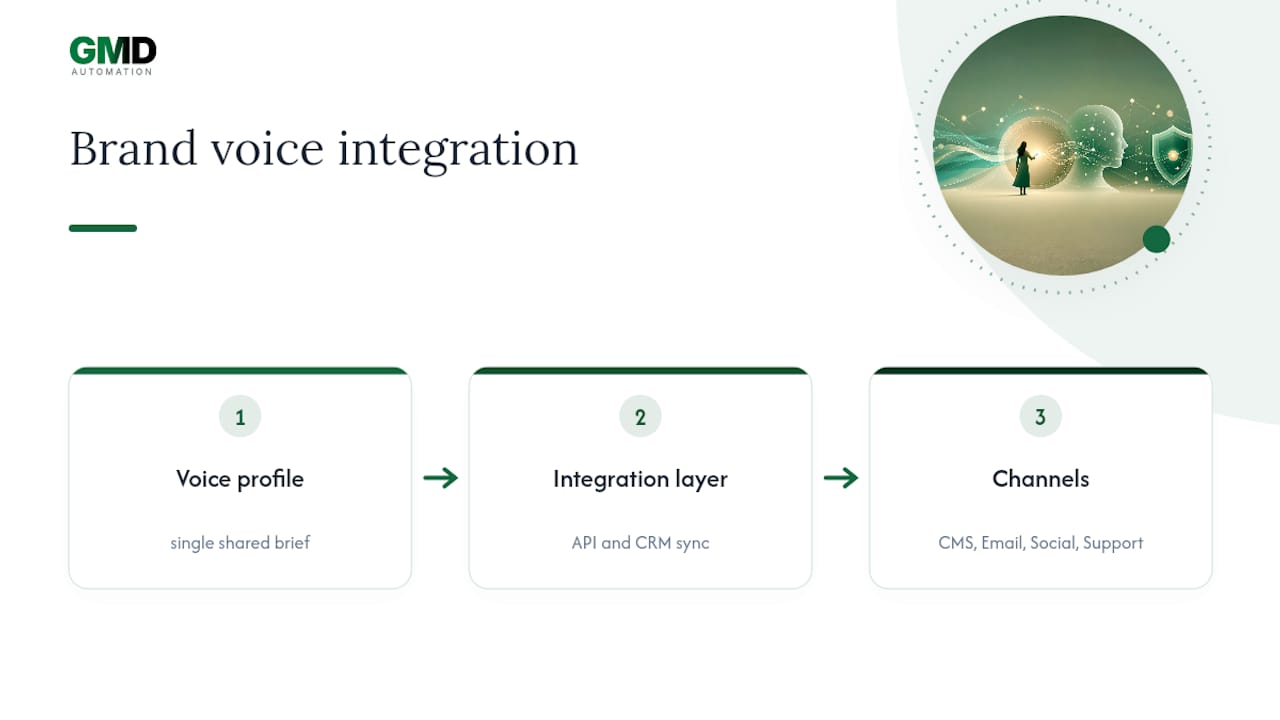
For teams running content calendars, a single brand brief can drive multi-channel output without each channel needing a separate tone conversation with the AI. That's the model worth aiming for: one profile, applied consistently, feeding a content calendar built from one brief rather than five disconnected prompts.
On the technical side, integration usually means connecting the voice profile to your CMS via API, syncing it with your CRM for personalised messaging, and wiring it into whatever chat or ticketing system handles customer replies. This is genuinely an IT conversation as much as a marketing one. A technical integration checklist for connecting AI tools to your existing CMS and CRM stack is worth reviewing before you commit to a specific platform, because the tone quality matters far less if the profile never actually reaches your live content editor.
What are the data privacy and ethical risks?
Feeding a brand voice AI platform your best-performing content, customer service transcripts and internal messaging means handing over material that may contain personal data, commercially sensitive language or, in the case of support transcripts, direct customer information.
Before uploading anything, check what the vendor does with your samples: whether they're used to train models beyond your own account, how long they're retained, and whether the platform is compliant with UK GDPR if you're handling customer data as part of the training corpus. Anthropic's brand voice plugin indexes materials from tools like Notion, Google Drive and Slack, which is efficient, but it also means those repositories need the same access controls and data hygiene you'd apply to any system holding customer or commercially sensitive information.
There's an ethical dimension too, particularly around disclosure. If a customer is chatting with an AI trained to sound exactly like your best human support agent, some regulators and increasingly some customers expect that to be disclosed. Building that disclosure into your channel guidance from the start avoids a retrofit later, when trust is harder to rebuild than to establish.
The security architecture question sits alongside this: who can edit the voice profile, who can see the audit logs, and what happens if the trained profile itself gets exposed or copied. A security-first approach to enterprise AI deployment treats the voice profile itself as a protected asset, not just the customer data flowing through it.
How should brand voice AI evolve over time?
A voice profile built once and left alone will drift out of relevance as your brand, your products and your market position change. Treat it the way you'd treat any living style guide, not a one-off setup task.
Schedule a formal review at least twice a year, and more often if you're launching new products, entering new markets, or rebranding. Each review should pull fresh sample content, particularly anything that's performed unusually well or badly, and feed it back into the corpus. Decagon's guidance on treating tone as a living asset applies directly here: score outputs periodically and test across different emotional registers, not just the happy-path scenarios.
Version control matters more than most teams expect. Keep a record of what changed in each profile revision and why, so if a change causes an unexpected drop in CSAT or alignment score, you can roll back to the previous version rather than guessing which adjustment caused the problem.

Advanced teams go beyond simple tone labels and map finer linguistic details, punctuation habits, typical sentence openers and closers, rhythm and cadence, to sharpen alignment further. This kind of linguistic fingerprinting is a genuinely useful refinement once the basic profile is stable, but it's not where you should start. Get the core profile working and trusted first, then layer in that level of detail during a later revision cycle.
What common mistakes derail brand voice AI projects?
The most frequent failure isn't a bad AI model. It's a governance gap. Teams deploy a trained voice profile without agreeing who reviews flagged outputs, and drift creeps in unnoticed for weeks before anyone catches it in a customer complaint.
Under-sampling is close behind. A team runs an initial batch of twenty outputs at launch, scores them, feels satisfied, and never checks again. Voice drift tends to show up gradually, not all at once, which is exactly why irregular sampling misses it.
Mixing tone settings with language or localisation settings causes a subtler problem. A tone field configured for "professional" and a separate language setting configured for regional spelling can conflict in ways that produce oddly formal, oddly formatted text that reads as neither fully professional nor properly localised.
Skipping the pilot phase entirely is the mistake with the highest cost. Teams that go straight from profile creation to full rollout across every channel lose the chance to catch channel-specific problems, like a tone that works beautifully in email but reads stiff and robotic in live chat, before customers see them at scale.
Finally, treating the profile as finished after the initial setup rather than a living asset means the voice ages badly. A brand that repositions itself but never updates its AI training samples ends up with an AI voice that sounds like last year's brand, not this year's.
What does a successful brand voice AI rollout look like in practice?
The pattern across successful rollouts is consistent: narrow scope first, governance built in from day one, then expansion only once the numbers hold steady.
A common structure starts with a single channel, usually customer support chat or social replies, rather than attempting simultaneous rollout across email, social and voice. That narrower scope lets the team validate alignment scores and CSAT before adding complexity. Outbound calling deployments follow a similar logic: a compliance-first pilot approach proves the voice works within a defined, monitored scope before it touches a wider customer base.
For voice-based channels specifically, the written tone has to be translated into spoken guidelines, covering pacing, pauses and vocal warmth, not just word choice. A guide to generating natural AI voiceovers is a useful reference here, because a voice profile that reads warmly on a page can sound flat or rushed when converted to speech without deliberate attention to cadence.
Onboarding speed is one of the more consistently reported wins. New marketing hires and support agents can produce on-brand content from their first week using the trained profile, rather than spending several weeks shadowing senior colleagues to absorb the brand's unwritten rules. That single benefit often justifies the setup cost on its own, well before the harder-to-measure gains in consistency and review time show up in the numbers.
Author perspective: lessons from enterprise rollouts
The teams that succeed with brand voice AI aren't the ones with the cleverest prompts. They're the ones who treat governance as the actual product, not an afterthought bolted onto a faster output rate. The recurring failure pattern is depressingly consistent: under-sampling after launch, no defined escalation rule for ambiguous replies, and tone settings tangled up with language configuration until nobody can tell which one broke. A tightly scoped pilot, reviewed honestly against a gold standard, does more to earn stakeholder trust than any impressive demo ever will.
— Ravi
How GMD Automation supports a brand voice AI pilot
Gmdautomation is the practical route for marketing teams who want a trained voice profile deployed properly, without the upfront cost of building and maintaining the infrastructure yourselves. Instead of stitching together separate tools for chat, email and voice, you get a managed system covering implementation, operation and ongoing optimisation under one predictable monthly subscription, with zero upfront investment.
A typical engagement starts with a scoped pilot, similar in structure to the phased approach outlined earlier, running over a matter of weeks rather than months, so you see alignment scores and CSAT movement before committing to a wider rollout. GMD Automation's own AI-driven services, including AI agents that qualify leads and book appointments from £300 a month, are built on the same compliance-first, human-in-loop principles this article has covered throughout. If you're weighing up whether to build a voice profile internally or bring in a managed system that already handles the governance layer, get in touch to discuss a short pilot scoped to your channels.
Selected vendor docs and guides to consult next
For hands-on configuration, these are worth bookmarking:
- HubSpot's brand voice setup guide for sample sizes and personality trait selection
- Gorgias's tone-of-voice documentation for preset options and custom guidance fields
- Anthropic's brand voice plugin for indexing scattered brand materials
- Junia AI's brand voice generator for corpus sizing and alignment scoring
Sources
- Set up brand voice using AI — HubSpot Knowledge
- Customize AI agents' tone of voice — Gorgias docs
- Brand Voice Plugin | Claude by Anthropic
- AI Brand Voice & Writing Style Generator — Junia AI
FAQ
What is a brand voice example?
A brand voice example is a piece of content, an email, a social post, a support reply, that clearly demonstrates a brand's consistent tone, vocabulary and personality. Marketing teams typically compile several of these to train a brand voice AI profile.
What is brand voice?
Brand voice is the consistent personality and tone a company uses across all its written and spoken communication, distinct from visual branding like logos or colour schemes. It covers word choice, sentence rhythm, formality level and emotional register.
What is the most famous AI voice?
There isn't a single agreed "most famous" AI voice, since recognition varies heavily by platform and region; voice assistants and AI-generated voiceovers each have their own well-known examples within their category. What matters more for brand use is whether a voice, AI-generated or trained, matches your specific brand rather than sounding like a generic assistant.
What is Nike's brand voice?
Nike's brand voice is widely recognised as motivational, direct and confident, built around short, punchy statements rather than elaborate explanation. It's frequently cited as a reference example precisely because the tone stays recognisable whether it appears in a tagline, an email subject line or a product description.
How much content do you need to train a brand voice AI profile?
Most platforms recommend between 500 and 3,000 words of representative samples, with some tools like Junia AI suggesting a tighter 1,500 to 3,000 word range drawn from three to five of your best-performing pieces.
Does Gmdautomation offer brand voice AI as part of its services?
Gmdautomation's managed AI services, including lead qualification and appointment booking agents, are built on trained voice profiles rather than generic prompts, with pricing available on its services page.