

Marketing teams should adopt AI for social media now, but only with human-in-the-loop review and clear governance built in from day one. Done properly, it saves hours of manual scheduling each week, keeps publishing consistent even when a team is stretched thin, and lets you react to a trending moment in minutes rather than days. The rest of this guide breaks down the capabilities worth paying for, the workflows that actually deliver, and how a managed approach removes most of the operational risk.
TL;DR:
- Reliable AI social media management depends on robust integration of platform APIs, analytics, CRM, and approval systems, not just on feature offerings.
- Focus on governance essentials like audit logs, prompt retention, and access control to prevent operational failures and ensure compliance.
- Pilot AI tools on secondary channels to assess real-world reliability, scalability, and the team’s capacity for daily review before full deployment.
- Building in-house is only advantageous if your team has significant engineering resources; most teams benefit from managed services for faster, safer implementation.
- The market expects AI automation in marketing to roughly double by 2028, emphasizing the need for controlled, well-governed workflows over feature hype.
Table of Contents
- What does AI social media management actually cover?
- How does AI power practical social workflows?
- What systems should you connect, and why?
- How do you evaluate and choose the right AI approach?
- What's the rollout plan, and where do teams go wrong?
- Why does implementation experience matter more than feature lists?
- When should you build in-house versus choose a managed service?
- Gmdautomation: managed AI social media without the upfront risk
- Selected further reading and primary sources
- Sources
- FAQ
What does AI social media management actually cover?
The phrase gets used loosely, so it helps to be precise about what's on offer. Six capability areas make up the working definition of AI social media management today: content generation, platform-specific adaptation, scheduling and publishing, social listening, engagement automation, and predictive analytics.
Tool roundups tend to differentiate themselves on content generation, platform optimisation, recycling and conditional posting, which tells you where vendors think the value sits. But that's only half the picture. The other half, and arguably the more valuable one, is what the industry now calls social intelligence rather than social content: predictive analytics, trend detection, and risk monitoring that flag problems before they become crises, as Meta's own guidance on AI-driven social workflows makes clear.
Here's the practical breakdown:
- Content generation — drafting captions, image variants, and short video scripts from a single brief, usually with a human editing pass before publishing.
- Platform-specific adaptation — reformatting one idea into a LinkedIn post, an Instagram carousel, and a TikTok script, each matched to that platform's tone and constraints.
- Scheduling and publishing — queueing content against optimal-time models and platform-specific posting rules.
- Social listening — tracking brand mentions, competitor activity, and sentiment shifts across channels in real time.
- Engagement automation — triaging comments and DMs, suggesting replies, and escalating anything sensitive to a human.
- Analytics and prediction — forecasting which content formats or topics are likely to perform before you commit budget to them.
Where AI genuinely earns its keep is the repetitive middle: reformatting a brief for five platforms, or spotting a spike in negative sentiment at 2am. Where it still needs a human hand is judgement calls: tone during a genuine crisis, anything touching a legal or safety claim, and any reply that could be read as a promise the business can't keep. Treat those categories as separate approval lanes, not as one blanket "AI writes, human checks" rule.
How does AI power practical social workflows?
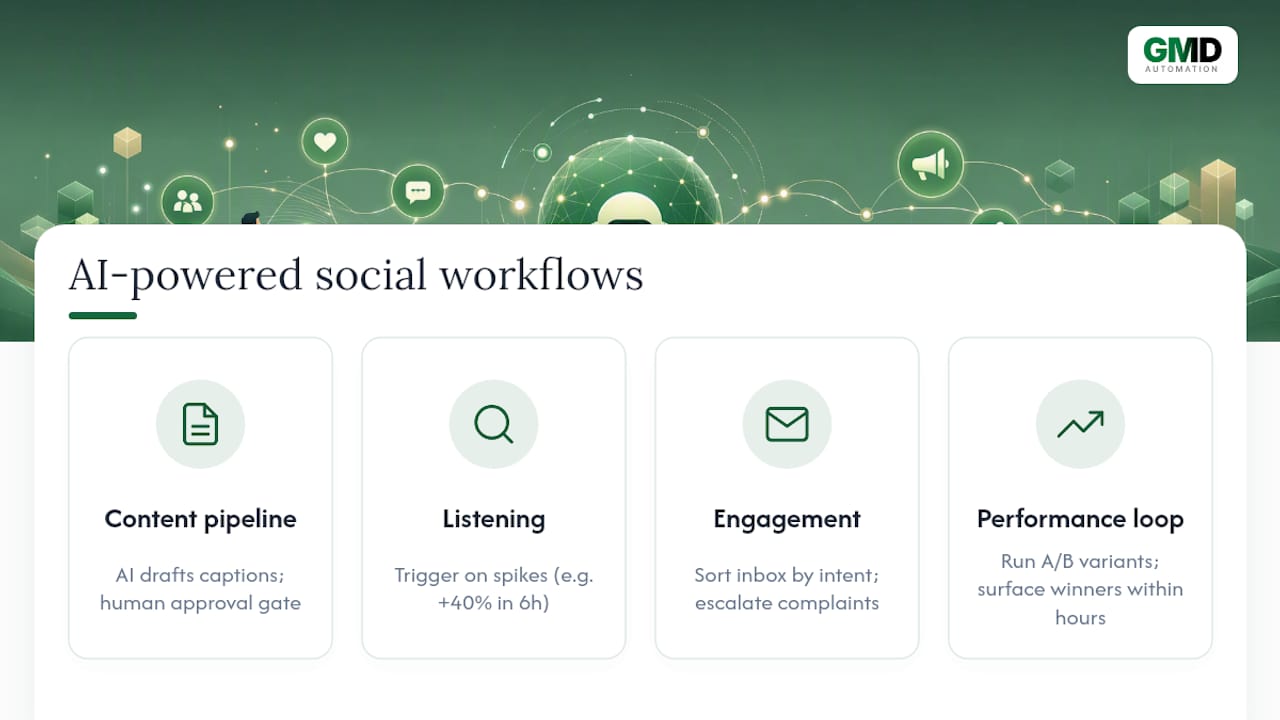
Feature lists are one thing. What matters is whether they chain together into something a small team can run without babysitting it. Four workflows cover most of what marketing teams actually build.
1. Content pipeline: idea to publish. A brief goes in (a campaign theme, a product update, a seasonal hook) and AI drafts captions and visual variants tailored to each platform's format. A human reviewer edits and approves, then the system schedules across channels using its own optimal-timing model. The handover point that matters most is the approval gate. Skip it and you're publishing unreviewed AI copy under your brand name, which is exactly the scenario that produces the awkward screenshots people share on the internet.
2. Listening to campaign ideation. Social listening tools flag a spike, a competitor stumble, or a sudden shift in what your audience is talking about. Set a trigger threshold (say, mention volume up 40% in six hours, or sentiment dropping below a set baseline) and route anything past that threshold to a Slack channel or a campaign brainstorm rather than letting it sit in a dashboard nobody checks. Independent guides to social listening platforms are worth reading before you commit budget here, because the market has genuine range in how fast and how accurately different tools catch a rising signal.
3. Engagement automation with escalation rules. Inbox triage is where AI pays for itself fastest. Comments and DMs get sorted by intent (question, complaint, sales lead, spam) and routine questions get a suggested reply a human can approve in one click. Anything flagged as a complaint, a legal mention, or an ambiguous tone gets escalated automatically rather than auto-replied to. Gmdautomation's own guide to automating Instagram DMs walks through exactly this kind of escalation logic in more depth.
4. The performance loop. AI can generate A/B variants of a headline or a thumbnail, publish them in parallel, and surface which variant is outperforming within hours rather than days. The system then suggests the next iteration based on what won, so the loop tightens with each cycle instead of starting cold every time.
Pro Tip: Set your escalation thresholds before launch, not after the first bad interaction goes live. Teams that wait to define "what counts as urgent" end up defining it reactively, usually right after something has already gone wrong.
Gartner's research suggests marketing leaders expect AI automation of marketing work to roughly double by 2028, which is a useful reality check: the shift isn't a future possibility, it's already priced into how marketing departments are planning headcount and budget for the next two years.
What systems should you connect, and why?
Getting AI social media management to work reliably isn't really a content problem. It's an integration problem. The tools that fail in production usually fail because nobody thought through what needs to talk to what.
Six systems typically need to connect for a workflow to run without manual patching:
- Platform APIs (Meta, LinkedIn, X, TikTok) for actual publishing and data pull.
- Digital asset management (DAM) so AI tools pull approved brand imagery rather than generating off-brand visuals from scratch.
- Analytics platforms to feed performance data back into the prediction loop.
- CRM systems so engagement automation can recognise an existing customer versus a cold lead.
- Single sign-on (SSO) for access control across a growing tool stack.
- Approval or workflow systems to log who signed off on what, and when.
There are two broad architectural patterns worth knowing before you buy anything. The first is an AI assistant plus a separate publishing layer: you keep whichever generative AI tool your writers already like using, and connect it to a dedicated scheduler that handles the platform-specific mechanics. Products following this pattern let teams keep their preferred AI writer and pay only for the publishing infrastructure, which keeps costs modular but means you're managing two vendor relationships instead of one. The second pattern is AI embedded inside an existing scheduler, where generation and publishing live in the same interface. Hootsuite's approach is the clearest example: platform optimisation and scheduling happen without switching interfaces at all, which reduces friction but ties you more tightly to that one vendor's roadmap.
Neither pattern is universally right. A modular assistant-plus-publisher setup suits a team that already has strong opinions about which AI writer it likes. An embedded system suits a team that wants one login and one support line, and is willing to trade some flexibility for that simplicity.
Whichever pattern you choose, three governance essentials shouldn't be optional:
- Audit logs recording every AI-generated draft, every edit, and every approval, timestamped and attributable to a named person.
- Prompt retention so you can reconstruct exactly what instruction produced a given piece of content if a client, regulator, or journalist ever asks.
- Access control that limits who can approve a post going live, separate from who can draft one.
Teams that treat AI as one component of an auditable workflow, with preserved prompts and rollback options, consistently avoid the largest operational risks. Teams that treat it as a black box that "just posts stuff" are the ones that end up explaining themselves to a client at short notice.
How do you evaluate and choose the right AI approach?
Most procurement conversations about AI social tools focus on features. The better conversation is about reliability, because a tool that generates brilliant captions but occasionally publishes them to the wrong account, or drops a scheduled post entirely, will cost you more in cleanup than it saves in drafting time.
Run any shortlist against this checklist before you sign anything:
- Publishing reliability — does it actually post on time, every time, across every connected platform?
- Platform coverage — does it support every network you actually use, not just the major three?
- Human-in-the-loop controls — can you insert a mandatory approval step, or does it publish automatically by default?
- Auditability — can you pull a log of every AI-generated draft and every human edit, months later, if you need to?
- Security and compliance — where is data stored, who can access it, and does it meet whatever standard your sector requires?
- Support SLAs — what happens, and how fast, when publishing breaks at 8am on a Monday?
For the pilot itself, measure against a small number of clear KPIs rather than trying to prove everything at once. Track time saved per week against your current manual process, publishing frequency versus your pre-AI baseline, engagement uplift on AI-assisted posts against a control group of manually written ones, and the error rate: missed posts, wrong platform, formatting failures. A publishing layer that validates platform constraints before a post goes out, character counts, media sizes, thread lengths, catches a surprising number of failures before they become a support ticket, and that validation step alone is worth asking about directly in any vendor demo.
Before you commit budget, close out a short list of questions with any vendor: What happens to your data if you cancel? Who owns the content generated during the trial? Can you export your full audit history if you switch providers later? And internally: does your team actually have the capacity to review AI drafts daily, or will the approval queue become the new bottleneck? Nine practical examples from Meta's own AI social workflows are a useful sanity check here, because they show what "working well" looks like in practice rather than in a sales deck.
Pro Tip: Run your pilot on your second-most-important social channel, not your flagship one. You want real production pressure without betting your primary brand presence on a tool you're still learning to trust.
What's the rollout plan, and where do teams go wrong?
A pilot that skips scoping tends to sprawl. Before you touch a single tool, get four things settled: which platforms are in scope, what API access you actually have (some platforms restrict third-party publishing more than others), who signs off on brand voice and legal risk, and a written content policy covering what AI can draft unsupervised versus what always needs a human first.
The rollout itself works best in four stages:
- Pilot on one channel with a small content set, running your KPI tracking from day one rather than bolting it on afterwards.
- Review after two to four weeks against the time-saved, frequency, engagement, and error-rate metrics you set going in.
- Expand gradually, adding platforms and workflow types (listening, then engagement automation) rather than switching everything on at once.
- Add operational guardrails as you scale: rate limits on auto-publishing, mandatory human review for anything mentioning pricing, promotions, or competitors, and a documented rollback process if something goes wrong publicly.
The pitfalls that actually sink these projects are rarely about the AI's writing quality. Over-automation, letting AI publish without any review gate because the pilot went smoothly, is the most common one, and it usually surfaces the first time a platform changes its policies without warning and an unreviewed post breaches it. Ignoring platform policy changes is the second: networks update advertising and automation rules regularly, and a workflow built against last year's rules can quietly start breaking things. Missing audit trails is the third, and the most expensive to fix retroactively, because you can't reconstruct an approval history you never logged in the first place. Gmdautomation's broader checklist for operations managers rolling out AI automation covers the same territory from an operational rather than marketing angle, and it's worth reading alongside this one if procurement sits outside the marketing team.
— Ravi
Why does implementation experience matter more than feature lists?
Anyone can demo a tool that writes a decent caption. What separates a workflow that survives contact with a real publishing calendar from one that collapses under it is implementation experience, the accumulated knowledge of exactly where things break and why.
The gap between a tool that works in a demo and a workflow that survives a real, messy publishing calendar is almost always governance, not generation quality. The captions are rarely the problem. The approval chain, the audit trail, and what happens when a platform changes its API without warning, that's where projects actually fail.
DIY toolchains, stitching together a generative AI writer, a separate scheduler, a listening tool, and a spreadsheet to track approvals, tend to fail quietly rather than dramatically. A missed API rate limit here, an unlogged approval there, and six months later nobody can explain why a post went out without sign off. A managed service absorbs that operational overhead by design: onboarding, ongoing maintenance, and compliance monitoring are built into the subscription rather than left for an already-stretched marketing team to patch together. That's the practical argument for a managed model over a self-assembled stack: not that the individual tools are worse, but that nobody is watching the seams between them.
When should you build in-house versus choose a managed service?
Building in-house makes sense when you have engineering capacity to spare, a genuinely unusual workflow no off-the-shelf tool covers, and the patience for a multi-month build. It gives you full customisability and no recurring vendor fee, at the cost of unpredictable timelines and the burden of maintaining it yourself when a platform API changes.
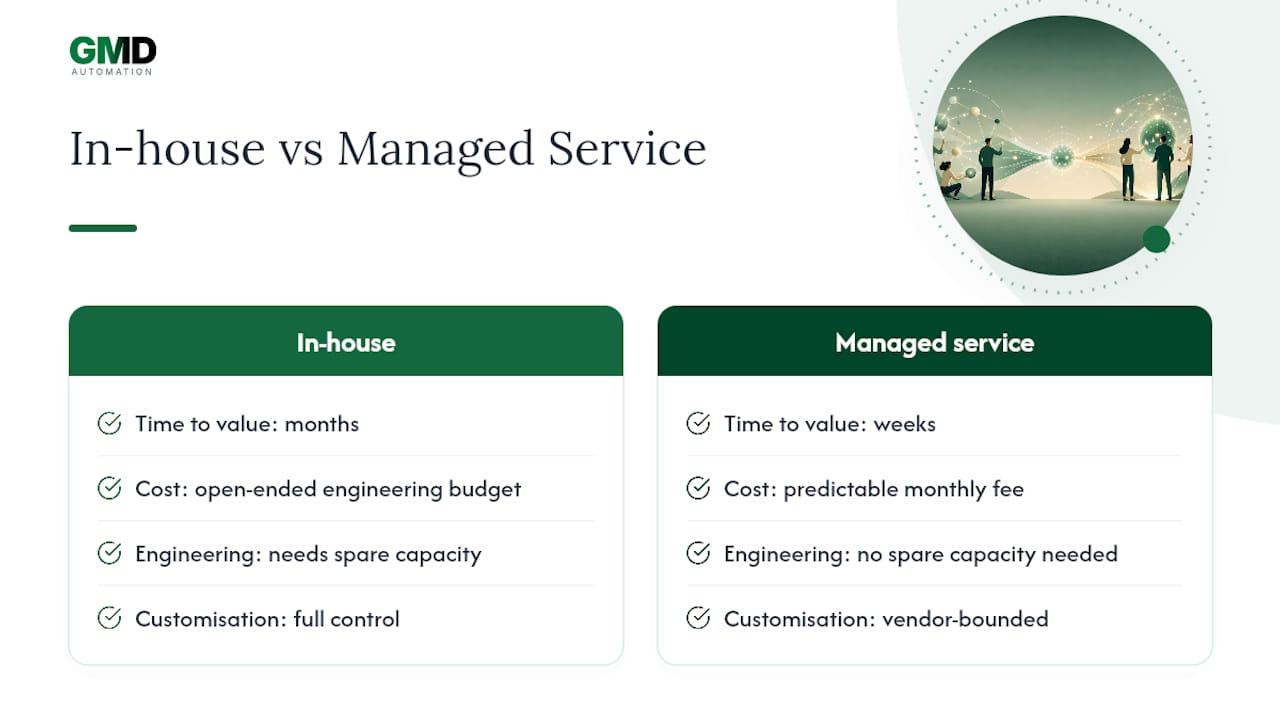
A managed service makes more sense for most marketing teams, because time to value is measured in weeks rather than months, cost is a predictable monthly figure rather than an open-ended engineering budget, and governance, compliance, and platform-policy monitoring are somebody else's job to stay on top of. Three organisational signals point clearly towards managed: your team has no spare engineering capacity, you need auditable compliance now rather than eventually, and you'd rather pay a known monthly cost than gamble on an in-house build's timeline. If none of those apply and you have engineers itching to build something bespoke, in-house is a legitimate route. For most marketing and social teams, it isn't the faster one.
Gmdautomation: managed AI social media without the upfront risk
An alternative to stitching together separate AI writers, schedulers, and listening tools yourself is one production-ready system, covered by a single monthly subscription, with no upfront build cost.
The service can be delivered as a fully managed subscription where implementation, day-to-day operation, maintenance, and ongoing optimisation are included in the monthly fee rather than billed as separate projects. Onboarding can be handled end-to-end, governance and security controls may be built into the deployment rather than bolted on afterwards, and the system can scale as your channel count or content volume grows, without a fresh procurement cycle every time a platform is added. This approach matters for the audit trail and approval-chain problems covered earlier in this guide, because such issues are addressed as part of the standard build rather than left for teams to configure from scratch.
If the checklist in this article looks like more governance work than your team has capacity for, book a demo with Gmdautomation to see how a managed rollout maps against your own publishing calendar and approval requirements.
Selected further reading and primary sources
- Zapier's roundup of AI tools for social media management covers content generation, recycling, and conditional posting differentiators across current tools.
- Hootsuite's guide on AI at Meta explains the shift from generative content towards predictive social intelligence.
- Gartner's press release on marketing AI automation quantifies expected automation growth among marketing leaders.
- Meta's practical AI creativity examples demonstrate real workflow patterns across its family of apps.
- Monday.com's roundup of AI tools for social media marketing illustrates common vendor claims worth verifying in a pilot.
Sources
- The 9 best AI tools for social media management in 2026
- How to use AI for social media management | AI at Meta
- Gartner press release: survey on marketing leaders' AI automation expectations
- How to use AI for social media management | AI at Meta
FAQ
Is there an AI social media manager?
Yes, in the sense of software that handles content generation, scheduling, listening, and engagement automation, but none of it replaces a human strategist. The strongest setups pair AI-driven execution with human oversight on tone, judgement calls, and approvals, which is exactly the model a managed service like Gmdautomation delivers.
What is the 5 5 5 rule for social media?
Definitions of this rule vary across marketing sources, so treat any single version cautiously rather than as a fixed, industry-standard rule. It's generally used as a rough content-mix guideline rather than a rule with one agreed meaning.
How much does AI social media management typically cost per month?
Costs vary widely depending on whether you're paying for a self-serve tool, a per-account subscription, or a fully managed service that bundles implementation and ongoing optimisation into one fee. A managed subscription model, like Gmdautomation's, replaces unpredictable build costs with one fixed monthly figure covering the whole lifecycle.
Which AI is best for social media management?
There's no single best option: the right choice depends on whether you need a modular assistant-plus-publisher setup, an all-in-one embedded platform, or a managed service that removes the integration work entirely. Match the choice to your team's engineering capacity and governance needs rather than to a feature list alone.