

Managed AI services are defined as outsourced, expert-operated AI capabilities delivered under a subscription or service agreement, where the provider handles deployment, maintenance, and optimisation. The alternative, building an in-house AI team, means recruiting, training, and retaining your own data scientists, ML engineers, and infrastructure specialists. For UK business leaders weighing these two paths, the decision rests on five factors: speed, cost, control, governance, and long-term strategy. 63% of CFOs identify a lack of internal AI talent as a key barrier to adoption in 2026. That statistic alone tells you why the managed AI service vs in-house debate has moved from technical discussion to boardroom priority.
What are the cost differences between managed AI and in-house AI?
Cost is the most visible factor in the managed AI service vs in-house decision, but the headline numbers often mislead. Outsourcing AI services typically costs £40,000–£120,000 in initial investment, while a fully loaded in-house build runs £400,000–£900,000. That gap is significant before you account for salaries, benefits, and ongoing infrastructure.
Over a three-year horizon, the difference widens further. Managed SaaS and AI solutions cost £150,000–£1.2M over three years, compared to £800,000–£15M for custom internal development. The upper end of the in-house range reflects enterprise-scale builds with specialist teams, proprietary infrastructure, and continuous model retraining.
Talent acquisition adds a layer of cost that many finance teams underestimate. A senior ML engineer in the UK commands a base salary of £90,000–£130,000, and that figure excludes recruitment fees, onboarding time, and the very real risk of attrition. When a key hire leaves, the institutional knowledge walks out with them.

KPMG research shows a 236% ROI over three years for organisations using managed AI and SaaS management. That figure reflects not just cost savings but the compounding value of faster deployment and reduced operational drag.
| Cost factor | Managed AI service | In-house AI team |
|---|---|---|
| Initial investment | £40k–£120k | £400k–£900k |
| 3-year total cost | £150k–£1.2M | £800k–£15M |
| Talent risk | Low (provider absorbs) | High (attrition, recruitment) |
| Cost predictability | High (subscription model) | Low (variable, project-dependent) |
| Capital expenditure | Minimal | Substantial |
Pro Tip: When budgeting for an in-house build, add a 30% contingency for hidden costs: data labelling, model monitoring, compliance tooling, and the productivity loss during onboarding. These costs rarely appear in initial business cases.
How does speed to value compare between managed and in-house AI?
Speed is where managed AI services hold their clearest advantage. Managed AI deployments reach production within 8–14 weeks, while building an equivalent in-house team takes 24–36 weeks before the first model reaches live traffic. For UK businesses under competitive pressure, that gap represents real revenue and efficiency lost.
The delay in in-house builds is rarely about technology. It is almost always about people. Hiring a team of five AI specialists in a tight labour market takes months. Onboarding them, aligning them to your data infrastructure, and running a first pilot adds more time still. By the time an in-house team ships its first working model, a managed service could have completed two full iteration cycles.
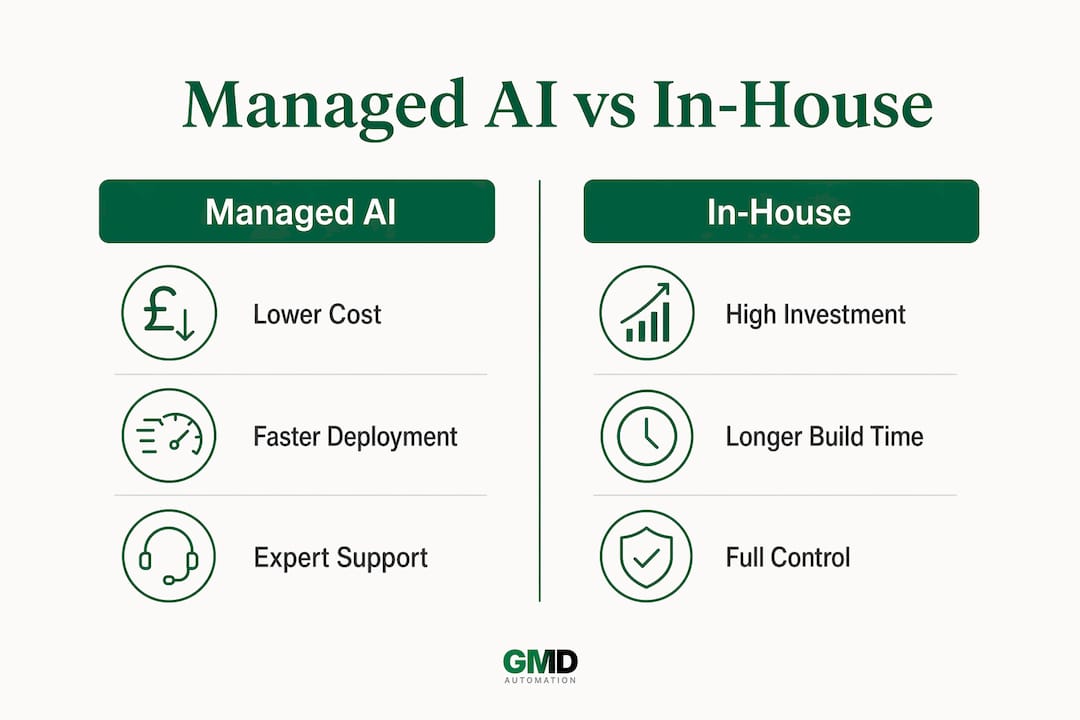
Speed to first value also shapes how your organisation learns. Early results from a managed deployment give business leaders real data on which processes benefit most from AI. That evidence base makes subsequent investment decisions far easier to justify to boards and finance committees.
The role of AI in business efficiency is well documented, but only organisations that deploy quickly capture early-mover advantages in their sectors. Waiting 36 weeks for an in-house team to reach production is a strategic cost, not just a scheduling inconvenience.
- Managed AI: 8–14 weeks to initial production traffic
- In-house build: 24–36 weeks to equivalent capability
- Talent shortages extend in-house timelines further in competitive hiring markets
- Managed services allow phased rollouts, reducing risk on each iteration
- Early deployments generate the evidence base needed for board-level AI investment decisions
Pro Tip: Run a managed AI pilot on one high-value process before committing to either model at scale. The data from a real deployment is worth more than any vendor presentation or internal feasibility study.
What governance and compliance factors affect your AI model choice?
Governance is the factor that most UK business leaders underestimate until it becomes a blocker. The choice between self-hosted and managed AI is fundamentally a governance call, not a cost or speed calculation. Regulated industries, including financial services, healthcare, and legal, face requirements around data residency, auditability, and access control that can override every other consideration.
Data residency is the most common governance constraint. If your organisation processes personal data under UK GDPR or sector-specific regulations, you need to know exactly where that data sits and who can access it. Some managed AI providers operate infrastructure outside the UK or EEA, which creates compliance exposure. Strict data residency requirements can mandate self-hosted deployments regardless of the cost or speed advantages of managed services.
Auditability is equally critical. Regulators increasingly expect organisations to produce detailed logs of AI-driven decisions, particularly in credit, insurance, and clinical contexts. Managed services vary significantly in the depth of audit trails they provide. Understanding what logs are available, and who owns them, is a non-negotiable part of vendor evaluation.
Vendor lock-in is a governance risk that sits alongside regulatory compliance. If your AI capability is entirely owned and operated by a third party, your ability to exit, switch providers, or bring capability in-house is constrained. That dependency can affect your negotiating position and your operational resilience.
Governance factors to evaluate before choosing your AI model:
- Data residency: Where does the provider store and process your data? Is it UK or EEA compliant?
- Audit logs: What decision-level traceability does the service provide? Who owns the logs?
- Exit rights: Can you extract your models, data, and configurations if you end the contract?
- Access controls: Who within the provider's organisation can access your data?
- Regulatory alignment: Does the service meet FCA, ICO, or sector-specific requirements relevant to your business?
- Incident response: What is the provider's contractual obligation when a compliance incident occurs?
For a deeper look at what good looks like, the AI system transparency guide from Gmdautomation covers audit log standards and compliance considerations in practical detail.
How do managed services and in-house teams compare for scaling AI?
Scaling AI is where the operational reality of each model becomes clear. Internal teams face a compounding challenge: as AI use cases grow, so does the demand for infrastructure, model maintenance, and specialist headcount. Most UK IT departments are already managing significant infrastructure and compliance obligations. Adding AI operations on top of that creates capacity risk.
Managed AI services free internal teams from operational burdens including platform reliability, model monitoring, and scaling infrastructure. That operational relief is not a minor convenience. It is the difference between an IT team that ships new AI capabilities every quarter and one that spends its time firefighting uptime issues.
Hybrid models are gaining traction as a practical middle ground. 38% of organisations now favour hybrid approaches that combine in-house control with external managed services. This model lets businesses retain ownership of data strategy and core business logic while outsourcing the operational complexity of running AI at scale.
Hybrid models work best when architectural boundaries are clear. Successful hybrid AI adoption requires defined accountability roles internally to prevent fragmentation between managed and in-house components. Without that clarity, hybrid models create the worst of both worlds: the cost of in-house and the dependency of managed.
| Scaling factor | Managed AI service | In-house AI team | Hybrid model |
|---|---|---|---|
| Infrastructure burden | Provider managed | Internal responsibility | Shared |
| Talent pipeline dependency | Low | High | Moderate |
| Speed of scaling | Fast | Slow | Moderate |
| Strategic control | Lower | Full | High |
| Operational resilience | High | Variable | High (if well governed) |
| Long-term vendor dependency | Higher | None | Moderate |
For smaller internal teams, the how small teams use AI automation guide from Gmdautomation outlines practical approaches to scaling AI without building large internal functions. The AI accelerator models used in the technology sector offer a useful parallel for how managed services can compress scaling timelines significantly.
Managed AI should be understood as an integrated service model, not a vendor relationship. For mid-market businesses, managed AI alleviates capacity constraints and enhances strategic AI execution rather than simply outsourcing a technical function. That framing changes how you structure the contract, the governance, and the internal ownership model.
Key takeaways
The most effective AI model for UK businesses is the one that matches governance requirements first, then optimises for cost and speed.
| Point | Details |
|---|---|
| Cost gap is substantial | In-house builds cost up to 12 times more than managed services over three years. |
| Speed favours managed services | Managed AI reaches production in 8–14 weeks versus 24–36 weeks for in-house teams. |
| Governance can override cost | Data residency and audit requirements may mandate self-hosted AI regardless of price. |
| Hybrid models are growing | 38% of organisations now combine managed and in-house AI for control and scale. |
| Internal ownership still matters | Even with managed services, businesses must own their data strategy and business logic. |
The governance question nobody asks early enough
I have worked with enough mid-market and enterprise teams to know that the managed AI versus in-house debate almost always starts in the wrong place. Finance teams want to talk about cost. IT leaders want to talk about control. Neither group leads with governance, and that is where the real decisions get made.
The businesses I have seen struggle most are those that chose a managed service for its price point, then discovered six months later that their audit requirements could not be met by the provider's standard logging. Rebuilding that capability, or switching providers mid-deployment, costs far more than the original saving.
Managed AI as a force multiplier is the right mental model for IT leaders who are already stretched. The question is not "do we outsource AI?" It is "what do we retain ownership of, and what do we hand to a provider who is accountable for it?" The answer to that question is always governance-first, then speed, then cost.
My honest advice: do not let a 12-week deployment timeline be the reason you skip the governance review. The businesses that get this right treat their managed AI provider as a service engine, not a strategy owner. They keep data strategy, business logic, and compliance accountability internal. Everything else can be handed over.
— Ravi
How Gmdautomation supports UK businesses with managed AI
Gmdautomation builds and operates managed AI systems for UK businesses that need production-ready AI without the capital expenditure or talent risk of an in-house build. Every deployment covers implementation, operation, maintenance, and ongoing improvement under a predictable monthly subscription, with no upfront costs.
For IT leaders managing compliance obligations, Gmdautomation's systems are built with UK data residency, audit logging, and governance support as standard. For business leaders focused on speed, deployments reach production significantly faster than equivalent in-house builds. Whether your organisation needs a fully managed model or a hybrid approach that preserves internal control, Gmdautomation acts as a delivery partner, not a replacement for your internal strategy. Speak to the team to assess which model fits your operational context.
FAQ
What is the main difference between managed AI and in-house AI?
Managed AI services are operated by an external provider under a service agreement, covering deployment, maintenance, and scaling. In-house AI means your organisation recruits and manages its own AI specialists and infrastructure.
Is managed AI cheaper than building an in-house team?
Managed AI services cost significantly less upfront, with initial investments of £40,000–£120,000 compared to £400,000–£900,000 for in-house builds. Over three years, the total cost difference can reach into the millions.
When should a UK business choose in-house AI over managed services?
In-house AI is the better choice when strict data residency rules, full model ownership, or deep proprietary customisation are non-negotiable requirements. Governance constraints often outweigh the cost and speed advantages of managed services.
What is a hybrid AI model?
A hybrid AI model combines managed services for operational delivery with in-house ownership of data strategy and business logic. It suits organisations that want external operational capacity without surrendering strategic control.
How long does it take to deploy managed AI versus building in-house?
Managed AI services typically reach initial production within 8–14 weeks. Building an equivalent in-house team takes 24–36 weeks before the first model reaches live traffic.