

For enterprise customer voice automation, start a short managed pilot with an enterprise voice-AI partner that handles telephony, integrations and compliance, rather than stitching together your own stack. That approach gets you a working answer in weeks, not months, and it shifts the compliance and maintenance burden onto a partner built for it. Everything below explains why, and how to run that pilot properly.
TL;DR:
- Conduct a short, two- to eight-week pilot focused on containment and escalation metrics to validate the voice agent's performance under real call conditions.
- Prioritize vendors that demonstrate low latency under 300 milliseconds, full-duplex architecture, SIP compatibility, and high accuracy in noisy, real-world environments.
- Verify that the platform offers transparent observability, including transcripts, tool-call logs, and confidence scores for each call, to troubleshoot and improve performance effectively.
- Ensure the provider can deliver GDPR compliance, data residency options, and recognized security certifications like SOC 2, especially for regulated industries.
- Choose managed service providers to eliminate ongoing maintenance risks and optimize deployment, especially for high-volume, regulated, or customer-facing call workflows.
Table of Contents
- What are AI voice agents and why do they matter for enterprise?
- How do modern voice agent architectures actually work?
- What should you prioritise when evaluating a voice-AI partner?
- What does a realistic pilot look like, and how long should it take?
- Where do AI voice agents deliver the clearest ROI?
- How does GMD Automation run a managed voice-AI pilot?
- What criteria should shape your final provider shortlist?
- What questions should you ask vendors before you commit?
- What are the common pitfalls when choosing an AI voice agent?
- How do leading AI voice agent platforms actually compare?
- What does the full timeline from evaluation to deployment look like?
- When should you buy a managed service instead of building your own stack?
- Ready to pilot AI voice agents without the upfront risk?
- Sources
- FAQ
What are AI voice agents and why do they matter for enterprise?
AI voice agents are not the interactive voice response (IVR) menus your customers have been shouting "representative" at for twenty years. An IVR follows a fixed decision tree. A consumer virtual assistant like the one on your phone answers questions but can't act on your behalf. An enterprise-grade voice agent listens, reasons about intent, calls internal tools or APIs to actually do something (check an order, book a slot, update a CRM record), and hands off to a human when it hits the edge of its competence.
That last part matters more than vendors usually admit. The value of a voice agent isn't how convincingly it talks. It's whether it can resolve a query end to end without a human touching it, and whether it knows when to stop trying.
What separates a genuinely enterprise-ready system from a chatbot with a voice on top:
- Intent recognition that survives real speech — interruptions, filler words, regional accents and background noise, not the clean audio used in vendor demos.
- Tool calling — the agent can query a booking system, pull account data, or trigger a workflow mid-conversation, described in detail in OpenAI's guidance on building voice agents.
- Action taking, not just answering — confirming a refund, rescheduling an appointment, escalating a complaint with context attached.
- Graceful handoff — recognising uncertainty and routing to a human agent with a summary, rather than looping the caller through the same three questions.
The technology underpinning this shifted meaningfully going into 2026. Full-duplex voice models, where the system listens and speaks at the same time rather than waiting for a turn signal, have started replacing the older "wait, then respond" pattern. This change allows modern voice agents to be interrupted mid-sentence and recover naturally, improving over previous generations that handled interruptions poorly or not at all.
How do modern voice agent architectures actually work?
There are two dominant approaches on the market, and the difference between them shows up the moment a caller talks over the agent.
Chained architecture runs three separate systems in sequence: speech-to-text (STT) converts audio to words, a large language model (LLM) decides what to say, and text-to-speech (TTS) converts the response back to audio. Each stage adds latency, and each handoff is a place where context can be lost. Chained systems typically rely on a "turn detector" to guess when the caller has finished speaking, and that guess is often wrong, which is why so many voice bots talk over people or leave awkward silences.
Full-duplex architecture processes audio continuously in both directions through a single model, rather than three bolted-together ones. OpenAI's engineering team describes building this kind of realtime system specifically to remove the brittle turn-detection step, letting the agent listen while it's talking and adjust or stop the moment the caller interrupts. Its GPT-Live-1 model, built for the API, is designed with telephony deployments and live tool calling in mind rather than as a lab demo.
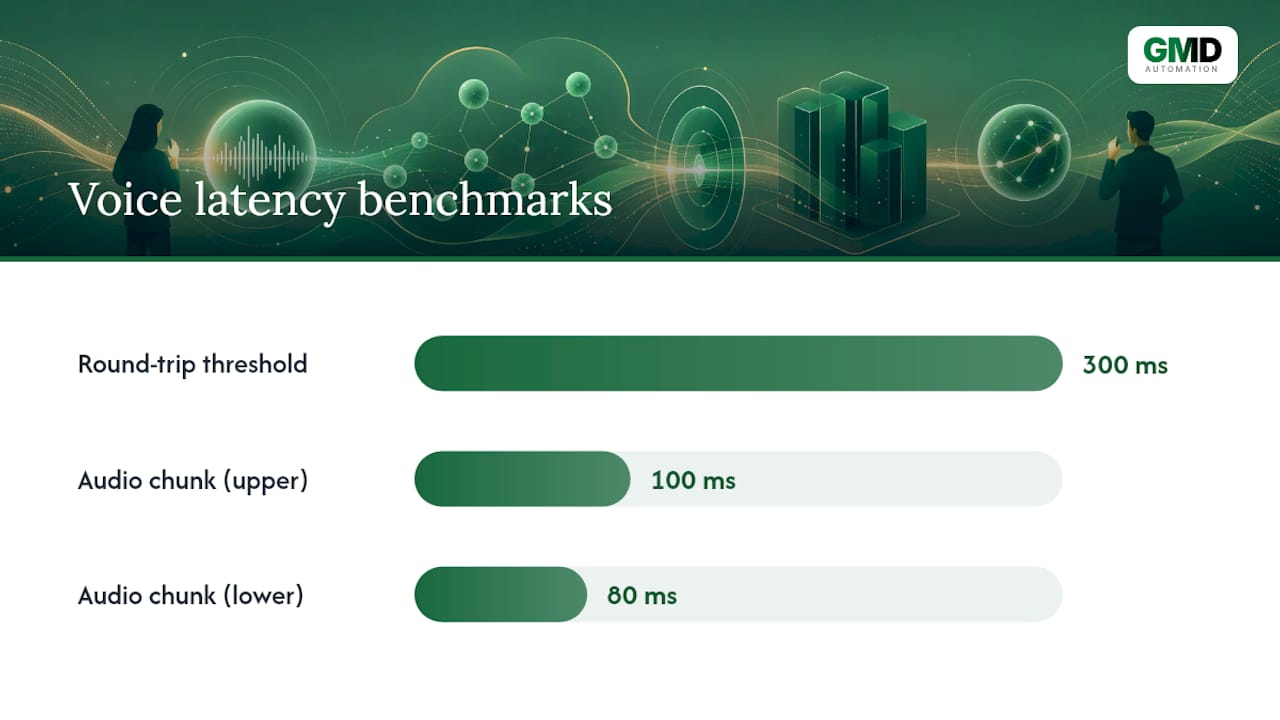
Statistic callout: Twilio's engineering team treats a round-trip response time under 300 milliseconds as the practical threshold for a conversation to feel natural over the phone, working with audio streamed in roughly 80 to 100 millisecond chunks, according to Twilio's overview of voice AI. Cross that threshold and callers start noticing the delay as a hesitation, then as dead air.
What this means practically for a buyer:
- Ask any vendor demoing a voice agent what their measured round-trip latency is under real telephony conditions, not on a quiet laptop microphone.
- Ask whether the architecture is full-duplex or chained, and if chained, how they've reduced handoff overhead between the three stages.
- Check the integration surface: does the platform connect over SIP trunking for traditional telephony, WebRTC for browser-based calls, or both? Most enterprise deployments still need SIP.
- Confirm streaming ASR quality in noisy conditions. Meta's research on streaming transcription and diarization shows how much progress has been made on separating overlapping speakers, which matters the moment a call has background noise or a second person joining mid-call.
- Ask for observability: can you see a transcript, a tool-call log, and a confidence score for every completed call, or just a pass/fail summary?
Telephony integration deserves its own line of scrutiny. Provisioning direct SIP trunks and co-locating the media, speech recognition and language model components physically closer together measurably cuts round-trip time, a point Twilio's own engineering overview makes when explaining production deployments. If your vendor's architecture routes audio through three separate cloud regions before it reaches the model, that latency budget disappears fast. For a deeper technical grounding on how these pieces fit together, our own guide to AI agent architecture covers the pattern in more depth.
What should you prioritise when evaluating a voice-AI partner?
Most RFPs for voice AI are written by people who have watched one polished demo and assumed the rest of the platform works the same way. It rarely does. Score vendors against three categories, in this order.
1. Technical fit
- Real-time tool calling that can hit your APIs mid-call, not just at the end of a conversation.
- Latency under real telephony conditions (see the 300 millisecond benchmark above), tested with your own network, not the vendor's lab.
- Multilingual ASR accuracy if your customer base isn't English-only, and TTS quality that doesn't sound uncanny on a phone line's compressed audio.
- SIP compatibility with your existing telephony provider, so you're not ripping out infrastructure to adopt the agent.
- A genuine test harness: the ability to replay failed calls, simulate caller personas, and catch regressions before they reach production. Independent reviewers testing 2026 voice platforms flag this as one of the clearest gaps between vendors, according to GetVoIP's testing round-up.
2. Operational and compliance fit
- GDPR readiness as a default, not an add-on module, including clear answers on where voice data is processed and stored.
- Data residency options if your regulator or contracts require UK or EU-only processing.
- Recognised security certifications (SOC 2 is the common baseline vendors should be able to produce on request) and awareness of ICO expectations around recorded calls and consent.
- Audit trails and escalation logs that a compliance team can actually review, not a black box.
3. Commercial fit
- Predictable total cost of ownership. Some platforms bundle the LLM, speech processing and telephony into a single all-in per-minute rate, which makes cost comparison across vendors much easier than stacking separate line items.
- A genuine pilot price, distinct from full production pricing, so you're not committing to enterprise volume before you've proven the use case.
- An SLA with real numbers attached (uptime, response time to incidents), and clarity on whether ongoing optimisation and maintenance are included in the price or billed separately.
Pro Tip: Score every vendor against the same weighted checklist and insist each one answers in writing, not just verbally in a sales call. Vendors are consistently more precise on paper than they are live on a demo, and a written answer is something you can hold them to later.
What does a realistic pilot look like, and how long should it take?
Enterprise voice AI doesn't need a year-long transformation programme to prove itself. A tightly scoped pilot, run over two to eight weeks, gives you enough live data to decide whether to scale, adjust, or walk away, and our own pilot framework is built around exactly that window.
Before anything goes live, define what success actually means:
- Containment rate — the percentage of calls the agent resolves without human intervention.
- Deflection rate — how many calls that would have hit a human queue get handled entirely by the agent.
- Booked meetings or appointments — for sales or scheduling use cases, the number of confirmed bookings the agent completes.
- Average handle time — whether calls resolve faster than with a human agent, or just differently.
The minimum technical groundwork, regardless of vendor, looks similar every time:
- Route a defined slice of inbound (or outbound) calls to the agent, either via a new number or a ring-group split of existing traffic.
- Provision SIP trunking or dedicated numbers so calls reach the agent without a manual transfer step.
- Ingest your knowledge base so the agent can answer product, policy and account questions with grounded information rather than guessing, a point OpenAI's own developer documentation stresses as core to enterprise reliability.
- Set up tool-calling endpoints for the two or three actions that matter most (booking, order lookup, ticket creation).
- Build a test harness that can run simulated calls across different caller personas and replay any call that failed, so developers can fix the actual failure rather than guessing at it.
A sensible milestone structure over that window:
- Weeks 1 to 2: scoping, knowledge base ingestion, SIP or number provisioning, and defining the two or three tool-calling actions in scope.
- Weeks 3 to 5: simulated call testing against scripted personas and edge cases, refining prompts and escalation logic based on failure patterns, a step reviewers consistently flag as the difference between a pilot that works and one that embarrasses everyone, per GetVoIP's testing methodology.
- Weeks 6 to 8: a small live traffic pilot, typically a defined percentage of real inbound or outbound calls, measured against the containment and escalation targets set in week one.
Acceptance criteria should be agreed before the pilot starts, not negotiated afterwards. A containment rate below your baseline, an escalation rate that spikes on a particular call type, or any privacy incident should trigger a defined review point, not a quiet extension of the pilot.
Where do AI voice agents deliver the clearest ROI?
Not every call centre workflow is a good candidate for automation, and pretending otherwise is how pilots fail. Four use cases consistently show the strongest results:
- Inbound support — password resets, order status, billing queries and other high-volume, low-complexity calls that don't require judgement.
- Outbound qualification — calling a lead list to confirm interest, gather basic information, and route qualified leads to a sales rep.
- Appointment booking — scheduling, rescheduling and confirming appointments against a live calendar, one of the cleanest tool-calling use cases available.
- Voicemail triage — transcribing, categorising and routing voicemail so nothing sits unread in a queue overnight.
Statistic callout: the practical latency ceiling of roughly 300 milliseconds round trip isn't a nice-to-have for these workflows, it's the difference between a booking call that feels like talking to a person and one that feels like talking to a machine with a bad phone line, as Twilio's engineering analysis makes clear.
Translating this into operational terms means picking two or three KPIs before launch and tracking them weekly, not monthly. If containment sits at a workable level and escalation load on human agents drops accordingly, the savings show up directly in headcount hours freed for higher-value work. If booked meetings from outbound qualification calls climb, that's a revenue line, not a cost saving, and it should be tracked separately.
Watch for three warning signs during and after rollout:
- Rising misrecognition rates on specific accents, industry terminology, or noisy call types, usually a sign the ASR wasn't tuned for your actual caller base.
- Escalation load creeping upward over time rather than settling, which often means the agent is being pushed into scenarios outside its original scope.
- Any privacy or data-handling incident, however small, treated as an immediate pause-and-review trigger rather than a footnote in a monthly report.
How does GMD Automation run a managed voice-AI pilot?
Some providers run voice-AI deployment as a managed, subscription-based service rather than a project you buy once and maintain yourself, with implementation, operation, maintenance and optimisation included inside a single monthly fee, offering an alternative commercial model to paying a systems integrator for a bespoke build and owning upkeep.
The pilot structure follows the same short-cycle logic covered above, drawn from our detailed pilot playbook: scope the use case, connect telephony and knowledge base, run simulated and then live traffic, and measure containment and escalation before scaling. That sequencing exists because rushing straight to full production on an unproven agent is how most in-house voice AI projects lose credibility with the operations team that has to live with the result.
The underlying architecture is built to scale from a pilot's modest call volume to full production traffic without a redesign, with maintenance and optimisation folded into the subscription rather than billed as separate change requests. For readers who want the operational detail on how the pieces connect, our guides to conversational AI IVR implementation and API integration for automation tools go further into the mechanics than a pilot overview can.
What criteria should shape your final provider shortlist?
Once you've screened out platforms that fail on latency or telephony compatibility, the shortlist decision usually comes down to fit with your specific environment rather than any single platform being universally best. Weight your criteria against your actual constraints, not a generic checklist.
If you operate in a regulated sector, data residency and audit trail depth should outweigh a marginally better voice quality score. If your call volume is highly seasonal, ask specifically how pricing and capacity flex during peaks, since a flat per-seat model can punish you in your busiest month. If your existing telephony is deeply embedded in a particular carrier relationship, SIP compatibility with that specific carrier matters more than a platform's broader feature list.
Three practical filters tend to separate serious enterprise providers from platforms still finding their footing:
- Can they show a live demo agent you can call and stress-test yourself, rather than a scripted video?
- Can they point to pilot or case study results with real containment or deflection numbers attached?
- Can they answer compliance questions (SOC 2, GDPR, data residency) in writing, on request, without a follow-up sales call?
Any provider that hesitates on the third point is telling you something worth hearing before you sign anything.
What questions should you ask vendors before you commit?
A short, specific set of questions, asked in writing, will do more to protect your decision than any amount of demo-watching.
Ask for the measured round-trip latency under real telephony conditions, not a lab benchmark, and ask what happens to that number under peak call volume. Ask whether the architecture is full-duplex or chained, and if chained, what they've done to minimise handoff delay between the STT, LLM and TTS stages.
Ask exactly what's included in the monthly or per-minute price: does it cover ongoing optimisation and maintenance, or are those billed separately once the pilot ends? Ask what data residency options exist and where voice recordings and transcripts are actually stored. Ask for a written answer on SOC 2 status and GDPR compliance rather than a verbal assurance in a sales call.
Finally, ask what a failed call actually looks like in their system: can you see the transcript, the tool calls attempted, and the point where it broke down, or does the platform just log a generic failure with no diagnostic trail? A vendor that can't answer this clearly hasn't built the observability enterprise deployments need.
What are the common pitfalls when choosing an AI voice agent?
The most common mistake is buying on demo polish rather than production performance. A clean, quiet-room demo tells you almost nothing about how the system handles a caller on a mobile line with traffic noise in the background.
The second is skipping the test harness. Without the ability to replay failed calls and run scripted personas against edge cases, you're debugging in production, which is exactly how a pilot's reputation gets damaged internally before it's had a fair chance.
The third is underweighting compliance until late in the process. Discovering in month two that your chosen platform can't guarantee UK or EU data residency, when your legal team required it from day one, is an avoidable and expensive delay. The fourth is treating pricing per minute as the whole cost picture, when optimisation, maintenance and support costs outside the core usage fee can shift the total meaningfully. Ask for the full cost breakdown before comparing headline rates.
How do leading AI voice agent platforms actually compare?
Rather than naming names in a category that shifts every quarter, it's more useful to compare platforms by category, since most enterprise buyers end up choosing between three broad shapes of offering.
Entry-level field tools target small teams and simple use cases, usually with lighter telephony integration and limited tool-calling depth. They're fast to set up but tend to hit a ceiling once you need genuine CRM actions or multilingual support.
Enterprise platforms offer deeper SIP integration, stronger observability, and compliance features built in from the start, generally at a higher and less predictable price point, often requiring a dedicated implementation team on your side.
Managed service providers sit between the two: enterprise-grade architecture and compliance, delivered as a subscription that includes implementation, maintenance and optimisation rather than requiring you to run the platform yourself. For most mid-size and enterprise buyers without a dedicated voice-AI engineering team, this category removes the highest-risk part of the decision, the ongoing maintenance burden, without sacrificing the technical depth the first category lacks.
Which shape fits depends on whether you have in-house capacity to run and tune a platform long-term, or whether you'd rather that capacity sat with the provider.
What does the full timeline from evaluation to deployment look like?
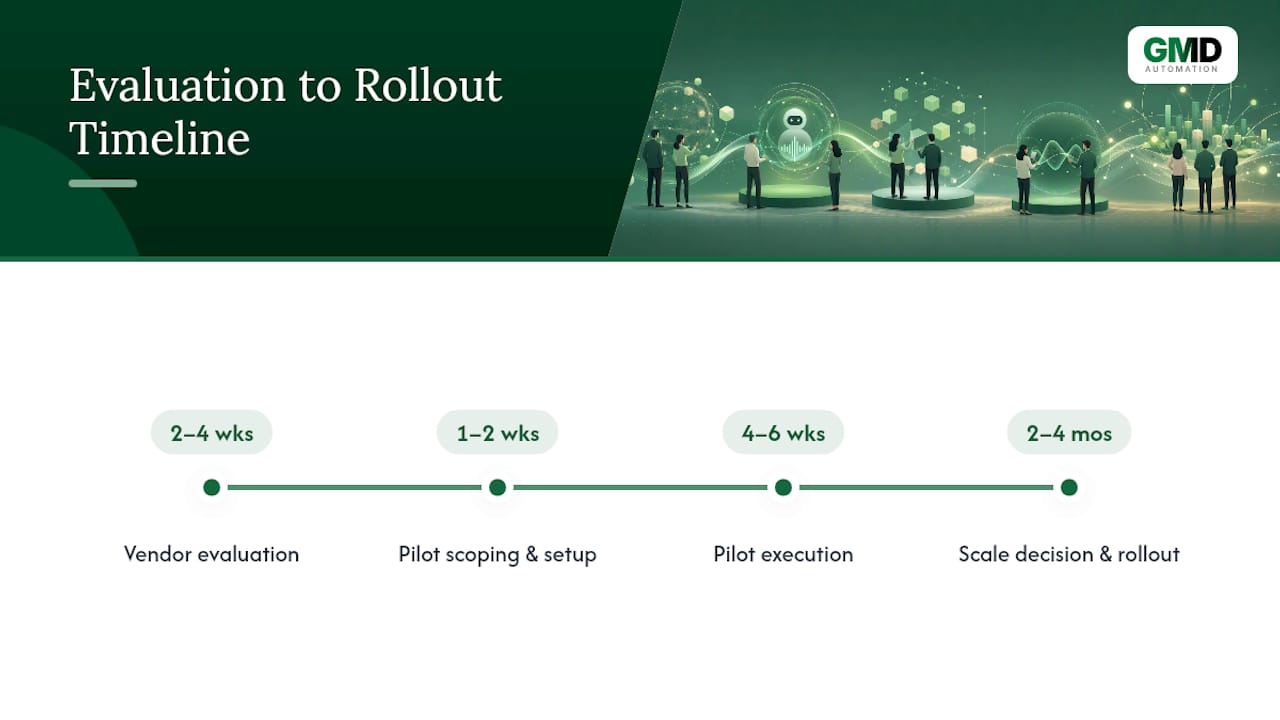
From a standing start, a realistic enterprise voice-AI project moves through four phases.
Vendor evaluation typically takes two to four weeks: shortlisting against the technical, operational and commercial criteria above, requesting written compliance answers, and testing a live demo agent yourself rather than relying on a scripted walkthrough.
Pilot scoping and setup runs one to two weeks: defining success metrics, provisioning SIP trunks or numbers, ingesting the knowledge base, and configuring the two or three tool-calling actions in scope.
Pilot execution, as covered earlier, runs a further four to six weeks: simulated testing, prompt and escalation refinement, then a live traffic slice measured against agreed acceptance criteria.
Scale decision and rollout follows the pilot review: either scaling call volume gradually against the same monitoring signals, adjusting scope and running a second pilot cycle, or stopping if the numbers don't support the business case. Total elapsed time from first vendor conversation to a scaled production deployment typically lands somewhere between two and four months for a well-scoped single use case, longer if multiple workflows or languages are in scope from the start.
When should you buy a managed service instead of building your own stack?
The build-versus-buy debate on voice AI gets framed as a technology decision when it's really a resourcing and risk decision. Building your own stack means owning the engineering cost of stitching together ASR, an LLM, TTS, telephony and observability, and then maintaining that stack indefinitely as each component evolves. That's a defensible choice if you have a dedicated platform team and a use case unusual enough that off-the-shelf platforms genuinely don't fit.
For most organisations, though, the honest maths doesn't favour building. The engineering cost of a competent in-house voice stack rarely shows up on the original budget, and the compliance risk of getting data residency or consent handling wrong sits entirely with your own team rather than a partner whose business depends on getting it right at scale.
The clearest heuristic: if your call volume is high, your industry is regulated, or the workflow is customer-facing at scale, buy a managed service and use the pilot to validate fit before committing further. If your use case is narrow, low-risk, and you already have engineering capacity sitting idle, building may make sense. Let the pilot's containment and escalation numbers, not a sunk-cost feeling about work already done, decide whether you scale with the partner or pull the workflow back in-house.
— Ravi
Ready to pilot AI voice agents without the upfront risk?
Some providers offer an alternative to building and maintaining your own voice-AI stack in-house with no upfront engineering spend and a single monthly subscription covering implementation, operation, and ongoing optimisation. This managed pilot approach can transfer responsibilities such as SIP integration and model updates from the customer's team to a service provider focused on continuous operation.
A pilot with Gmdautomation follows the same short, measurable structure covered above: define your target use case, whether inbound support, outbound qualification, or appointment booking; connect your existing telephony and knowledge base; and run a live traffic slice against agreed containment and escalation targets. To scope a pilot properly, we'll need your expected call volume, the systems you need the agent to connect to (CRM, booking calendar, ticketing), and the specific outcome you're measuring against.
If your team is ready to see this working on your own use case, book a demo with GMD Automation and get a pilot scoped against your actual call data rather than a generic script.
Sources
For deeper technical grounding beyond this guide, OpenAI's engineering posts on continuous voice interaction and voice agent architecture cover the model side in detail, while Twilio's voice AI overview explains the telephony and latency engineering. For chat and assistant integration patterns that complement voice deployments, AmmarAI's virtual assistant work is worth a look.
- How we built a realtime system for responsive voice AI in six months | OpenAI
- What is voice AI and how does it work in 2026? | Twilio
- Introducing Muse Voice Transcribe | Meta Research
- SpeechifyAI Agents — Realtime Voice Agents on One API
FAQ
What are AI voice agents?
AI voice agents are systems that listen to a caller, reason about what they need, and take action, such as booking an appointment or pulling account data, rather than just following a fixed menu like a traditional IVR or answering questions like a basic virtual assistant.
How do AI voice agents work?
Modern voice agents either chain together separate speech-to-text, language model, and text-to-speech systems, or run on a full-duplex model that listens and speaks simultaneously, which OpenAI's engineering team built specifically to handle interruptions more naturally than the older chained approach.
Which is the best AI voice agent?
There's no single best platform for every business. The right choice depends on your call volume, telephony setup, and compliance requirements, and for most enterprises without a dedicated in-house engineering team, a managed provider like Gmdautomation removes the maintenance burden that a self-built or entry-level tool leaves with you.
Is there a free AI voice calling agent available?
Some platforms offer limited free trials or low-volume tiers for testing, but enterprise-grade features such as SIP telephony integration, compliance certifications, and dedicated support are almost never included in a free tier, which is why a scoped pilot is a more realistic way to test fit than a free plan.
Where can I find AI voice agents for UK businesses?
UK businesses can evaluate managed voice-AI providers directly, including some that offer demo agents and structured pilots for organisations wanting to test the technology on their own call data before committing to full deployment.