

An AI consultant finds the repetitive, high-cost tasks in your operation and turns them into reliable systems that save hours and reduce errors. For most UK small businesses, that is the fastest route to measurable AI results — faster than hiring in-house and far less risky than buying point tools and hoping they connect.
The practical next step is simple: run a short readiness assessment (half a day, no technical knowledge required) to identify your two or three highest-payoff processes. From there, a well-scoped pilot typically runs 4–8 weeks and produces a working system you can measure against real KPIs before committing further budget.
- Hire an AI consultant when you want reliable automation in weeks, not months of internal experimentation.
- Expect concrete outcomes: hours reclaimed from admin, faster lead response, fewer manual errors.
- Start with a readiness assessment or a one-day working session before any larger spend.
- For a low-risk, fully managed route, Gmdautomation offers a subscription model with zero upfront costs and compliance built in.
Pro Tip: Book a readiness assessment before you write a brief or a budget. The output tells you which process to automate first and gives you the numbers to justify the spend internally.
Key takeaways
AI consulting for small businesses delivers the fastest, lowest-risk route to measurable automation when you start with a scoped pilot, measure against clear KPIs, and choose a provider who covers ongoing operation, not just delivery.
| Point | Details |
|---|---|
| Start with a readiness assessment | Map your highest-cost manual processes before spending anything on tools or consultants. |
| Prioritise people and process | The 10–20–70 principle shows 70% of AI adoption value comes from workflow and staff changes, not the technology itself. |
| Insist on a working MVP | Any engagement that runs six weeks or more without a live system is producing strategy documents, not automation. |
| Subscription models reduce risk | A managed monthly subscription covers implementation, compliance, and optimisation with no large upfront capital cost. |
| Gmdautomation as your next step | Gmdautomation's fully managed subscription delivers production-ready AI for UK small businesses with zero upfront costs and compliance built in. |
Table of Contents
- What does AI consulting for small businesses actually involve?
- How can AI help small businesses grow and save time?
- What are the typical stages of an AI consulting engagement?
- What does AI consulting cost, and when will you see a return?
- How do you choose and vet an AI consultant?
- Where do small businesses get the biggest wins from AI?
- Why people and process matter more than the technology
- How to get started with AI consulting safely and cheaply
- What I have seen work with UK small businesses
- Gmdautomation: managed AI for UK small businesses, with no upfront cost
- Sources
What does AI consulting for small businesses actually involve?
AI consulting, in the context of small businesses, is the practice of bringing in an external specialist to identify where artificial intelligence can replace or support manual work, then building and running those systems on your behalf. The industry term is AI implementation consulting, though "AI consulting" is the phrase most owners search for and most providers use.
A consultant's work follows a predictable arc: discovery, roadmap, build, and operate. In practice, that means:
- Process mapping: identifying which tasks are high-frequency, rule-based, and currently eating staff time.
- Readiness assessment: checking whether your data, tools, and team are ready to support automation.
- Pilot design: scoping a small, testable proof of concept with clear success criteria.
- Integration and deployment: connecting AI tools to your existing systems (CRM, inbox, booking platform) and moving them into production.
- Training and handover: making sure your team knows how to use, monitor, and escalate issues with the new system.
- Ongoing monitoring: tracking performance and adjusting models or workflows as your business changes.
The difference between small-business and enterprise consulting is mostly about speed and pragmatism. Enterprise engagements run for months and involve large procurement cycles. A good small-business consultant ships a working MVP in days or weeks, keeps the codebase simple enough for you to own, and avoids building dependencies you cannot maintain. When consulting beats hiring in-house: when you need results in weeks, when you lack the internal data science skills, or when you want a system that is already production-tested rather than built from scratch by a junior hire.
How can AI help small businesses grow and save time?
The clearest wins fall into four categories, and the speed of payback varies by function.
Time saved through automation is usually the first and most visible benefit. Admin tasks — inbox triage, appointment booking, invoice chasing, data entry — are high-frequency and well-defined, which makes them straightforward to automate. Microsoft's UK case studies show frontline professionals reclaiming meaningful administrative time after AI integration, reallocating it to client-facing work that actually drives revenue.
Better customer service comes from AI agents handling first-contact queries, qualifying leads, and booking appointments around the clock. A small business that responds to an enquiry within five minutes converts at a significantly higher rate than one that responds the next morning.
Improved decision-making follows from having clean, centralised data feeding simple dashboards. When your sales, stock, and customer data live in one place, patterns that previously required a spreadsheet analyst become visible in seconds. A single source of truth for your data is often the practical prerequisite before any reliable AI can run across your operation.
New revenue streams emerge when AI handles the operational load that previously capped your capacity. Agencies take on more clients; retailers personalise offers at scale; service businesses launch subscription tiers they could not staff manually.
The functions with the fastest payback typically include operations, sales and marketing, admin, and customer support, though the exact order varies by case. Non-financial benefits matter too: staff who spend less time on repetitive tasks report higher job satisfaction, and a well-documented AI system reduces key-person dependency when someone leaves.
Stat to know: Affordable AI strategies for UK SMEs consistently point to quick wins in high-frequency, well-defined tasks as the fastest route to measurable ROI for small businesses.
What are the typical stages of an AI consulting engagement?
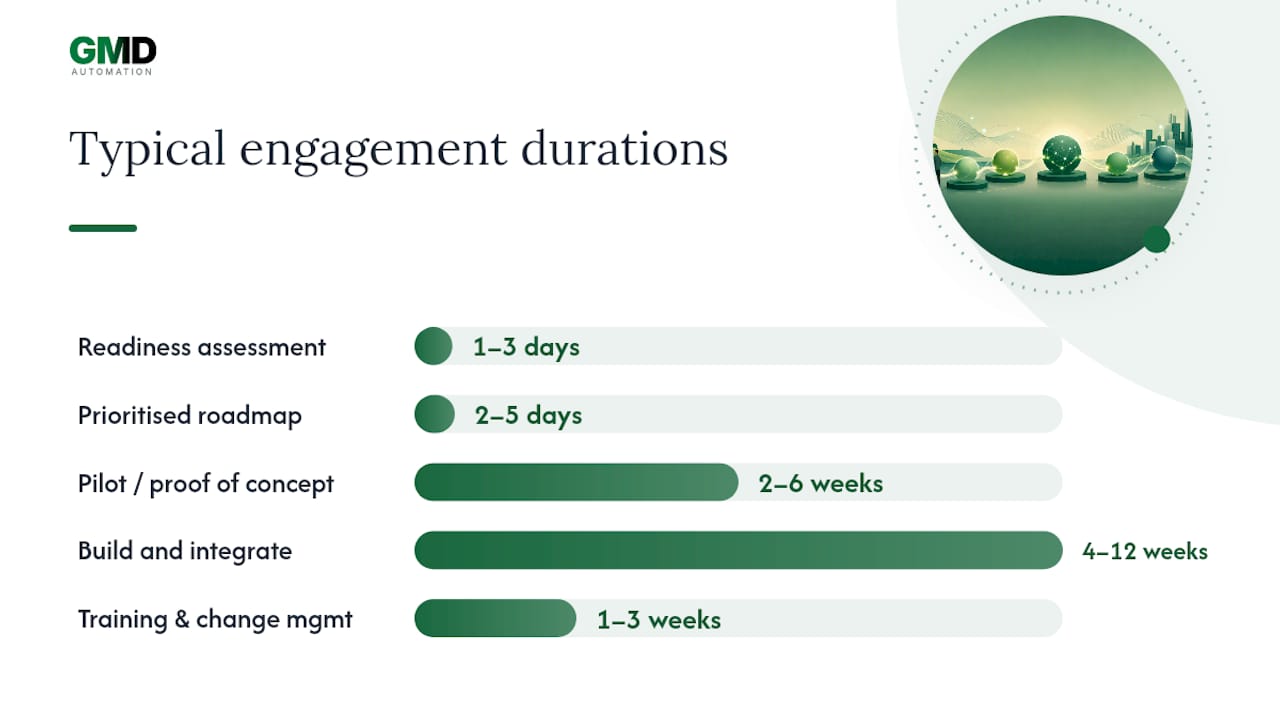
A well-run engagement for an SME moves through six stages. The timelines below assume a focused scope; larger or more complex projects take longer at every stage.
- Readiness assessment (1–3 days): maps your current processes, data sources, and technical stack. Output: a written summary of gaps and opportunities, ranked by effort and impact.
- Prioritised roadmap (2–5 days): translates the assessment into a sequenced plan with estimated costs, timelines, and success KPIs. Output: a one-to-two-page roadmap document you can use to get internal sign-off.
- Pilot / proof of concept (2–6 weeks): builds a minimal working system for the highest-priority use case. Output: a live MVP agent or automated workflow with baseline performance data.
- Build and integrate (4–12 weeks): extends the pilot into a production-ready system, connected to your real data and tools. Output: integrated system, integration specification, and a testing and rollback plan.
- Training and change management (1–3 weeks, overlapping with build): prepares your team to use, monitor, and escalate issues. Output: training materials, a named internal owner, and a documented escalation path.
- Operate and optimise (ongoing): monitors performance, updates models, and adjusts workflows as your business evolves. Output: monthly performance reports and a continuous improvement log.
Ownership matters at every stage. Before signing anything, confirm who holds the code, the data, and the IP after go-live. A reputable consultant hands these over clearly; a poor one builds lock-in by keeping them.
| Stage | Typical duration | Key deliverable |
|---|---|---|
| Readiness assessment | 1–3 days | Written gap and opportunity summary |
| Prioritised roadmap | 2–5 days | Sequenced plan with KPIs and cost estimates |
| Pilot / proof of concept | 2–6 weeks | Live MVP with baseline performance data |
| Build and integrate | 4–12 weeks | Production system with integration spec |
| Training and change management | 1–3 weeks | Training materials and named internal owner |
| Operate and optimise | Ongoing | Monthly performance reports |
The role of IT in AI transformation is worth reading before your assessment: it covers the technical prerequisites and data hygiene steps that most small businesses underestimate.
What does AI consulting cost, and when will you see a return?
Costs vary widely depending on scope, and the market has not standardised pricing the way traditional IT consulting has. Published cost research shows that lightweight API integrations can start below $5,000 (roughly £4,000), while first AI projects more commonly sit in the tens of thousands and above once custom development, integration, and testing are included.
For UK small businesses, pricing varies widely depending on project scope and complexity, ranging from low-cost fixed-fee assessments and short-sprint builds to larger bespoke pilots and monthly managed subscriptions with no large upfront costs. ROI timelines vary by use case and project size, with some fast wins occurring in weeks, while more complex builds may take several months to become profitable. The AI business case guide for executives walks through KPI selection and payback calculations in detail.
Questions to ask any provider before signing:
- What is included in the quoted price, and what triggers additional costs?
- Who owns the code, data, and IP after the engagement ends?
- What does the testing and rollback plan look like?
- What are the ongoing hosting or operational costs once the system is live?
- How do you handle UK data protection and ICO compliance requirements?
How do you choose and vet an AI consultant?
The selection process is where most small businesses make avoidable mistakes. A polished deck and a confident pitch are not evidence of delivery capability. Here is a practical checklist.
Before you start talking to providers:
- Map the process you want to automate and write down the current cost in hours per week.
- Confirm who in your business has decision rights over data, systems, and budget.
- Set a pilot budget ceiling and a timeline by which you need a working result.
- Check your data: is it centralised, clean, and accessible? If not, that is the first problem to solve.
Interview questions that reveal real capability:
- "Show me a working system you built for a business similar to mine." (Not a case study PDF — a live demo or a video of the system running.)
- "What happens if the pilot does not hit the agreed KPIs? What is the exit plan?"
- "How do you handle GDPR and ICO compliance for the data we share with you?"
- "Who owns the code and the model weights at the end of the engagement?"
- "What does your monitoring process look like six months after go-live?"
Trust signals to look for: sector-specific case studies with named outcomes, clear KPIs agreed before work starts, documented data protection processes, and client references you can actually call. The AI automation agency hiring guide covers the full vendor checklist in more detail.
Red flags: a long strategy-only phase with no working MVP in the first six weeks; vague answers about IP and code ownership; lock-in clauses that prevent you from switching providers; no operational plan for what happens after launch. Any consultant who cannot show you a live system within a few weeks of starting is building strategy documents, not automation.
Where do small businesses get the biggest wins from AI?
The use cases below are drawn from UK-relevant sectors. Each one shares a common trait: the task is high-frequency, well-defined, and currently handled manually.
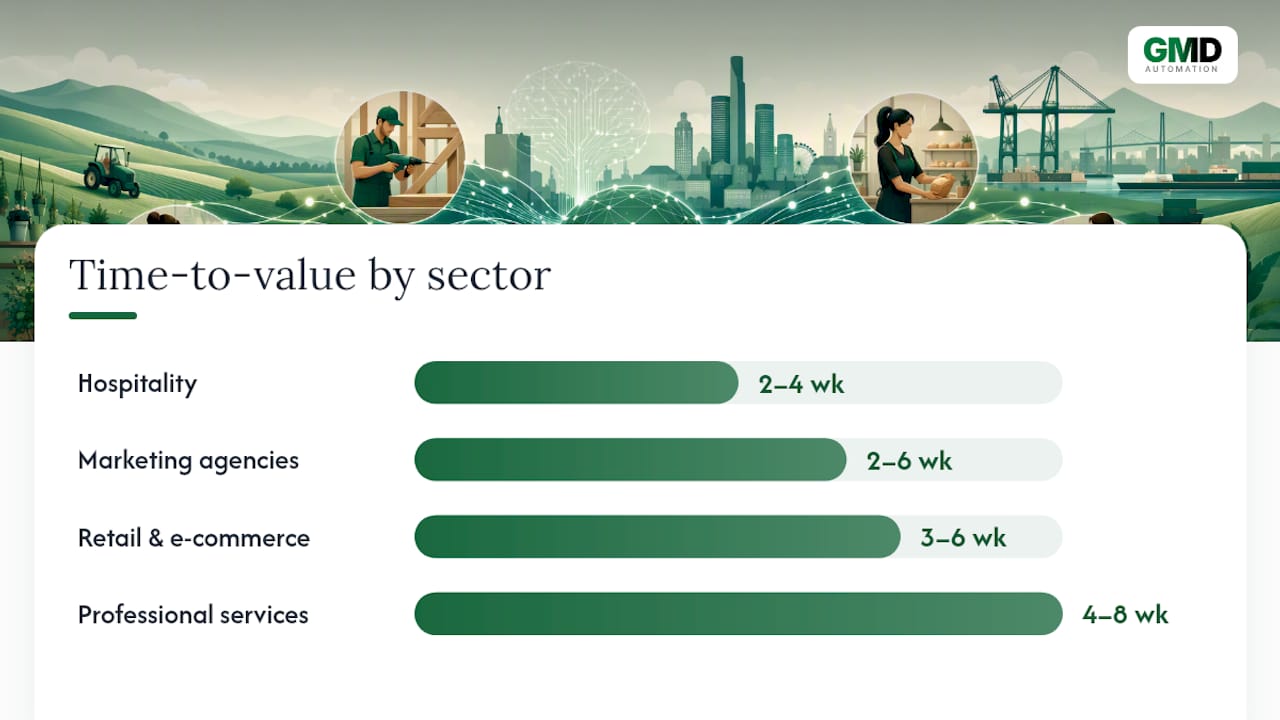
Retail and e-commerce: AI agents triage incoming customer queries, route returns, and generate personalised product recommendations based on purchase history. Time to value: 3–6 weeks.
Professional services (accountants, solicitors, consultants): Document automation handles client intake forms, engagement letters, and standard report generation. AI-assisted scheduling reduces the back-and-forth of booking client meetings. Time to value: 4–8 weeks.
Hospitality: AI handles booking confirmations, pre-arrival messaging, and post-stay follow-ups. A small hotel or restaurant group running these manually across multiple channels can consolidate into a single automated workflow. Time to value: 2–4 weeks.
Local health and care practices: Admin automation reduces the time clinicians spend on appointment reminders, referral letters, and patient follow-ups. Microsoft's UK case studies document this pattern directly: frontline staff reclaim hours previously lost to administrative tasks and redirect them to patient care.
Marketing agencies: Content generation and scheduling tools, combined with AI-managed social media DM responses, let small agencies handle more client accounts without proportional headcount growth. Time to value: 2–6 weeks.
Pro Tip: If you recognise your business in one of these examples, the fastest starting point is to count how many hours per week your team spends on that specific task. That number becomes your pilot's baseline KPI and your ROI calculation's foundation. See how small teams use AI automation for worked examples.
Why people and process matter more than the technology
The 10–20–70 principle, widely cited by strategy groups including BCG, holds that successful AI adoption allocates roughly 10% of effort to algorithms, 20% to technology and data, and 70% to people and process work. Most small businesses get this backwards: they spend the majority of their budget on the tool and almost nothing on the change management that determines whether anyone actually uses it.
It means training staff to trust the system's outputs, redesigning workflows so the AI sits in the natural path of daily work rather than as an add-on, and appointing an internal owner who is accountable for adoption. Without those steps, even a technically excellent system sits unused within three months.
Managed subscription models address this directly. When a provider covers implementation, operation, maintenance, and optimisation under a single monthly fee, the incentive structure changes: the provider only succeeds if your team is actually using the system and seeing results. That alignment is harder to achieve in a one-off project engagement where the consultant's job ends at go-live.
Pro Tip: Embed AI into the daily workflow rather than running it as a parallel system. If your team has to remember to check a separate dashboard, adoption will stall. The system should sit inside the tools your team already opens every morning.
For practical guidance on AI change management, including how to structure roles and responsibilities during rollout, the linked guide covers the operational detail most consultants skip.
How to get started with AI consulting safely and cheaply
Four steps. Each one is a decision gate: if the output does not justify the next step, stop there.
-
Run a quick readiness assessment. Half a day, no technical knowledge required. Map your three most time-consuming manual processes, estimate the hours per week each costs, and check whether your data is centralised enough to support automation. Affordable AI strategies for UK SMEs provides a practical framework for this step.
-
Pick one high-payoff pilot. Choose the process with the best combination of high frequency, clear rules, and measurable output. Appointment booking, lead qualification, and inbox triage are the most common starting points for good reason: they are well-defined and the ROI is easy to calculate.
-
Run a short pilot with agreed KPIs. Four to eight weeks, one process, one success metric. Typical KPIs: hours saved per week, lead response time, error rate, or customer satisfaction score. Set a minimum threshold before you start — if the system does not hit it, you stop and reassess rather than throwing more budget at it.
-
Decide to scale or stop. If the pilot hits its KPIs, extend to the next process on your list. If it does not, the readiness assessment tells you what to fix before trying again. Either outcome is useful data.
Success at pilot end looks like: a working system in production, a baseline KPI measured before and after, and a named internal owner who can monitor and escalate issues. For building the financial case to take to your board or partners, the AI business case guide covers the stakeholder-alignment and payback-calculation steps in detail.
Place internal accountability with one person, not a committee. That person does not need to be technical; they need to be the one who cares most about the process being automated.
What I have seen work with UK small businesses
The pattern I see most often with UK SMEs is this: the business has already tried one or two AI tools, got inconsistent results, and concluded that AI is not ready for businesses their size. Almost always, the problem was not the technology. It was that no one defined what success looked like before the tool was switched on.
The businesses that get genuine results start with a single, well-scoped problem and measure it obsessively for the first six weeks. They do not try to automate everything at once. They pick the one process that is costing them the most time, build something that works reliably for that process, and then use the confidence and the data from that win to justify the next step.
Security and data protection come up in almost every first conversation, and rightly so. UK GDPR applies to any personal data your AI system processes, and the ICO expects you to document your lawful basis, your data flows, and your retention policies. A reputable consultant builds this into the engagement from day one, not as an afterthought. If a provider cannot tell you clearly how they handle your data under UK law, that is a disqualifying red flag.
The ownership question matters more than most owners realise at the start. Who holds the code when the engagement ends? Who can modify the system if the consultant is unavailable? These are not hypothetical concerns. Build them into your contract before work starts.
Gmdautomation: managed AI for UK small businesses, with no upfront cost
The fastest way to get a working AI system without capital risk is a fully managed subscription. Gmdautomation delivers enterprise-grade AI automation to UK businesses under a predictable monthly fee that covers implementation, operation, maintenance, compliance, and ongoing optimisation. No large upfront project cost, no internal technical hire required.
The subscription includes AI-powered workflow automation, voice agents for lead qualification and appointment booking, and AI-driven social media management. Every system is built to UK GDPR and ICO standards, with security and compliance included rather than bolted on. Onboarding is fast: Gmdautomation's production-ready approach means you get a working system in weeks, not months.
The practical next step is a free discovery session where Gmdautomation maps your highest-payoff processes and shows you what a working system looks like for your specific operation. Book your free discovery session and leave with a clear picture of what AI can do for your business and what it will cost.
Sources
A short list of trusted resources for UK small businesses exploring AI consulting:
- How Much Does AI Cost? The Complete Guide For 2026
- Microsoft UK Stories — Less time on admin means more quality time with my patients
- Why Your Business Needs a Single Source of Truth for Data - Data Taal