

An AI business case is a structured financial proposal that demonstrates how an AI investment delivers measurable business value through realistic ROI scenarios, risk-adjusted returns, and defined success metrics. Executives and CFOs do not fund technology projects. They fund capital allocation decisions with clear payback timelines and quantified risk. The Carnegie Mellon SEI makes this distinction explicit: AI initiatives must be framed as capital proposals, not IT upgrades. Getting this framing right is the difference between a project that receives board approval and one that stalls indefinitely. The ai business case explained framework below gives you the structure to build a proposal that survives executive scrutiny.
What are the essential components of a defensible AI business case?
A defensible AI business case contains nine sections. Miss any one of them and a CFO will send it back unsigned.
- Business problem statement. Quantify the current cost of the problem. Vague pain points do not get funded. Attach a number: hours lost per week, error rates, customer churn attributed to the gap.
- Proposed AI solution and rationale. Describe what the AI system does and why it solves the stated problem better than the current process. Avoid technical architecture details at this stage.
- Build versus buy decision. A decision matrix comparing in-house development against third-party deployment is expected. Factor in time to value, internal capability, and ongoing maintenance obligations. Gmdautomation's analysis of build vs buy decisions is a useful reference point for UK executives working through this choice.
- Three-scenario financial model. CFOs expect a downside, base, and upside case. The base case payback period should target 12–18 months. The downside case should model 24–36 months with full total cost of ownership contingencies included.
- Total cost of ownership breakdown. This is where most proposals fail. Infrastructure, data preparation, maintenance, retraining, and change management costs are routinely omitted. Research shows that organisations typically under-budget total costs by 200–400%.
- Risk register. List the top five risks with probability, impact, and mitigation. Include a named owner for each risk.
- Kill criteria. Define the conditions under which the project stops. Without kill criteria, projects drift past their value window and consume budget without delivering returns.
- Success metrics and KPIs. Tie every metric directly to a business objective. Cycle time reduction, cost per transaction, and customer satisfaction scores are measurable. "Improved efficiency" is not.
- Governance and accountability. Name a single executive owner. Committees do not deliver AI projects. Individuals do.
The most commonly overlooked insight here is the effort split. AI build effort accounts for only 15–20% of total project work. Data preparation alone consumes 30–40% of the budget. Executives who budget based on the build phase alone will overspend and underdeliver.
How does workflow redesign drive AI value beyond simple automation?
AI does not create value by automating existing broken processes. It creates value by enabling you to redesign those processes entirely. This distinction matters enormously for your business case.

Bain & Company research shows that 48% of finance leaders prioritise speed and cycle-time reduction as their primary AI value driver. The same research identifies 10–30% savings in software and maintenance costs for firms that redesign workflows rather than bolt AI onto legacy processes. That gap between automation and redesign is where most of the financial return lives.
Practical workflow redesign for AI success requires attention to three areas:
- Workflow debt reduction. Simplify processes before automating them. AI applied to a convoluted ten-step approval process will automate the confusion, not eliminate it. Map the process, remove redundant steps, then deploy AI on the simplified version.
- Human-AI role redesign. Identify which tasks AI handles and which tasks humans handle post-deployment. Staff who understand their new role adopt AI faster. Staff who feel replaced by it resist it. Adoption rates directly affect your ROI calculations.
- Cycle-time measurement. Set a baseline cycle time before deployment. Measure it weekly after go-live. Cycle-time reduction is one of the clearest, most CFO-friendly metrics available.
Pro Tip: Measure AI value at the enterprise level, not just within the team that uses it. A sales AI that cuts proposal time by 40% creates value in sales, but also in legal, finance, and customer success. Capture the full picture in your business case.
Firms that treat AI as a bolt-on tool without process change consistently report disappointing returns. The technology performs as designed. The process around it does not change. The expected value never materialises.
What are the common challenges when building and deploying AI business cases?
The most common reason AI business cases fail is not technology. Carnegie Mellon SEI research identifies vague objectives and ignored adoption realities as the primary culprits. The technology works. The proposal around it does not.
Executives building AI business cases in 2026 face four recurring obstacles:
- Skills gap. Between 34% and 53% of mature organisations cite the AI skills gap as a major deployment challenge. This is not just a hiring problem. It affects your total cost of ownership, your timeline, and your risk register. Budget for training and external expertise from day one.
- Infrastructure cost underestimation. Compute and infrastructure costs are routinely underestimated by 200–300%. Data storage and ongoing model maintenance drive the overruns. A proof-of-value experiment should be capped at 4–8 weeks to limit exposure before full commitment.
- Trust deficits. 80% of business leaders mistrust AI for autonomous decisions without explainability and transparency. This is not irrational caution. It is a legitimate operational concern. Your business case must address how the AI system explains its outputs. Gmdautomation's guide on AI system transparency covers this requirement in detail for UK deployments.
- The innovation trap. Organisations run pilots indefinitely, never committing to full deployment. Pilots that exceed 8 weeks without a go or no-go decision consume budget and organisational goodwill without producing returns.
Pro Tip: Build your budget from the total cost of ownership backwards, not from the build cost forwards. Start with infrastructure, maintenance, and change management. Add the build cost last. This approach produces a realistic number that survives CFO review.
How to quantify financial benefits and risks in an AI business case?
Financial modelling is the section that determines whether your business case gets funded. Qualitative benefits do not move budget committees. Numbers do.
The three-scenario model is the standard framework CFOs use to evaluate AI investments. Each scenario must be fully costed, not just revenue-side estimates.
- Downside case. Assume 50% of projected adoption. Include full infrastructure and maintenance costs. Model a payback period of 24–36 months. This is your floor. If the downside case still shows positive return, the project is fundable.
- Base case. Assume realistic adoption based on comparable deployments. Target a payback period of 12–18 months. This is the number your CFO will anchor to.
- Upside case. Model full adoption with workflow redesign benefits included. This is your ceiling. Do not present this as the expected outcome. Present it as the achievable outcome under optimal conditions.
Financial models must incorporate adoption and capture haircuts explicitly. An adoption haircut reduces your projected benefit by the percentage of staff or processes that will not fully use the system in year one. A capture haircut reduces the benefit further to reflect partial realisation of efficiency gains. Both adjustments make your ROI figure defensible.
| Metric | What to measure | Why it matters |
|---|---|---|
| Payback period | Months to recover total investment | Primary CFO funding criterion |
| Adoption rate | % of target users actively using the system | Drives actual vs projected ROI |
| Cycle-time reduction | % decrease in process completion time | Directly links AI to operational output |
| Cost per transaction | Pre and post-deployment unit cost | Quantifies efficiency gain in financial terms |
| Error rate reduction | % decrease in rework or correction events | Reduces hidden operational costs |
Pro Tip: Link every financial benefit in your model to a named KPI that already exists in your management reporting. If your CFO already tracks cost per transaction, show AI's impact on that number. New metrics require explanation. Existing metrics require only a comparison.
For further detail on enterprise AI ROI modelling, Gmdautomation's 2026 guide for leaders covers the calculation frameworks in full.
What practical steps can business owners take to build a compelling AI business case?
A compelling AI business case requires preparation before you write a single slide. The groundwork determines whether the proposal is credible.
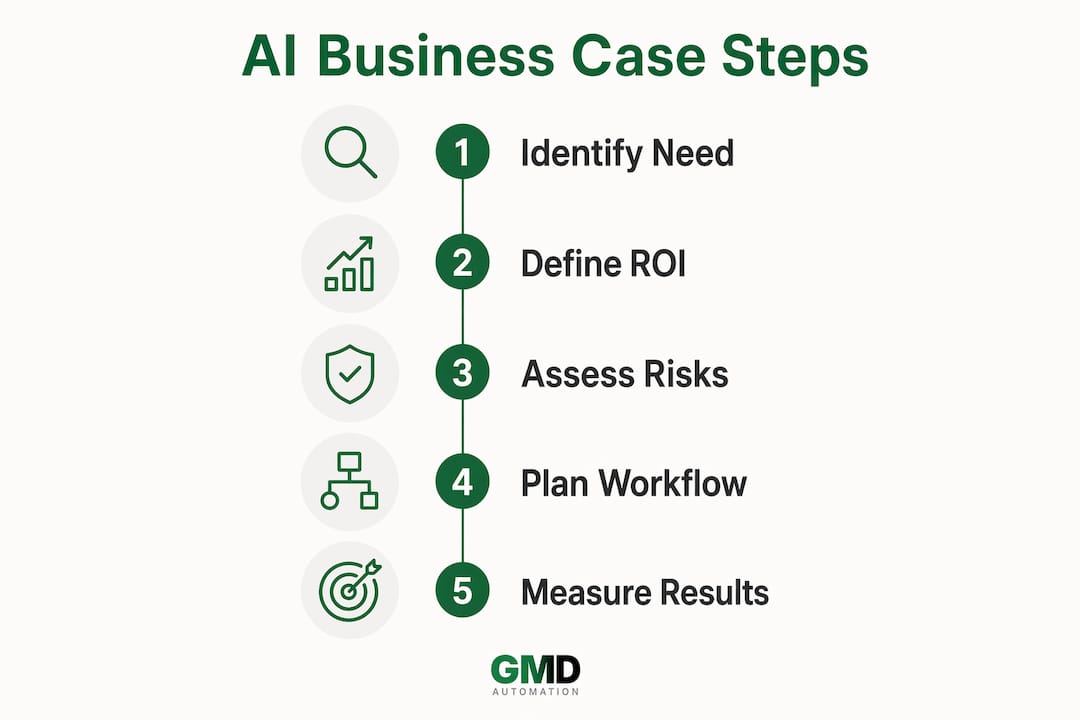
- Audit your current baseline. Measure the cost of the problem today. Time spent, error rates, headcount involved, and customer impact. Without a baseline, you cannot demonstrate improvement.
- Use a decision framework for build versus buy. Evaluate internal capability honestly. Most UK businesses do not have the data science resource to build production-grade AI in-house. A subscription-based deployment model removes capital expenditure and accelerates time to value.
- Name a governance owner before you present. Proposals without a named executive owner signal that no one is truly accountable. Boards fund people, not projects.
- Frame AI around growth, not just cost reduction. Firms that use AI as a growth lever, through faster deal cycles, premium service delivery, and better products, generate stronger long-term returns than those focused solely on headcount reduction.
- Prepare a one-page executive summary. Write it in financial language. ROI, payback period, risk-adjusted return. Leave the technical architecture for the appendix.
Consulting resources from Skopx provide additional frameworks for operational AI transformation that complement the financial modelling approach described here.
Key takeaways
A defensible AI business case is a capital allocation proposal built on three-scenario financial modelling, realistic total cost of ownership, and named governance accountability.
| Point | Details |
|---|---|
| Frame it as capital allocation | CFOs fund ROI proposals, not technology projects. Use financial language throughout. |
| Model three financial scenarios | Include downside, base, and upside cases with adoption haircuts applied to each. |
| Budget from total cost of ownership | Infrastructure and maintenance costs are underestimated by 200–400%; start there. |
| Redesign workflows before automating | AI applied to broken processes automates the problem, not the solution. |
| Name a governance owner | Accountability drives adoption. Committees do not deliver AI projects. |
Why most AI business cases fail before they reach the board
I have reviewed a significant number of AI proposals from UK businesses over the past few years, and the pattern of failure is remarkably consistent. The technology section is thorough. The financial section is thin. The governance section is absent entirely.
The uncomfortable truth is that most AI business cases fail because the people writing them are excited about the technology and uncomfortable with the financial rigour required to justify it. They present what the AI does rather than what it returns. A CFO does not care how the model works. They care whether the investment pays back within an acceptable timeframe and what happens if it does not.
Kill criteria are the most neglected element I encounter. Organisations are reluctant to define the conditions under which they will stop a project. That reluctance is understandable but costly. Without kill criteria, failing projects consume resources long past the point where a rational decision would have ended them.
Cultural and organisational readiness matter as much as technical feasibility. I have seen technically sound AI deployments fail because the team using the system was never genuinely involved in the redesign of their own workflow. Adoption is not a communications problem. It is a design problem. Solve it before go-live, not after.
My advice to any executive building an AI business case in 2026 is this: write the financial model first. If the numbers do not work under conservative assumptions, the technology does not matter. If they do work, the technology becomes the easy part.
— Ravi
How Gmdautomation supports UK businesses in building AI business cases
Gmdautomation works with UK businesses to deploy enterprise-grade AI automation systems without upfront capital expenditure. The subscription model covers implementation, operation, maintenance, and ongoing optimisation, which means your total cost of ownership is fixed and predictable from day one. That predictability is exactly what a defensible business case requires. Gmdautomation's AI automation solutions are designed for rapid deployment, full compliance, and measurable ROI, giving executives the evidence base they need to present a credible proposal to their board. If you are building an AI business case and need a deployment partner with transparent pricing and a proven framework, Gmdautomation is built for that conversation.
FAQ
What is an AI business case?
An AI business case is a structured financial proposal that quantifies the expected return, risk, and total cost of an AI investment. It uses three-scenario financial modelling and defined KPIs to secure executive funding approval.
How long should an AI payback period be?
The base case payback period for most AI initiatives is 12–18 months. The downside case should model 24–36 months with full total cost of ownership included.
Why do AI business cases fail?
AI business cases most commonly fail due to vague objectives, ignored adoption realities, and missing kill criteria. Underestimating total cost of ownership by 200–400% is also a leading cause of rejection.
What is an adoption haircut in AI financial modelling?
An adoption haircut reduces projected financial benefits by the percentage of users or processes that will not fully adopt the system in year one. It makes ROI calculations defensible to CFOs.
How does workflow redesign affect AI ROI?
Workflow redesign drives 10–30% additional savings in software and maintenance costs compared to simple automation. Redesigning processes before deploying AI produces significantly stronger and more sustained returns.