

AI performance monitoring is the continuous measurement and analysis of an AI system's quality, reliability, safety, cost, and user impact to confirm it delivers accurate and efficient outcomes in production. Unlike traditional software monitoring, which tracks uptime and error rates, AI monitoring must also measure non-deterministic output quality: hallucination rates, factual accuracy, and bias. The industry term for this broader discipline is AI observability, and it sits at the heart of responsible AI deployment. This guide explains the 7-dimension performance scorecard, the role of observability, and the practical frameworks IT teams and decision-makers need to build a monitoring strategy that holds up under regulatory scrutiny.
What is AI performance monitoring and why does it matter?
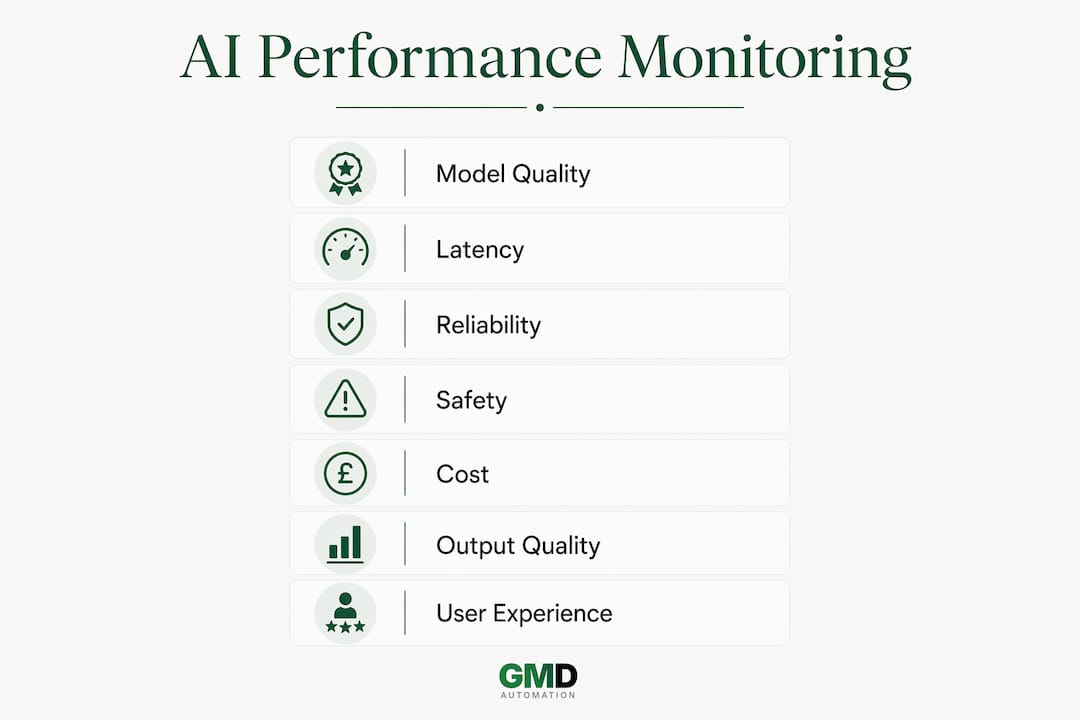
AI performance monitoring is defined as the ongoing process of measuring, analysing, and acting on data about an AI system's behaviour in live environments. The discipline covers seven core dimensions: model quality, latency, reliability, safety, cost, scalability, and user outcomes. Each dimension captures a different failure mode, and neglecting any one of them creates blind spots that can be costly.
Traditional software monitoring asks: "Is the server up?" AI performance management asks a harder question: "Is the output correct, fair, and safe?" A system can show 99.9% uptime and still produce hallucinated answers that mislead users or violate compliance rules. That gap is why AI monitoring tools must go beyond infrastructure dashboards and measure what the model actually produces.

The business case is direct. A model with poor latency or high costs will fail in production despite high accuracy. Decision-makers who treat monitoring as a post-launch afterthought typically discover this through customer complaints or regulatory findings, not through proactive data. Building monitoring into the deployment pipeline from day one prevents that outcome.
What metrics and dimensions define AI performance monitoring?
The 7-dimension scorecard gives teams a structured way to track AI system performance evaluation without missing critical signals. Each dimension maps to concrete metrics.
| Dimension | Key metric | Warning sign |
|---|---|---|
| Model quality | Accuracy, recall, F1 score | Accuracy drops below baseline |
| Latency | P95 and P99 response time | P95 exceeds agreed SLA threshold |
| Reliability | Uptime, error rate | Error rate rises above 1% |
| Safety | Hallucination rate, bias score | Hallucination rate increases week-on-week |
| Cost | Cost per successful task | Cost per task rises without output improvement |
| Scalability | Throughput under load | Degraded accuracy at peak load |
| User outcomes | CSAT, NPS, deflection rate | NPS falls or escalation rate rises |
Latency metrics should use percentiles such as P95 and P99 rather than averages. Averages hide the slow tail of responses that real users actually experience. A system averaging 400ms may still deliver 3-second responses to one in twenty users, which is enough to damage satisfaction scores.
Output quality metrics are the hardest to automate. Hallucination rate, factual accuracy, and bias require specialised evaluation frameworks, commonly called evals, rather than simple pass/fail checks. Business impact metrics like CSAT, Net Promoter Score, and deflection rate connect technical performance to real-world value. Tracking them alongside infrastructure metrics shows whether the AI system is actually helping users or just running without errors.
Pro Tip: Set alert thresholds on P95 latency and hallucination rate before you go live. Retrofitting thresholds after deployment means your first warning is a user complaint, not a dashboard alert.
How does AI observability enhance performance monitoring?
AI observability is the practice of capturing trace-level visibility into the internal states of an AI system, including prompts, retrieved context, and tool calls, to diagnose why a specific output occurred. It goes further than monitoring, which reports what happened. Observability explains why.
Observability enables debugging of "black-box" behaviours and confirms that AI systems align with governance policies. Without it, a team investigating a hallucinated response has no record of which documents were retrieved, which prompt was sent, or which tool was called. With trace-level logs, the failure becomes reproducible and fixable.
"LLM and agentic AI systems require trace-level logs of prompts, retrieved documents, and tool calls to debug failures and improve systematically. Black-box scoring is insufficient for governance or performance improvement."
AI observability spans three layers:
- Infrastructure layer: CPU, memory, GPU utilisation, and network latency.
- Data quality layer: Input data drift, schema changes, and retrieval relevance scores.
- Output quality layer: Hallucination detection, factual grounding, bias measurement, and response relevance.
Output failures like hallucinations are undetectable by traditional infrastructure monitoring. A server health dashboard will show green while the model confidently produces incorrect information. The output quality layer is where most production AI failures actually live, and it is the layer most teams under-invest in.
AI governance and compliance requirements increasingly demand demonstrable monitoring of output quality and transparency. Regulations including the EU AI Act and mandates from financial regulators such as the FCA and BaFin require organisations to show they can detect and correct AI failures. Observability logs provide the audit trail that makes this possible.
What practical frameworks and tools support AI performance monitoring?
Effective AI performance monitoring depends on three interconnected components: evaluation frameworks, feedback loops, and integration with deployment pipelines.
-
Define your evals. Build a test set of representative inputs and expected outputs for your specific AI task. Run these evals automatically on every model update. Evals are mandatory for AI use in regulated industries and provide the baseline against which production drift is measured.
-
Instrument your metrics. Add logging to capture prompts, retrieved documents, tool calls, latency, and output scores at the point of inference. Instrumentation must happen before deployment, not after.
-
Set thresholds and alerts. Define acceptable ranges for each metric in the 7-dimension scorecard. Alerts should fire on statistically significant changes, not single data points, to reduce noise.
-
Build feedback loops. Monitoring dashboards without active feedback loops risk becoming ignored alert wallpaper. A feedback loop routes flagged outputs to human reviewers, collects corrections, and feeds those corrections back into model fine-tuning or prompt revision cycles.
-
Integrate with MLOps pipelines. Monitoring should trigger automated rollback or canary deployment when a metric breaches its threshold. Manual intervention alone is too slow for production AI systems handling thousands of requests per hour.
Pro Tip: Avoid metric tunnel vision. Teams that optimise only for accuracy often discover they have quietly degraded latency or increased cost per task. Review all seven dimensions together on a weekly cadence.
Why is AI performance monitoring critical for business efficiency and risk management?
AI performance monitoring prevents the two most expensive outcomes in production AI: silent failures and regulatory penalties. Silent failures occur when a model degrades gradually, producing lower-quality outputs without triggering any alert. Regulatory penalties occur when an organisation cannot demonstrate it monitored and controlled its AI outputs.
The business benefits of real-time AI performance tracking are concrete:
- Cost control: Monitoring cost per successful task identifies when a model is consuming tokens or compute without delivering proportional value, enabling prompt engineering or model substitution before costs escalate.
- User satisfaction: Optimised latency and low hallucination rates directly improve CSAT and NPS scores. Users who receive fast, accurate responses are significantly less likely to escalate to human agents.
- Operational efficiency: Deflection rate, the proportion of queries resolved without human intervention, is a direct measure of AI return on investment. Monitoring it shows whether the AI system is genuinely reducing workload.
- Regulatory compliance: The EU AI Act, FCA guidance, and BaFin requirements all demand evidence of ongoing output quality monitoring. An AI system transparency framework built on observability logs satisfies this requirement.
- Risk mitigation: Bias monitoring catches discriminatory output patterns before they affect customers or attract regulatory attention.
Practitioners know that system-level metrics like uptime and latency can become vanity metrics. Highly performant infrastructure can still deliver biased or hallucinated outputs. The organisations that manage AI risk effectively are those that treat output quality as a statistical challenge requiring continuous measurement, not a one-time validation exercise.
How to implement an effective AI performance monitoring strategy
A monitoring strategy that works in production follows a structured sequence. Skipping steps creates gaps that surface as incidents.
-
Define the AI task precisely. Specify the input, the expected output format, and the success criteria. Vague task definitions produce vague metrics.
-
Build a representative test set. Include edge cases, adversarial inputs, and examples from each user segment. This test set becomes the foundation for your evals.
-
Instrument all inference calls. Log prompts, context, tool calls, latency, and output scores. Use a structured logging format that your monitoring platform can query.
-
Set multi-dimensional thresholds. Define acceptable ranges for all seven scorecard dimensions. Use historical data to set baselines before going live.
-
Integrate feedback loops. Route low-confidence or flagged outputs to human review. Feed corrections back into the model improvement cycle on a regular cadence.
-
Review governance alignment. Check your monitoring framework against AI governance requirements for your sector. Document your monitoring processes to satisfy audit requirements.
Effective AI performance monitoring combines technical measurement with human review and feedback loops as best practice. Automated metrics catch volume-level patterns; human review catches subtle quality failures that evals miss. Both are necessary for a production system that handles real business decisions.
Pro Tip: Start with the AI automation checklist for operations managers to map your current AI tasks before designing your monitoring framework. Monitoring a poorly defined task produces misleading data.
Key takeaways
Effective AI performance monitoring requires tracking all seven dimensions of the performance scorecard, not just uptime or accuracy, to prevent silent failures and meet regulatory obligations.
| Point | Details |
|---|---|
| Use the 7-dimension scorecard | Track model quality, latency, reliability, safety, cost, scalability, and user outcomes together. |
| Prioritise output quality metrics | Hallucination rate and bias require specialised evals that infrastructure monitoring cannot detect. |
| Use percentile latency, not averages | P95 and P99 metrics reveal the slow tail that average response times hide from teams. |
| Build active feedback loops | Monitoring data must feed back into model improvement cycles or dashboards become ignored. |
| Align with regulatory requirements | EU AI Act, FCA, and BaFin mandates require documented, ongoing output quality monitoring. |
The metric that most teams get wrong
Most teams I work with arrive with the same blind spot: they have excellent infrastructure monitoring and almost no output quality monitoring. They can tell you their uptime to four decimal places. They cannot tell you their hallucination rate from last Tuesday.
The uncomfortable truth is that output quality is the dimension that actually determines whether an AI system creates or destroys business value. A customer-facing AI agent with 99.9% uptime and a 15% hallucination rate is not a reliable business tool. It is a liability dressed up in a green dashboard.
The shift I have seen work is treating output quality as a statistical process, not a binary pass/fail. You set a baseline, you measure drift, and you treat any upward movement in hallucination rate or bias score as a signal that demands investigation. That framing changes how teams allocate engineering time. They stop celebrating uptime and start asking harder questions about what the model is actually saying to users.
Regulatory pressure is accelerating this shift. The AI transparency requirements coming into force across the UK and EU mean that "we monitor our servers" is no longer an acceptable answer to a regulator asking about AI governance. Organisations that build output quality monitoring now will be significantly better positioned when those audits arrive.
— Ravi
How Gmdautomation supports AI performance monitoring for UK businesses
Gmdautomation builds enterprise-grade AI automation systems for UK businesses that are designed with performance monitoring built in from the start, not bolted on afterwards.
Every system Gmdautomation deploys includes instrumentation for the key dimensions of the performance scorecard: latency, output quality, cost per task, and user outcomes. The monthly subscription model covers ongoing monitoring, maintenance, and optimisation, so your team is not managing dashboards manually. For IT leaders and decision-makers who need AI systems that meet UK and EU governance standards without significant upfront investment, Gmdautomation's AI automation platform provides a fully prepared, compliance-ready deployment with transparent performance reporting from day one.
FAQ
What is AI performance monitoring in simple terms?
AI performance monitoring is the continuous process of measuring an AI system's accuracy, speed, safety, cost, and user impact in live production environments. It goes beyond server health checks to track whether the AI's outputs are correct, fair, and useful.
How does AI observability differ from standard monitoring?
Standard monitoring tracks infrastructure metrics like uptime and error rates. AI observability adds trace-level visibility into prompts, retrieved documents, and tool calls, enabling teams to diagnose why a specific output was produced and fix it systematically.
What are the most important AI performance metrics to track?
The most critical metrics span all seven scorecard dimensions: accuracy and recall for model quality, P95 latency for speed, hallucination rate for safety, cost per successful task for efficiency, and CSAT or NPS for user outcomes.
Why do AI systems need specialised evaluation frameworks?
AI outputs are non-deterministic, meaning the same input can produce different outputs. Specialised evals use statistical methods and human review to detect hallucinations, bias, and quality drift that simple pass/fail tests cannot identify.
What regulations require AI performance monitoring?
The EU AI Act, FCA guidance, and BaFin requirements all mandate documented monitoring of AI output quality and transparency for regulated industries. Organisations must demonstrate ongoing oversight of their AI systems to satisfy these obligations.